100×worker · job analysis
Will AI Replace Credit Analysts? What Changes in the Job
Credit analysts spend their days digging through financial statements, credit histories, and debt files to decide whether a borrower can be trusted with money. That work is a mix of repetitive data handling and judgment calls, and the two halves respond very differently to AI.
Microsoft Research analyzed 200,000 real Copilot conversations and scored how much of each occupation's work generative AI can plausibly handle. Credit analysts came in at 16.2%, one of the lower scores in the dataset (translators topped the list at 49%, nurses sat near the bottom at 12%). That number matters: it tells you the profession is not being automated away, but a meaningful slice of the paperwork is.
The European Commission's ESCO taxonomy lists credit analyst as one of 3,039 classified occupations, with skills like analyzing loans, applying credit risk policy, and interpreting financial statements. Some of those skills are already partly handled by document extraction and spreadsheet automation. Others, like advising on creditworthiness in a borderline case, still require a person who understands the client and carries the responsibility for the call.
Credit analyst: a professional who reviews loan applications and advises on a client's creditworthiness.
The task split: what AI takes over and what stays yours
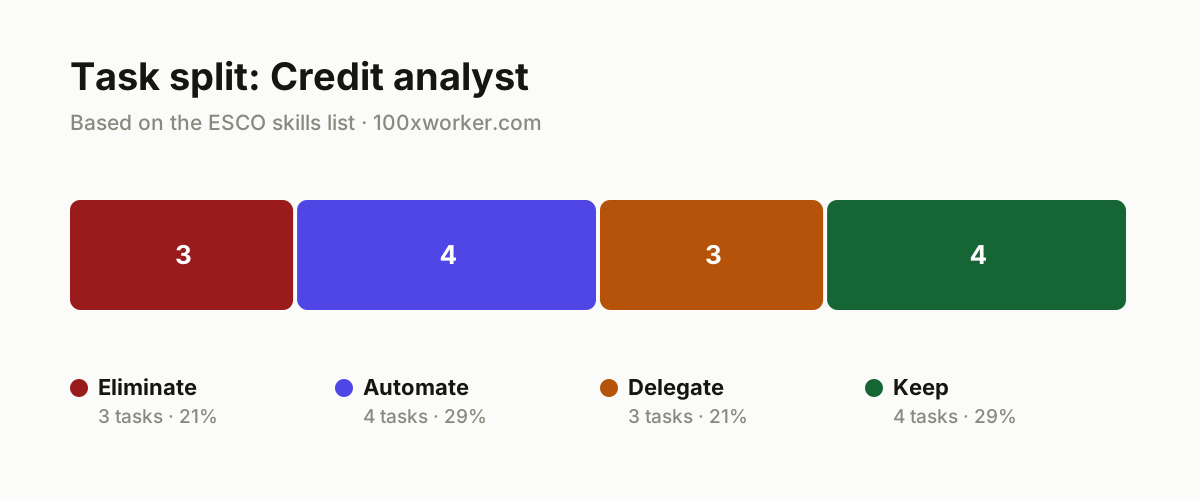
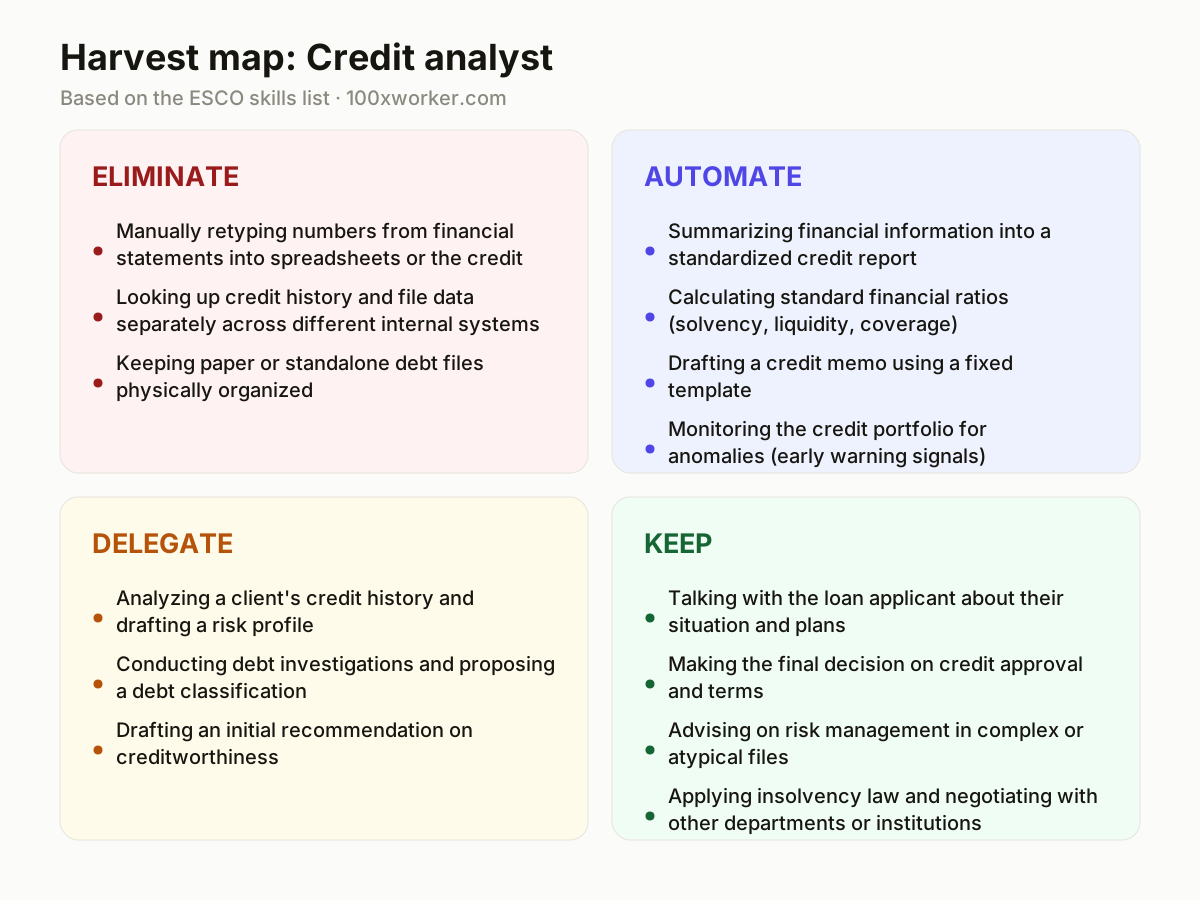
To see what actually changes, split the job into four buckets: tasks AI eliminates outright, tasks it can fully automate under supervision, tasks you delegate to AI for a first draft you then check, and tasks that stay firmly with a human. For a credit analyst, most of the mechanical data work falls into the first two buckets, while the decisions that carry legal and financial weight stay in the last one.
| Task | Bucket | Why |
|---|---|---|
| Manually retyping numbers from financial statements into spreadsheets or the credit system | eliminate | Document recognition AI reads and structures figures directly from PDFs, repeatably and without transcription errors. |
| Looking up credit history and file data separately across different internal systems | eliminate | Automated integration pulls everything into one view, ending the scattered manual searching. |
| Keeping paper or standalone debt files physically organized | eliminate | Digital systems log and update files automatically, without manual archive work. |
| Summarizing financial information into a standardized credit report | automate | An AI agent generates a first full summary from the submitted documents. |
| Calculating standard financial ratios (solvency, liquidity, coverage) | automate | Formula-based calculations are exactly the kind of task agents handle without error. |
| Drafting a credit memo using a fixed template | automate | AI fills the template with available figures, ready for initial review. |
| Monitoring the credit portfolio for anomalies (early warning signals) | automate | Automated triggers flag deviations faster than periodic manual checks. |
| Analyzing a client's credit history and drafting a risk profile | delegate | AI structures and interprets a first version, you check it against context and experience. |
| Conducting debt investigations and proposing a debt classification | delegate | AI produces a first classification, you decide on edge cases and exceptions. |
| Drafting an initial recommendation on creditworthiness | delegate | The model delivers a reasoned proposal, you weigh sector knowledge and the client relationship. |
| Talking with the loan applicant about their situation and plans | keep | Building trust and reading intentions requires one person facing another. (Your edge: Sensing what someone leaves unsaid.) |
| Making the final decision on credit approval and terms | keep | Legal and financial responsibility for the decision rests with the analyst. (Your edge: Responsibility you cannot outsource.) |
| Advising on risk management in complex or atypical files | keep | Exceptions require experience and judgment no model has lived through. (Your edge: Experience with what isn't in the data.) |
| Applying insolvency law and negotiating with other departments or institutions | keep | Legal nuance and negotiation require people skills and institutional insight. (Your edge: Negotiating requires a human who can flex.) |
Which tasks will AI take over from credit analysts?
AI takes over the mechanical middle of the job first: pulling numbers out of financial statements, calculating standard ratios, and drafting a first version of the credit memo or report. Chasing down data across systems and keeping physical files organized also disappear, since automated tools handle both. What AI does not take over is the judgment layer: deciding what a borderline number means for this specific borrower, or how much weight to give a client's explanation. Microsoft Research's 16.2% applicability score for the occupation reflects exactly this split, a real but limited slice of the work.
Will AI replace credit analysts?
No. The occupation scores 16.2% on Microsoft Research's applicability scale, well below occupations built almost entirely on text transformation, like translation (49%). Credit analysis depends on the final lending decision, direct conversations with applicants, and legal accountability under insolvency and credit risk rules. Those elements do not transfer to a model. What changes is the shape of the day: less time spent assembling and summarizing data, more time spent reviewing AI-generated drafts, questioning edge cases, and making the calls that carry your signature. The job narrows toward judgment and relationship work rather than disappearing.
How do you become the AI-savvy person on your credit team?
Start by using AI on the tasks in the automate and delegate buckets: let it draft the first summary, calculate the ratios, and propose a debt classification, then spend your time checking that output against the actual client file. Learn to write clear prompts that specify the document type, the ratios you need, and the format of the memo, since vague prompts produce vague drafts. Track where the AI draft gets things wrong (a missed liability, a misread footnote) and build that into how you review future drafts. Being the AI-savvy analyst means being the best editor of AI output, not the fastest typist.
What can you do this month to start working with AI?
Pick one recurring task, such as summarizing a financial statement into your standard report format, and test an AI tool on five real (anonymized) cases. Compare the draft against what you would have written manually, and note where it saved time and where it missed context. Ask your compliance or IT team what tools are already approved for client data before feeding in anything sensitive. Then extend the same test to ratio calculations or early-warning monitoring, one task at a time, rather than trying to change your whole workflow at once.
Generative AI is applicable to just 16.2% of credit analysts' work activities, one of the lower scores among the occupations we measured.
Microsoft Research, Working with AI: Measuring the Applicability of Generative AI to Occupations (2025)
Become the AI person on your team
Build a review checklist for AI-drafted memos
Write down the three or four things you always check in a credit memo (liability completeness, ratio sourcing, classification logic) and run every AI draft against that list before it goes further. This turns your judgment into a repeatable filter instead of a one-off gut check.
Feed exceptions back into your own notes
Keep a short log of cases where the AI-generated risk profile missed something a human would have caught. Over time this becomes your own reference for what the model is weak at, which is more useful than any generic warning about AI limits.
Push automation upstream of your desk
Ask whether document intake and ratio extraction can be automated before a file reaches you, not just after. The earlier the mechanical work disappears, the more of your day goes to the analysis and conversations that actually need you.
Want this for your actual task list?
The free scan on the homepage builds your personal task map in 30 seconds, based on your role and industry.
Run the free task scanTools for this work
| Tool | For which tasks | The sober take |
|---|---|---|
| Microsoft Copilot | Summarizing financial information, drafting credit memos, monitoring portfolios | The same Copilot conversation data underlies Microsoft's applicability scoring for this occupation. |
| Claude (Anthropic) | Analyzing credit history, drafting risk profiles, proposing debt classifications | Anthropic's Economic Index tracks whether such use looks more automation-like or more augmentation-like. |
| Document extraction / OCR software | Pulling figures from financial statements into spreadsheets or the credit system | Removes the retyping step but still needs a spot-check against the source document. |
| Credit risk monitoring platforms | Portfolio monitoring, early warning signal detection | Rule-based triggers catch anomalies faster than periodic manual review. |
Prompts to try today
First-draft credit memo
Debt classification proposal
Risk profile draft for a new applicant
Related jobs
Frequently asked questions
Is credit analysis one of the jobs most exposed to AI?
No. Microsoft Research's applicability score for credit analysts is 16.2%, closer to the low end of the scale it built from real Copilot conversations. Occupations built almost entirely around producing or transforming text, like translation at 49%, score far higher. Credit analysis mixes data work with judgment and legal responsibility, which keeps the AI-applicable share lower than in many office roles.
Which parts of a credit analyst's job change first?
Data entry, ratio calculation, and first-draft report writing change first, since these follow predictable patterns AI handles well. Client conversations, exception handling, and the final approval decision change last, because they depend on judgment, trust, and accountability that current AI systems cannot carry.
Do credit analysts need to learn to code or use AI tools directly?
You do not need to code, but you do need to know how to prompt a tool clearly, read its output critically, and spot where it got something wrong. Across the EU, 32.7% of people aged 16 to 74 used generative AI in the past three months in 2025 according to Eurostat, so basic AI literacy is becoming a baseline expectation, not a specialist skill.
How is the credit analyst occupation officially defined?
The European Commission's ESCO taxonomy defines a credit analyst as someone who examines loan applications, checks them against regulation and lender guidelines, and advises on a client's creditworthiness based on financial data, credit history, and debt analysis. ESCO lists this alongside 3,039 other occupations across 28 languages.
Sources
- Microsoft Research, Working with AI: Measuring the Applicability of Generative AI to Occupations (2025)
- Anthropic Economic Index
- Eurostat, isoc_ai_iaiu (2025)
- ESCO, European Commission
Hendrik De Winne, author of Becoming AI-Savvy, founder of VibeLab. Helps teams redesign their work with AI.
This article was drafted with AI assistance from public data sources and editorially reviewed.