100×worker · job analysis
Will AI Replace Compliance Officers?
A tax compliance officer, also called a revenue officer or tax collector depending on the jurisdiction, collects taxes, fees, and debts for government bodies and checks that collection follows the law. Microsoft Research analyzed 200,000 real Copilot conversations and found generative AI demonstrably applicable to 34% of the work activities in this occupation category, compared with 49% for translators and only 12% for nurses.
That 34% is not spread evenly across the job. Anthropic's Economic Index, which classifies millions of Claude conversations against standardized task lists, splits AI use into automation-like work, where the model does the task, and augmentation-like work, where the model assists you. For tax compliance officers, most of the automation-like share sits in document handling and calculation, not in judgment calls or enforcement decisions.
This article sorts the job into four buckets: tasks that disappear, tasks a system now runs, tasks you hand off with review, and tasks that stay yours because they require legal judgment, negotiation, or physical presence.
A tax compliance officer collects taxes and debts for government bodies and enforces lawful, accurate case handling.
The task split: what AI takes over and what stays yours
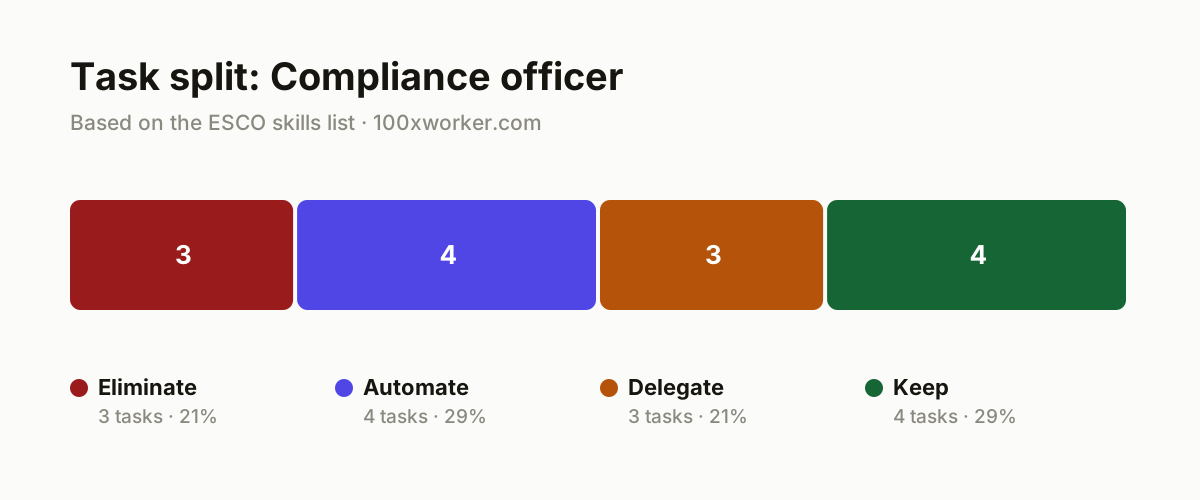
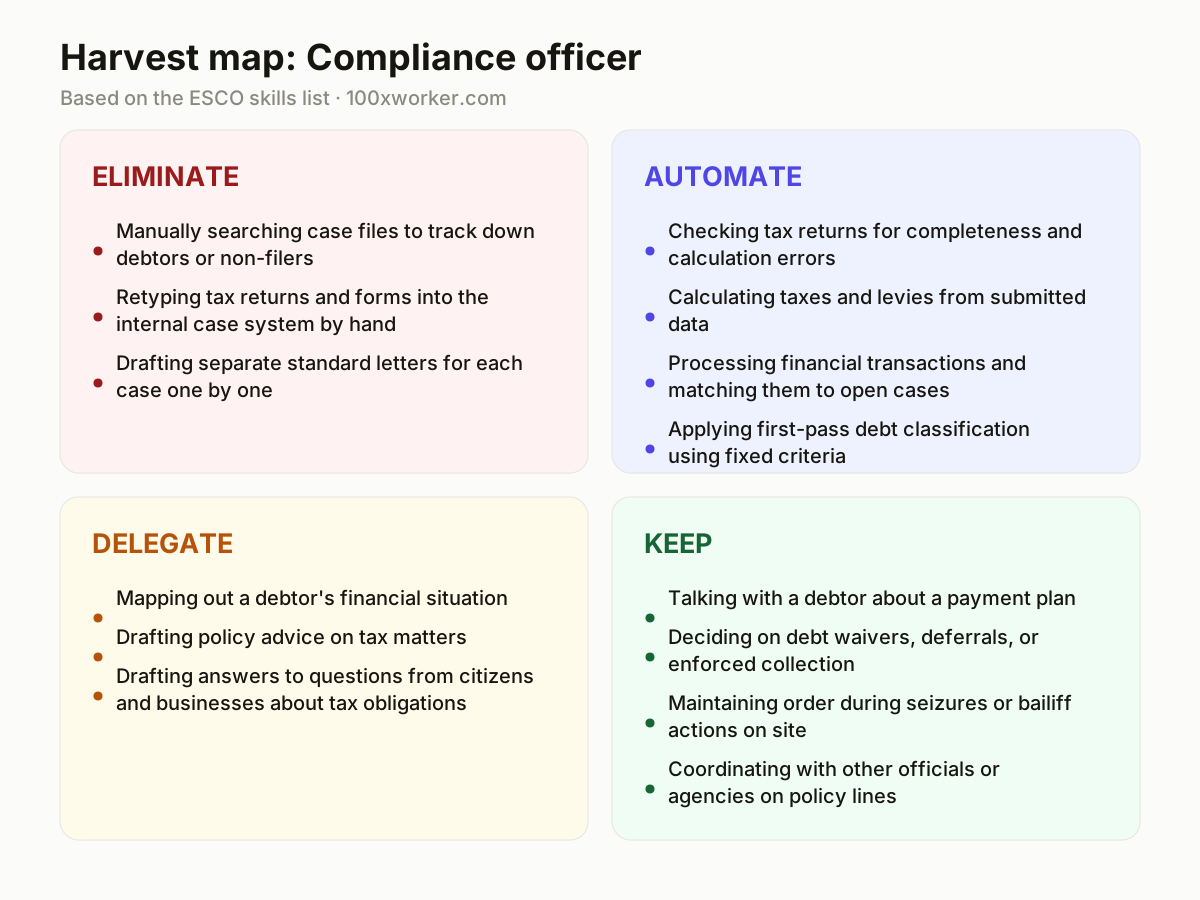
The tax compliance officer role covers roughly 3,039 catalogued occupations' worth of overlapping skills according to the EU's ESCO taxonomy, but the core work splits cleanly into four groups once you apply AI to it. Some tasks vanish because a system now does the searching or drafting nobody wants to do by hand. Some get automated end to end under rules you already follow. Some you delegate to a draft-then-review workflow. And some stay entirely yours because they involve legal consequences, negotiation, or standing in front of a debtor.
| Task | Bucket | Why |
|---|---|---|
| Manually searching case files to track down debtors or non-filers | eliminate | Automated matching across databases replaces manually paging through registers. |
| Retyping tax returns and forms into the internal case system by hand | eliminate | Data extraction from scanned documents removes retyping and is less error-prone than a person. |
| Drafting separate standard letters for each case one by one | eliminate | Generative templates produce reminders and notices in seconds, not case by case. |
| Checking tax returns for completeness and calculation errors | automate | An agent compares figures against prior filings and flags discrepancies automatically. |
| Calculating taxes and levies from submitted data | automate | Rule-based calculation against current rates runs faster and more consistently through an agent. |
| Processing financial transactions and matching them to open cases | automate | Automatically matching payments to outstanding debts is pattern recognition, not judgment. |
| Applying first-pass debt classification using fixed criteria | automate | Sorting cases into risk categories by predefined rules needs no human judgment call. |
| Mapping out a debtor's financial situation | delegate | AI drafts an initial asset and risk analysis from submitted data, you check it for completeness and context. |
| Drafting policy advice on tax matters | delegate | AI writes a first version based on existing regulation, you check it for currency and legal precision. |
| Drafting answers to questions from citizens and businesses about tax obligations | delegate | AI produces a draft reply, you review the legal nuance before you send it. |
| Talking with a debtor about a payment plan | keep | Negotiating deferral or installment terms needs judgment no model has. (Your edge: You build trust and judge when to escalate.) |
| Deciding on debt waivers, deferrals, or enforced collection | keep | This is a legally binding decision with personal consequences for the debtor. (Your edge: Final responsibility and liability stay with you.) |
| Maintaining order during seizures or bailiff actions on site | keep | Physical presence and de-escalation on location cannot be delegated. (Your edge: Your body language and on-site judgment matter.) |
| Coordinating with other officials or agencies on policy lines | keep | Politically sensitive tradeoffs and policy interpretation need human judgment. (Your edge: You know the local context no dataset holds.) |
Which tasks does AI take over from a compliance officer?
AI takes over the repetitive, rule-bound parts of the job first. Searching records for debtors or non-filers gets replaced by automated database matching. Retyping returns into a case system gets replaced by document data extraction. Standard reminder letters get generated instead of drafted one by one. Beyond removing tasks entirely, AI also automates checking returns for errors, calculating taxes and levies from submitted data, matching payments to open cases, and sorting cases into risk categories by fixed rules. None of this touches decisions about waivers, enforcement, or negotiation, which stay with the officer.
Will AI replace compliance officers?
Full replacement is unlikely for this occupation. Microsoft Research's applicability score of 34% means AI is demonstrably useful for about a third of the work, concentrated in document handling, calculation, and first-draft writing. The remaining two-thirds involves legal decisions on seizures and waivers, negotiation with debtors, physical presence during enforcement, and coordination with other agencies on policy, none of which a model can be accountable for. The realistic outcome is a smaller, faster task list per case rather than fewer officers, though caseloads and staffing levels may still shift as productivity per officer rises.
How do you become the AI point person on your compliance team?
Start by mapping which of your team's recurring tasks fall into the automate and delegate buckets: return checks, calculations, first-draft correspondence, and policy-advice drafts. Pick one task, pilot an AI workflow on it, and document the accuracy and time saved. Build a shared prompt library so colleagues don't each reinvent letter templates or debtor-summary formats. Set a review standard, meaning every AI draft gets a named human check before it goes out, and track exceptions so the team learns where the tool fails. Being the person who owns that documentation makes you the go-to for rollout questions.
What can you do this month as a compliance officer?
Pick one eliminate-bucket task, such as retyping forms, and test a document extraction tool on a batch of real filings to see how much manual entry it removes. Pick one automate-bucket task, such as return checks, and run it in parallel with your normal process for two weeks to compare error rates. Draft a one-page checklist for reviewing AI-generated letters and policy notes before they go out under your name. None of this requires a system overhaul, just a controlled trial on tasks you already do every week.
Generative AI's applicability varies sharply by occupation, from 49% for translators down to 12% for nurses, with tax examiners and revenue agents at 34%.
Microsoft Research, Working with AI: Measuring the Applicability of Generative AI to Occupations (2025)
Become the AI person on your team
Run a shadow test on document extraction
Take 20 recent case files and run them through an AI document extraction tool alongside your normal manual entry. Compare error rates and time spent, then bring the numbers to your team lead as a pilot proposal.
Build a debtor-letter prompt library
Collect your five most-used standard letters (reminders, payment plan offers, final notices) and turn each into a reusable prompt template. Store them where colleagues can find and adapt them.
Set a mandatory review checklist for AI drafts
Write a short checklist covering legal accuracy, correct debtor details, and tone before any AI-drafted letter or policy note leaves the team. Make it the default step, not an optional extra.
Want this for your actual task list?
The free scan on the homepage builds your personal task map in 30 seconds, based on your role and industry.
Run the free task scanTools for this work
| Tool | For which tasks | The sober take |
|---|---|---|
| Microsoft Copilot | drafting standard letters, first-pass policy advice, summarizing case notes | Widely deployed in government office suites, so it is often the tool already available to you. |
| Claude (Anthropic) | drafting responses to citizen and business questions, financial-situation summaries | Anthropic's own Economic Index shows this kind of drafting falls on the augmentation side of AI use, meaning it assists rather than replaces the officer. |
| Document extraction tools (e.g. Azure AI Document Intelligence) | pulling data from scanned tax returns and forms into the case system | Reduces retyping but still needs a spot-check step for scanned handwriting or poor-quality copies. |
| Workflow automation platforms (e.g. Power Automate) | matching payments to open cases, routing flagged returns for review | Works well once your matching rules are stable; brittle if case categories change often. |
Prompts to try today
Draft a payment plan letter
Summarize a debtor's financial situation
Draft policy advice on a tax question
Related jobs
Frequently asked questions
Does a 34% AI applicability score mean a third of compliance officers will lose their jobs?
No. The score measures the share of work activities where generative AI is demonstrably useful, not the share of jobs at risk. Microsoft Research built it from real Copilot conversations mapped to occupational task lists, so it shows where AI helps within a job, not how many roles disappear. Most of that 34% sits in document checking, calculation, and drafting, tasks that free up time rather than eliminate the position.
Which parts of the job can never be automated?
Decisions with legal and personal consequences stay with you: granting a debt waiver, ordering enforced collection, or negotiating a payment plan face to face. Physical presence during a seizure or bailiff action also cannot be delegated, since it requires real-time judgment and de-escalation on site. These tasks involve accountability that current AI systems cannot carry.
How widely is generative AI already used across the general population?
Eurostat reports that 32.7% of the EU population aged 16 to 74 used generative AI in the three months before being surveyed in 2025. Adoption is far from universal but growing quickly, which matters for compliance officers because more of the citizens and businesses they deal with will already expect AI-assisted correspondence and faster response times.
Is the ESCO taxonomy a good place to check which of my specific tasks are affected?
Yes. ESCO, the European Commission's occupational taxonomy, lists 3,039 occupations with their associated skills in 28 languages, including the specific skills tied to tax compliance officer roles such as debt classification, insolvency legislation, and tax document inspection. Cross-checking your actual task list against ESCO's skill list is a practical way to see which of your specific duties map onto the eliminate, automate, delegate, or keep buckets described here.
Sources
- Microsoft Research, Working with AI: Measuring the Applicability of Generative AI to Occupations (2025)
- Anthropic Economic Index
- Eurostat, Individuals' level of digital skills and use of AI (isoc_ai_iaiu)
- ESCO, European Commission occupational taxonomy
Hendrik De Winne, author of Becoming AI-Savvy, founder of VibeLab. Helps teams redesign their work with AI.
This article was drafted with AI assistance from public data sources and editorially reviewed.