100×worker · job analysis
Will AI Replace Tax Inspectors? A Task-by-Task Breakdown
Tax inspectors spend a large part of their week on work that has little to do with judgment: retyping figures from scanned returns, sorting files by type, and cross-checking financial accounts against submitted declarations. That is the part of the job most exposed to generative AI.
Microsoft Research analyzed 200,000 real conversations with its Copilot assistant and scored how applicable generative AI is to the work activities of hundreds of occupations. For the category closest to tax inspection, tax examiners, collectors, and revenue agents, the applicability score is 34.0%. For comparison, translators score highest at 49%, and nurses score low at 12%. Tax inspection sits in the middle: real AI use, but far from full automation.
Anthropic's Economic Index, which classifies millions of conversations with its Claude models against standardized task lists, draws a similar line between automation-style use (AI does the task) and augmentation-style use (AI assists, you decide). That split maps closely onto what this article does below: separating tasks AI can fully take over from tasks where AI drafts and you judge.
Tax inspector: reviews returns and accounts for compliance and fraud, with AI handling calculation and document analysis.
The task split: what AI takes over and what stays yours
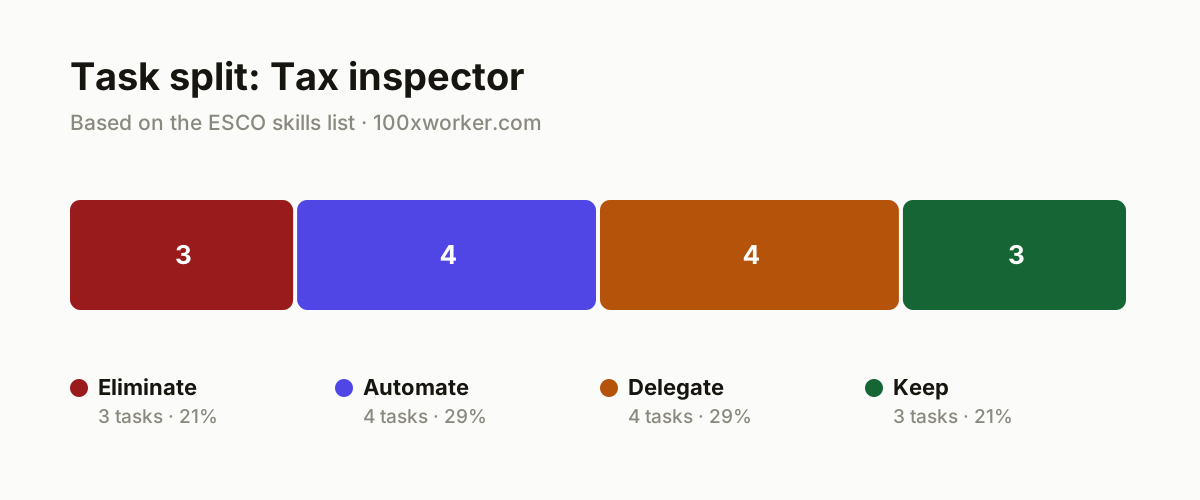
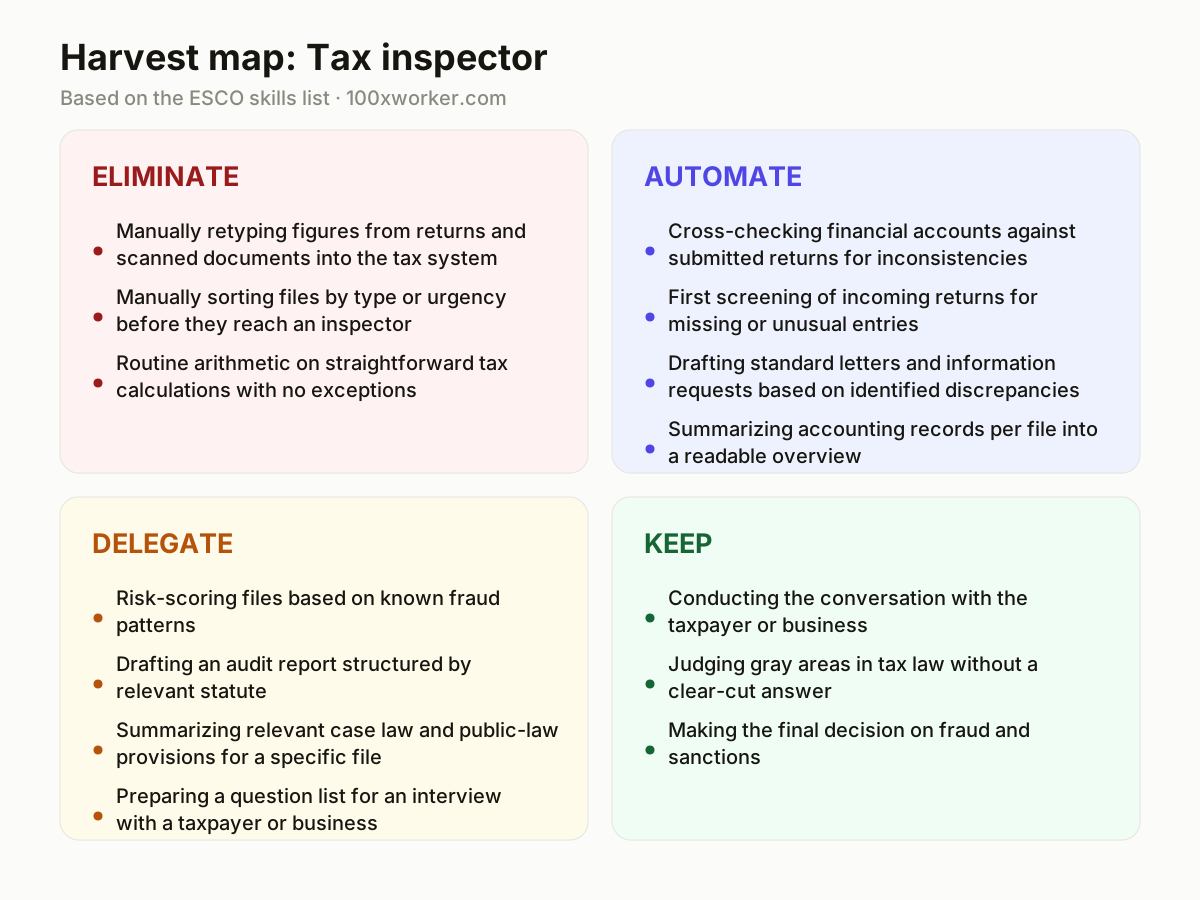
Not every task in a tax inspector's job is affected by AI the same way. Some tasks disappear because software already does them better than a person typing numbers into a screen. Some get automated end-to-end, with a human checking the output. Some get delegated, meaning AI produces a first draft or a first score that you review and correct. And some stay entirely with you, because they require legal judgment, live conversation, or a signature that carries legal weight. The four buckets below sort the core tasks from the ESCO occupational profile for tax inspectors into these categories.
| Task | Bucket | Why |
|---|---|---|
| Manually retyping figures from returns and scanned documents into the tax system | eliminate | Optical character recognition and data pipelines do this faster and with fewer errors than a person. |
| Manually sorting files by type or urgency before they reach an inspector | eliminate | Rule-based classification on fixed criteria does not need human judgment. |
| Routine arithmetic on straightforward tax calculations with no exceptions | eliminate | Pure calculation without interpretation has been automated for decades already. |
| Cross-checking financial accounts against submitted returns for inconsistencies | automate | Pattern detection across large datasets is exactly where generative AI performs well. |
| First screening of incoming returns for missing or unusual entries | automate | Repeatable checks on fixed fields do not require knowledge of a specific case. |
| Drafting standard letters and information requests based on identified discrepancies | automate | The structure and tone of these letters are largely fixed; AI fills in the details. |
| Summarizing accounting records per file into a readable overview | automate | Reducing long documentation to key points is a text task, not a judgment task. |
| Risk-scoring files based on known fraud patterns | delegate | AI gives a first estimate; you weigh it against context the system does not have. |
| Drafting an audit report structured by relevant statute | delegate | A first draft saves writing time, but the legal reasoning stays your responsibility. |
| Summarizing relevant case law and public-law provisions for a specific file | delegate | AI searches and structures quickly; you verify the sources actually apply. |
| Preparing a question list for an interview with a taxpayer or business | delegate | An AI tool proposes a logical order; you adjust based on file knowledge. |
| Conducting the conversation with the taxpayer or business | keep | Building trust and probing contradictions in real time requires social judgment. (Your edge: You read posture and hesitation; no model does that.) |
| Judging gray areas in tax law without a clear-cut answer | keep | Interpreting ambiguous public law requires legal reasoning and experience. (Your edge: You carry the responsibility for the interpretation.) |
| Making the final decision on fraud and sanctions | keep | This is a legally binding decision with consequences for someone's rights. (Your edge: The signature and the accountability stay with you.) |
What tasks does AI take over from a tax inspector?
AI takes over the mechanical parts of the job first: typing figures from scanned returns into a system, sorting files by category, and running standard calculations with no exceptions. It also handles a growing share of pattern-matching work, such as cross-checking financial accounts against declared income and flagging entries that look off. Drafting standard information-request letters and summarizing long accounting files into readable overviews also move largely to AI. None of this replaces the inspector's judgment; it removes the repetitive data-handling that used to eat up hours before the actual review could start.
Will AI replace tax inspectors?
No single occupation with a mix of legal, social, and analytical tasks gets fully automated by current AI. Microsoft Research puts generative AI's applicability to tax examiners and revenue agents at 34% of work activities, in the middle of the range across occupations it studied, well below translators (49%) and well above nurses (12%). That means roughly a third of the work is a strong fit for AI assistance, mostly the document-heavy, pattern-based parts. The remaining two-thirds, including interviews, legal interpretation of gray areas, and final decisions on sanctions, stays with the human inspector for the foreseeable future.
How does AI change a tax inspector's work in practice?
In practice, an inspector's day shifts from data entry and manual cross-checking toward review and decision-making. AI produces a risk score on a file, a draft summary of the accounting records, and a first version of an audit report. The inspector spends less time assembling information and more time judging it: checking whether the AI-flagged discrepancy is actually fraud or a filing error, deciding how to phrase a legal conclusion, and preparing for a face-to-face conversation with the taxpayer. The workload does not disappear, it moves from production to verification and judgment.
What can you do this month to start using AI as a tax inspector?
Start narrow. Pick one recurring task, such as summarizing accounting documents for a file or drafting a standard information-request letter, and test whether an AI tool produces a usable first draft. Keep a human check on every output before it goes out. Ask your department whether case summaries or risk-scoring tools are already in a pilot phase, since many tax authorities are testing this internally before wider rollout. Document what AI gets wrong on your files; those error patterns are useful feedback for whoever manages the tooling, and they sharpen your own sense of where AI output needs a second look.
Generative AI's applicability to tax examiner and revenue agent work sits at 34%, well below translators and well above nurses.
Microsoft Research, Working with AI (2025)
Become the AI person on your team
Let AI do the first pass, you do the second
Have AI cross-check accounts against returns and flag anomalies first. You then decide which flags are worth pursuing and which are noise, based on context the system does not have access to.
Use AI drafts as a starting point for reports, not a final answer
A first draft of an audit report structured by statute saves you the blank-page problem. You still verify every legal citation and adjust the reasoning to fit the actual case.
Keep interviews and final decisions fully human
AI can prepare a question list for an interview, but the conversation itself, and the final ruling on fraud and sanctions, stays entirely in your hands because it carries legal and personal weight.
Want this for your actual task list?
The free scan on the homepage builds your personal task map in 30 seconds, based on your role and industry.
Run the free task scanTools for this work
| Tool | For which tasks | The sober take |
|---|---|---|
| Microsoft Copilot | Drafting standard letters, summarizing accounting documents, first-pass file screening | Microsoft's own applicability research is based on real Copilot conversation data, which makes it a reasonable starting point for document-heavy tasks. |
| Claude (Anthropic) | Summarizing case law and public-law provisions, structuring long documents into overviews | Anthropic's Economic Index tracks whether usage is automation-style or augmentation-style, useful for deciding what to hand off versus what to review. |
| OCR and data-extraction software | Retyping figures from scans, extracting fields from returns into the tax system | This is the oldest and most reliable automation layer; it predates generative AI by years. |
| Internal risk-scoring models | Flagging files with fraud-pattern indicators for closer review | Most tax authorities already run some version of this; the newer layer is generative AI summarizing the reasoning behind a score. |
Prompts to try today
Summarize a file's accounting records
Draft a first audit report structured by statute
Prepare an interview question list
Related jobs
Frequently asked questions
Is a tax inspector's job at high risk from AI?
Not by current measures. Microsoft Research scores generative AI's applicability to tax examiners and revenue agents at 34% of work activities, a moderate figure compared to occupations like translation (49%) or nursing (12%). The tasks most exposed are document handling and pattern-matching. The tasks least exposed involve legal judgment, live conversation, and final decisions with legal consequences, which stay with a human.
Which AI tool should a tax inspector start with?
There is no single required tool; most tax authorities pilot general-purpose assistants like Microsoft Copilot or Claude for document summarization and drafting before adopting anything specialized. Start with whichever tool your organization already licenses, and use it for low-stakes drafting tasks first, such as summarizing a file, before trusting it with anything that feeds directly into a decision.
Does AI use in tax offices actually happen at scale yet?
Adoption of generative AI among the general public has grown quickly. Eurostat reports that 32.7% of the EU population aged 16-74 used generative AI in the three months before being surveyed in 2025. Inside tax administrations specifically, adoption tends to lag public use and moves through pilots and internal approval processes, so exact figures for tax offices are not part of the verified data here.
Will AI change what tax inspector actually means as a job title?
The occupational category itself, as defined in taxonomies like ESCO (which lists 3,039 occupations across 28 languages), is not disappearing. What changes is the task mix inside it: less manual data entry and document sorting, more review of AI-generated drafts and risk scores, and continued full ownership of interviews, legal interpretation, and final rulings.
Sources
- Microsoft Research, Working with AI: Measuring the Applicability of Generative AI to Occupations (2025)
- Anthropic Economic Index
- Eurostat, isoc_ai_iaiu, generative AI use in the EU (2025)
- ESCO, European Commission occupational taxonomy
Hendrik De Winne, author of Becoming AI-Savvy, founder of VibeLab. Helps teams redesign their work with AI.
This article was drafted with AI assistance from public data sources and editorially reviewed.