100×worker · job analysis
Will AI Replace Tax Advisors?
Tax advice looks like a job built for automation: forms, rules, calculations, deadlines. That is only half the picture. Microsoft Research analyzed 200,000 real Copilot conversations and published an AI applicability score for occupations, showing that most jobs mix tasks that AI handles well with tasks it does not touch at all. Tax advisory work fits that pattern closely.
Across Europe, AI use for work is already common. Eurostat found that 32.7% of the EU population aged 16 to 74 used generative AI in the last three months of 2025. Anthropic's Economic Index, which classifies millions of Claude conversations against O*NET task lists, shows that professional and financial tasks split between automation-style use (AI doing the task) and augmentation-style use (AI helping a person do it faster). For tax advisors, that split runs right through the middle of the job.
This article breaks the tax advisor role into four buckets: tasks to eliminate, tasks to automate, tasks to delegate to AI and check, and tasks to keep for yourself. It is based on the ESCO occupational taxonomy, which lists tax advisor among 3,039 occupations described by the European Commission.
For tax advisors, AI automates calculations and research, while advice, signing, and confidentiality remain human work.
The task split: what AI takes over and what stays yours
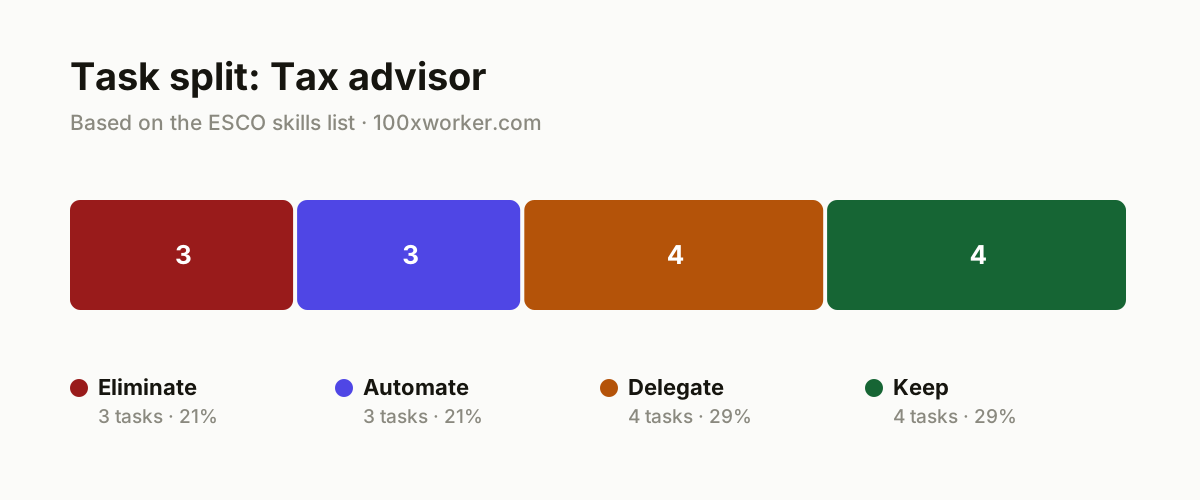
Not every task in a tax advisor's job is affected by AI in the same way. Some manual steps simply disappear because software does them automatically. Others get fully automated but still need a human to run and check them. A third group gets delegated to AI as a first draft, with you reviewing and finalizing. And a final group stays entirely with you because it involves legal liability, trust, or judgment calls that a model cannot make. Sorting your own task list into these four buckets is the most useful exercise you can do this quarter.
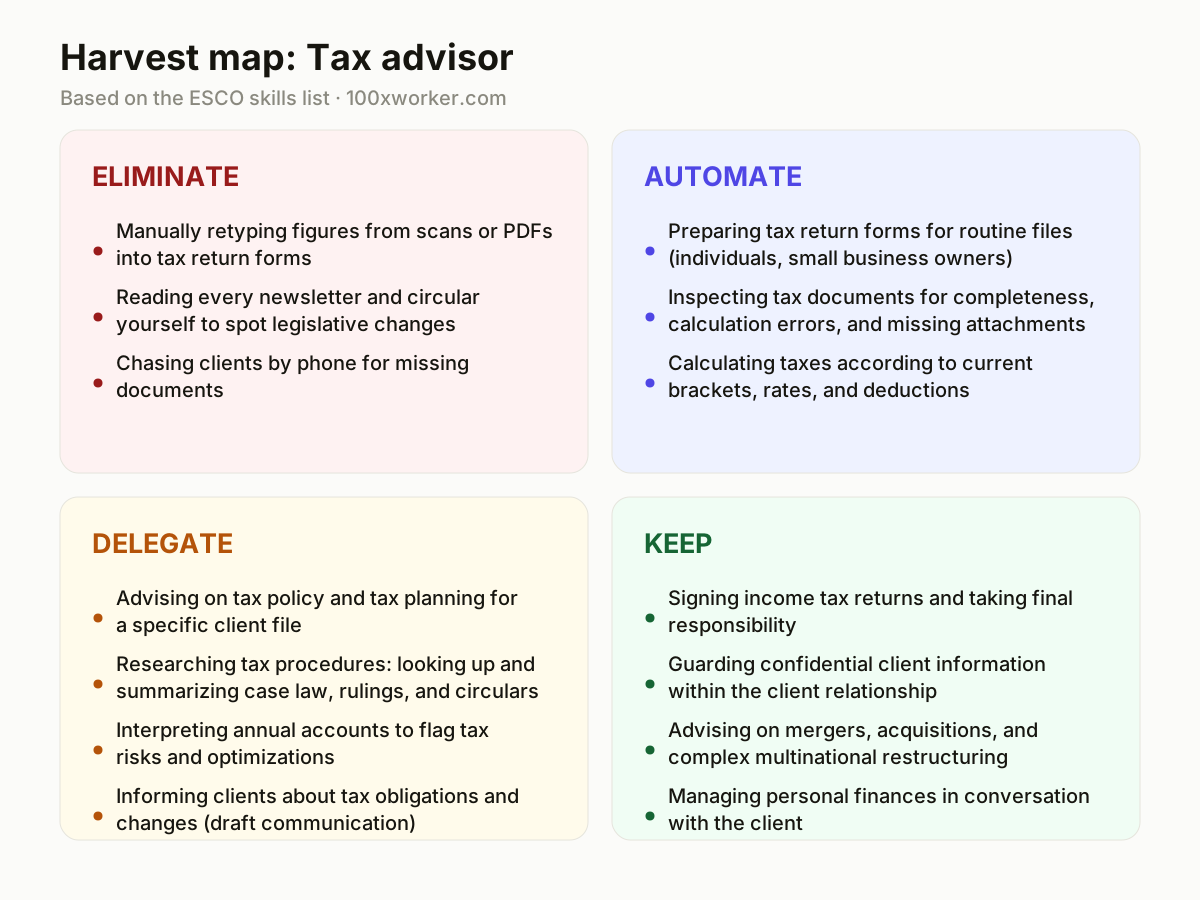
| Task | Bucket | Why |
|---|---|---|
| Manually retyping figures from scans or PDFs into tax return forms | eliminate | AI extraction and OCR do this instantly and without errors, so no one needs to type it by hand anymore. |
| Reading every newsletter and circular yourself to spot legislative changes | eliminate | AI monitoring tools flag relevant changes faster and more completely than manually scanning newsletters. |
| Chasing clients by phone for missing documents | eliminate | Automated reminders and client portals handle this without you picking up the phone. |
| Preparing tax return forms for routine files (individuals, small business owners) | automate | An agent pre-fills the form from bookkeeping data, ready for your review before filing. |
| Inspecting tax documents for completeness, calculation errors, and missing attachments | automate | Software checks consistency and completeness faster and more consistently than a manual pass. |
| Calculating taxes according to current brackets, rates, and deductions | automate | Rule-based calculation is exactly the kind of task where AI systems make zero arithmetic errors. |
| Advising on tax policy and tax planning for a specific client file | delegate | AI sketches scenarios and calculates variants, but you choose the strategy and defend it to the client. |
| Researching tax procedures: looking up and summarizing case law, rulings, and circulars | delegate | AI searches and summarizes sources quickly, but you judge whether they actually apply to this file. |
| Interpreting annual accounts to flag tax risks and optimizations | delegate | AI highlights anomalies and opportunities in the figures, but you decide what matters for this client. |
| Informing clients about tax obligations and changes (draft communication) | delegate | AI writes the first draft email or explanation, and you refine tone, nuance, and risk framing. |
| Signing income tax returns and taking final responsibility | keep | Legal liability for a filing cannot shift to an AI system regardless of who drafted it. (Your edge: Signature and liability stay with the human by law.) |
| Guarding confidential client information within the client relationship | keep | Building trust with a client who shares sensitive family or business information requires a person. (Your edge: Clients trust sensitive information to a person, not a system.) |
| Advising on mergers, acquisitions, and complex multinational restructuring | keep | Every file is unique, involving negotiation, context, and liability that generic AI cannot weigh. (Your edge: Unique context and negotiation demand human judgment.) |
| Managing personal finances in conversation with the client | keep | Life stage, emotion, and personal choices matter, and you cannot read that from data alone. (Your edge: You read a client's life stage and emotion in person.) |
Will AI replace tax advisors?
No. Microsoft Research's analysis of 200,000 real Copilot conversations found that most occupations, including tax and finance roles, mix tasks that AI handles well with tasks it cannot touch. There is no published applicability score specific to tax advisor as a standalone US occupation, but the pattern across similar professional roles holds: data entry, form-filling, and research summaries get automated first, while signing off on a return, advising on a merger, or holding a client's trust stay with a person. The job changes shape rather than disappearing.
Which tasks of a tax advisor does AI take over?
AI takes over the mechanical layer of the job first: retyping numbers from scanned documents, checking a return for missing attachments or calculation errors, and pre-filling routine forms for individuals and small businesses. It also takes over first-pass research, searching case law, rulings, and circulars and summarizing them. It does not take over the parts of the job that involve legal liability, negotiation, or reading a client's situation, such as signing a return, advising on a restructuring, or planning someone's personal finances.
What can a tax advisor do this month to become the AI person on the team?
Start by listing your own recurring tasks against the ESCO skill list for tax advisor: interpreting accounts, calculating tax, drafting client communication, researching procedures. Mark which ones are pure data entry (automate them with an extraction tool this week), which are research (test an AI assistant on last month's rulings and compare its summary to your own), and which involve advice or signing (keep doing these yourself, but let AI draft the first version of the explanation). Document what worked so your team can reuse it.
How many people already use AI for work today?
Generative AI use for work-related tasks is now mainstream rather than niche. Eurostat found that 32.7% of the EU population aged 16 to 74 used generative AI in the three months before the 2025 survey. Anthropic's Economic Index, which classifies millions of real Claude conversations against O*NET task categories, shows professional and financial work among the areas with the heaviest mixed automation and augmentation use. For a tax advisor, this means clients and colleagues are already forming expectations about AI-assisted turnaround times, whether or not the firm has adopted a tool yet.
An AI applicability score shows which tasks within a job an AI system can assist with, based on real conversations, not whether the entire job can be handed over.
Based on Microsoft Research, Working with AI: Measuring the Applicability of Generative AI to Occupations (2025)
Become the AI person on your team
Run one routine file through an AI-assisted workflow end to end
Pick a small individual tax return, feed the scanned documents into an extraction tool, and let an AI assistant pre-fill the form. Compare the output line by line against what you would have entered manually and note where it needed correction.
Build a research-summary habit
Before you dig into case law or a new circular yourself, ask an AI assistant to summarize it first. Use that summary as your starting point, then verify the parts that matter for the specific client file.
Draft client emails with AI, then rewrite the risk parts yourself
Let AI produce the first version of a client update on a tax obligation or legislative change. Rewrite the sections that carry legal or financial risk in your own words, since that is the part clients remember and the part liability attaches to.
Want this for your actual task list?
The free scan on the homepage builds your personal task map in 30 seconds, based on your role and industry.
Run the free task scanTools for this work
| Tool | For which tasks | The sober take |
|---|---|---|
| Document extraction / OCR software | Eliminating manual retyping of figures from scans and PDFs | Reduces data entry to a review step rather than a typing task. |
| General-purpose AI assistants (e.g. Copilot, Claude) | Automating routine form pre-fill and delegating research summaries and draft client communication | Useful as a first-pass drafter, not as a source you cite without checking. |
| Practice management software with built-in AI checks | Automating document completeness checks and flagging missing attachments | Catches consistency errors faster than a manual review pass. |
| Legislative and circular monitoring tools | Eliminating manual newsletter scanning for legislative changes | Still needs a human to judge which changes actually apply to a given client. |
Prompts to try today
Summarize a ruling or circular before you read it in full
Flag tax risks in an annual account
Draft a client update on a legislative change
Related jobs
Frequently asked questions
Can AI file a tax return without a human?
AI can pre-fill a routine return from bookkeeping data and check it for completeness, but someone still needs to review it, take responsibility for its accuracy, and sign it. For complex files involving deductions, prior-year carryovers, or judgment calls about what counts as deductible, a human needs to check the AI's output line by line before it goes anywhere near a signature.
Which part of a tax advisor's job is safest from AI?
Signing returns, advising on mergers and complex restructuring, and managing the client relationship around sensitive personal or business information are the least exposed. These involve legal liability, negotiation, and reading a client's specific situation, none of which a generic AI model can take on. Routine calculation and document checking are the most exposed, since those follow fixed rules that software already handles reliably.
Should a small tax practice invest in AI tools now?
It makes sense to start with low-risk, high-repetition tasks: document extraction, form pre-fill for simple returns, and research summaries. Test these on files you would review anyway, so you can measure accuracy before trusting the output on a client-facing document. Skip AI for anything involving a signature, a legal opinion, or a client's confidential financial history until you have a clear review process in place.
How is AI use in tax and finance work measured?
Two research efforts track this at scale: Microsoft Research analyzed 200,000 real Copilot conversations to score how applicable generative AI is to different occupations, and Anthropic's Economic Index classifies millions of Claude conversations against the O*NET task framework, splitting usage into automation-style (AI does the task) and augmentation-style (AI helps a person do the task) categories. Both point to professional and financial work as areas with heavy mixed use rather than full automation.
Sources
- Microsoft Research, Working with AI: Measuring the Applicability of Generative AI to Occupations (2025)
- Anthropic Economic Index
- Eurostat, isoc_ai_iaiu
- ESCO, European Commission
Hendrik De Winne, author of Becoming AI-Savvy, founder of VibeLab. Helps teams redesign their work with AI.
This article was drafted with AI assistance from public data sources and editorially reviewed.