100×worker · job analysis
Will AI Replace Bookkeepers?
Bookkeepers spend their days recording sales, purchases, payments, and receipts, then making sure every journal and ledger balances. A lot of that work is repetitive by design, which is exactly the kind of task generative AI is good at supporting. Microsoft Research analyzed 200,000 real conversations people had with Copilot and scored how applicable generative AI is to each occupation's actual work activities. Bookkeeping, accounting, and auditing clerks scored 24.4%, well below translators at the top (49%) but far from negligible.
That number does not mean a quarter of bookkeepers lose their jobs. It means roughly a quarter of the tasks that make up the job can already be supported by a language model, things like drafting a trial balance or flagging an odd entry. Anthropic's Economic Index, which classifies millions of Claude conversations against standard occupational task lists, finds a similar split across jobs between tasks AI can fully automate and tasks where it mainly augments a person's work. For bookkeepers, the practical question is not whether AI arrives, it already has, but which of your daily tasks fall into which category, and what you do next.
A bookkeeper records and checks an organization's daily financial transactions in journals and ledgers.
The task split: what AI takes over and what stays yours
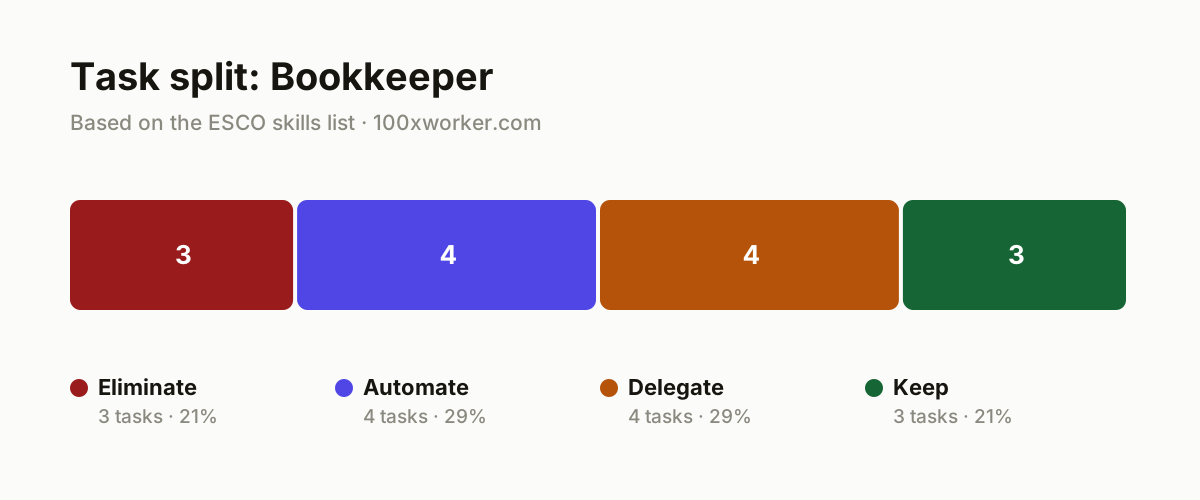
Not every bookkeeping task changes the same way. Some tasks disappear because software already does them better (eliminate). Some get fully handled by AI systems that post entries and flag errors on their own (automate). Some are best done as a draft by AI that you then review and finalize (delegate). And some stay entirely with you, because they require judgment, liability, or a client relationship that no model can carry (keep). Sorting your own task list into these four buckets is a more useful exercise than asking whether the job as a whole will survive.
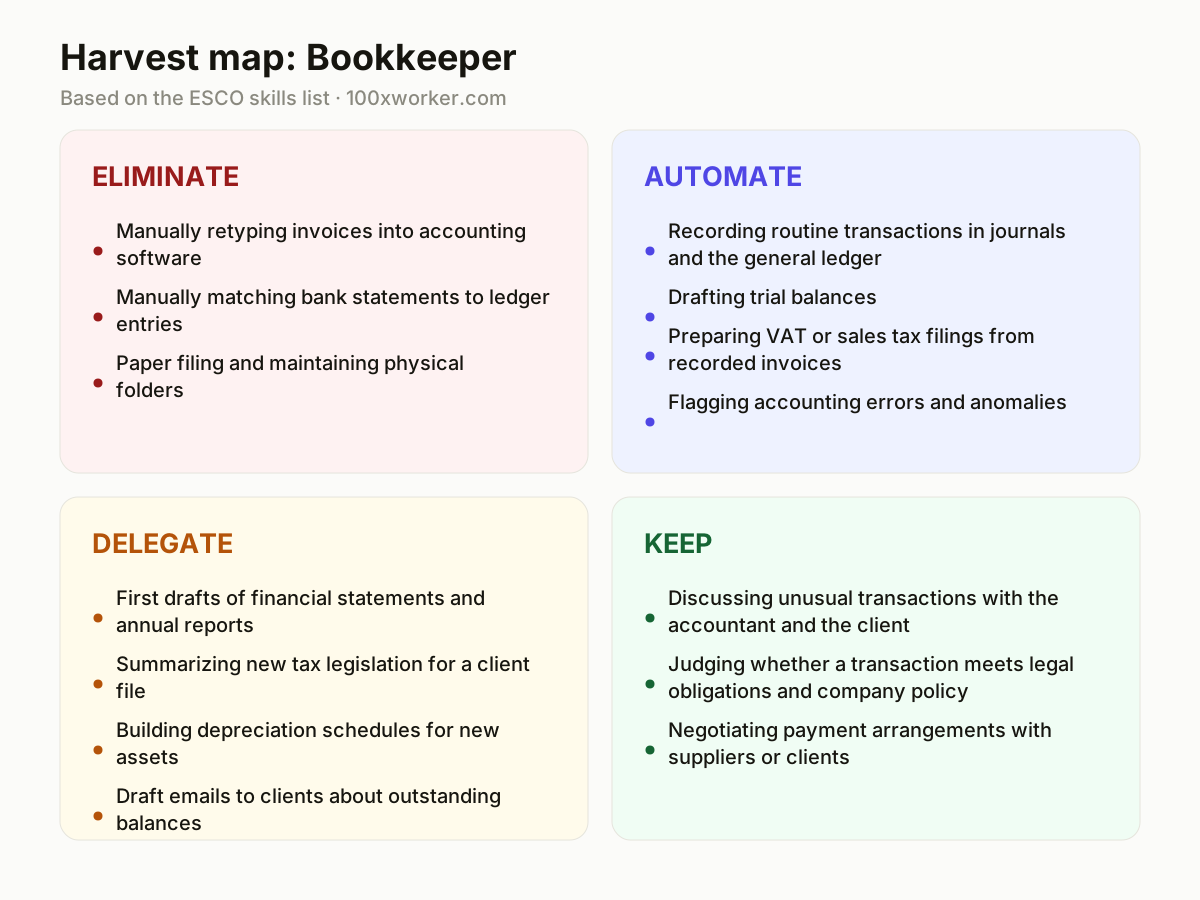
| Task | Bucket | Why |
|---|---|---|
| Manually retyping invoices into accounting software | eliminate | Invoice-capture tools already read amounts, VAT, and vendor details automatically, so typing adds no value. |
| Manually matching bank statements to ledger entries | eliminate | Reconciliation modules match transactions by amount, date, and reference faster and with fewer errors. |
| Paper filing and maintaining physical folders | eliminate | Searchable digital document storage makes physical filing systems unnecessary. |
| Recording routine transactions in journals and the general ledger | automate | Agents post sales, purchases, and payments by fixed rules, ready for use without manual entry. |
| Drafting trial balances | automate | Software generates these automatically from data already entered, ready for review. |
| Preparing VAT or sales tax filings from recorded invoices | automate | The link between the accounting system and the filing form works automatically, figure by figure. |
| Flagging accounting errors and anomalies | automate | Detection algorithms scan the ledger continuously for duplicate entries and figures that don't add up. |
| First drafts of financial statements and annual reports | delegate | AI produces a draft from the bookkeeping data; you check figures, notes, and consistency. |
| Summarizing new tax legislation for a client file | delegate | AI summarizes legal changes; you judge how they apply to the specific client situation. |
| Building depreciation schedules for new assets | delegate | AI calculates method and rate; you validate against tax rules and company policy. |
| Draft emails to clients about outstanding balances | delegate | AI writes a first version; you refine tone, nuance, and the client relationship. |
| Discussing unusual transactions with the accountant and the client | keep | Edge cases require context and trust that no model can judge. (Your edge: Human judgment in gray areas and client relationships.) |
| Judging whether a transaction meets legal obligations and company policy | keep | Legal interpretation and liability stay with the professional, not a tool. (Your edge: Final responsibility and liability rest with you.) |
| Negotiating payment arrangements with suppliers or clients | keep | Flexibility, empathy, and local knowledge of the client determine the outcome. (Your edge: Human relationship and negotiation skill.) |
Which tasks does AI take over from bookkeepers?
AI takes over the mechanical parts of the job first: reading invoices, matching bank transactions to ledger entries, and posting routine sales and purchase transactions. It also drafts documents that used to take hours, like trial balances and first-pass financial statements. Anthropic's Economic Index describes this split as automation-like use, where AI does the task end to end, versus augmentation-like use, where a person still directs and checks the work. For bookkeepers, most of the higher-value tasks, like reviewing a client's financial position or deciding how to classify a borderline transaction, remain augmentation, not automation.
Will AI replace bookkeepers?
Not as a wholesale replacement. Microsoft Research's 24.4% applicability score for bookkeeping and accounting clerks means AI can support roughly a quarter of the work, concentrated in data entry, reconciliation, and drafting. That leaves the majority of the role, judgment calls, legal compliance, and client conversations, in human hands. Older estimates like the widely cited Frey & Osborne (Oxford, 2013) automation-risk figures predate large language models entirely and should be treated with caution. The more accurate picture is that the bookkeeper's task list shrinks in some places and shifts toward review, oversight, and client communication in others.
What can you do this month as a bookkeeper?
Pick one recurring task, like invoice entry or bank reconciliation, and run it through an AI-enabled tool already built into your accounting software for two weeks. Compare the time saved against the time spent checking the output. Then pick one delegate-bucket task, such as drafting a client email about an overdue invoice, and have AI produce the first version every time before you edit it. These two small changes tell you more about where AI fits your actual workflow than any general reading on the topic.
How do you become the AI person on the bookkeeping team?
Start by documenting which of your tasks are already automated, which are AI-drafted and human-checked, and which stay fully manual. Share that breakdown with your manager or firm, since most firms have no clear picture of this yet. Volunteer to pilot one new AI feature in the accounting software the team already uses, and report back on accuracy and time saved. Being the person who can explain what the AI got wrong, not just what it got right, is what makes you useful during this shift.
Generative AI is applicable to roughly a quarter of the work activities of bookkeeping, accounting, and auditing clerks, one of the lower applicability scores among office occupations studied.
Microsoft Research, Working with AI: Measuring the Applicability of Generative AI to Occupations (2025)
Become the AI person on your team
Audit your own task list first
List every recurring task you do in a week and sort it into eliminate, automate, delegate, or keep. This takes an hour and gives you a concrete basis for any conversation about tools or workload.
Pilot one tool on one workflow
Don't try to overhaul the whole practice. Run bank reconciliation or invoice capture through an AI feature for a set number of weeks, track errors caught versus errors missed, and report the result.
Turn draft review into a skill
As AI drafts more financial statements and client emails, the valuable skill becomes fast, accurate review, not fast writing. Practice spotting the kind of errors AI tools typically make in figures and citations.
Want this for your actual task list?
The free scan on the homepage builds your personal task map in 30 seconds, based on your role and industry.
Run the free task scanTools for this work
| Tool | For which tasks | The sober take |
|---|---|---|
| Dext (or similar invoice-capture software) | Eliminate: manual invoice retyping | Reads amounts, VAT, and vendor details from scanned invoices and receipts automatically. |
| QuickBooks Online / Xero built-in AI features | Automate: routine transaction posting, bank reconciliation, trial balances | Reconciliation and categorization features are increasingly built into standard bookkeeping platforms rather than sold separately. |
| ChatGPT or Claude | Delegate: draft client emails, summarize tax legislation, first-pass financial statement text | Useful for drafting; always verify figures and legal claims before sending to a client. |
| Anomaly-detection modules within accounting suites | Automate: flagging accounting errors and duplicate entries | Runs continuously in the background rather than as a one-off check at period close. |
Prompts to try today
Draft a client email about an overdue balance
Summarize a tax law change for a client file
Check a draft trial balance for anomalies
Related jobs
Frequently asked questions
Will AI replace bookkeepers entirely?
No. Microsoft Research's applicability score of 24.4% for bookkeeping and accounting clerks shows AI supports a meaningful share of the work, mainly data entry, reconciliation, and drafting, but the majority of tasks still require human judgment, legal accountability, and client relationships that AI systems don't handle on their own.
What's the difference between an automated task and a delegated task?
An automated task runs end to end without your involvement, like posting a routine sales transaction or matching a bank entry. A delegated task means AI produces a first draft, such as a client email or a section of a financial statement, and you review, correct, and approve it before it goes out. The automate bucket needs monitoring; the delegate bucket needs editing.
Can I trust AI-generated financial statements?
Treat any AI-drafted financial statement as a first draft, not a final document. AI is good at pulling structure and numbers from data you've already entered, but it can misclassify transactions or miss context specific to a client. Always check figures against the source ledger and confirm compliance with applicable accounting and tax rules before signing off.
Do bookkeepers need to learn to code to keep up?
No. The relevant skill is being able to set up, run, and check AI-assisted workflows inside the accounting software you already use, not writing code. Understanding how to prompt an AI tool clearly, and how to spot when its output is wrong, matters more than technical programming skills for this role.
Sources
- Microsoft Research, Working with AI: Measuring the Applicability of Generative AI to Occupations (2025)
- Anthropic Economic Index
- Eurostat, isoc_ai_iaiu (2025)
- ESCO, European Commission occupation taxonomy
Hendrik De Winne, author of Becoming AI-Savvy, founder of VibeLab. Helps teams redesign their work with AI.
This article was drafted with AI assistance from public data sources and editorially reviewed.