100×worker · job analysis
What AI Changes for Treasurers (Public Finance Accountants)
A treasurer, classified in ESCO as a public finance accountant, runs the treasury function inside a government body. You manage spending, revenue, tax compliance, budget planning, and financial forecasting for the institution. The job sits at the intersection of accounting, compliance, and public administration.
Microsoft Research analyzed 200,000 real Copilot conversations and scored how applicable generative AI is to different occupations. Financial managers, the closest US occupational match to a treasurer, scored 14.9% (Working with AI: Measuring the Applicability of Generative AI to Occupations, 2025). That is far below translators at 49% but well above nurses at 12%. It means AI touches a meaningful slice of your task list, not the whole job.
Anthropic's Economic Index, which classifies millions of Claude conversations against O*NET tasks, finds that most professional AI use looks like augmentation rather than full automation. That pattern matches what this article maps out for treasurers below: some tasks disappear, some get automated end to end, some get delegated to AI with a human check, and some stay fully human.
A treasurer is the public finance accountant who manages a government body's spending, revenue, and tax compliance.
The task split: what AI takes over and what stays yours
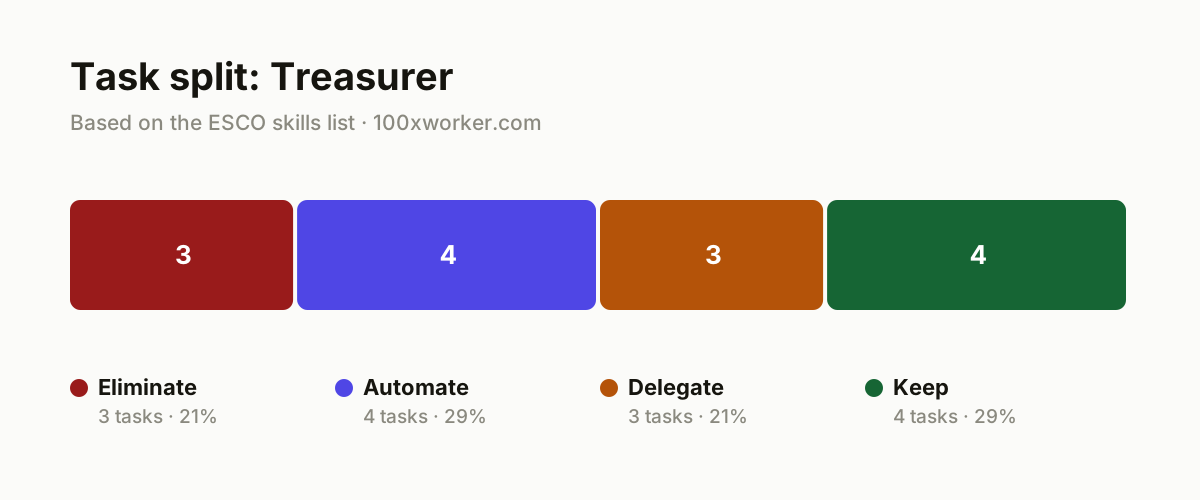
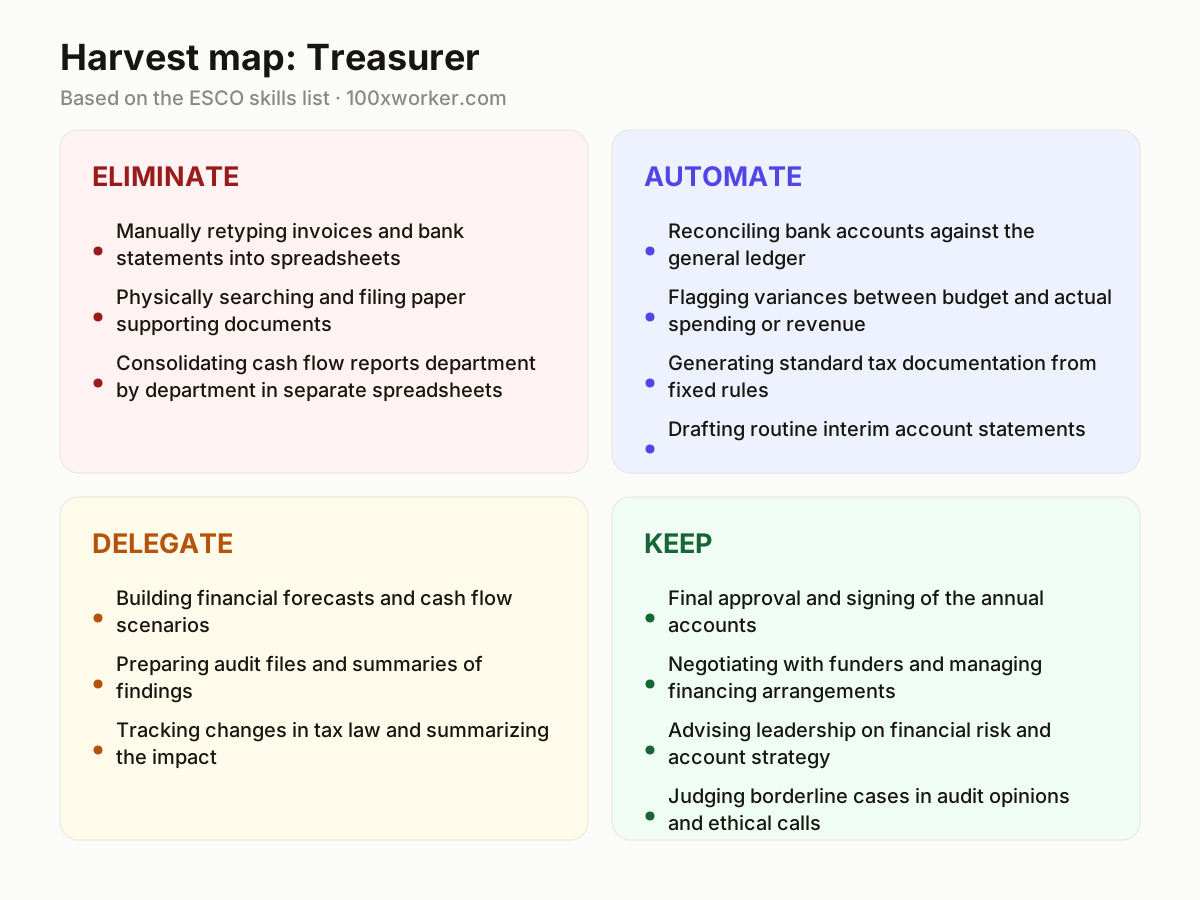
This article sorts treasury tasks into four buckets: eliminate (work that disappears because software now does it natively), automate (rule-based tasks an AI agent can run end to end), delegate (tasks where AI drafts a first version and you review it), and keep (tasks that stay with you because they require judgment, accountability, or human relationships). The split follows how generative AI actually gets used in finance work, based on task-level analysis rather than job titles.
| Task | Bucket | Why |
|---|---|---|
| Manually retyping invoices and bank statements into spreadsheets | eliminate | OCR and accounting integrations read documents directly, removing error-prone manual entry. |
| Physically searching and filing paper supporting documents | eliminate | Digital document storage with search replaces the filing cabinet. |
| Consolidating cash flow reports department by department in separate spreadsheets | eliminate | One connected dashboard replaces manually merging separate files. |
| Reconciling bank accounts against the general ledger | automate | Matching transactions to entries is rule-based work an agent can handle end to end. |
| Flagging variances between budget and actual spending or revenue | automate | Pattern detection spots outliers faster and more consistently than manual sampling. |
| Generating standard tax documentation from fixed rules | automate | Standard forms and filings follow a template an agent can complete on its own. |
| Drafting routine interim account statements | automate | Recurring control reports follow a fixed format with no interpretation required. |
| Building financial forecasts and cash flow scenarios | delegate | AI produces a first-pass model from historical data, you test the assumptions. |
| Preparing audit files and summaries of findings | delegate | An agent structures evidence and drafts initial conclusions, the accountant judges the risk. |
| Tracking changes in tax law and summarizing the impact | delegate | AI summarizes new regulation, you decide what it means for your institution. |
| Final approval and signing of the annual accounts | keep | Legal responsibility and liability sit with the treasurer, not a model. (Your edge: The signature and the liability behind it stay human.) |
| Negotiating with funders and managing financing arrangements | keep | Relationship management and negotiating room require personal contact and political sense. (Your edge: No algorithm builds trust for you.) |
| Advising leadership on financial risk and account strategy | keep | Executives want a person who can weigh context and consequences. (Your edge: You cannot read organizational politics from a dataset.) |
| Judging borderline cases in audit opinions and ethical calls | keep | Close calls require professional judgment and accountability, not just rule application. (Your edge: Weighing doubt stays a professional call, not a statistical one.) |
Which treasurer tasks will AI take over first?
AI moves fastest into treasury tasks that follow a fixed rule and produce a fixed output. Retyping invoices and bank statements into spreadsheets goes first, because OCR and accounting software integrations read the documents directly. Bank reconciliation, variance flagging between budget and actuals, and standard tax form generation follow next, since these are pattern-matching tasks with clear rules. Microsoft Research's applicability score of 14.9% for financial managers reflects exactly this kind of work: high-volume, rule-bound tasks that make up a real but limited share of the job. Forecasting, audits, and judgment calls stay largely untouched at this stage.
Will AI replace treasurers?
No. Microsoft Research scores financial managers, the closest match to a treasurer, at 14.9% AI applicability, meaning generative AI is demonstrably useful for a slice of tasks, not the whole role. The job keeps its core: signing off on the annual accounts, negotiating with funders, and carrying legal liability for the institution's finances. Those responsibilities do not transfer to software. What changes is the mix of daily tasks. Data entry, reconciliation, and routine reporting shrink. Forecasting, audit prep, and regulatory tracking shift toward an AI-assisted first draft that you check. The treasurer who adapts spends less time on entry and more time on judgment and oversight.
How do you become the AI person on your treasury team?
Start by mapping your own task list against the four buckets: eliminate, automate, delegate, keep. Pick one recurring task, like monthly reconciliation or a standard tax filing, and test whether an AI tool can handle a full pass while you check the output. Document what works so colleagues can reuse it. Learn to write specific prompts that include your data, your format, and your assumptions, rather than vague requests. Volunteer to pilot a tool your finance department is evaluating, and report back on where it fails, not just where it succeeds. Being the person who knows the failure modes makes you more useful than being the person who just uses the tool.
What can you do this month with AI as a treasurer?
Pick one eliminate-bucket task, such as manual invoice entry, and switch it to an OCR or accounting-integration tool this week. Next, take one delegate-bucket task, like your quarterly cash flow forecast, and run it through an AI tool for a first draft, then compare it against your own numbers before deciding how much you trust it. Use an AI assistant to summarize one recent tax law change relevant to your institution and check the summary against the source text. Keep a short log of where the AI output was wrong, since that log becomes your case for what to trust next month.
Across real-world use, most professional AI activity looks like augmentation working alongside a person rather than full automation of a task.
Anthropic Economic Index
Become the AI person on your team
Map your task list before you pick a tool
List every recurring task you do in a month and sort it into eliminate, automate, delegate, or keep. This tells you where AI actually saves time instead of guessing based on a vendor pitch.
Build one working prompt per task type
Save a working prompt for reconciliation checks, one for forecast drafts, and one for regulation summaries. Reuse and refine them instead of starting from scratch each time.
Track AI mistakes, not just AI wins
Keep a running note of every time an AI-generated number or summary was wrong. That record is what lets you calibrate how much oversight each task actually needs.
Want this for your actual task list?
The free scan on the homepage builds your personal task map in 30 seconds, based on your role and industry.
Run the free task scanTools for this work
| Tool | For which tasks | The sober take |
|---|---|---|
| Microsoft Copilot (Microsoft 365) | Automate and delegate buckets: reconciliation prep, drafting interim reports, summarizing tax law changes | Sits inside Excel and Outlook, useful for routine drafts, but check the numbers before you file them. |
| Claude (Anthropic) | Delegate bucket: forecasting drafts, audit file summaries | Handles long documents well, good for a first pass that you then review. |
| OCR and document capture platforms | Eliminate bucket: invoice and bank statement entry | Replace manual retyping, but you still need to spot-check exceptions. |
| Reconciliation software with matching engines | Automate bucket: bank reconciliation and variance flagging | Handles routine matching and escalates only the exceptions to you. |
Prompts to try today
Draft a first-pass cash flow forecast
Summarize a tax law change
Flag reconciliation exceptions
Related jobs
Frequently asked questions
Does AI replace a treasurer's legal sign-off responsibility?
No. Signing and approving annual accounts carries legal liability that stays with the treasurer, not with software. AI can draft summaries, flag anomalies, and prepare supporting documents, but the accountability for the final numbers and the decision to approve them remains a human responsibility. This is consistent across the keep bucket of tasks: sign-off, negotiation, and judgment calls all stay with the person, not the model.
What share of a treasurer's job can AI currently do?
Microsoft Research's 2025 study of 200,000 real Copilot conversations scored financial managers, the closest US occupational match to a treasurer, at 14.9% AI applicability. That means generative AI is demonstrably useful for roughly a seventh of typical task time, concentrated in data entry, reconciliation, and standard reporting. For comparison, translators scored 49% and nurses scored 12% on the same scale.
How many people already use generative AI at work?
Adoption varies by region and survey method. Eurostat found that 32.7% of the EU population aged 16 to 74 used generative AI in the three months before being surveyed in 2025. Anthropic's Economic Index separately tracks how millions of Claude conversations map onto real work tasks, showing that most professional use looks like augmentation rather than full automation. Both point to the same trend: rising but still partial adoption.
Where can I find the official skill list for this occupation?
The European Commission's ESCO taxonomy lists public finance accountant (the formal term for treasurer) under code 2411.1.11, with essential skills including auditing, budget principles, tax legislation, and managing financing resources. ESCO covers 3,039 occupations across 28 languages, and it is a useful reference for comparing your task list against the formal skill definition of the role.
Sources
- Microsoft Research: Working with AI: Measuring the Applicability of Generative AI to Occupations (2025)
- Anthropic Economic Index
- Eurostat, isoc_ai_iaiu dataset
- ESCO occupation taxonomy, European Commission
Hendrik De Winne, author of Becoming AI-Savvy, founder of VibeLab. Helps teams redesign their work with AI.
This article was drafted with AI assistance from public data sources and editorially reviewed.