100×worker · job analysis
Will AI Replace Machine Learning Engineers? A Task-by-Task Breakdown
Machine learning engineering is changing faster than the job title suggests. Microsoft Research analyzed 200,000 real Copilot conversations and published an AI applicability score per occupation. For Computer and Information Research Scientists, the closest available category to machine learning engineering, generative AI is measurably applicable to 16.9% of daily work activities (Microsoft Research, Working with AI, 2025). That puts the role well below translators, who top the list at 49%, but above nurses, who sit near 12%.
That 16.9% is not evenly spread. Some tasks, like writing boilerplate preprocessing code or summarizing papers from arXiv, are close to fully automatable today. Others, like choosing a research methodology or deciding whether a model is safe to ship, are not something a language model can own. Anthropic's Economic Index, which classifies millions of Claude conversations against O*NET task lists, makes a similar split: some AI use is automation-like (the AI does the task), and some is augmentation-like (the AI assists while a person decides). This article sorts the actual tasks of a machine learning engineer into four buckets: eliminate, automate, delegate, and keep, so you can see where your time is actually going next year.
A machine learning engineer builds and maintains systems that learn patterns from data to make predictions.
The task split: what AI takes over and what stays yours
Not every task in a machine learning engineer's job changes the same way. Some tasks disappear entirely because AI tools do them faster with no meaningful loss (eliminate). Some run unattended once you set them up, needing only occasional review (automate). Some are still your responsibility but AI produces the first draft or first pass (delegate). And some require judgment, accountability, or trust that no model can take on (keep). Sorting your actual week into these four buckets, rather than asking whether AI will 'take the job,' is the useful way to think about it.
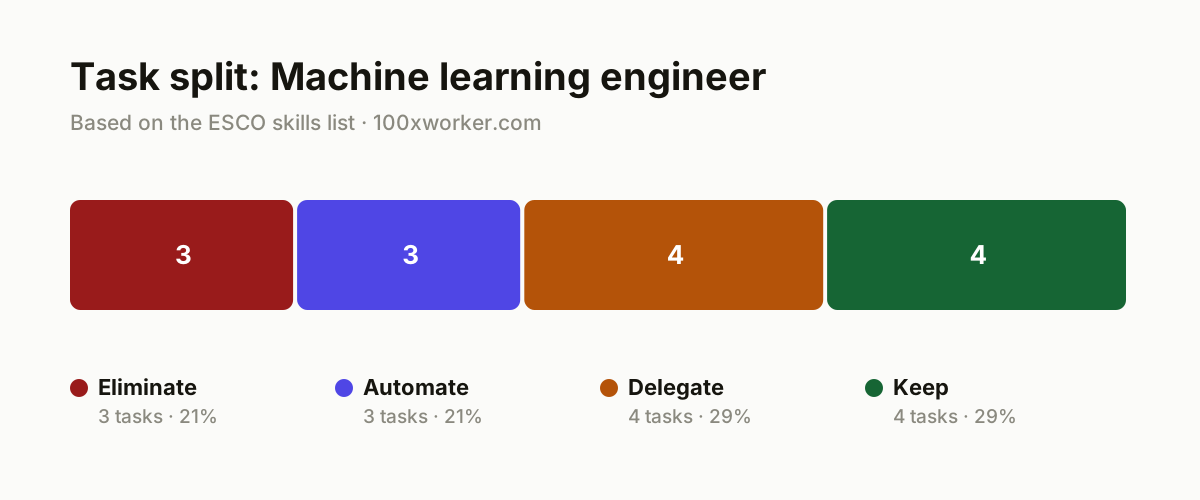
| Task | Bucket | Why |
|---|---|---|
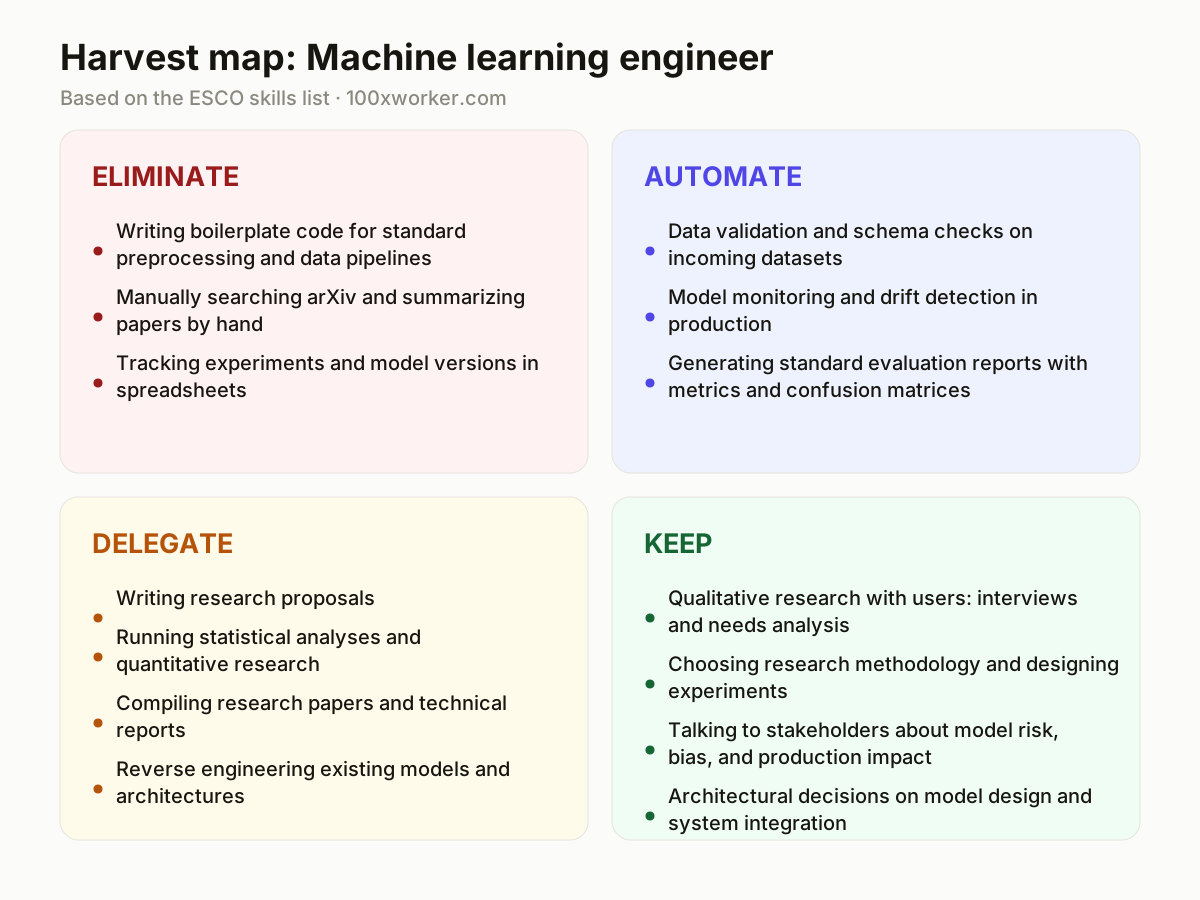
| Writing boilerplate code for standard preprocessing and data pipelines | eliminate | AI coding assistants generate this faster and with fewer errors than typing it by hand. |
| Manually searching arXiv and summarizing papers by hand | eliminate | AI search tools scan and synthesize hundreds of papers in minutes, wider than manual review. |
| Tracking experiments and model versions in spreadsheets | eliminate | Automated tracking logs parameters and results at every run without manual entry. |
| Data validation and schema checks on incoming datasets | automate | Agents run these checks on every new data batch and flag anomalies without supervision. |
| Model monitoring and drift detection in production | automate | Systems measure performance continuously and send alerts, so daily manual checks are unnecessary. |
| Generating standard evaluation reports with metrics and confusion matrices | automate | Scripts run automatically after every training job and the output is usable immediately. |
| Writing research proposals | delegate | AI drafts an initial structure and argument, you sharpen the research question and scope. |
| Running statistical analyses and quantitative research | delegate | AI runs the analysis and flags patterns, you judge the methodology and draw the conclusion. |
| Compiling research papers and technical reports | delegate | AI writes a first draft of sections, you check accuracy and originality. |
| Reverse engineering existing models and architectures | delegate | AI parses code and documentation quickly, you assess feasibility and risk. |
| Qualitative research with users: interviews and needs analysis | keep | People tell other people things they will not tell a chatbot. (Your edge: Building trust and listening for what is not said.) |
| Choosing research methodology and designing experiments | keep | Framing the right research question needs domain judgment AI does not have on its own. (Your edge: Scientific judgment about what the question actually is.) |
| Talking to stakeholders about model risk, bias, and production impact | keep | Taking responsibility for a model's consequences cannot be outsourced to a tool. (Your edge: Accountability and trust that cannot be delegated.) |
| Architectural decisions on model design and system integration | keep | Trade-offs between speed, cost, and accuracy require experience and context. (Your edge: Years of experience reading the trade-offs correctly.) |
Which tasks of a machine learning engineer does AI take over?
AI is strongest on well-defined, repeatable tasks: writing boilerplate preprocessing code, running literature searches across arXiv, logging experiment parameters, validating incoming data schemas, monitoring models in production for drift, and generating standard evaluation reports. These are tasks with a clear input, a clear output, and little judgment required. Microsoft Research's analysis of 200,000 Copilot conversations backs this up: applicability clusters around tasks with defined structure, not around open-ended research decisions. The tasks that survive are the ones where the question itself is unclear until a person defines it.
Will AI replace machine learning engineers?
Not as a role, no. Microsoft Research puts the AI applicability score for the closest occupational category, Computer and Information Research Scientists, at 16.9% of work activities, well below high-exposure roles like translation (49%) and well above low-exposure roles like nursing (12%). That means most of the job stays intact, but the composition of daily work shifts: less time on code scaffolding and literature triage, more time on judgment calls, methodology, and explaining risk to stakeholders who need to trust the result. Older 'robotization percentage' figures circulating for many jobs come from a 2013 Oxford study (Frey and Osborne) done before large language models existed, so treat those numbers as outdated compared to newer, task-level data.
How do you become the AI person on your team as a machine learning engineer?
Start by using AI tools openly for the eliminate and automate tasks, code scaffolding, literature synthesis, drift monitoring, so your team sees the time savings directly. Then build a habit around the delegate tasks: draft a research proposal or report with AI, and show your teammates exactly how you check and correct it. Document what you keep doing yourself and why. Being the AI person is not about using the most tools, it is about being the one who can explain clearly what AI got right, what it got wrong, and where a human still has to decide.
What can you do this month to start working with AI as a machine learning engineer?
Pick one eliminate task, like literature search or preprocessing code, and fully hand it to an AI tool for two weeks. Track the time saved. Pick one delegate task, like a research proposal draft, and run it through AI first, then edit. Set up automated drift detection on one production model if you have not already. Finally, write down which three tasks in your week absolutely require your judgment, and protect that time. This gives you a concrete before-and-after instead of a vague sense that 'AI is changing things.'
Translators show the highest measured applicability of generative AI among occupations analyzed, at 49%, while nurses sit near the bottom at 12%.
Microsoft Research, Working with AI: Measuring the Applicability of Generative AI to Occupations (2025)
Become the AI person on your team
Run a two-week automation audit
Log every task you do for two weeks and mark which ones an AI tool could do at least a draft of. Most engineers find 20-30% of their week is boilerplate. Share the audit with your team lead as a concrete starting point, not a theory.
Build a prompt library for recurring research tasks
Save the prompts that reliably produce a good first draft of a research proposal, literature summary, or evaluation report. Version them like code, so teammates can reuse and improve them instead of starting from scratch every time.
Own the model risk conversation
Be the person who translates model behavior (bias, drift, failure modes) into language stakeholders without ML background can act on. This is the task AI cannot take over, so claiming it explicitly makes you harder to replace, not easier.
Want this for your actual task list?
The free scan on the homepage builds your personal task map in 30 seconds, based on your role and industry.
Run the free task scanTools for this work
| Tool | For which tasks | The sober take |
|---|---|---|
| GitHub Copilot / Cursor | eliminate: boilerplate code, preprocessing pipelines | Good for scaffolding, still needs review for edge cases in production data. |
| Weights & Biases / MLflow | eliminate: experiment tracking; automate: evaluation reports | Logs runs automatically, but you still decide which run to promote. |
| Elicit / Perplexity | eliminate: literature review and paper summaries | Faster than manual arXiv search, but check citations against the original papers. |
| Evidently AI / Arize | automate: drift detection and production monitoring | Flags statistical shifts, does not tell you whether the shift matters for your use case. |
| Claude / ChatGPT for drafting | delegate: research proposals, technical report sections | Produces usable first drafts, weak on domain-specific accuracy without your correction. |
Prompts to try today
Draft a research proposal skeleton
Summarize a batch of papers for a literature review
Explain model risk to a non-technical stakeholder
Related jobs
Frequently asked questions
Is machine learning engineering a high-risk job for AI automation?
Not by the numbers available. Microsoft Research's applicability score for the closest occupational category, Computer and Information Research Scientists, is 16.9%, well below high-exposure roles like translation (49%). That places ML engineering in a moderate range: a meaningful share of daily tasks shift to AI tools, but the core research and decision-making work stays with people.
What is the difference between AI automating and AI augmenting a task?
Anthropic's Economic Index, which classifies millions of Claude conversations against O*NET task categories, splits AI use into automation-like (the AI performs the task with minimal human input) and augmentation-like (a person stays in the loop and decides). For machine learning engineers, code scaffolding leans automation-like, while research proposal writing leans augmentation-like.
Should machine learning engineers worry about being replaced entirely?
The available data does not support that. Applicability scores measure task-level overlap with generative AI, not whole-job replacement. A 16.9% applicability score for the closest occupational category means part of the job changes composition, not that the job disappears. The tasks that remain, methodology, risk judgment, stakeholder trust, are not the kind of task current models can own.
How is ESCO relevant to understanding this job's tasks?
The European Commission's ESCO taxonomy describes 3,039 occupations with associated skills across 28 languages. It lists 'computer scientist' (ESCO code 2511.1) with essential skills including quantitative research, statistical analysis, and writing research proposals, tasks that map closely onto machine learning engineering, though ESCO does not yet have a dedicated 'machine learning engineer' entry.
Sources
- Microsoft Research, Working with AI: Measuring the Applicability of Generative AI to Occupations (2025)
- Anthropic Economic Index
- Eurostat, isoc_ai_iaiu (2025)
- ESCO, European Commission
Hendrik De Winne, author of Becoming AI-Savvy, founder of VibeLab. Helps teams redesign their work with AI.
This article was drafted with AI assistance from public data sources and editorially reviewed.