100×worker · job analysis
Will AI Replace Librarians, and What Should You Do About It?

Librarians spend less time than people assume answering trivia at a reference desk. The job is metadata, collection strategy, research support, contracts, and community relationships. AI is already changing how much time each of those takes, but not by replacing the role wholesale.
Microsoft Research analyzed 200,000 real Copilot conversations and scored occupations on how much of their work generative AI can plausibly touch. Librarians and media-collection specialists land at 25.4%, a moderate score. Translators top the list at 49%, nurses sit near the bottom at 12%. That places librarian work closer to augmentation than to automation.
The useful question is not whether AI replaces librarians. It is which specific tasks shift, and what that means for how you spend a Tuesday. This article breaks the job into four buckets: tasks that disappear, tasks AI now does with a quick check from you, tasks you hand to AI as a first draft, and tasks that stay firmly human.
A librarian manages information resources and makes them findable and accessible to users.
The task split: what AI takes over and what stays yours
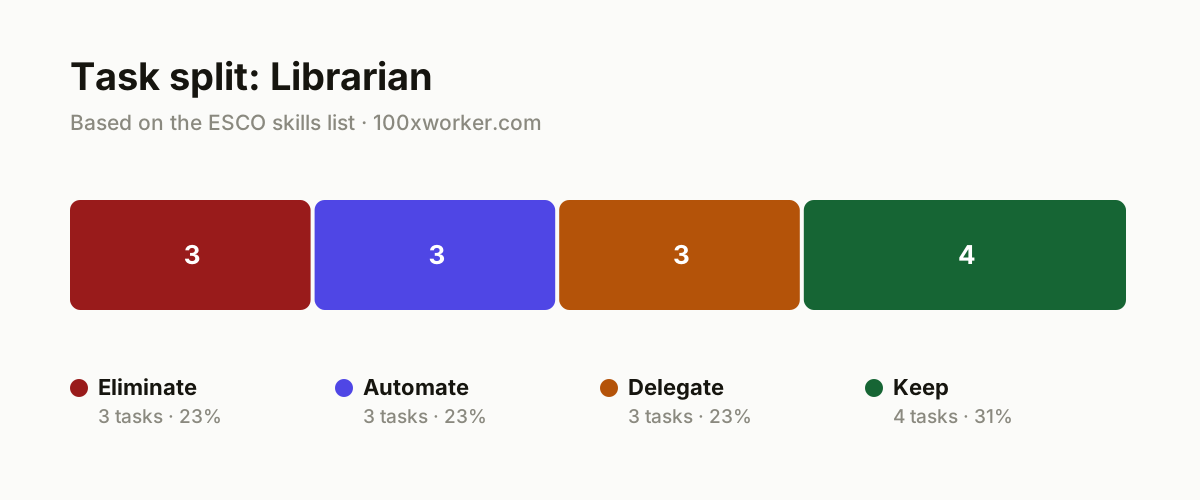
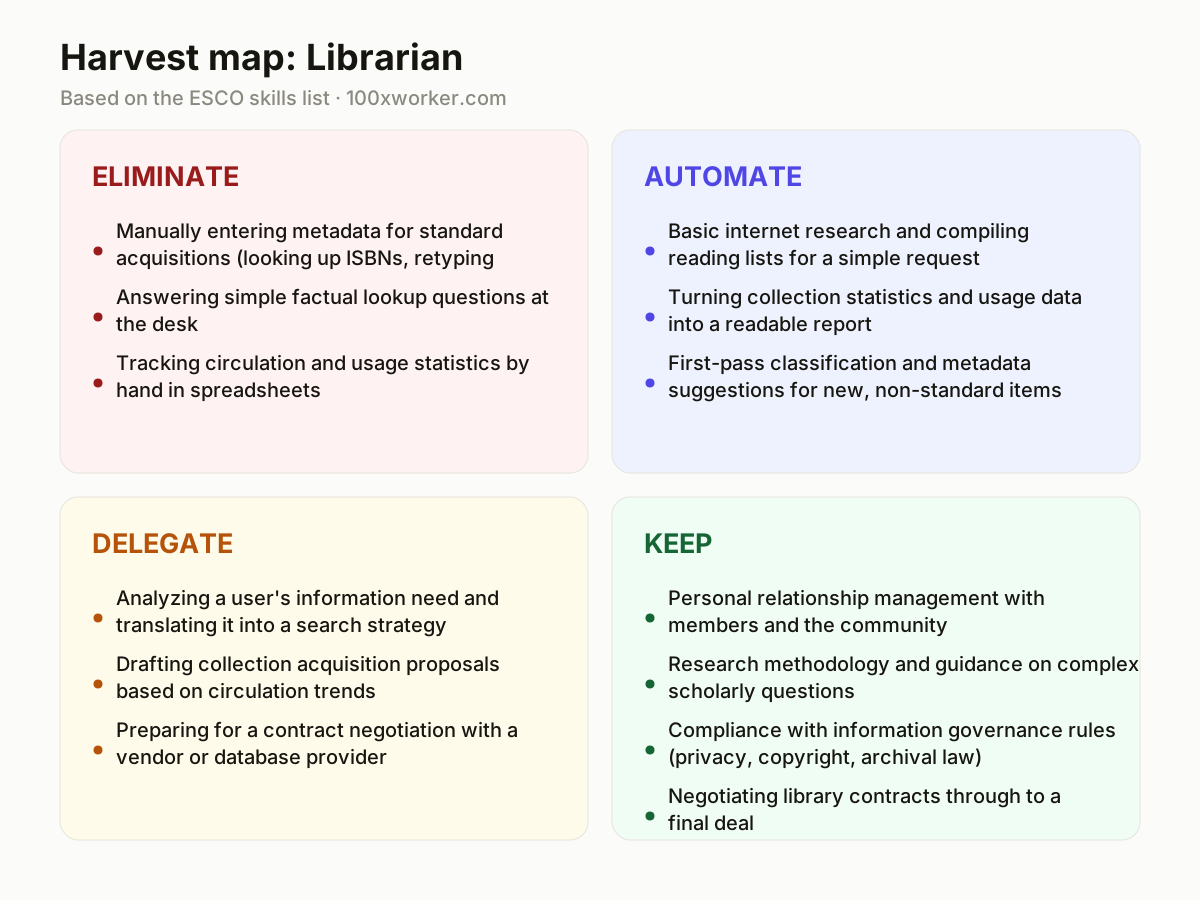
We sort librarian tasks into four buckets: eliminate (AI or systems now do this and you should stop doing it by hand), automate (AI produces a usable first version, you check it), delegate (AI drafts, you decide and take responsibility), and keep (human judgment, relationships, or accountability that AI cannot substitute for).
| Task | Bucket | Why |
|---|---|---|
| Manually entering metadata for standard acquisitions (looking up ISBNs, retyping basic fields) | eliminate | Automated metadata feeds and classification models do this faster and with fewer errors. |
| Answering simple factual lookup questions at the desk | eliminate | Users now ask a chatbot these questions before they even walk into the library. |
| Tracking circulation and usage statistics by hand in spreadsheets | eliminate | Dashboards and system reports fully replace manually retyping numbers. |
| Basic internet research and compiling reading lists for a simple request | automate | An AI agent searches sources and delivers a usable first list, ready to send after a quick check. |
| Turning collection statistics and usage data into a readable report | automate | Converting numbers into a board or funding report is repeatable work AI handles reliably. |
| First-pass classification and metadata suggestions for new, non-standard items | automate | AI generates a classification proposal, you confirm or correct it in seconds. |
| Analyzing a user's information need and translating it into a search strategy | delegate | AI proposes an initial search strategy from the question, you check it against the user's real context. |
| Drafting collection acquisition proposals based on circulation trends | delegate | AI compares trends and gaps in the collection, you decide what fits your audience and budget. |
| Preparing for a contract negotiation with a vendor or database provider | delegate | AI summarizes past contracts and lines up price comparisons, you negotiate the actual deal. |
| Personal relationship management with members and the community | keep | Trust, local knowledge, and reading what someone actually needs stay human work. (Your edge: You know your community, a model only knows text.) |
| Research methodology and guidance on complex scholarly questions | keep | AI supplies sources, but judging quality, relevance, and context takes subject expertise. (Your edge: You spot a weak source, a model sometimes does not.) |
| Compliance with information governance rules (privacy, copyright, archival law) | keep | Legal and ethical responsibility for what gets made accessible rests with a person. (Your edge: You carry the liability, not the tool.) |
| Negotiating library contracts through to a final deal | keep | Building relationships, weighing priorities, and shifting position strategically stays human work. (Your edge: AI prepares the ground, you close the deal.) |
Will AI replace librarians?
No. Microsoft Research scores librarian and media-collection work at 25.4% AI applicability, meaning about a quarter of typical work activities are ones where generative AI is demonstrably useful. That is a moderate score, well below translators (49%) and above nurses (12%). The tasks most affected are lookup, metadata, and reporting. The tasks that remain, community trust, research judgment, negotiation, legal compliance, require a person accountable for the decision. The job shrinks in some areas and grows in others, but it does not disappear.
How does AI change a librarian's actual task list?
It removes repetitive input work, such as retyping metadata for standard purchases and manually logging circulation stats. It speeds up drafting: literature searches, acquisition proposals, and reports go from a multi-hour task to a first draft you edit. It leaves untouched the parts that require judgment about a specific person or a specific legal obligation: reference interviews that need follow-up questions, evaluating whether a scholarly source is trustworthy, and deciding what an archive can legally release. The Anthropic Economic Index finds that professional AI use splits between automation (AI does the task) and augmentation (AI assists while a person decides), and librarian work leans toward the second.
Which skills matter more for librarians because of AI?
Prompting and verifying AI output well enough to catch a wrong citation or a bad classification suggestion. Judging source quality faster, since AI surfaces more candidate sources than before and someone has to filter them. Negotiation and vendor management, since database and platform contracts increasingly include AI-related licensing terms. Data governance literacy, since deciding what metadata or archival material can be fed into an AI tool touches privacy and copyright rules directly. ESCO already lists compliance with information management regulation as a core skill; AI adoption makes that skill more central, not less.
What can a librarian do this month with AI?
Pick one recurring report, a circulation summary or a collection usage update, and draft it with an AI tool instead of a spreadsheet template, checking the numbers before sending it. Try an AI-assisted search on your next reference request and compare it against your own search strategy, so you know where the tool helps and where it misses context. Ask your vendor whether their contract terms mention AI-generated content or data use, since that changes what you negotiate next renewal cycle.
AI does not change your job, it changes your task list.
UWV employer survey framing, paraphrased for general use
Become the AI person on your team
Turn your reference log into a training set
Review a month of reference questions and sort them into ones a chatbot answers well versus ones that needed your judgment. Use that split to redesign desk hours around the harder questions.
Build a metadata QA habit, not a metadata typing habit
Stop manually entering standard fields. Instead, spend that time spot-checking AI-generated metadata for accuracy, since errors at scale are worse than errors one at a time.
Add an AI clause to vendor renewal talks
Ask database and platform vendors directly how their AI features handle user data and licensing. Bring a summary from AI-assisted contract review into the room, but negotiate the terms yourself.
Want this for your actual task list?
The free scan on the homepage builds your personal task map in 30 seconds, based on your role and industry.
Run the free task scanTools for this work
| Tool | For which tasks | The sober take |
|---|---|---|
| Microsoft Copilot | Literature searches, first-draft reports, metadata suggestions (automate bucket) | Useful for drafting, still needs your check before it goes out. |
| Claude (Anthropic) | Research support, summarizing sources, drafting acquisition proposals (automate, delegate) | Anthropic's own data shows this kind of work skews toward augmentation, not full automation. |
| Library management systems with built-in AI metadata (e.g., OCLC-connected cataloging tools) | Standard metadata entry and classification proposals (eliminate, automate) | Reduces manual cataloging but still needs periodic accuracy audits. |
| Generic chatbot search (any consumer AI assistant) | Simple factual lookups patrons now do themselves (eliminate) | This is exactly why desk traffic for basic questions is dropping. |
Prompts to try today
First-draft literature list
Collection usage report
Contract negotiation prep
Related jobs
Frequently asked questions
Is librarianship a high-risk job for AI automation?
Not by current measures. Microsoft Research scores librarian and media-collection work at 25.4% AI applicability, a moderate figure. For comparison, translators score 49% and nurses score 12%. The role includes many tasks, community relationships, research judgment, legal compliance, that current generative AI tools do not perform reliably on their own. Older studies using pre-language-model methods, such as Frey and Osborne (2013), estimated much higher automation risk for many roles, but that research predates the technology now actually in use.
What percentage of library tasks can AI currently handle?
Microsoft Research's applicability score suggests generative AI is demonstrably useful for roughly a quarter of the work activities typical in librarian and media-collection roles. That does not mean AI performs those tasks unsupervised. Anthropic's Economic Index shows professional AI use splits between automation (AI does the task) and augmentation (AI assists, a person decides), and librarian-type work leans toward augmentation rather than full automation.
Do librarians need to learn to code or use AI tools directly?
You need to know how to prompt an AI tool, check its output, and spot when it gets a citation, classification, or source wrong. That is closer to critical evaluation, a skill ESCO already lists for the profession, than to programming. Formal coding skills are not required for most librarian roles, but comfort testing and verifying AI output is becoming a practical necessity.
How common is AI use among the public that libraries serve?
Adoption varies by region but is rising fast. Eurostat found 32.7% of the EU population aged 16-74 had used generative AI in the past three months as of 2025. In Belgium, 61% of people had used an AI chatbot in a Google/Ipsos survey from the same year. That means many patrons already try AI tools before asking a librarian, which shifts reference desk work toward more complex, unresolved questions.
Sources
- Microsoft Research, Working with AI: Measuring the Applicability of Generative AI to Occupations (2025)
- Anthropic Economic Index
- Eurostat, Individuals' use of generative AI (isoc_ai_iaiu)
- ESCO, European Commission occupation taxonomy
Hendrik De Winne, author of Becoming AI-Savvy, founder of VibeLab. Helps teams redesign their work with AI.
This article was drafted with AI assistance from public data sources and editorially reviewed.