100×worker · job analysis
Will AI Replace Psychotherapists?

Psychotherapists spend real hours each week on tasks that have nothing to do with sitting across from a patient: typing up notes, filling in invoices, chasing studies on a treatment method. Generative AI is already changing how much of that work looks, though it cannot touch the part of the job that actually matters most, the session itself.
Microsoft Research analyzed 200,000 real conversations with its Copilot assistant and published occupation-level 'AI applicability scores' for hundreds of jobs (Working with AI: Measuring the Applicability of Generative AI to Occupations, 2025). There is no single official score for psychotherapist in that dataset, since it maps most closely to US occupational codes, but the method behind it applies directly here: a large share of a therapist's task list is writing, summarizing, and searching, exactly what people already hand to AI assistants.
The ESCO taxonomy from the European Commission lists psychotherapist among 3,039 occupations and breaks the job into dozens of specific skills, from psychological diagnostics to managing the therapeutic relationship. That breakdown is the useful unit here. Instead of asking whether AI replaces 'the therapist,' this article sorts those individual skills into what you can drop, automate, delegate, or must keep doing yourself.
A psychotherapist treats psychological, psychosocial, and psychosomatic problems using scientifically grounded therapeutic methods.
The task split: what AI takes over and what stays yours
The clearest way to see what AI changes for psychotherapists is to sort the job into four buckets. Eliminate covers manual work that software should already handle for you. Automate covers tasks an AI agent can run largely on its own, with a quick check from you. Delegate covers work you hand to AI as a first draft, then correct with clinical judgment. Keep covers the parts of the job that stay entirely yours: the session, the diagnosis, the crisis response, and the ending of a therapeutic relationship.
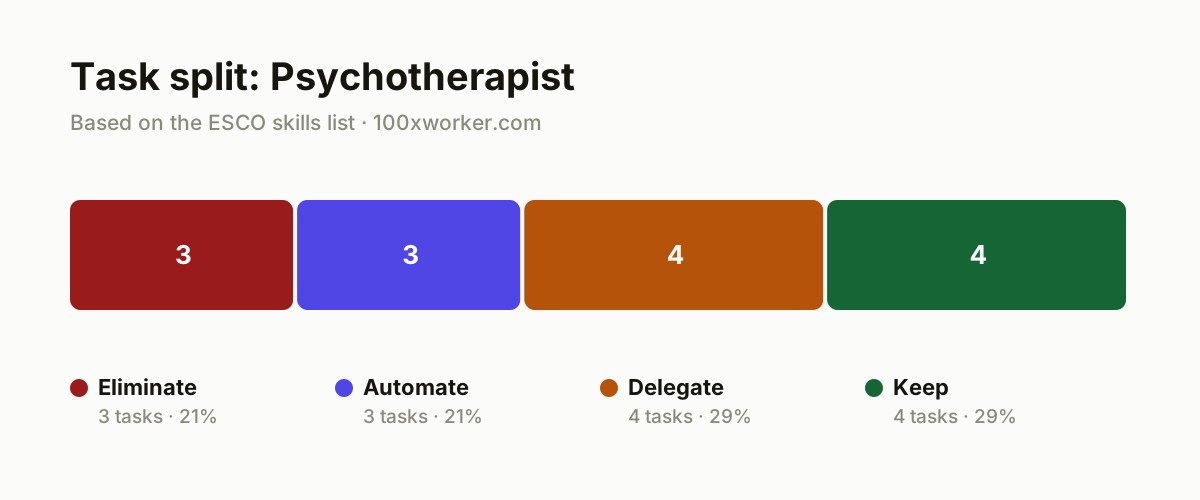
| Task | Bucket | Why |
|---|---|---|
| Typing session notes word for word after every appointment | eliminate | Speech-to-text and summarizing AI models do this faster and more consistently than manual typing. |
| Manually filling in invoices and insurance claim forms | eliminate | Practice management software links your calendar, fee schedule, and insurer data automatically, so you stop retyping numbers. |
| Searching one by one for individual studies on a treatment method | eliminate | AI research tools search and cluster clinical literature wider and faster than a manual search. |
| First draft of the session note or case file entry | automate | An agent turns audio notes or keywords into a structured draft, and you review and sign off. |
| Scheduling, reminders, and no-show follow-up | automate | Booking systems send confirmations automatically, so you stop managing every appointment by hand. |
| Keeping a literature review current for a therapy modality | automate | An agent gathers new publications on approaches like schema therapy or EMDR and delivers a summary. |
| First draft of a theoretical case formulation | delegate | AI structures intake information into a provisional model, and you test it against your clinical judgment. |
| Draft intake report based on questionnaires and history | delegate | AI summarizes submitted forms into a readable report, and you add clinical nuance and context. |
| Psychoeducational material and between-session exercises | delegate | AI writes a first draft of an explanation or homework exercise, and you adapt it to the patient. |
| Progress summary for multidisciplinary review or referral | delegate | AI distills session notes into an overview of progress, and you decide what matters for colleagues. |
| Running the therapy session itself and building the therapeutic relationship | keep | Trust, timing, and nonverbal attunement happen in real contact, not on a screen. (Your edge: Empathy in the moment stays irreplaceable.) |
| Deciding on the therapeutic approach and treatment strategy | keep | This choice needs clinical judgment about the unique patient and full accountability. (Your edge: You carry clinical responsibility, always.) |
| Responding to extreme emotion, trauma, and crisis situations | keep | Real-time risk assessment needs human presence, ethical judgment, and direct action. (Your edge: Crisis intervention needs a presence no agent has.) |
| Ending therapeutic relationships and discussing relapse prevention | keep | Closure needs sensitivity and adaptation to the patient's specific life history. (Your edge: A goodbye needs sensitivity, not a script.) |
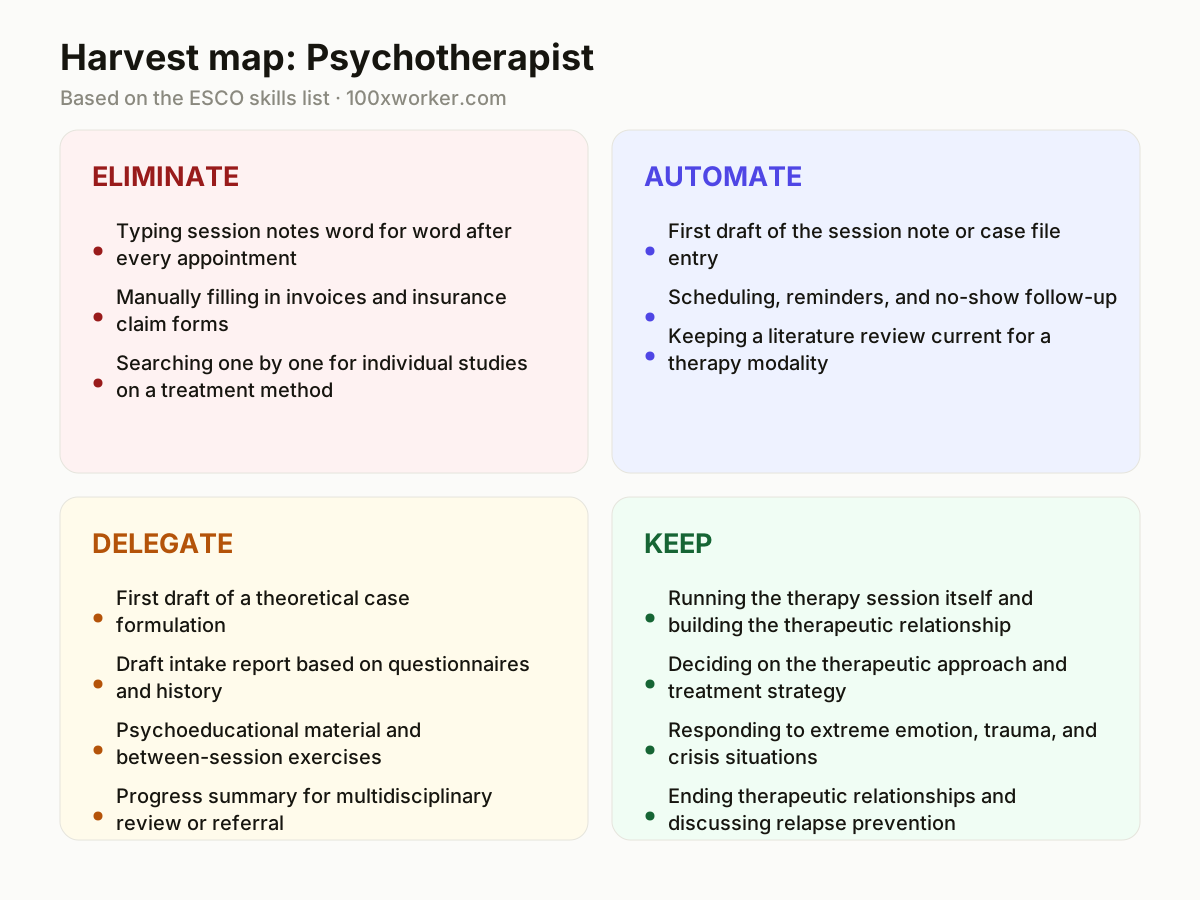
Will AI replace psychotherapists?
No. The core of psychotherapy, the session itself, the therapeutic relationship, and decisions about treatment strategy, requires a human who can read a room, sit with distress, and take clinical responsibility. What AI replaces is the paperwork wrapped around that work: typing notes, filling in invoices, and hunting for studies one at a time. Microsoft Research's analysis of 200,000 real Copilot conversations found that the tasks people already hand to AI assistants are writing, summarizing, and researching, exactly the non-clinical layer of a therapist's job. The clinical core stays with you, but the hours you spend on everything around it are shrinking.
Which tasks can AI take over from a psychotherapist?
AI can take over most of the writing and searching around your sessions. It can eliminate manual note-typing, invoice entry, and one-by-one literature searches. It can automate a first draft of your session note, your scheduling and reminder system, and a running literature digest for a specific therapy modality. Beyond that, you can delegate a first draft of a case formulation, an intake summary, psychoeducation handouts, or a progress note for a referral, as long as you review and adjust every draft. None of this replaces running the session, deciding on treatment strategy, or handling a crisis in the room.
What can you do this month as a psychotherapist?
Start by listing your recurring non-session tasks: session notes, invoicing, intake summaries, literature searches, psychoeducation material. Mark each one as eliminate, automate, delegate, or keep. Pick one task from the eliminate or automate list, such as session notes, and test a scribe tool for two to four weeks using de-identified data. Set a hard rule before you start: no identifiable patient information goes into a general consumer chatbot. Review every AI draft the way you would a trainee's note, checking it against the actual session before it enters the file. Track how many minutes you save each week to decide if the tool earns a permanent place in your workflow.
How does AI change a psychotherapist's task list, according to research?
Two studies point the same direction. Microsoft Research analyzed 200,000 real Copilot conversations and scored how applicable generative AI is across occupations, based on what people actually ask it to do, not predictions about job loss (2025). Anthropic's Economic Index classifies millions of Claude conversations against the O*NET task list and separates automation-like use, where AI does the task, from augmentation-like use, where it supports a person doing the task. For a role like psychotherapist, most real AI use likely falls into augmentation: drafting, summarizing, and researching, while the session and the clinical decision stay with the practitioner. Eurostat found that 32.7% of the EU population aged 16 to 74 used generative AI in the last three months of 2025, so this shift is already underway broadly, not just in specialist software.
AI applicability scores in this research come from analyzing real conversations people already have with an AI assistant, not from predictions about which jobs might disappear.
Microsoft Research, Working with AI (2025)
Become the AI person on your team
Map your ESCO skill list against the four buckets
ESCO lists dozens of skills under psychotherapist, from psychological diagnostics to managing the therapeutic relationship. Go through that list and sort each skill into eliminate, automate, delegate, or keep. You will likely find that almost every 'keep' skill involves direct patient contact or clinical judgment, while almost every 'automate' or 'delegate' skill involves paperwork or research.
Pilot one AI scribe tool with a strict data rule
Choose a single documentation task, such as drafting session notes, and test one tool for a month. Set a rule upfront that no identifiable patient data goes into a general consumer chatbot, and use de-identified summaries instead. Review every AI-generated note against your own memory of the session before filing it.
Turn literature review into a standing AI task
Ask an AI research assistant to send you a monthly digest of new studies on the modalities you use most, such as schema therapy or ACT. Treat the summaries as a starting point rather than a citable source, and check original studies before referencing them in supervision or with a client.
Log augmentation versus automation in your own practice
Anthropic's Economic Index found that most real AI use across professions is augmentation, meaning AI supports a task rather than fully doing it. Track for a month which AI-assisted tasks you fully hand over versus which ones you still shape and correct, so you know where your own practice actually sits.
Want this for your actual task list?
The free scan on the homepage builds your personal task map in 30 seconds, based on your role and industry.
Run the free task scanTools for this work
| Tool | For which tasks | The sober take |
|---|---|---|
| AI scribe and notetaking tools (for example Heidi Health, Nabla, Suki) | Automate: first draft of session notes; Eliminate: word-for-word manual note-typing | Check that any tool you pick meets your jurisdiction's health data rules before recording sessions. |
| Practice management software (for example SimplePractice, TheraNest) | Eliminate: manual invoicing and scheduling; Automate: reminders and no-show follow-up | Most already automate billing and reminders, so this bucket is often already solved by your existing software. |
| AI research assistants (for example Elicit, Consensus) | Eliminate: one-by-one literature searches; Automate: standing literature digest by modality | Useful for scanning new studies, but check original sources before citing them in supervision or notes. |
| General-purpose AI assistants (for example ChatGPT, Claude, Copilot) | Delegate: intake report drafts, psychoeducation material, first-pass case formulations | Never paste identifiable patient information into a general consumer chatbot. |
Prompts to try today
Draft a psychoeducation handout
Structure an intake summary
Summarize new literature on a modality
Related jobs
Frequently asked questions
Can AI diagnose mental health conditions instead of a psychotherapist?
No. ESCO lists psychological diagnostics and psychotherapeutic risk assessment as core skills for this occupation, and both require weighing clinical history, presentation, and context in a way a model cannot verify or take responsibility for. AI can help structure information from questionnaires or session notes into a draft summary, which can support your thinking. The actual diagnostic decision, the risk assessment, and the resulting treatment plan stay a clinical judgment call that you make and are accountable for, not something a tool produces on its own.
Is it safe to use AI chatbots for taking session notes?
It depends on the tool and what you type into it. General consumer chatbots are not built for identifiable health data, so a safer workflow uses de-identified summaries or a scribe tool designed for clinical settings with proper data agreements. Even then, treat the AI output as a first draft: review it against your own memory of the session, correct anything inaccurate, and sign off before it goes into the record. Check your local data protection and health record rules before adopting any specific tool.
How many people already use AI tools like the ones therapists might adopt?
Adoption is already broad. Eurostat found that 32.7% of the EU population aged 16 to 74 used generative AI in the last three months of 2025. Anthropic's Economic Index shows millions of Claude conversations span nearly every occupation tracked in the O*NET task database, with most use falling into augmentation rather than full automation. For psychotherapists specifically, the relevant shift is less about patients using AI and more about the writing, research, and admin tools now built into everyday practice software.
What is the biggest risk of using AI as a psychotherapist?
The biggest risks are confidentiality and misplaced trust in AI output. Typing identifiable patient details into a general chatbot can expose sensitive health data outside your practice's data agreements. Separately, AI-generated literature summaries or draft case formulations can sound confident while missing nuance or getting details wrong, so treat every draft as unverified until you check it against the original source or your own clinical judgment. Build a habit of reviewing before you file, not after.
Sources
- Microsoft Research, Working with AI: Measuring the Applicability of Generative AI to Occupations (2025)
- Anthropic Economic Index
- Eurostat, Use of generative artificial intelligence by individuals (isoc_ai_iaiu)
- ESCO, European Commission occupation and skills taxonomy
Hendrik De Winne, author of Becoming AI-Savvy, founder of VibeLab. Helps teams redesign their work with AI.
This article was drafted with AI assistance from public data sources and editorially reviewed.