100×worker · job analysis
Will AI Replace Laboratory Technicians, and What Should You Do About It?
Laboratory technicians spend their days on sample handling, culturing, staining, microscopy, and documentation under strict safety protocols. Much of this happens in a physical, sterile environment that a chatbot cannot touch. That is exactly why the occupation shows up near the bottom of Microsoft Research's 2025 study of 200,000 real Copilot conversations: generative AI is applicable to just 9.1% of the tasks biological technicians actually perform, far below translators (49%) and even below nurses (12%).
That low number does not mean nothing changes. Anthropic's Economic Index, which classifies millions of Claude conversations against O*NET task lists, finds that AI use in technical occupations tends to look like augmentation rather than full automation: a technician asks for a draft, a summary, or a pattern check, then verifies it. For a laboratory technician, that plays out in the reporting, inventory, and literature-review layer of the job, not in the bench work itself.
This article breaks the role into four buckets, tasks to eliminate, automate, delegate to AI, or keep for yourself, so you can see exactly where your time will shift over the next few years.
A laboratory technician runs lab tests and analyses, collects data, and documents research following fixed protocols.
The task split: what AI takes over and what stays yours
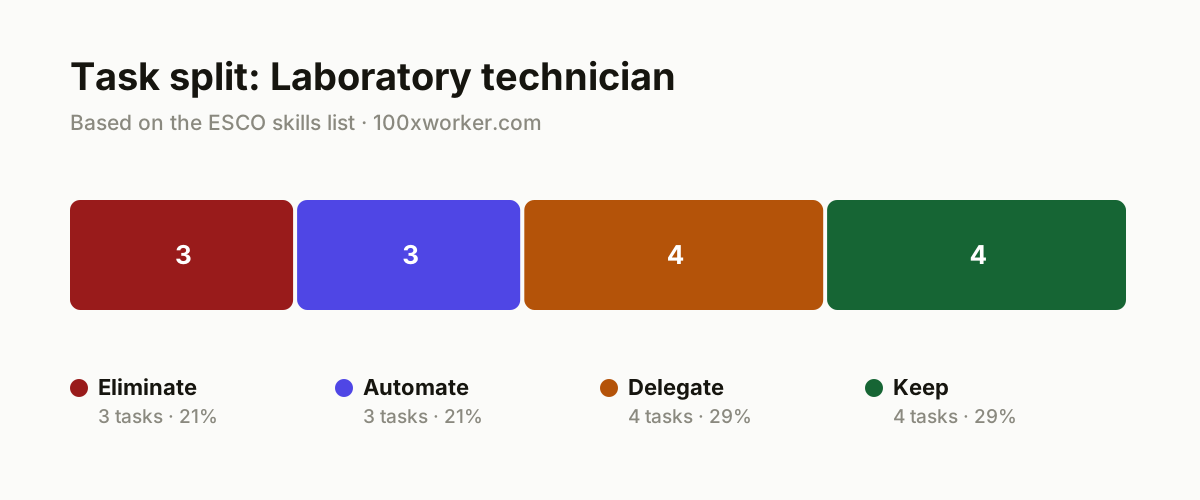
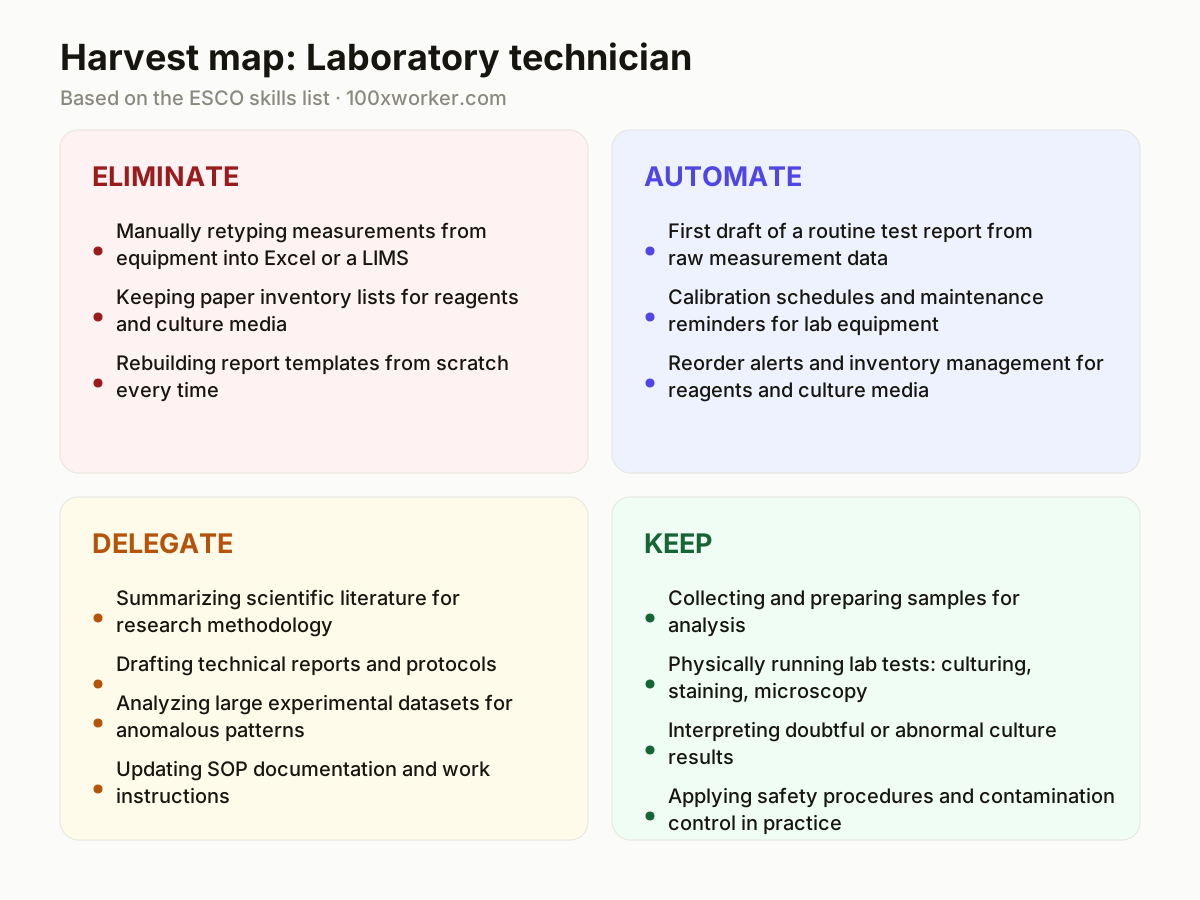
Not every task in a laboratory technician's job changes the same way. Some tasks disappear because better systems make them pointless. Some get fully automated by software or an AI agent. Some stay your job but AI drafts the first version for you to check. And some stay entirely human because they require physical presence, sterile handling, or judgment calls that no model can make. Sorting your own task list into these four buckets is the fastest way to see where AI actually changes your day.
| Task | Bucket | Why |
|---|---|---|
| Manually retyping measurements from equipment into Excel or a LIMS | eliminate | Direct instrument-to-system connections make retyping unnecessary, and error-prone manual entry disappears. |
| Keeping paper inventory lists for reagents and culture media | eliminate | Digital inventory systems count and flag stock automatically, so a paper list adds nothing. |
| Rebuilding report templates from scratch every time | eliminate | A fixed template with automatic fill-in replaces repeatedly reconstructing the same document. |
| First draft of a routine test report from raw measurement data | automate | An AI agent turns numbers, units, and threshold values into a readable draft without you touching it. |
| Calibration schedules and maintenance reminders for lab equipment | automate | Software plans and reminds automatically when a device needs calibration or servicing. |
| Reorder alerts and inventory management for reagents and culture media | automate | The system flags approaching thresholds and drafts a reorder request, you only confirm it. |
| Summarizing scientific literature for research methodology | delegate | AI reads through studies quickly and extracts the relevant method, you check the source and context. |
| Drafting technical reports and protocols | delegate | AI writes a first version based on your data, you rewrite where it is technically wrong. |
| Analyzing large experimental datasets for anomalous patterns | delegate | AI flags outliers and trends, you judge whether they are scientifically or technically explainable. |
| Updating SOP documentation and work instructions | delegate | AI proposes a revision based on changed rules, you test it against actual lab practice. |
| Collecting and preparing samples for analysis | keep | This requires physical handling in a sterile environment that no AI can perform. (Your edge: Physical precision and contamination control on site.) |
| Physically running lab tests: culturing, staining, microscopy | keep | The action itself, pipetting, incubating, reading under the microscope, stays human work. (Your edge: Manual skill and sensory judgment in the lab.) |
| Interpreting doubtful or abnormal culture results | keep | A borderline case requires experience and technical insight a language model does not have. (Your edge: Years of experience catch what a number cannot say.) |
| Applying safety procedures and contamination control in practice | keep | Risk assessment on the lab floor requires presence and responsibility. (Your edge: Taking responsibility for safety on site.) |
What tasks can AI take over from a laboratory technician?
AI is best at the paperwork layer of the job, not the bench work. It can draft a first version of a routine test report from raw measurement data, generate calibration and maintenance reminders for equipment, flag reorder points for reagents and culture media, summarize scientific literature, and propose SOP updates when rules change. All of this still needs a human check before it goes into a real report or protocol. What it cannot do is collect a sample, run the actual test, or read a culture plate under a microscope. Those stay manual, physical tasks.
Will AI replace laboratory technicians?
No. Microsoft Research's 2025 study of real Copilot use puts the AI applicability score for biological technicians at 9.1%, one of the lowest of any occupation measured, well behind roles like translation (49%). Anthropic's Economic Index finds that where AI does show up in technical work, it mostly augments rather than automates: a technician still verifies the output. The core of the job, sample handling, culturing, microscopy, and safety-critical judgment calls in a sterile environment, has no AI substitute. What changes is the time spent on reporting, scheduling, and documentation around that core work.
What does this mean for bacteriology and microbiology technicians specifically?
Bacteriology technicians (ESCO code 3141.2.1) work with medical microbiology, molecular biology, and lab technique skills that involve physical culturing, staining, and interpretation of results, exactly the tasks with no AI substitute. The parts of the job most exposed to AI are the surrounding documentation: technical report writing, tracking lab inventory, and applying scientific research methodology to write up findings. If your day is mostly bench work, expect little change. If a large share of your time goes to writing reports or chasing literature reviews, that share is likely to shrink.
What can you do this month as a laboratory technician?
List every task you did last week and sort it into eliminate, automate, delegate, or keep using the framework above. Pick one recurring report and test whether an AI chatbot can produce a usable first draft from your raw data. Ask your lab manager whether your LIMS already supports direct instrument import, so manual retyping can stop. Save one working prompt for literature summaries and one for SOP drafts, and reuse them. This takes an afternoon and tells you exactly where your task list is about to shift.
Most AI use in technical, task-based occupations looks like augmentation of existing work, not full automation of it.
Anthropic Economic Index
Become the AI person on your team
Audit your task list once a quarter
Write down every recurring task and sort it into the four buckets. Tasks move between buckets as tools improve, so repeat this every few months rather than once.
Use AI as a first-draft writer, not a final author
Feed raw measurement data or SOP changes into an AI tool and ask for a draft report or revision. Always verify units, thresholds, and technical accuracy before it goes into a real document.
Push for direct instrument-to-LIMS connections
If your lab still relies on manual data entry from equipment into Excel or a LIMS, flag it. This is the single biggest source of avoidable error and wasted time in the eliminate bucket.
Want this for your actual task list?
The free scan on the homepage builds your personal task map in 30 seconds, based on your role and industry.
Run the free task scanTools for this work
| Tool | For which tasks | The sober take |
|---|---|---|
| LIMS (Laboratory Information Management System) | eliminate: manual data entry; automate: calibration reminders, inventory alerts | Value depends on whether it connects directly to your instruments, not just on having one installed. |
| General AI chatbot (e.g., ChatGPT, Claude) | delegate: literature summaries, draft technical reports, SOP updates | Useful for a first draft, but every technical claim still needs a human check against the source data. |
| Spreadsheet automation (Excel macros or scripts) | eliminate: repeated report template building; automate: routine calculations | Often cheaper and simpler than a full AI tool for structured, repetitive numeric work. |
| Digital inventory management software | eliminate: paper stock lists; automate: reorder signals for reagents and culture media | Only replaces paper lists if staff actually log usage consistently. |
Prompts to try today
Draft a routine test report from raw data
Summarize a research paper for methodology
Draft an SOP update after a protocol change
Related jobs
Frequently asked questions
Will AI take over laboratory technician jobs entirely?
No. Microsoft Research's 2025 analysis of real-world AI use scores biological technicians at 9.1% applicability, one of the lowest of any occupation studied. Core tasks like sample collection, culturing, staining, and microscopy require physical handling in a sterile environment, which current generative AI tools cannot perform. The job changes at the edges, in reporting and documentation, not at its core.
Which AI tools are lab technicians already using?
General-purpose AI chatbots are increasingly used for drafting reports, summarizing scientific literature, and proposing SOP revisions. Anthropic's Economic Index shows this kind of technical, document-based use tends to be augmentation, meaning a human still checks the output, rather than full automation of the underlying lab work.
How is bacteriology technician work different from general lab work when it comes to AI?
ESCO lists bacteriology technician (code 3141.2.1) as a specific role built around medical microbiology, molecular biology, and hands-on lab technique, skills that involve physical culturing and interpretation rather than data processing. That makes the bench-work core of the job even more resistant to AI than lab work in general, while the documentation layer, report writing and inventory tracking, changes in the same way as for other lab technicians.
What skills should I develop to stay ahead as a lab technician?
Focus on skills AI cannot replicate: hands-on technique, judgment on borderline or abnormal results, and safety decision-making under real lab conditions. Alongside that, get comfortable using AI tools to draft reports and summarize literature quickly, since verifying and correcting AI output is becoming a standard part of the job rather than a bonus skill.
Sources
- Microsoft Research, Working with AI: Measuring the Applicability of Generative AI to Occupations (2025)
- Anthropic Economic Index
- Eurostat, Individuals using generative AI (isoc_ai_iaiu)
- ESCO (European Commission occupation taxonomy)
Hendrik De Winne, author of Becoming AI-Savvy, founder of VibeLab. Helps teams redesign their work with AI.
This article was drafted with AI assistance from public data sources and editorially reviewed.