100×worker · job analysis
Will AI Replace Maintenance Managers, and What Should You Do About It?
Maintenance managers, also listed under ESCO as maintenance and repair engineers (code 2141.7), spend their days inspecting equipment, running quality control checks, writing technical reports, and keeping production lines available at the lowest possible cost. Generative AI is now part of that job, but not in the way headlines suggest.
Microsoft Research analyzed 200,000 real Copilot conversations and scored how applicable generative AI is to different occupations. For industrial engineers, the closest match to maintenance and repair work, that score sits at 25.3% of work activities, a mid-range figure. Translators top the list at 49%, nurses sit near the bottom at 12%. That gap tells you something concrete: AI is good at drafting, summarizing, and pattern-matching from sensor data, and much weaker at the physical, judgment-heavy parts of maintenance work.
This article breaks the job into four buckets: tasks to eliminate outright, tasks to automate with a tool, tasks to delegate to AI as a first draft you check, and tasks to keep because they need your eyes, your hands, or your signature.
A maintenance manager optimizes equipment, procedures, and infrastructure for maximum uptime at minimum cost.
The task split: what AI takes over and what stays yours
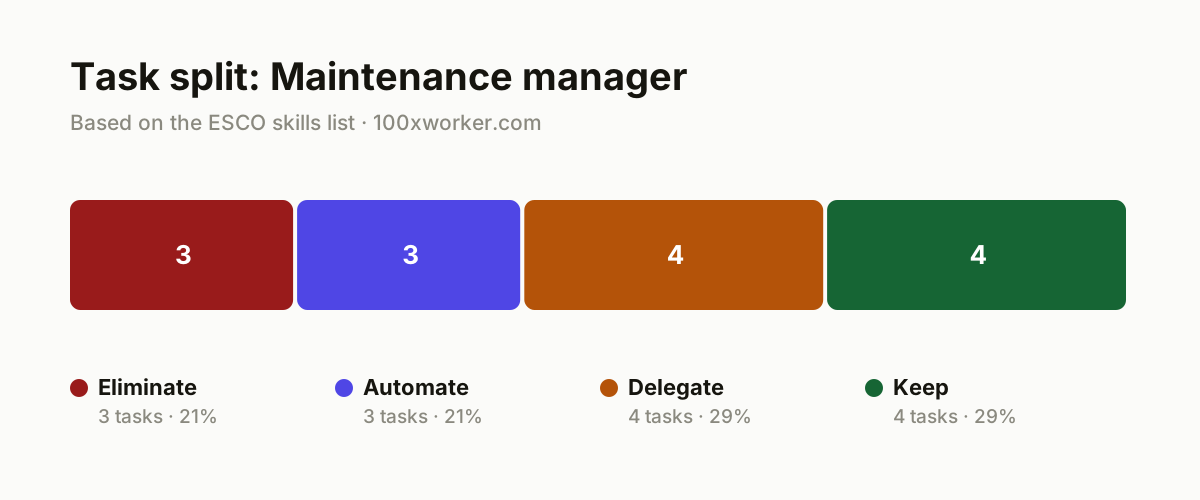
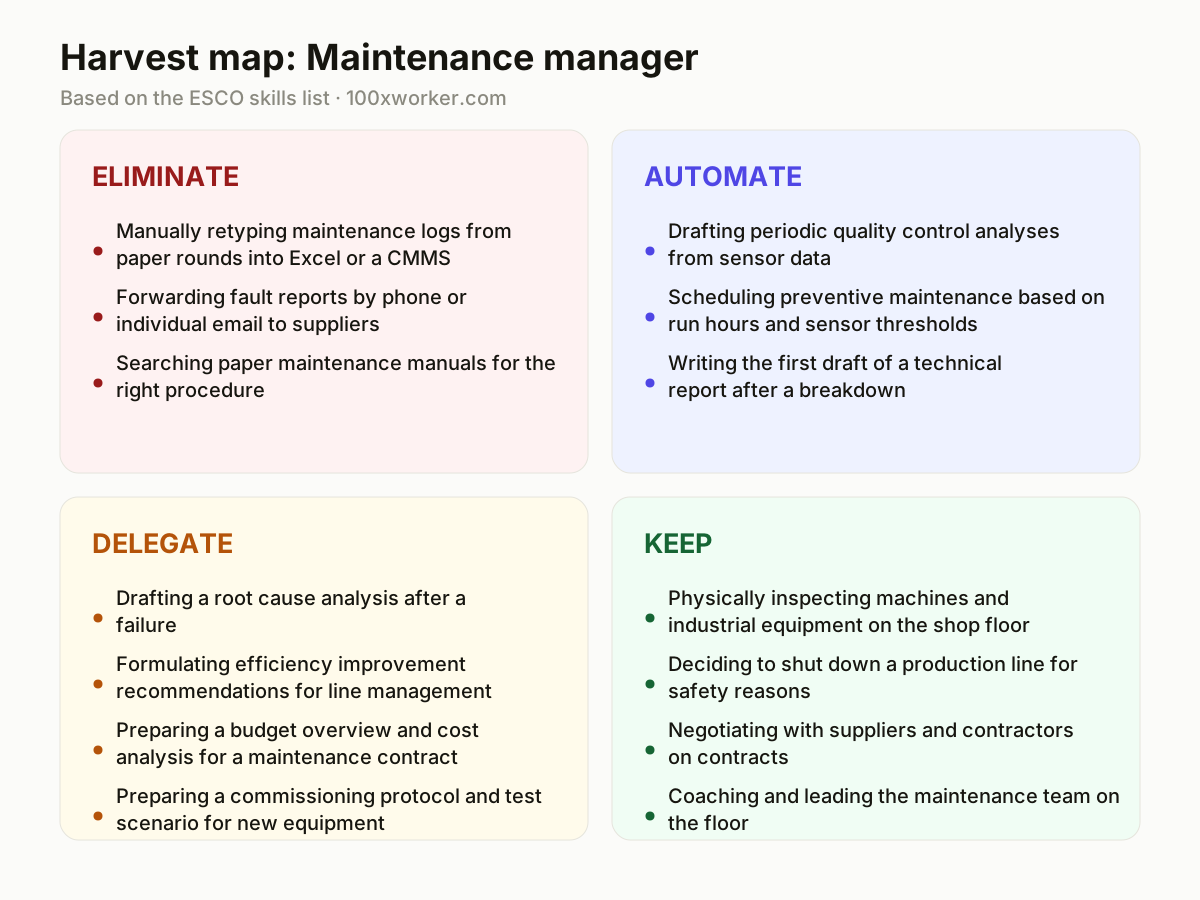
The eliminate/automate/delegate/keep framework sorts maintenance manager tasks by how much a human needs to stay involved. Eliminate covers manual work that a digital system now handles without you touching it. Automate covers tasks where AI produces a near-final result you approve. Delegate covers tasks where AI drafts and you correct or decide. Keep covers tasks that stay with you because they involve physical presence, liability, or trust that a language model cannot replicate.
| Task | Bucket | Why |
|---|---|---|
| Manually retyping maintenance logs from paper rounds into Excel or a CMMS | eliminate | Sensors and digital checklists already capture this automatically, so retyping adds no value. |
| Forwarding fault reports by phone or individual email to suppliers | eliminate | A ticketing system routes this faster and with fewer errors than a person calling around. |
| Searching paper maintenance manuals for the right procedure | eliminate | Digital documentation with search finds the right page in seconds. |
| Drafting periodic quality control analyses from sensor data | automate | An AI agent extracts patterns from measurement data and produces a report ready for your sign-off. |
| Scheduling preventive maintenance based on run hours and sensor thresholds | automate | Linking a CMMS with AI turns threshold values into concrete scheduling proposals. |
| Writing the first draft of a technical report after a breakdown | automate | AI fills in the template and fault codes automatically, and you check the content. |
| Drafting a root cause analysis after a failure | delegate | AI proposes hypotheses based on historical data, and you test them against the actual machine. |
| Formulating efficiency improvement recommendations for line management | delegate | AI writes the first draft memo, and you weigh practical feasibility and budget. |
| Preparing a budget overview and cost analysis for a maintenance contract | delegate | AI processes invoices and quotes into an overview, and you negotiate the final numbers. |
| Preparing a commissioning protocol and test scenario for new equipment | delegate | AI builds the checklist from prior protocols, and you adapt it to the specific machine. |
| Physically inspecting machines and industrial equipment on the shop floor | keep | Sound, smell, and vibration are signals no sensor fully captures. (Your edge: Experience recognizes anomalies no dataset has ever seen.) |
| Deciding to shut down a production line for safety reasons | keep | This call carries liability and requires context that AI does not have. (Your edge: No algorithm can take on responsibility for you.) |
| Negotiating with suppliers and contractors on contracts | keep | Relationships, trust, and negotiating room are not a task for a language model. (Your edge: People trust people, not a chatbot.) |
| Coaching and leading the maintenance team on the floor | keep | Motivation and team dynamics need personal contact, not generated text. (Your edge: Leadership stays a human-to-human skill.) |
Which maintenance manager tasks will AI take over?
AI takes over the paperwork layer of the job first: retyping logs, chasing suppliers by phone, and hunting through manuals for a procedure. Those tasks disappear into digital systems that already exist. On top of that, AI drafts quality control analyses from sensor data, proposes preventive maintenance schedules based on run hours, and writes the first version of a technical report after a breakdown. None of this removes your job. It removes the parts of the job that were never about engineering judgment in the first place, freeing time for inspection, root cause work, and decisions that carry consequences.
Will AI replace maintenance managers?
No. Microsoft Research's applicability score for industrial engineering work sits at 25.3%, meaning roughly a quarter of tasks are places where generative AI is demonstrably useful, not a quarter of jobs at risk. Compare that to translators at 49% or nurses at 12%: maintenance sits in the middle because it mixes desk work AI handles well with physical inspection, safety calls, and supplier relationships it cannot touch. Older estimates that predicted near-total automation for technical trades, such as the widely cited 2013 Oxford study by Frey and Osborne, predate large language models and did not anticipate how AI would actually get used in practice: as a drafting and analysis assistant, not a replacement for physical judgment.
How do you become the AI-savvy person on the maintenance team?
Start by feeding AI the inputs it needs to be useful: sensor logs, historical fault data, and past technical reports. Use it to draft root cause hypotheses, efficiency memos, and budget summaries, then correct them with what you know about the actual machines. Build a habit of checking AI output against physical inspection rather than trusting it blindly. Teams that treat AI as a fast first-draft writer, and keep the final technical call human, get more value than teams that either ignore it or hand it decisions it should not make.
What can you do this month to get started?
Pick one recurring report you write by hand, such as a post-breakdown technical report or a monthly quality control summary, and try drafting it with an AI tool fed your sensor data or fault logs. Compare the draft against your own version and note where it gets details wrong. Separately, check whether your CMMS has a built-in AI scheduling feature and turn it on for one equipment line as a test. Small, bounded trials beat a full rollout, because you learn exactly where AI output needs correction before it touches a real maintenance decision.
Generative AI applicability measures the share of work activities where the technology is demonstrably useful, not the share of jobs at risk of disappearing.
Microsoft Research, Working with AI (2025)
Become the AI person on your team
Turn sensor data into a standing report template
Set up a recurring prompt that pulls run-hour and sensor threshold data into a draft preventive maintenance schedule. Review and adjust it weekly instead of building the schedule from scratch each time.
Use AI as a root cause sparring partner, not a verdict
Feed AI the failure history and symptoms, let it propose two or three hypotheses, then rule them out against the physical machine. Treat the output as a starting list, not a diagnosis.
Draft supplier and budget documents faster, negotiate the same way
Let AI turn invoices and quotes into a clean cost comparison so you walk into supplier conversations with the numbers ready. The negotiation itself stays a human conversation.
Want this for your actual task list?
The free scan on the homepage builds your personal task map in 30 seconds, based on your role and industry.
Run the free task scanTools for this work
| Tool | For which tasks | The sober take |
|---|---|---|
| CMMS platforms with AI scheduling (e.g. Fiix, UpKeep) | Automate: preventive maintenance scheduling from run hours and sensor data | Most modern CMMS tools now ship a scheduling assistant as a paid add-on rather than a separate purchase. |
| Microsoft Copilot | Automate/Delegate: drafting technical reports, quality control summaries, efficiency memos | Useful for first drafts inside Word or Excel where your maintenance data already lives. |
| General-purpose chat assistants (ChatGPT, Claude) | Delegate: root cause hypotheses, budget overviews, commissioning protocol drafts | Works well when you paste in your own logs and history rather than asking from a blank prompt. |
| Predictive maintenance analytics platforms | Automate: periodic quality control analysis from sensor streams | Only worth the setup cost if you already have consistent sensor coverage on the equipment in question. |
Prompts to try today
Draft a root cause analysis
Turn a breakdown into a technical report
Build an efficiency improvement memo
Related jobs
Frequently asked questions
What percentage of maintenance manager tasks can AI handle?
Microsoft Research's applicability score for industrial engineers, the closest US occupational match, is 25.3% of work activities. That figure covers tasks like drafting reports and analyzing sensor data, not physical inspection or safety decisions, so it should be read as a task-level estimate, not a job-loss prediction.
Do I need to learn to code to use AI in maintenance work?
No. Most useful AI applications for maintenance managers involve chat-based tools where you paste in sensor logs, fault histories, or invoices and ask for a draft report, schedule, or analysis. CMMS platforms increasingly build AI scheduling directly into the interface, so no coding is required for day-to-day use.
Which maintenance tasks are safest from AI automation?
Physical inspection, safety shutdown decisions, and supplier negotiation stay firmly human. These tasks depend on sensory judgment on the shop floor, personal liability, and trust-based relationships, none of which a language model can take on. They sit in the keep bucket regardless of how AI tools improve.
How is AI use in technical occupations tracked internationally?
Eurostat measured that 32.7% of the EU population aged 16 to 74 used generative AI in the three months before being surveyed in 2025. The ESCO taxonomy, maintained by the European Commission, catalogs 3,039 occupations including maintenance and repair engineering, which lets researchers map AI applicability onto specific task lists rather than whole job titles.
Sources
- Microsoft Research, Working with AI: Measuring the Applicability of Generative AI to Occupations (2025)
- Anthropic Economic Index
- Eurostat, Use of generative AI (isoc_ai_iaiu)
- ESCO, European Commission
Hendrik De Winne, author of Becoming AI-Savvy, founder of VibeLab. Helps teams redesign their work with AI.
This article was drafted with AI assistance from public data sources and editorially reviewed.