100×worker · job analysis
Will AI Replace Civil Engineers?
Civil engineering firms are already testing generative AI on real work, not just pilots. Microsoft Research analyzed 200,000 real Copilot conversations and scored how much of each occupation's daily work generative AI can plausibly handle. For civil engineering technicians, that applicability score sits at 19.9%, well below translators (49%) but above nurses (12%) (Microsoft Research, Working with AI: Measuring the Applicability of Generative AI to Occupations, 2025). That number doesn't tell you whether you keep your job. It tells you which parts of the job change first.
Adoption is already broad. Eurostat found that 32.7% of the EU population aged 16 to 74 used generative AI in the last three months of 2025. The European Commission's ESCO taxonomy lists civil engineering technician as one of 3,039 occupations with defined skill sets, from using measurement instruments to reading technical drawings. This article breaks the job down at task level using four buckets: eliminate, automate, delegate, keep.
A civil engineer designs, calculates, and oversees the construction of infrastructure and structures.
The task split: what AI takes over and what stays yours
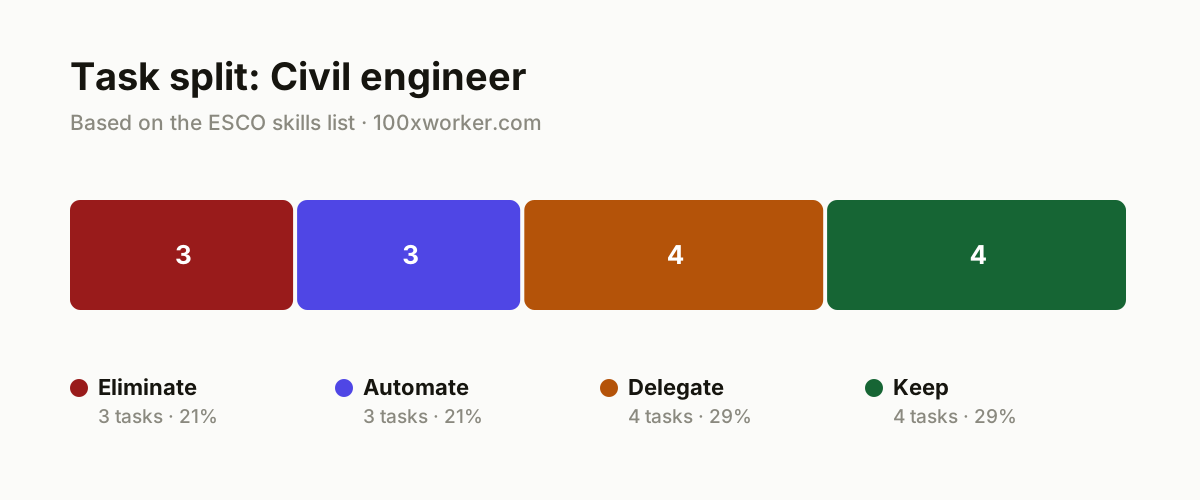
Not every task in a civil engineering technician's job responds to AI the same way. Some tasks disappear because better tools make the old method pointless. Some get automated end to end because they're repetitive and rule-based. Others get delegated to AI as a first draft that you check and finish. And some stay firmly with you because they require judgment, presence, and accountability that no model carries. Sorting your own tasks into these four buckets is more useful than any single applicability percentage.
| Task | Bucket | Why |
|---|---|---|
| Manually retyping field measurements into spreadsheets | eliminate | Sensors and measurement tools now feed data straight into digital reporting systems. |
| Paper filing and manual searches through building codes per project file | eliminate | Searchable digital knowledge bases make this physical lookup work unnecessary. |
| Manually counting material quantities off drawings (quantity takeoff) | eliminate | BIM models calculate quantities automatically once the design is locked in. |
| First-pass review of technical drawings for code compliance | automate | An agent checks rules and standards against the drawings, you review the exceptions. |
| Drafting progress reports from project data | automate | Progress data already sits in digital systems, an agent turns it into readable reports. |
| Generating standard time estimates from historical project data | automate | Patterns from past projects give a repeatable first estimate. |
| Drafting technical specification documents and tender packages | delegate | AI produces a strong first draft, you adjust it for project context and risk. |
| Analyzing site investigation data and flagging anomalies | delegate | AI spots patterns faster in raw data, you judge whether an anomaly matters. |
| Producing design variants in CAD or BIM software against stated requirements | delegate | AI generates the variants, you choose and justify the final one. |
| Prioritizing and scheduling tasks and work packages across a project team | delegate | AI proposes a schedule based on dependencies, you adjust for people and resources. |
| Deciding between conflicting requirements like safety, cost, and schedule | keep | This requires weighing interests that don't all live in data. (Your edge: You carry the liability for that call.) |
| On-site coordination with contractors, utility companies, and local authorities | keep | Trust and negotiation on site remain human work. (Your edge: You don't build trust through a chat window.) |
| Physical inspection of building materials and infrastructure on site | keep | What you see, hear, and feel on site doesn't always reach a sensor. (Your edge: Experience spots deviations no checklist anticipates.) |
| Overseeing safety and stepping in when there's acute risk on site | keep | Direct intervention when there's danger requires authority and speed on the ground. (Your edge: You're the one who stops the work, not an algorithm.) |
What tasks can AI take over from a civil engineer?
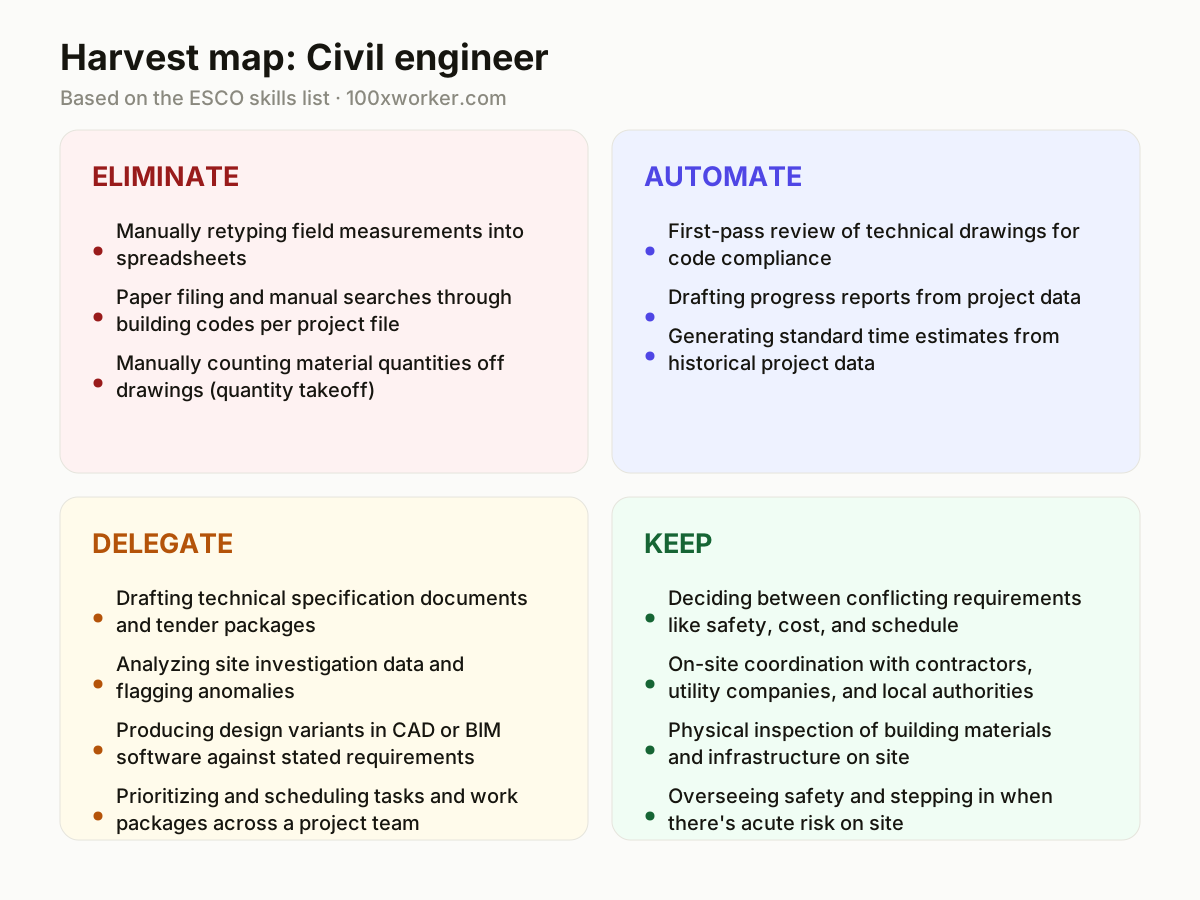
AI already handles the parts of the job that are repetitive or purely computational. Retyping field measurements into spreadsheets, manually counting material quantities off drawings, and digging through paper archives for the right building code clause are disappearing because sensors, BIM models, and searchable databases do this automatically now. Beyond that, AI can run a first-pass check of technical drawings against code, draft progress reports from project data, and generate standard time estimates from historical projects. None of this replaces you: someone still reviews the flagged exceptions, decides which anomalies matter, and signs off on the final specification. AI removes the mechanical steps so more of your time goes to judgment calls.
Will AI replace civil engineers?
No single job disappears, but the task mix shifts. Microsoft Research puts the applicability of generative AI to civil engineering technician work at 19.9%, meaning roughly a fifth of daily work activities have a plausible AI match today. That leaves most of the job, site inspections, stakeholder negotiation, safety calls, and trade-offs between cost and safety, in human hands. Anthropic's Economic Index, which classifies millions of real AI conversations against O*NET tasks, finds that AI use splits between automation (AI does the task) and augmentation (AI helps you think it through). For technical, code-heavy tasks the split leans toward automation. For judgment calls on site, it leans toward augmentation, if it shows up at all.
How do you become the AI point person on your engineering team?
Start by mapping your own task list against the four buckets above and being honest about which tasks take up the most hours. Pick one recurring task, drafting specification sections or building progress reports, and run it through an AI tool for two weeks, comparing the output against what you'd normally produce. Document where it saves time and where it gets things wrong on your projects specifically, since local codes and site conditions vary. Share that documented comparison with your team instead of a general opinion about AI. Being the person who has actually tested the tools on real project data, with real failure cases noted, is what makes you the reference point colleagues ask before management does.
What can you do this month to start working with AI?
Pick one delegate-bucket task, such as drafting a specification document or analyzing site investigation data, and run it through a general AI assistant this month. Keep the human review step exactly where it is now: you still check the output against code and project context. Time both the AI-assisted version and your usual process so you have real numbers, not impressions. Also try automating one automate-bucket task, like a progress report, and note exactly what you had to correct. That gives you a concrete basis for deciding what to change in how you work next quarter.
Real-world AI use splits between doing a task outright and helping someone think a task through.
Anthropic Economic Index
Become the AI person on your team
Run a side-by-side test
Take one document you'd normally draft from scratch, a spec section or a report, and produce it twice: once your usual way, once with AI assistance. Compare time spent and errors caught in review.
Keep a correction log
Every time you fix an AI-drafted document, note what was wrong: a missed code clause, a wrong quantity, an unrealistic timeline. After a month you'll see exactly where the tool is reliable and where it isn't.
Bring data, not opinions, to your team
When your firm discusses AI tools, show your side-by-side comparison and correction log instead of a general impression. Concrete numbers from your own projects carry more weight than a vendor demo.
Want this for your actual task list?
The free scan on the homepage builds your personal task map in 30 seconds, based on your role and industry.
Run the free task scanTools for this work
| Tool | For which tasks | The sober take |
|---|---|---|
| General-purpose AI assistants (e.g., ChatGPT, Claude) | Drafting specification documents, summarizing progress data, first-pass compliance checks | Useful for drafting, but every code reference and quantity still needs your verification. |
| BIM software (Building Information Modeling) | Automatic quantity takeoff, generating design variants | Handles calculations once a design is fixed, but you still set the design intent. |
| Field data capture apps with sensor integration | Eliminating manual retyping of field measurements | Removes a transcription step, not a judgment step. |
| Compliance-checking add-ons within CAD/BIM platforms | First-pass review of drawings against building codes | Flags likely issues, a licensed reviewer still signs off. |
Prompts to try today
Draft a specification section
Summarize progress data for a client
Flag compliance risks in a drawing
Related jobs
Frequently asked questions
How many people in the EU use generative AI regularly?
Eurostat found that 32.7% of the EU population aged 16 to 74 used generative AI in the three months before being surveyed in 2025. That's a broad base of adoption, though it doesn't tell you which occupations use it for which tasks specifically. For civil engineering, the more relevant figure is Microsoft Research's task-level applicability score of 19.9% for civil engineering technician work.
Is the old 'automation risk percentage' for civil engineers still reliable?
The widely cited robotization percentages that circulate for many occupations trace back to a 2013 Oxford study (Frey & Osborne) that predates large language models entirely. It measured automation risk from older technology, not generative AI. Newer, task-level data such as Microsoft Research's 2025 applicability scores or Anthropic's Economic Index give a more current picture of what generative AI actually does in this job today.
What does ESCO say a civil engineering technician does?
The European Commission's ESCO taxonomy describes the role as helping design and execute construction plans, calculating material needs, ensuring quality of building materials, and carrying out technical tasks such as fieldwork, using measurement instruments, reading technical drawings, and following health and safety procedures on site. ESCO lists this as one of 3,039 occupations with defined skill sets across the EU.
Does AI mostly automate civil engineering tasks or does it assist with them?
Both, depending on the task. Anthropic's Economic Index, which classifies millions of real AI conversations against O*NET task categories, distinguishes automation-like use (AI performs the task) from augmentation-like use (AI helps a person work through it). Routine, rule-based work such as compliance checks tends toward automation. Judgment calls, like weighing safety against cost, tend toward augmentation, where AI supports rather than replaces the decision.
Sources
- Microsoft Research, Working with AI: Measuring the Applicability of Generative AI to Occupations (2025)
- Anthropic Economic Index
- Eurostat, isoc_ai_iaiu (2025)
- ESCO, European Commission
Hendrik De Winne, author of Becoming AI-Savvy, founder of VibeLab. Helps teams redesign their work with AI.
This article was drafted with AI assistance from public data sources and editorially reviewed.