100×worker · job analysis
Will AI Replace Mechanical Engineers, and What Should You Do About It?
Mechanical engineering has always meant math, materials, and judgment calls that carry real consequences if you get them wrong. AI now handles a chunk of the math and paperwork, but not the judgment. Microsoft Research analyzed 200,000 real Copilot conversations and scored how applicable generative AI is to different occupations. Industrial engineering roles, the closest match to mechanical engineering in that dataset, scored 25.3%. That is a quarter of typical work activities where AI tools already show up usefully, compared to 49% for translators and 12% for nurses.
That number does not mean a quarter of mechanical engineers lose their jobs. It means a quarter of the task list changes shape. Anthropic's Economic Index, which classifies millions of Claude conversations against standardized occupational task lists, draws a similar distinction: some AI use replaces a task outright (automation), and some AI use extends what a person can do without replacing their judgment (augmentation). For mechanical engineers, most of the real gains sit in that second category.
This article breaks the job into four buckets: tasks to stop doing by hand, tasks to hand fully to AI, tasks to delegate to AI with your review, and tasks that stay yours because the responsibility, the trust, or the tacit knowledge cannot be handed off.
Mechanical engineer: designs, calculates, and optimizes mechanical systems, machines, and production processes.
The task split: what AI takes over and what stays yours
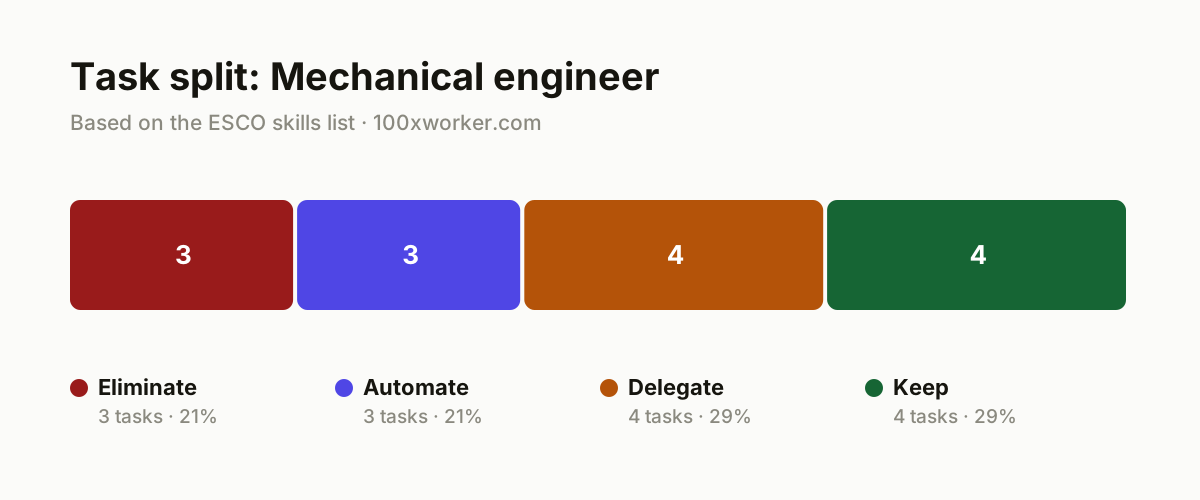
Not every task in a mechanical engineering job changes the same way. Some tasks disappear because software already does them better than a person with a calculator. Some get fully automated end to end. Others get delegated to AI as a first draft that you check and correct. And some stay with you because they involve liability, trust, or knowledge you cannot type into a prompt. Sorting your own task list into these four buckets is the fastest way to see where your time actually goes next.
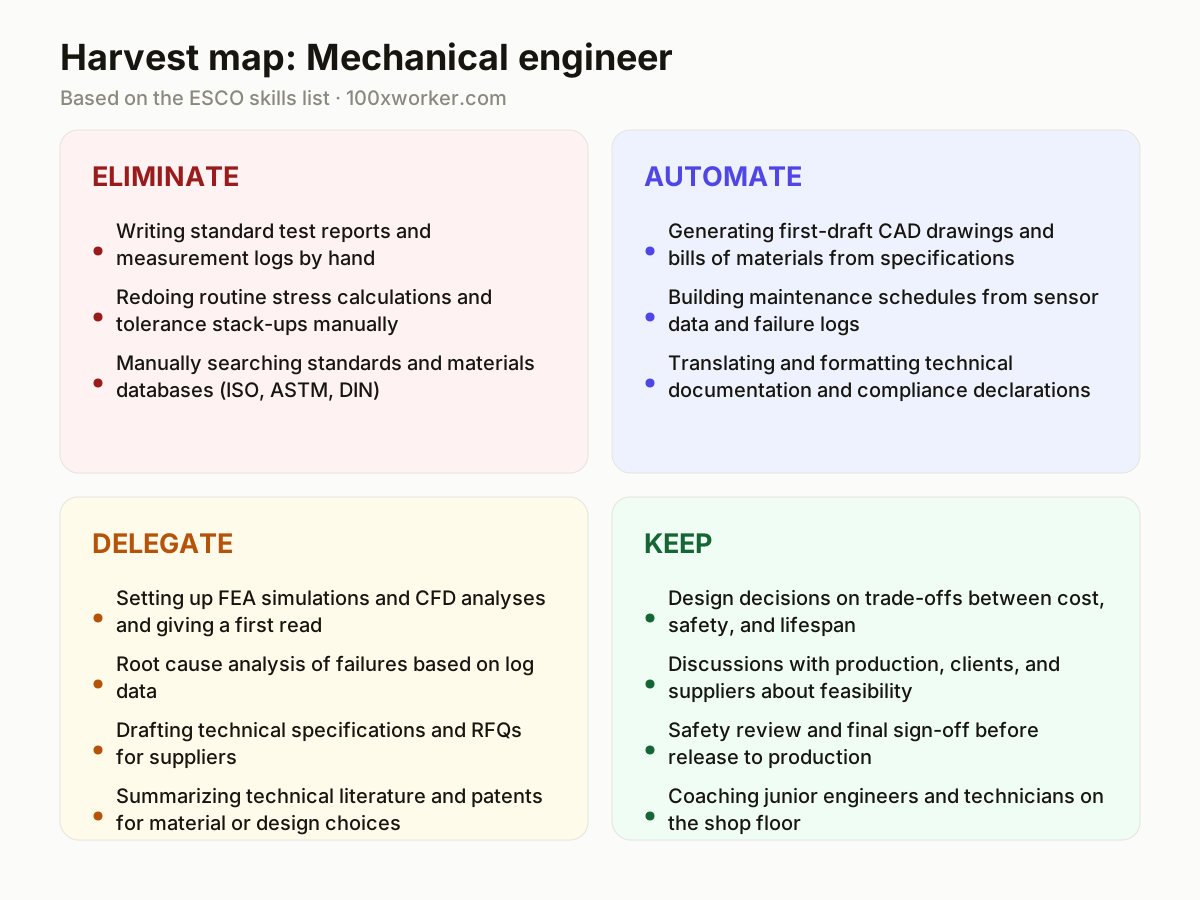
| Task | Bucket | Why |
|---|---|---|
| Writing standard test reports and measurement logs by hand | eliminate | AI generates these directly from measurement data, faster and with fewer transcription errors. |
| Redoing routine stress calculations and tolerance stack-ups manually | eliminate | Calculation software and AI models have done this more accurately than hand math for years. |
| Manually searching standards and materials databases (ISO, ASTM, DIN) | eliminate | Searchable databases and AI summaries make paging through standards binders unnecessary. |
| Generating first-draft CAD drawings and bills of materials from specifications | automate | An AI agent turns functional requirements into a draft design that you refine. |
| Building maintenance schedules from sensor data and failure logs | automate | Predictive maintenance agents produce a usable schedule straight from the patterns. |
| Translating and formatting technical documentation and compliance declarations | automate | Language and formatting work is mechanical and can be fully automated. |
| Setting up FEA simulations and CFD analyses and giving a first read | delegate | AI proposes boundary conditions and results, you check the physical assumptions. |
| Root cause analysis of failures based on log data | delegate | AI generates hypotheses from patterns, you judge which ones hold up technically. |
| Drafting technical specifications and RFQs for suppliers | delegate | AI writes the first version, you check tolerances and responsibilities. |
| Summarizing technical literature and patents for material or design choices | delegate | AI reads faster, you judge relevance and fit for your specific context. |
| Design decisions on trade-offs between cost, safety, and lifespan | keep | This requires judgment calls that go beyond what the data alone shows. (Your edge: You carry the responsibility if it fails, not the model.) |
| Discussions with production, clients, and suppliers about feasibility | keep | Negotiating and building trust stays human work. (Your edge: Relationships and negotiating room cannot be delegated.) |
| Safety review and final sign-off before release to production | keep | Legal and ethical final responsibility sits with the engineer. (Your edge: Liability for a mistake stays personal and professional.) |
| Coaching junior engineers and technicians on the shop floor | keep | You pass on hands-on knowledge in the context of the actual machine. (Your edge: Tacit knowledge gets learned on the floor, not from a prompt.) |
Which tasks can AI take over from a mechanical engineer, and what should you do instead?
AI is strongest at the mechanical, repeatable parts of the job: standard test reports, routine stress calculations, standards lookups, first-draft CAD, and documentation formatting. These are the eliminate and automate tasks. What you do instead is spend more time on the parts AI cannot do well: judging trade-offs between cost and safety, checking whether a simulation's assumptions actually match the physical situation, and talking to suppliers and clients about what is really feasible. The shift is from doing calculations to reviewing calculations, and from drafting documents to checking drafts.
Will AI replace mechanical engineers?
No, not as a job title. Microsoft Research's applicability score for industrial engineering work sits at 25.3%, meaning roughly a quarter of typical work activities show AI use, not a quarter of jobs disappearing. Anthropic's Economic Index shows AI use in technical fields splits between automating small sub-tasks and augmenting a person's own analysis, with augmentation being more common for technical judgment work. The tasks that stay firmly human are safety sign-off, liability, negotiation, and coaching, none of which an AI model can legally or practically own.
How is AI changing mechanical engineering work internationally?
Adoption is uneven but growing fast. Eurostat reports that 32.7% of the EU population aged 16 to 74 used generative AI in the last three months of 2025. Among professionals doing technical, document-heavy work like engineering, usage tends to run higher than the general population average. The ESCO taxonomy, maintained by the European Commission, now maps skills for 3,039 occupations across 28 languages, including mechanical and industrial engineering roles, which makes it easier for employers and job platforms to describe exactly which sub-skills AI affects and which stay with the person.
What can you do this month to become the AI-savvy person on your team?
Pick one recurring task from your automate or delegate bucket, such as drafting test reports or setting up a first-pass FEA run, and build a repeatable AI workflow for it this month. Write down the prompt or process, test it on three real cases, and compare the AI output against your own manual result. Share the workflow with your team once it is reliable. That single habit, documented and repeatable, is what separates someone who occasionally uses AI from someone who has actually changed how the work gets done.
Generative AI shows measurable applicability to a share of an occupation's work activities, not to entire jobs.
Microsoft Research, Working with AI: Measuring the Applicability of Generative AI to Occupations (2025)
Become the AI person on your team
Build a prompt library for recurring documents
Save the exact prompts you use for test reports, RFQs, and compliance summaries in a shared file. Update them as you find better phrasing, so the whole team benefits, not just you.
Run AI and manual calculations side by side for one month
Before trusting AI-generated stress calculations or tolerance stack-ups, run them alongside your normal method for a set period. Document where they match and where they diverge, then decide task by task where AI is reliable enough.
Volunteer to pilot generative design for one project
Offer to test AI-assisted CAD drafting or generative design tools on a low-risk project first. Bringing back a clear, honest assessment of what worked builds credibility faster than claiming expertise you have not tested.
Want this for your actual task list?
The free scan on the homepage builds your personal task map in 30 seconds, based on your role and industry.
Run the free task scanTools for this work
| Tool | For which tasks | The sober take |
|---|---|---|
| ChatGPT or Claude | Drafting test reports, summarizing standards and patents, first-draft RFQs and specifications | Useful for drafts and summaries, always verify technical claims before using them. |
| GitHub Copilot | Scripting calculations, automating data pipelines from sensor logs | Speeds up routine scripting, but you still need to check the underlying formulas. |
| Generative design tools in CAD platforms | First-draft CAD models and bills of materials from specifications | Good for generating starting points, not for final engineering sign-off. |
| Perplexity or similar AI search tools | Searching standards, materials databases, and technical literature | Faster than manual database searches, but check original sources for critical specs. |
Prompts to try today
First-draft failure report from log data
RFQ draft from a spec sheet
Literature summary for a material choice
Related jobs
Frequently asked questions
Will AI take over mechanical engineering jobs entirely?
No. Microsoft Research's applicability score for industrial engineering work is 25.3% of work activities, well below occupations like translation at 49%. That means AI reshapes a real portion of the task list, particularly calculations, drafting, and documentation, but the job itself, including design judgment and safety sign-off, stays with people.
Which mechanical engineering tasks does AI handle best right now?
AI is most reliable on repeatable, well-defined tasks: routine stress calculations, standard test reports, standards and materials lookups, first-draft CAD from a spec sheet, and formatting or translating documentation. These are tasks with clear inputs and outputs, which is exactly what current AI models handle well.
How is AI adoption in engineering measured internationally?
Eurostat tracks generative AI use across the EU population, finding 32.7% of people aged 16 to 74 used it in the last three months of 2025. Microsoft Research and Anthropic's Economic Index go further, analyzing real conversation data against standardized occupational task lists to see exactly which tasks AI touches within specific jobs like engineering.
Should mechanical engineers learn to use AI tools, or leave it to specialists?
Learning to use AI directly is worth it, since the tasks affected (documentation, first drafts, calculations, literature review) are core parts of daily engineering work, not a separate specialty. Engineers who build reliable AI workflows for these tasks free up time for design judgment, safety review, and client conversations, which is where their expertise still matters most.
Sources
- Microsoft Research, Working with AI: Measuring the Applicability of Generative AI to Occupations (2025)
- Anthropic Economic Index
- Eurostat, Use of AI by individuals (isoc_ai_iaiu)
- ESCO, European Commission
Hendrik De Winne, author of Becoming AI-Savvy, founder of VibeLab. Helps teams redesign their work with AI.
This article was drafted with AI assistance from public data sources and editorially reviewed.