100×worker · job analysis
Will AI Replace Architects, and What Should You Do About It?
Architecture firms are not being automated away, but the daily task list of an architect is shifting fast. Microsoft Research studied 200,000 real conversations between professionals and its Copilot assistant and scored how applicable generative AI is to each occupation's actual work activities. Architects landed at 17.5%, a mid-range score that puts them well above nurses (12%) but far below translators (49%).
That number does not mean 17.5% of architects lose their jobs. It means roughly that share of the tasks architects currently do, mostly document work, summarizing, and drafting, can already be handled by generative AI. Anthropic's Economic Index, which classifies millions of Claude conversations against the O*NET task taxonomy, draws a similar line between automation-like use (AI does the task) and augmentation-like use (AI assists while a person decides). For architects, most of the applicable work falls on the augmentation side: research, drafting, and formatting, not design decisions or sign-offs.
This article breaks the job into four buckets: tasks to eliminate outright, tasks to automate with an AI agent, tasks to delegate to AI with human review, and tasks to keep firmly in human hands. The task list itself is based on the ESCO occupational taxonomy (ESCO code 2161.1, Building architects), maintained by the European Commission.
An architect designs, advises, and signs off on regulations; AI mainly takes over calculation and document production.
The task split: what AI takes over and what stays yours
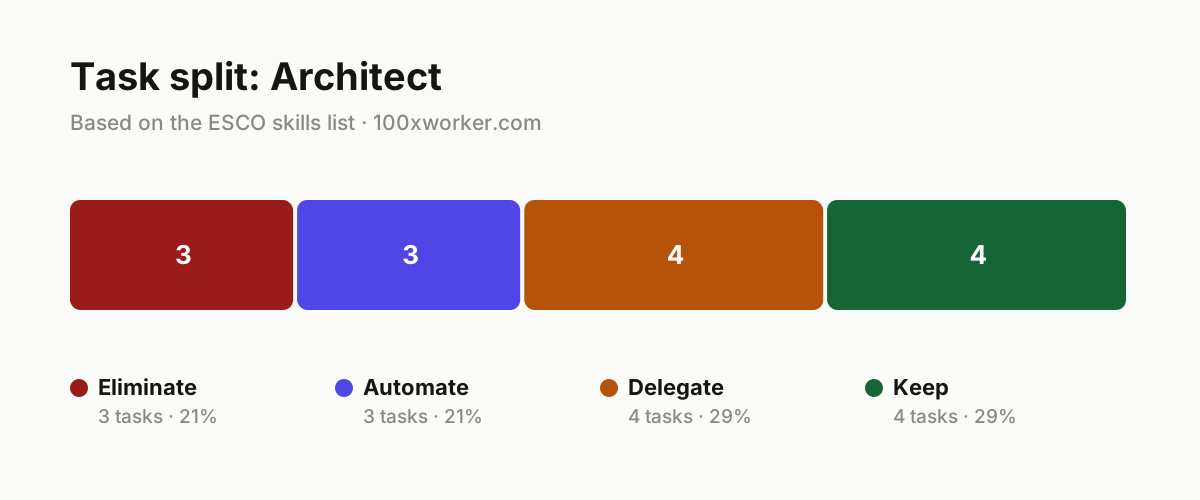
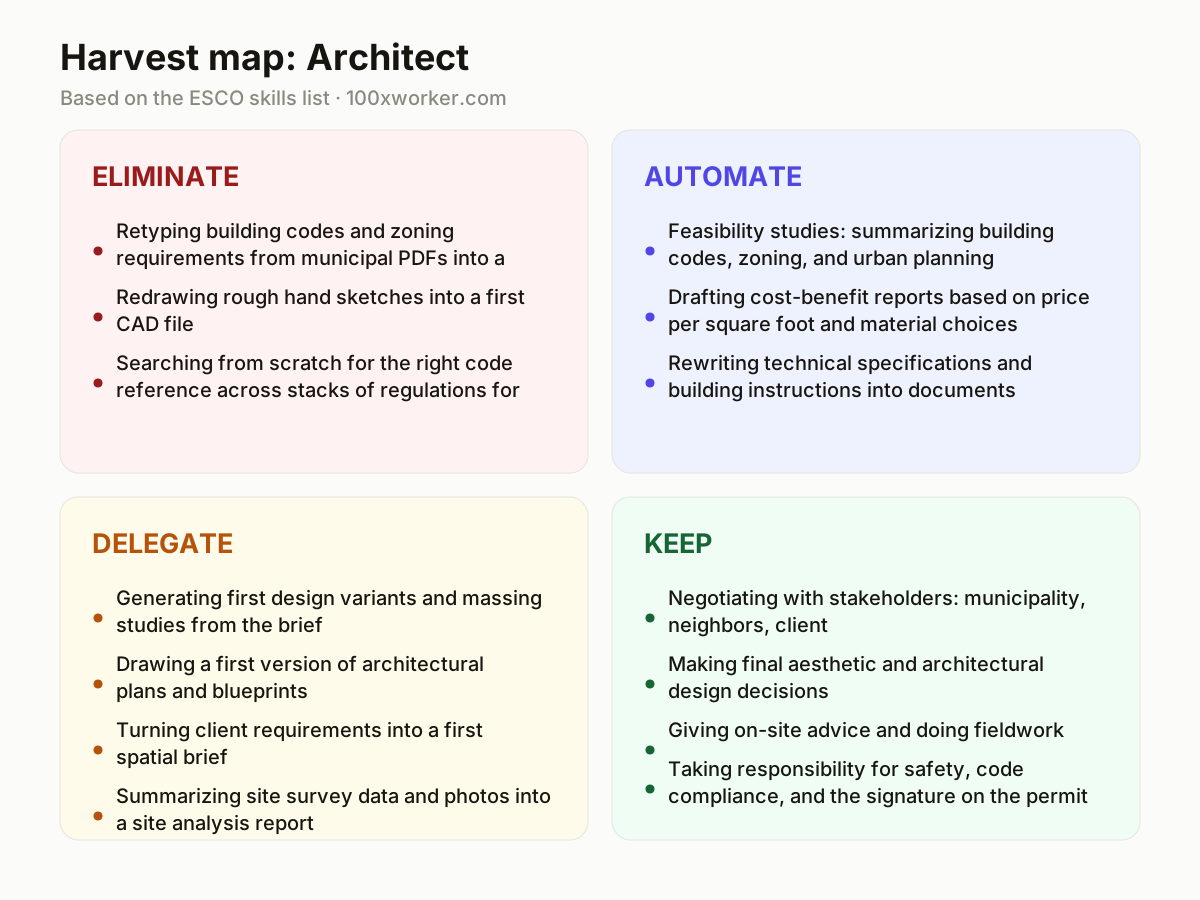
The eliminate/automate/delegate/keep framework sorts architect tasks by how much human judgment they require. Eliminate covers pure transcription or redrawing work that adds no value once AI can do it directly. Automate covers structured document tasks, such as a feasibility report, that an AI agent can complete start to finish with light review. Delegate covers first-draft creative or analytical work where AI produces a starting point but the architect still owns the outcome. Keep covers negotiation, aesthetic judgment, site presence, and legal liability, the parts of the job that stay with the person holding the stamp.
| Task | Bucket | Why |
|---|---|---|
| Retyping building codes and zoning requirements from municipal PDFs into a project checklist | eliminate | Pure transcription with no judgment call; a language model reads and structures this faster and with fewer errors. |
| Redrawing rough hand sketches into a first CAD file | eliminate | Retracing lines without design decisions is mechanical work; an AI tool converts a sketch into vectors faster. |
| Searching from scratch for the right code reference across stacks of regulations for every new project | eliminate | Searching fixed document sets is exactly where language models are more consistent than people. |
| Feasibility studies: summarizing building codes, zoning, and urban planning requirements into a report | automate | An agent reads the regulations, structures the constraints, and delivers a ready-to-use report. |
| Drafting cost-benefit reports based on price per square foot and material choices | automate | Calculations and report structure are repeatable; an AI agent handles this more consistently than a manual template. |
| Rewriting technical specifications and building instructions into documents contractors can actually read | automate | Turning technical language into clear instructions is a writing task an agent can finish end to end. |
| Generating first design variants and massing studies from the brief | delegate | AI produces several variants quickly; the architect chooses, refines, and justifies the direction. |
| Drawing a first version of architectural plans and blueprints | delegate | A first CAD/BIM draft is a solid starting point; the architect corrects dimensions and detailing. |
| Turning client requirements into a first spatial brief | delegate | AI converts a briefing into a room list; the architect checks that against what the client actually means. |
| Summarizing site survey data and photos into a site analysis report | delegate | Structuring observations is delegable; interpreting the site itself stays with the architect. |
| Negotiating with stakeholders: municipality, neighbors, client | keep | Building trust and reading the politics in a meeting room is not something you get from a dataset. (Your edge: Human trust and tact when interests conflict.) |
| Making final aesthetic and architectural design decisions | keep | Applying taste and architectural theory to an actual building stays a judgment call, not a calculation. (Your edge: Personal vision and artistic judgment.) |
| Giving on-site advice and doing fieldwork | keep | Being physically present on site and reading a place does not happen through a screen. (Your edge: Physical intuition and presence on site.) |
| Taking responsibility for safety, code compliance, and the signature on the permit application | keep | Legal liability sits with the architect, regardless of who prepared the report. (Your edge: Legal final responsibility cannot be delegated.) |
Will AI replace architects?
No. Microsoft Research's applicability score for architects is 17.5%, meaning roughly that share of work activities can be handled by generative AI today, mostly research, summarizing, and first drafts. The remaining work, negotiating with municipalities and clients, making design judgment calls, being present on site, and signing off legally, stays with the architect. The job's task list changes more than the job title. Firms that use AI for the document-heavy 17.5% free up hours for the parts of the work that actually require an architect: judgment, presence, and accountability.
Which architect tasks will AI take over first?
The first tasks to go are the ones with no design decision attached: transcribing building codes from PDFs, redrawing hand sketches into CAD, and searching regulation documents for the right clause. Right behind those come structured document tasks an AI agent can run almost unsupervised, such as feasibility reports that summarize zoning rules, cost-benefit tables based on material pricing, and rewriting technical specs into contractor-readable instructions. These are high-volume, low-judgment tasks that already match how generative AI performs best, according to Microsoft Research's task-level analysis of professional AI use.
How do you become the AI point person at your architecture firm?
Start by mapping your firm's actual task list against the four buckets: eliminate, automate, delegate, keep. Pick one recurring document, a feasibility report or a cost-benefit summary, and build a repeatable AI workflow for it, then test it on real projects before rolling it out. Track time saved and error rate, not just speed. Share the workflow with colleagues instead of keeping it as a personal shortcut. Firms that formalize one workflow well tend to gain more credibility internally than those that experiment broadly without ever standardizing anything.
What can you do this month with AI as an architect?
Pick one delegable task, such as generating first massing studies or drafting a spatial brief from client notes, and run it through an AI tool this week. Compare the output against your usual first draft and note where it saved time versus where you had to fix mistakes. Next, automate one document task, like a feasibility summary, using your firm's actual zoning documents as input. Keep a short log of what worked. That log becomes the basis for training colleagues and for deciding what to scale next month.
The AI applicability score measures the share of an occupation's work activities where generative AI is demonstrably usable, based on 200,000 real workplace conversations.
Microsoft Research, Working with AI: Measuring the Applicability of Generative AI to Occupations (2025)
Become the AI person on your team
Build a feasibility-report template with an AI agent
Feed a chatbot the municipal zoning PDF and building code excerpts for a real project and ask it to draft the constraints section of a feasibility report. Refine the prompt until the output needs only light editing, then save it as a reusable template for the whole team.
Run one design brief through an AI massing tool
Take a client's program of requirements and generate three to five massing variants using an AI-assisted design tool. Present the variants alongside your own sketch in the next client meeting and note which one clients respond to fastest.
Standardize the contractor-instructions rewrite
Use an AI tool to convert your technical specifications into plain-language instructions for contractors on one active project. Compare error and question rates from the contractor before and after, and use that comparison to justify wider adoption in the firm.
Want this for your actual task list?
The free scan on the homepage builds your personal task map in 30 seconds, based on your role and industry.
Run the free task scanTools for this work
| Tool | For which tasks | The sober take |
|---|---|---|
| ChatGPT or Claude | Automate: feasibility reports, cost-benefit drafts, rewriting technical specs; Eliminate: searching regulation text | General-purpose language models handle document drafting well but need a real document set fed in, not just a topic. |
| Autodesk Forma | Delegate: generating massing studies and design variants from site and program data | Useful for fast early-stage massing options, but still needs an architect to judge fit and buildability. |
| Midjourney or Stable Diffusion | Delegate: early concept visuals for client presentations | Good for mood and form exploration, not for technically accurate architectural drawing. |
| AI-assisted CAD add-ins (e.g. ArchiCAD AI features) | Eliminate: converting hand sketches to a first CAD file; Delegate: first-draft plans | Speeds up the drafting stage but dimensions and detailing still require manual correction. |
Prompts to try today
Feasibility report draft
Cost-benefit table
Contractor-readable instructions
Related jobs
Frequently asked questions
Will AI take over architectural design decisions?
No, not the final decisions. AI can generate massing studies, layout variants, and first-draft plans quickly, which speeds up early exploration. But choosing which design direction fits the client, the site, and the regulations still requires an architect's judgment. Microsoft Research's 17.5% applicability score for architects reflects tasks like document drafting and summarizing far more than it reflects creative design choices, which remain firmly in the keep bucket.
Which AI tool should an architecture firm start with?
Start with a general-purpose language model like ChatGPT or Claude for document-heavy tasks: feasibility summaries, cost-benefit drafts, and rewriting technical specs. These require no specialized setup and show results immediately. Add a design-specific tool like Autodesk Forma once the team is comfortable using AI for text, since massing and layout tools need more project data and produce output that still needs architectural review.
Is 17.5% applicability a low or high number for architects?
It is mid-range. Microsoft Research's occupation-wide comparison puts translators at the top (49% applicability) and nurses near the bottom (12%). Architects at 17.5% sit closer to occupations where physical presence, client relationships, and legal accountability limit how much of the work AI can touch, even though the document-production side of the job is quite exposed to generative AI.
Does AI change what architecture graduates need to learn?
Yes, in practice. Since document tasks such as feasibility reports and cost-benefit analyses can now be drafted by AI, the value of a junior architect shifts toward reviewing AI output critically, catching regulatory errors, and building client-facing skills like negotiation earlier. The core skills in the ESCO occupational profile for architects, such as interpreting technical regulations and integrating client requirements into a design, remain the skills that separate a junior from a senior, AI or not.
Sources
- Microsoft Research, Working with AI: Measuring the Applicability of Generative AI to Occupations (2025)
- Anthropic Economic Index
- Eurostat, isoc_ai_iaiu (generative AI use, EU population 16-74)
- ESCO occupational taxonomy, European Commission (Building architects, 2161.1)
Hendrik De Winne, author of Becoming AI-Savvy, founder of VibeLab. Helps teams redesign their work with AI.
This article was drafted with AI assistance from public data sources and editorially reviewed.