100×worker · job analysis
What AI Changes for Urban Planners
Urban planners spend their days building development plans for cities, neighborhoods, and regions. That means zoning research, feasibility studies, demographic analysis, environmental policy drafting, and long meetings with residents and local officials. A lot of that work involves reading documents, extracting data, and writing structured reports, exactly the kind of task generative AI is good at.
Microsoft Research analyzed 200,000 real Copilot conversations across occupations and found that generative AI is applicable to about 33% of the work activities of urban and regional planners (Microsoft Research, Working with AI: Measuring the Applicability of Generative AI to Occupations, 2025). That places planners in the middle of the pack: translators score highest at 49%, nurses score low at 12%. Anthropic's Economic Index, which classifies millions of Claude conversations against O*NET task lists, finds a similar split across knowledge work generally, between tasks AI can fully automate and tasks where it augments a person's judgment. This shift is happening against a backdrop of fast-growing general AI use: Eurostat reports that 32.7% of the EU population aged 16 to 74 used generative AI in the three months before its 2025 survey.
This article uses an eliminate/automate/delegate/keep framework to sort the tasks in the ESCO occupational profile for urban planner (ESCO code 2164.3), so you can see exactly which parts of the job change and which parts stay with you.
An urban planner develops development plans for cities and regions based on community needs and policy.
The task split: what AI takes over and what stays yours
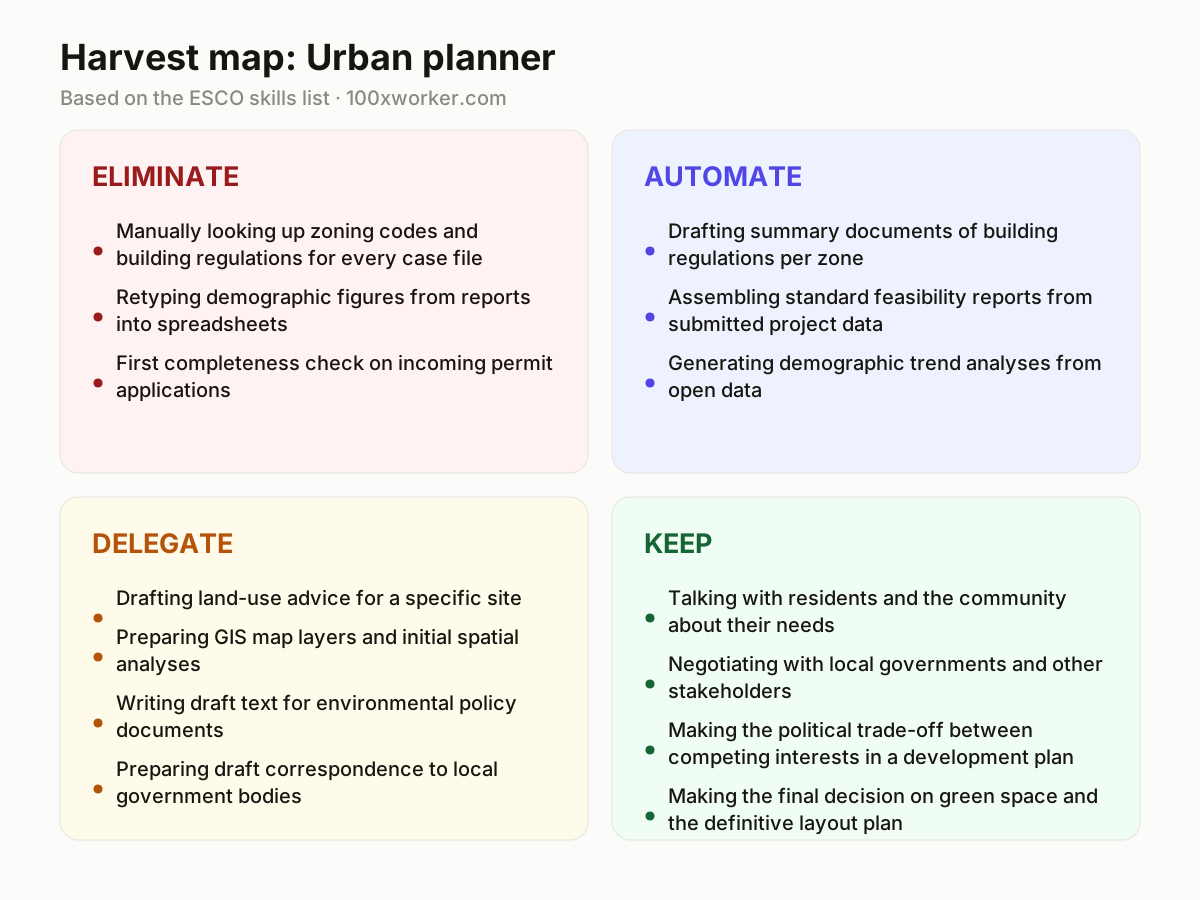
Not every planning task changes the same way. Some tasks disappear because software now does them instantly. Some get automated end to end. Some you hand to an AI assistant for a first draft, then you review and finish it. And some stay entirely with you because they require presence, negotiation, or a value judgment. The four buckets below sort the core tasks from the ESCO profile for urban planner into these categories.
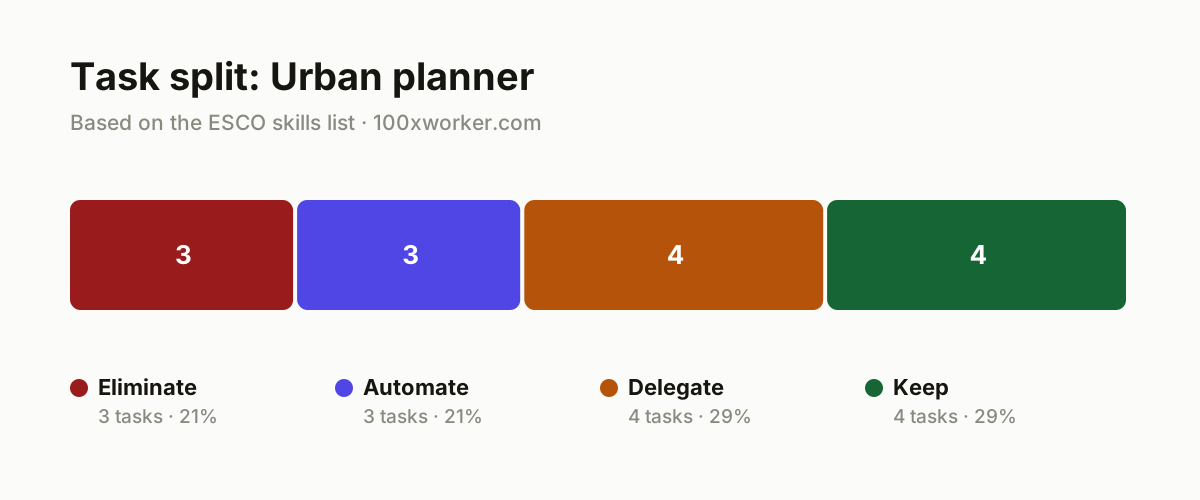
| Task | Bucket | Why |
|---|---|---|
| Manually looking up zoning codes and building regulations for every case file | eliminate | A language model searches regulations faster and more consistently than a planner with ten browser tabs open. |
| Retyping demographic figures from reports into spreadsheets | eliminate | Data extraction from PDFs and open datasets now happens automatically, without transcription errors. |
| First completeness check on incoming permit applications | eliminate | A checklist agent flags missing documents before a staff member even opens the file. |
| Drafting summary documents of building regulations per zone | automate | An agent generates a readable summary from the legal text, ready to circulate. |
| Assembling standard feasibility reports from submitted project data | automate | The structure of a feasibility study repeats often enough to automate fully. |
| Generating demographic trend analyses from open data | automate | Figures, charts, and a first interpretation come straight out of public government data. |
| Drafting land-use advice for a specific site | delegate | AI writes a first opinion based on existing criteria, you check it against local context. |
| Preparing GIS map layers and initial spatial analyses | delegate | The technical setup in the GIS platform can be handled by an assistant, interpretation stays with you. |
| Writing draft text for environmental policy documents | delegate | A first version based on existing policy saves hours, the policy choices remain yours. |
| Preparing draft correspondence to local government bodies | delegate | AI drafts the letter or memo, you adjust tone and political sensitivity before it goes out. |
| Talking with residents and the community about their needs | keep | Participation requires presence, reading body language, and improvising on what comes up on the spot. (Your edge: You do not build trust through a screen.) |
| Negotiating with local governments and other stakeholders | keep | Weighing interests and closing compromises takes political instinct no model has. (Your edge: Negotiation stays human work, with stakes and risk.) |
| Making the political trade-off between competing interests in a development plan | keep | Who wins and who loses in a spatial plan is a value judgment, not a calculation. (Your edge: Cutting through the knot stays your responsibility.) |
| Making the final decision on green space and the definitive layout plan | keep | The final choice weighs aesthetics, budget, and public support against each other. (Your edge: Responsibility for the outcome sits with you, not the tool.) |
Which urban planning tasks does AI take over?
AI takes over the repetitive, document-heavy parts of the job first. That includes looking up zoning codes and building regulations, retyping demographic data into spreadsheets, and running the first completeness check on permit applications. It also handles drafting work that follows a fixed structure: summaries of building regulations, standard feasibility reports, and demographic trend analyses built from open datasets. Microsoft Research's applicability score of 33% for urban and regional planners reflects exactly this: a third of the job is document review, data extraction, and structured writing, tasks generative AI already handles well. The rest, community engagement, negotiation, and final decisions, stays with you.
Will AI replace urban planners?
No single tool replaces the job. Urban planning covers dozens of distinct tasks, from zoning research to resident meetings, and each one changes differently. Microsoft Research puts generative AI's applicability at 33% of a planner's work activities, below translation (49%) and above nursing (12%). Roughly a third of the job, document research, data compilation, and standard report drafting, can be handled by AI. The rest, resident meetings, stakeholder negotiation, and political calls about who gets a park and who gets a parking lot, still needs a person in the room. Expect fewer hours on paperwork and more time for the parts of the job that require judgment.
How do you become the AI person on your planning team?
Start by mapping your own task list against the eliminate/automate/delegate/keep buckets above. Pick one recurring document, say, a feasibility report or a zoning summary, and build a repeatable AI workflow for it with your team. Share the prompts and templates that work, not just the output. Volunteer to test new GIS or drafting tools before your department rolls them out, and document what breaks. Being the AI person is less about knowing every tool and more about turning a messy manual process into a checklist an assistant can run, while flagging where human review still matters.
What can you do this month with AI as an urban planner?
Pick one task from the automate or delegate bucket, for example drafting a demographic trend summary from open census data, and run it through an AI assistant this week. Compare the output against a report you wrote manually and note what needed correction. Next, take one recurring document type, a feasibility report template or a zoning summary format, and build a prompt or workflow your whole team can reuse. Finally, block the time you saved for tasks in the keep bucket: an extra resident meeting, a longer stakeholder conversation, or actually reading the plan before the vote.
Generative AI's applicability varies sharply by occupation, from 49% for translators to 12% for nurses, with urban and regional planners at 33%.
Microsoft Research, Working with AI: Measuring the Applicability of Generative AI to Occupations (2025)
Become the AI person on your team
Own one recurring report
Pick the feasibility report or zoning summary you write most often and build a repeatable AI workflow for it. Share the prompt and template with your team so everyone drafts from the same starting point.
Pilot the GIS assistant
Test AI-assisted GIS layer preparation or spatial analysis tools before your department adopts them formally. Document where the output needs correction so colleagues know what to double-check.
Build a zoning code lookup
Set up a simple AI-searchable index of local zoning codes and building regulations. This removes the slowest part of most permit reviews and gives your team a shared reference point.
Want this for your actual task list?
The free scan on the homepage builds your personal task map in 30 seconds, based on your role and industry.
Run the free task scanTools for this work
| Tool | For which tasks | The sober take |
|---|---|---|
| Microsoft Copilot | Zoning code lookups, feasibility report drafts, meeting summaries | Useful for document-heavy drafting, but check regulatory citations against the source text. |
| Claude (Anthropic) | Drafting environmental policy text, summarizing long regulation PDFs | Anthropic's own Economic Index shows this kind of long-document work skews toward augmentation, not full automation. |
| ArcGIS with AI-assisted layer tools | Preparing GIS map layers and first-pass spatial analyses | Speeds up technical setup, but the spatial interpretation still needs a planner's read. |
| A general LLM assistant (e.g. ChatGPT) | Draft correspondence to local government, first land-use advice drafts | Good for a fast first draft, weak on local political nuance you need to add yourself. |
Prompts to try today
Zoning regulation summary
Feasibility report first draft
Demographic trend brief
Related jobs
Frequently asked questions
Will AI take over urban planning jobs entirely?
No. Microsoft Research's applicability analysis puts generative AI's reach at about 33% of an urban planner's work activities, based on 200,000 real Copilot conversations. That covers document research, data extraction, and standard report drafting. It does not cover resident meetings, stakeholder negotiation, or the political trade-offs in a development plan, all of which require a person in the room with judgment and accountability. Expect the job to keep the same title but a different task mix, with less time on paperwork and more on decisions only a human can own.
Which AI tools do urban planners actually use?
General assistants like Microsoft Copilot and Claude handle drafting: zoning summaries, feasibility report sections, and correspondence. GIS platforms are adding AI-assisted layer preparation and first-pass spatial analysis. None of these tools replace GIS interpretation, community engagement, or final sign-off, they speed up the drafting and data-handling steps that used to take hours. Anthropic's Economic Index finds this pattern across knowledge work generally: AI use splits between full automation of routine tasks and augmentation of judgment-heavy ones.
How much of my current workload could realistically move to AI?
Based on Microsoft Research's occupational analysis, roughly a third of an urban planner's work activities show generative AI applicability. That number sits below translators (49%) and well above nurses (12%), placing planning in the middle of the applicability range. In practice, that means the document-heavy and data-heavy parts of your week, regulation lookups, report drafts, trend analyses, are the parts most likely to shift toward AI-assisted work first.
Does AI change what skills matter for urban planners?
Yes. The ESCO skills list for urban planner already includes GIS use, land-use advice, and zoning-code knowledge, skills that AI tools now support directly rather than replace. What matters more going forward is directing an AI assistant well: writing a clear prompt, checking its regulatory citations, and knowing when to override its draft. Community engagement, negotiation, and political judgment remain unchanged and become the parts of the job that define your value.
Sources
- Microsoft Research, Working with AI: Measuring the Applicability of Generative AI to Occupations (2025)
- Anthropic Economic Index
- Eurostat, isoc_ai_iaiu (generative AI use, 2025)
- ESCO occupational taxonomy, European Commission
Hendrik De Winne, author of Becoming AI-Savvy, founder of VibeLab. Helps teams redesign their work with AI.
This article was drafted with AI assistance from public data sources and editorially reviewed.