100×worker · job analysis
Will AI Replace UX Designers, and What Should You Do About It?
UX designers spend their days moving between research, analysis, and interface design. Some of that work is repetitive and rule-based. Some of it depends on reading people, judgment calls, and creativity that no dataset fully covers. That mix is exactly why AI's effect on this job is uneven rather than total.
Microsoft Research analyzed 200,000 real Copilot conversations and scored how applicable generative AI is to different occupations. For web and digital interface designers, the closest match to UX design, the applicability score came out at 29.4%. For comparison, translators scored 49% and nurses scored 12%. UX design sits in the middle: enough exposure to change the job, not enough to eliminate it.
Anthropic's Economic Index, which classifies millions of Claude conversations against O*NET task categories, adds a useful distinction. It separates automation-like AI use (AI does the task) from augmentation-like use (AI helps a person do the task better). For design work, both patterns show up side by side. This article breaks the UX designer role into four buckets, tasks to eliminate, automate, delegate, or keep, so you can see exactly where your time is going and where it should go instead.
A UX designer studies user behavior and designs interfaces that make products clear and usable.
The task split: what AI takes over and what stays yours
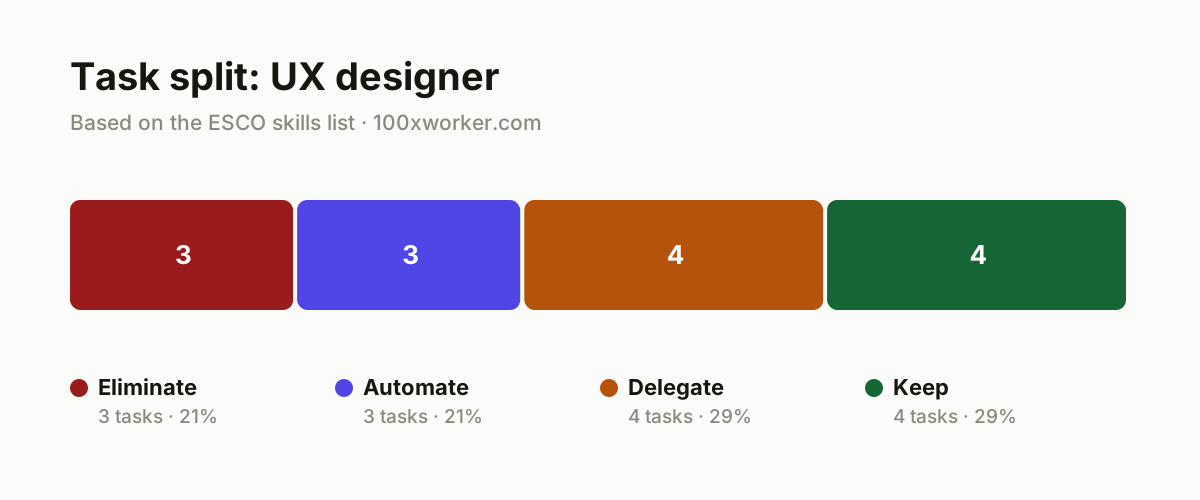
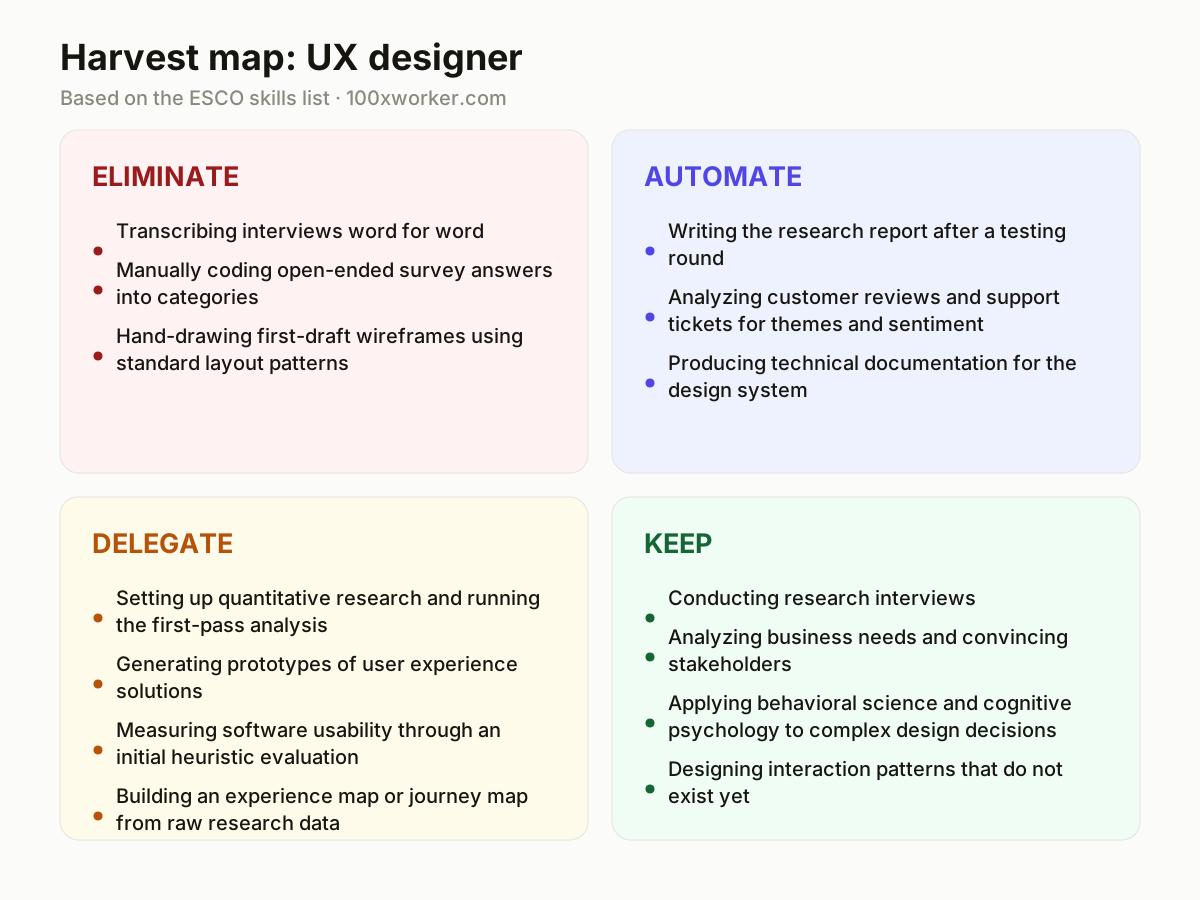
Not every UX task changes the same way. Some tasks disappear because a tool now does them outright. Some get fully automated end-to-end but still need your setup and review. Some you hand to AI as a first pass and then finish yourself. And some stay entirely yours because they depend on trust, judgment, or creativity that AI cannot supply. Sorting your task list into these four buckets, eliminate, automate, delegate, keep, is a more useful exercise than asking whether the job itself will survive.
| Task | Bucket | Why |
|---|---|---|
| Transcribing interviews word for word | eliminate | Speech-to-text tools do this faster and with fewer errors than manual typing. |
| Manually coding open-ended survey answers into categories | eliminate | AI clusters thousands of answers by theme in seconds, consistently and repeatably. |
| Hand-drawing first-draft wireframes using standard layout patterns | eliminate | Generating standard layouts is mechanical work with no design value added. |
| Writing the research report after a testing round | automate | An agent turns transcripts and notes into a first structured report draft. |
| Analyzing customer reviews and support tickets for themes and sentiment | automate | Clustering large volumes of text by topic is exactly what language models handle well. |
| Producing technical documentation for the design system | automate | An agent writes component descriptions and specs based on existing patterns. |
| Setting up quantitative research and running the first-pass analysis | delegate | AI processes the numbers, you frame the right question and read the context. |
| Generating prototypes of user experience solutions | delegate | AI produces several variants quickly, you choose and refine what actually works for users. |
| Measuring software usability through an initial heuristic evaluation | delegate | AI checks against known usability principles, you validate with real users and real context. |
| Building an experience map or journey map from raw research data | delegate | AI pulls structure out of scattered data, you test that structure against reality. |
| Conducting research interviews | keep | Building trust and probing unexpected answers requires a human presence in the room. (Your edge: Reading non-verbal cues and knowing when to push further.) |
| Analyzing business needs and convincing stakeholders | keep | Weighing priorities across departments is political work, not a language-model task. (Your edge: Negotiating between conflicting interests inside the organization.) |
| Applying behavioral science and cognitive psychology to complex design decisions | keep | Ethical gray areas and contextual trade-offs still need human judgment. (Your edge: Sensing when a logical solution still harms users.) |
| Designing interaction patterns that do not exist yet | keep | Designing something genuinely new requires creativity that sits outside existing training data. (Your edge: Inventing an interaction that no training example covers.) |
Which UX designer tasks does AI take over?
AI takes over the mechanical layer of UX work first: transcribing interviews, coding open survey responses into categories, and producing standard first-draft wireframes. These tasks have a clear right answer and a repeatable process, which is exactly what large language models handle well. Beyond that, AI increasingly automates full first drafts of research reports, thematic analysis of support tickets and reviews, and technical documentation for design systems. None of this eliminates the UX designer role. It removes the parts of the job that were always closer to data processing than to design judgment, freeing time for research and decision-making.
Will AI replace UX designers?
Full replacement looks unlikely based on current data. Microsoft Research puts AI applicability for this type of work at 29.4% of tasks, well below occupations like translation (49%) and well above occupations like nursing (12%). Anthropic's Economic Index shows AI use in design-adjacent work splitting between automation-like and augmentation-like patterns rather than one replacing the whole role. Older estimates that predicted much higher automation risk, such as the Frey and Osborne (2013) Oxford study often cited in "robotization percentage" lists, were published before large language models existed and should be treated with caution. The task-level view, not the job-title view, is the accurate one.
How do you become the AI person on your UX team?
Start by owning the workflow, not just the tool. Set up a shared prompt library for research report drafts, usability heuristics checks, and journey map generation so your team stops reinventing the same AI request each week. Run a pilot where AI produces the first-pass thematic analysis of a support ticket batch or review set, then present the before-and-after time saved to your manager. Volunteer to review AI-generated wireframes or documentation for accuracy before they go further, since that quality-control role becomes more valuable as more raw output gets generated automatically.
What can you do this month as a UX designer?
Pick one task from the automate bucket, most teams start with research report drafting or support ticket analysis, and test an AI workflow on your next project. Keep a human review step before anything ships. Move one delegate-bucket task, like prototype generation or a heuristic evaluation pass, into your regular process rather than treating it as a one-off experiment. Block time this month to practice the keep-bucket skills that will matter more, especially stakeholder negotiation and interview technique, since those are the parts of the job least likely to shrink.
AI use in design-related work splits between automation-like assistance and augmentation-like collaboration, not a wholesale replacement of the task.
Anthropic Economic Index, 2025
Become the AI person on your team
Build a prompt library for repeat research tasks
Save working prompts for transcript summarization, theme coding, and heuristic evaluation checklists in a shared team doc. This turns individual AI experiments into a repeatable team asset instead of one person's personal workaround.
Run a before-and-after time comparison
Time a research report written manually versus one drafted first by an agent and then edited. Bring the actual numbers to your team, not a general impression, when proposing a new workflow.
Own the AI output review step
As more first drafts get AI-generated, someone needs to catch errors and inconsistencies before they reach stakeholders. Position yourself as that reviewer, since it requires exactly the domain judgment AI lacks.
Want this for your actual task list?
The free scan on the homepage builds your personal task map in 30 seconds, based on your role and industry.
Run the free task scanTools for this work
| Tool | For which tasks | The sober take |
|---|---|---|
| Dovetail | Interview transcription, thematic coding, and turning raw research notes into structured findings | Reduces manual tagging time but still needs a human check on theme accuracy. |
| Maze | Usability testing analysis and generating first-pass reports from test sessions | Speeds up report drafting, results still need interpretation against your specific product context. |
| Figma (with AI features) | Generating first-draft wireframes and layout variants from standard patterns | Good for exploring options fast, not a substitute for validating with real users. |
| Claude or ChatGPT | Drafting research reports, coding open survey responses, writing design system documentation | Useful as a first-draft generator, output needs editing for tone and accuracy before use. |
Prompts to try today
Turn interview transcripts into a structured findings summary
Run a first-pass heuristic evaluation
Draft a journey map from raw research notes
Related jobs
Frequently asked questions
Do UX designers need to learn to code AI tools?
No, but you do need to know how to prompt AI tools effectively and how to check their output. Most UX-relevant AI use happens through existing research and design platforms (Dovetail, Maze, Figma) or general chat tools (Claude, ChatGPT), not through custom coding. The skill that matters is framing the right research question and catching errors in AI-generated summaries or wireframes before they reach stakeholders.
Which part of UX design is safest from AI?
Conducting research interviews and negotiating with stakeholders are the safest parts. Both depend on reading people in real time, building trust, and navigating organizational politics, none of which AI models are trained to do. Designing genuinely new interaction patterns, ones with no existing precedent to draw from, also stays largely human because AI output leans heavily on patterns already present in its training data.
How reliable are old 'automation risk' percentages for UX design?
Treat them with caution. Many widely cited robotization percentages trace back to the Frey and Osborne Oxford study from 2013, published years before large language models existed. Microsoft Research's 2025 applicability score, based on real usage of Copilot rather than theoretical task descriptions, gives a more current picture: 29.4% of tasks in web and digital interface design work show clear AI applicability.
Should I worry about AI taking my UX design job?
The task-level data suggests worry is misplaced but complacency is too. AI is not on track to replace the full UX designer role, since research interviews, stakeholder work, and novel design decisions remain human-dependent. But routine tasks like transcription, survey coding, and first-draft wireframing are already shifting to AI. The practical move is to shed those routine tasks deliberately and invest the time saved in the judgment-heavy parts of the job.
Sources
- Microsoft Research, Working with AI: Measuring the Applicability of Generative AI to Occupations (2025)
- Anthropic Economic Index
- ESCO (European Commission occupational taxonomy)
- Eurostat, isoc_ai_iaiu (generative AI usage, EU population 16-74)
Hendrik De Winne, author of Becoming AI-Savvy, founder of VibeLab. Helps teams redesign their work with AI.
This article was drafted with AI assistance from public data sources and editorially reviewed.