100×worker · job analysis
Will AI Replace Project Managers?
Project management shows up in almost every headline about AI and jobs, but the numbers tell a narrower story than the headlines suggest. Microsoft Research analyzed 200,000 real conversations people had with Copilot and scored occupations by how much of their actual work generative AI can plausibly touch. Project management specialists came in at 18.2%, far below translators (49%) and roughly in the middle of the pack overall. That is not zero, and it is not nothing to plan around, but it is also not a job replaced overnight.
The more useful question is not whether AI replaces project managers, but which specific tasks on your plate change first. Anthropic's Economic Index, which classifies millions of Claude conversations against the O*NET task framework, splits AI use into two patterns: automation-like use, where AI does the task end to end, and augmentation-like use, where AI supports a human who stays in the loop. Most of what a project manager does falls into the second category. The European Commission's ESCO taxonomy lists concrete skills for this occupation, from time estimation to risk analysis to stakeholder management, and that task-level list is exactly where the real change is visible.
This article breaks the job down using an eliminate, automate, delegate, keep framework, based on that same task list, so you can see precisely where AI tools already do the work and where your judgment still carries the project.
Project managers plan, budget, and steer projects so goals are met on time and within budget.
The task split: what AI takes over and what stays yours
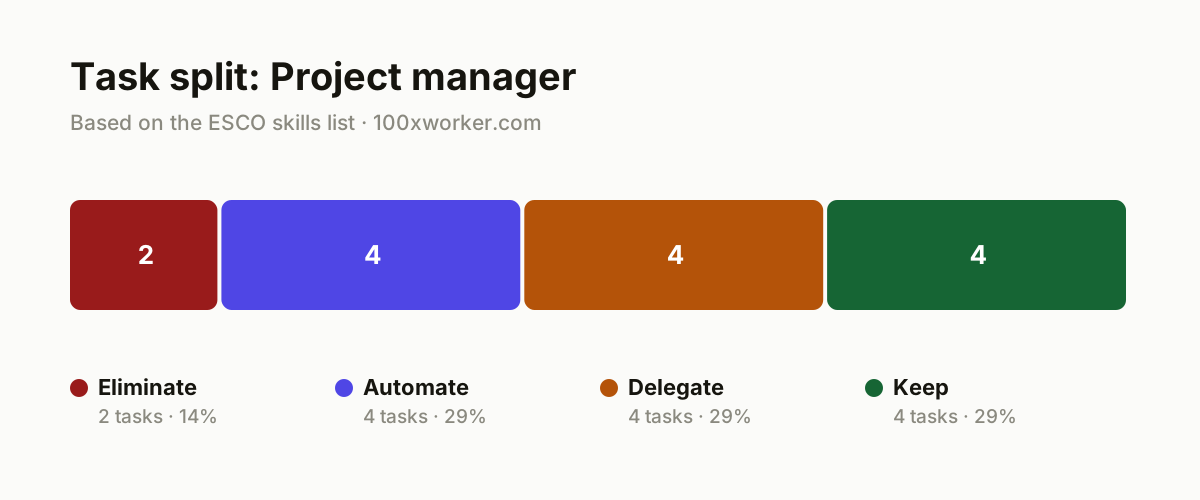
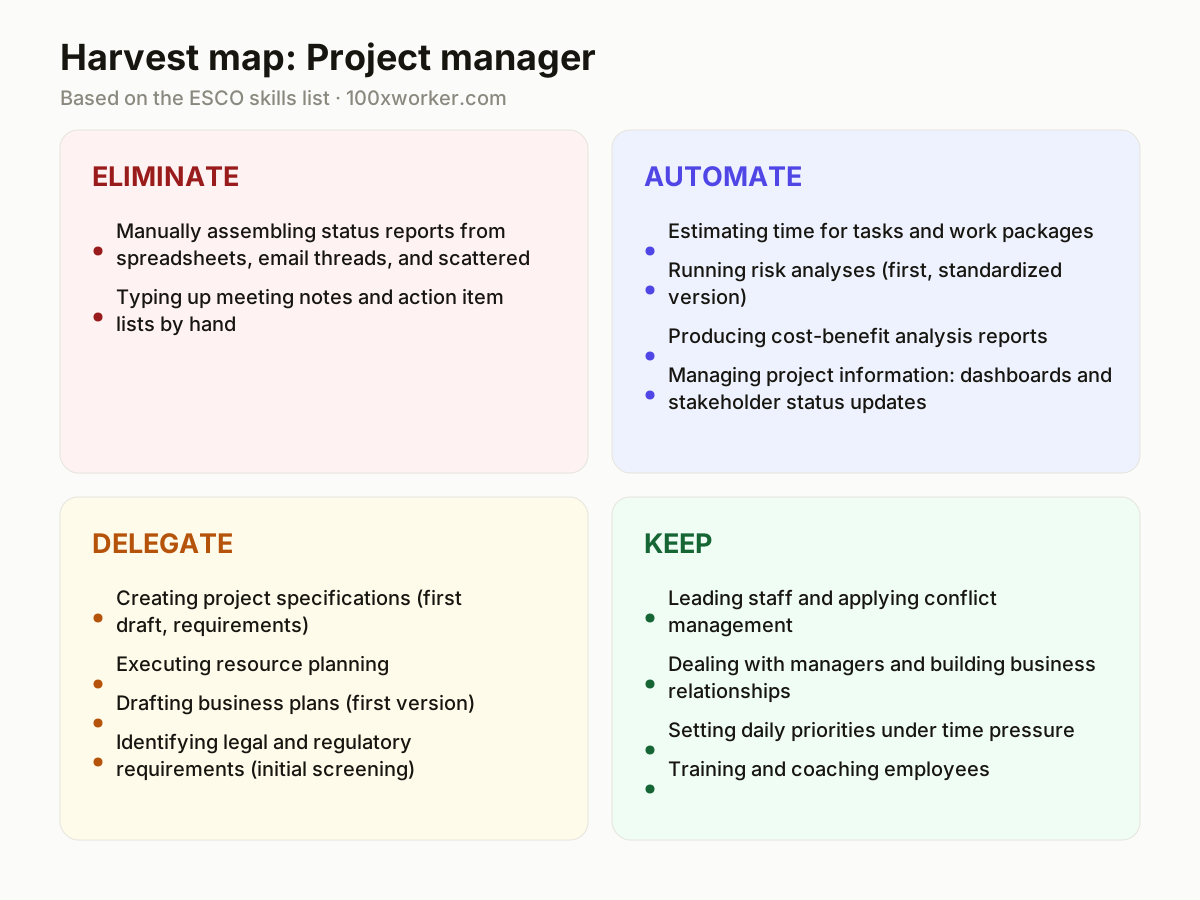
Instead of asking whether AI will take your job, it helps to sort your actual task list into four buckets: tasks that disappear because a tool does them without you, tasks a tool can fully automate under your supervision, tasks you can hand to AI as a first draft before you finish them, and tasks that stay yours because they depend on trust, judgment, or presence. The list below follows the core skills ESCO assigns to the project manager occupation, so it maps to real day-to-day work rather than abstract job titles.
| Task | Bucket | Why |
|---|---|---|
| Manually assembling status reports from spreadsheets, email threads, and scattered notes | eliminate | A tool that reads directly from your project system and calendar produces this faster and with fewer errors. |
| Typing up meeting notes and action item lists by hand | eliminate | Transcription and summarization happen automatically during or right after the meeting. |
| Estimating time for tasks and work packages | automate | An AI agent pulls patterns from your past projects and hands you a defensible first estimate. |
| Running risk analyses (first, standardized version) | automate | AI spots recurring risk types in historical project data faster than a manual checklist. |
| Producing cost-benefit analysis reports | automate | Number crunching and scenario modeling is exactly where language models with calculation tools perform well. |
| Managing project information: dashboards and stakeholder status updates | automate | Updates can be generated automatically, tailored to each recipient, from the same underlying data source. |
| Creating project specifications (first draft, requirements) | delegate | AI writes a full draft version, you check it against the real business context and client needs. |
| Executing resource planning | delegate | A proposal for who works on what and when is a solid starting point, but the political trade-offs stay yours. |
| Drafting business plans (first version) | delegate | Structure and first-pass text move faster with AI, the strategic choices remain yours. |
| Identifying legal and regulatory requirements (initial screening) | delegate | AI flags possible compliance issues, but a lawyer or you confirm the final interpretation. |
| Leading staff and applying conflict management | keep | Building trust and defusing tension in a team requires presence, not text. (Your edge: People follow people, not an interface.) |
| Dealing with managers and building business relationships | keep | Negotiating scope, budget, or deadlines is about reading the room, not producing text. (Your edge: Negotiation is reading what stays unsaid.) |
| Setting daily priorities under time pressure | keep | Deciding which deadline slips when two collide is a judgment call with real weight. (Your edge: Taking responsibility is not something an agent can do.) |
| Training and coaching employees | keep | Guiding someone's growth and giving feedback requires relationship, repetition, and patience. (Your edge: People grow through people, not prompts.) |
Which project manager tasks can AI take over?
AI takes over the mechanical parts first: pulling status reports out of scattered spreadsheets and emails, transcribing and summarizing meetings, generating a first-pass time estimate from past project data, running a standardized risk checklist, and building cost-benefit tables. These are tasks with clear inputs and repeatable structure. What AI does not take over is deciding which risk actually matters for this client, or which deadline you protect when two projects collide. Those calls stay with the project manager, informed by AI output but not made by it.
Will AI replace project managers?
No, not based on current evidence. Microsoft Research scored generative AI applicability at 18.2% of work activities for project management specialists, compared with 49% for translators and 12% for nurses. That places the role in the middle of the exposure range: real change, but not replacement. Anthropic's Economic Index shows most AI use in this kind of role is augmentation, meaning a person stays in the loop, rather than full automation. The job shifts toward managing AI-generated drafts, reports, and estimates, and away from producing them by hand.
What can you do this month with AI as a project manager?
Start by listing your recurring deliverables: weekly status reports, risk registers, resource plans, meeting notes. Pick one and connect an AI tool to the data source that feeds it, so it drafts the update instead of you typing it. Test an AI-generated first-draft risk analysis against your own review before you trust it unsupervised. Keep a short prompt library for the reports you write every week. Do not try to change every task at once; pick the two or three that eat the most hours and automate those first.
How much of a project manager's work is AI-exposed, according to research?
Microsoft Research puts the figure at 18.2% of work activities for the closest matching US occupational category, project management specialists, based on real Copilot usage data rather than survey guesses. Anthropic's Economic Index adds nuance by splitting that exposure into automation-like use, where AI fully completes a task, and augmentation-like use, where a person stays involved. For project managers, most AI use falls into the second group. The ESCO taxonomy's list of 28 core skills for this occupation shows which specific skills, like time estimation and cost-benefit reporting, drive that exposure.
Generative AI applicability varies sharply by occupation, from about half of work activities in translation down to about a tenth in nursing, with project management roles landing in between.
Microsoft Research, Working with AI (2025)
Become the AI person on your team
Run a task audit against your actual skill list
Take the ESCO skill list for project manager and mark each skill eliminate, automate, delegate, or keep, based on your own week. Most people are surprised by how much of their calendar sits in the automate and delegate buckets.
Build one AI-generated report before you build ten manual ones
Pick your most repetitive report, connect it to a project tool with AI features, and compare the output against your manual version for two cycles. Only fully switch once you trust the accuracy.
Reserve your judgment time for the keep-bucket work
The hours you free up from automating reports and estimates should go to conflict resolution, stakeholder negotiation, and coaching, the tasks research consistently shows AI cannot absorb.
Want this for your actual task list?
The free scan on the homepage builds your personal task map in 30 seconds, based on your role and industry.
Run the free task scanTools for this work
| Tool | For which tasks | The sober take |
|---|---|---|
| Microsoft Copilot (Project, Teams, Outlook) | Eliminating manual status reports, transcribing meetings, drafting stakeholder updates | Works directly inside the Microsoft stack many project managers already use. |
| Claude (Anthropic) | Drafting project specifications, business plans, and cost-benefit reports | Strong at longer structured drafts you then edit rather than write from scratch. |
| Otter.ai or similar meeting transcription tools | Eliminating manual meeting notes and action item lists | Captures the meeting so no one has to type notes live. |
| Asana AI or Monday.com AI features | Automating dashboards, resource planning drafts, and risk flagging | Built into project tools you likely already use, so no new system to adopt. |
| ChatGPT or Claude with a spreadsheet/data tool | First-pass time estimates and cost-benefit calculations | Useful for the numeric grunt work, but check the underlying assumptions before you present it. |
Prompts to try today
Draft a weekly status report from raw notes
Build a first-draft risk register
Turn a scope conversation into a specification draft
Related jobs
Frequently asked questions
What percentage of a project manager's job can AI do?
Microsoft Research scored generative AI applicability at 18.2% of work activities for the closest matching US occupational category, project management specialists, based on real usage data from 200,000 Copilot conversations. That figure covers tasks like drafting reports and running first-pass risk analyses. It does not mean 18.2% of project managers lose their jobs. It means about a fifth of typical task time overlaps with what current AI tools can plausibly handle.
Which project management skills become more important because of AI?
Skills that involve judgment under ambiguity become more valuable, not less: negotiating scope and budget with stakeholders, resolving conflict inside a team, deciding priorities when deadlines collide, and coaching people through change. As AI absorbs report writing and first-draft estimating, the time you free up should go toward these human-dependent skills, since research consistently places them outside AI's current reach.
Should project managers learn to write AI prompts?
Yes, at a basic level. You do not need to become a prompt engineer, but you do need to know how to ask an AI tool for a status report, a risk analysis draft, or a resource plan in a format you can quickly check and correct. Anthropic's Economic Index shows most professional AI use is augmentation, meaning a human reviews and edits, so the skill that matters most is fast, accurate review, not perfect prompt phrasing.
Is the project manager occupation at high risk compared to other jobs?
No. Microsoft Research's applicability scores rank project management specialists in the middle of the range, well below highly exposed roles like translation (49%) and above low-exposure roles like nursing (12%). Combined with Eurostat data showing about a third of the EU population aged 16 to 74 used generative AI in the past three months in 2025, project management sits closer to the general workforce average than to the most disrupted occupations.
Sources
- Microsoft Research, Working with AI: Measuring the Applicability of Generative AI to Occupations (2025)
- Anthropic Economic Index
- Eurostat, Use of AI by individuals (isoc_ai_iaiu)
- ESCO, European Commission occupation taxonomy
Hendrik De Winne, author of Becoming AI-Savvy, founder of VibeLab. Helps teams redesign their work with AI.
This article was drafted with AI assistance from public data sources and editorially reviewed.