100×worker · job analysis
Will AI Replace Quality Managers, and What Should You Do About It?
Quality managers spend a lot of their week on things that look automatable on paper: checking test data against limits, updating standards, writing audit reports. Generative AI now does a real share of that drafting and pattern-spotting work. Eurostat reports that 32.7% of the EU population aged 16 to 74 used generative AI in the last three months of 2025, and adoption is rising fastest among people who already work with documents and data for a living, which describes most quality roles.
The European Commission's ESCO taxonomy lists quality services manager under code 1219.7, with core skills that include running quality checks, analyzing test data, training staff on procedures, and creating solutions for problems. Several of those skills split cleanly along a line: some are checklist work an AI system can run continuously, others need a person in the room. Microsoft Research analyzed 200,000 real Copilot conversations and found that generative AI already handles a substantial portion of drafting, summarizing, and data-review tasks across office occupations, without replacing the judgment calls that sit around them.
This article breaks the quality manager job into four buckets: tasks to eliminate outright, tasks to automate, tasks to delegate to AI under your review, and tasks to keep doing yourself.
A quality manager monitors and improves the quality of services, processes, and standards inside an organization.
The task split: what AI takes over and what stays yours
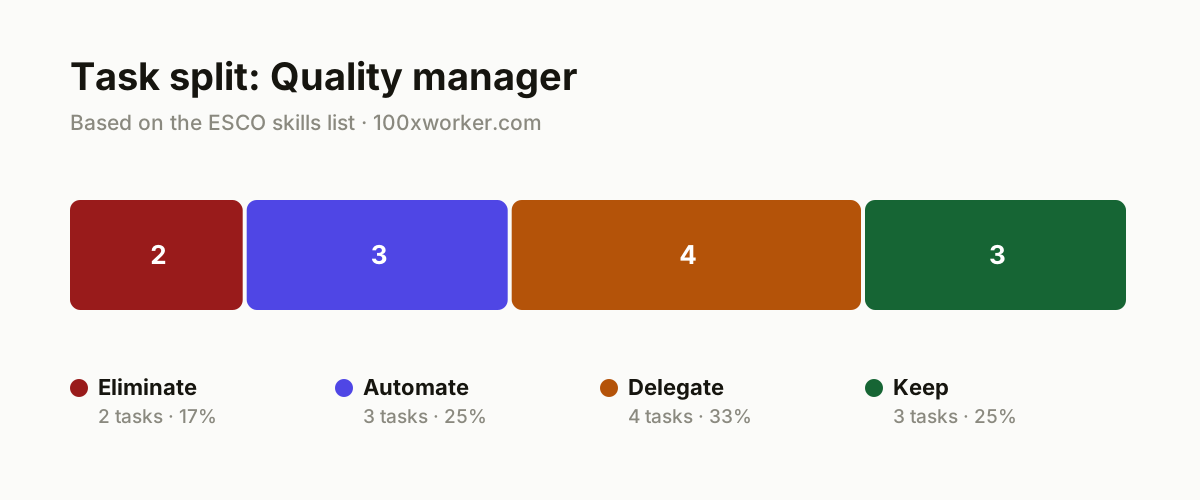
Not every quality management task changes the same way. Some tasks disappear once you redesign the workflow around them (eliminate). Some are repetitive enough that a system can run them without you watching (automate). Some AI can draft a first version of, but you still review and sign off (delegate). And some depend on trust, physical presence, or organizational politics that no AI model can replicate (keep). Sorting your task list into these four buckets is a more useful exercise than asking whether the job as a whole will survive.
| Task | Bucket | Why |
|---|---|---|
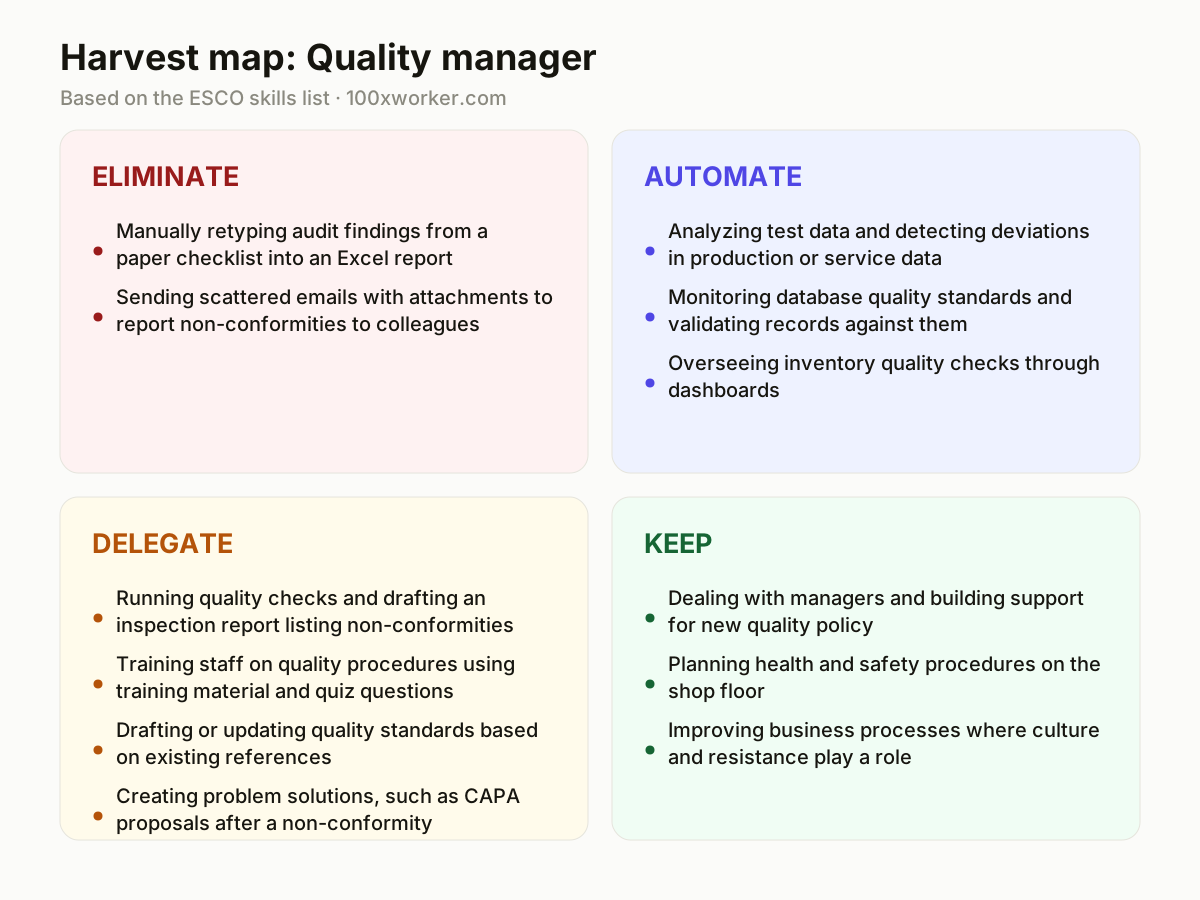
| Manually retyping audit findings from a paper checklist into an Excel report | eliminate | A digital form with built-in validation removes the need to retype data at all. |
| Sending scattered emails with attachments to report non-conformities to colleagues | eliminate | A structured reporting workflow captures deviations without an email thread. |
| Analyzing test data and detecting deviations in production or service data | automate | An AI agent scans datasets continuously and flags outliers faster than manual sampling. |
| Monitoring database quality standards and validating records against them | automate | Validation rules are fixed and repeatable, ideal for a system that never skips a check. |
| Overseeing inventory quality checks through dashboards | automate | Fixed thresholds and alerts suit full automation without a person watching every screen. |
| Running quality checks and drafting an inspection report listing non-conformities | delegate | AI drafts the report and the first list of deviations, you review and decide on follow-up actions. |
| Training staff on quality procedures using training material and quiz questions | delegate | AI writes a first draft of the module, you adapt it to real practice and deliver it. |
| Drafting or updating quality standards based on existing references | delegate | AI produces a draft standard, you check it against regulation, sector norms, and organizational reality. |
| Creating problem solutions, such as CAPA proposals after a non-conformity | delegate | AI generates possible root causes and action items, you choose and steer the implementation. |
| Dealing with managers and building support for new quality policy | keep | Persuasion requires trust and timing that no AI tool can build. (Your edge: Reading organizational trust and political sensitivity firsthand.) |
| Planning health and safety procedures on the shop floor | keep | Assessing physical risks on site requires presence and hands-on experience. (Your edge: Physically knowing the workplace and judging risk live.) |
| Improving business processes where culture and resistance play a role | keep | Driving change runs into people, not data, and that takes negotiation. (Your edge: Recognizing resistance and bringing people along through change.) |
Which quality manager tasks does AI take over?
AI takes over the parts of the job built on pattern recognition and repetitive writing: scanning test data for deviations, validating records against fixed database standards, and monitoring inventory dashboards against set thresholds. It also drafts first versions of documents you used to write from scratch: inspection reports, training modules, draft standards, and CAPA proposals. Tasks that involve retyping data between formats or chasing colleagues by email tend to disappear entirely once you redesign the workflow, rather than being automated as-is. What AI does not take over is deciding which deviations matter, negotiating with managers, or judging physical risk on site.
Will AI replace quality managers?
No single tool replaces the role, because quality management mixes data work with negotiation, trust-building, and physical risk assessment, and only the first part is automatable at scale. Microsoft Research's analysis of 200,000 Copilot conversations found generative AI already handling large shares of drafting and data-review tasks across office occupations, which matches what quality managers describe: reports and standards get drafted faster, but the decisions around them, and the relationships needed to get changes adopted, stay with a person. Expect the task list to shrink and shift, not the job title to vanish.
How do you become the AI go-to person on the quality team?
Start by mapping your own task list into the four buckets above, then pick one recurring report or audit and rebuild its workflow around an AI draft-and-review step instead of a from-scratch write-up. Document what worked, including where the AI draft was wrong, and share that with colleagues doing similar checks. Anthropic's Economic Index shows AI use in professional work splits between automation-like tasks and augmentation-like tasks; positioning yourself as the person who knows which is which for your team's specific reports makes you the reference point when new tools get evaluated.
What can you do this month with AI as a quality manager?
Pick one repeating task, such as your monthly non-conformity report or a training module you rewrite every year, and run it through an AI drafting step before you touch it yourself. Compare the time spent editing the draft against the time it used to take to write from scratch. Also check your database validation rules: if they are fixed and repeatable, that is a candidate for automation this quarter, not next year. Keep a short log of where the AI draft got something wrong, since that log becomes your case for or against wider rollout.
Across millions of analyzed conversations, AI use splits between tasks that fully automate the work and tasks that augment human judgment, a divide that lines up closely with the automate and delegate buckets used in occupation-level analysis.
Anthropic Economic Index
Become the AI person on your team
Rebuild one report workflow end to end
Take your most repeated inspection or audit report and redesign the intake so data enters a structured form instead of a checklist you retype later. Add an AI drafting step for the summary and non-conformity list, and measure how much review time it actually saves.
Set validation rules once, let the system watch
For database and inventory quality checks with fixed thresholds, move monitoring to a dashboard with automated alerts. Reserve your time for the alerts that need judgment, not for scanning every record yourself.
Keep a running log of AI mistakes
Every time an AI-drafted report, standard, or CAPA proposal gets something wrong, note it. This log becomes the evidence base for deciding where to expand AI use and where to keep the task fully manual.
Want this for your actual task list?
The free scan on the homepage builds your personal task map in 30 seconds, based on your role and industry.
Run the free task scanTools for this work
| Tool | For which tasks | The sober take |
|---|---|---|
| Microsoft Copilot (Word, Excel) | Drafting inspection reports, analyzing test data in spreadsheets | Works inside documents you already use, but flagged deviations still need your review before sign-off. |
| ChatGPT or Claude | Drafting training modules, CAPA proposals, and updated quality standard text | Good for a first draft, not for final wording without a check against regulation and internal policy. |
| QMS platforms with built-in analytics | Automated database validation and inventory quality dashboards | Handles fixed threshold checks well, but someone still has to set and periodically re-justify the thresholds. |
| Spreadsheet automation add-ins | Continuous scanning of production or service data for outliers | Reduces manual sampling but needs a data owner who checks for false positives. |
Prompts to try today
Draft a non-conformity report from raw notes
Generate CAPA root-cause options
Turn a procedure into a training module
Related jobs
Frequently asked questions
Do quality managers need to learn to code to use AI tools?
No. Most of the useful AI tools for this role work through plain-language prompts inside document editors, spreadsheets, or chat interfaces. What helps more than coding is knowing your own reporting formats and standards well enough to write a clear prompt and to spot when an AI draft gets a technical detail wrong.
Is there a specific AI risk score for the quality manager occupation?
There is no US SOC occupation exactly matching quality services manager, and no verified occupation-specific applicability score for this role from Microsoft Research or similar studies. General findings on office occupations from the Microsoft Copilot analysis apply directionally, but a role-specific number would need to be flagged for verification rather than invented.
Should I trust AI-drafted quality standards without checking them?
No. AI can produce a solid first draft of a quality standard based on existing references, but it does not know your organization's specific regulatory context, prior audit history, or internal exceptions. Treat every AI-drafted standard as a starting point that needs a review against current law and sector practice before it becomes official.
What happens to entry-level quality inspector tasks as AI expands?
Routine data-checking and report-formatting tasks that used to train junior staff are the first to shift toward AI drafting and review. That changes how entry-level roles build experience: junior staff increasingly learn by reviewing and correcting AI output rather than producing every report from a blank page, which shifts the skill they need to develop earlier toward judgment and error-spotting.
Sources
- Microsoft Research, Working with AI: Measuring the Applicability of Generative AI to Occupations (2025)
- Anthropic Economic Index
- Eurostat, Use of generative artificial intelligence (isoc_ai_iaiu)
- ESCO, quality services manager (1219.7)
Hendrik De Winne, author of Becoming AI-Savvy, founder of VibeLab. Helps teams redesign their work with AI.
This article was drafted with AI assistance from public data sources and editorially reviewed.