100×worker · job analysis
Will AI Replace Operations Managers?
Operations managers set goals for a business unit, turn strategy into a working plan, and keep an overview of daily activities so the plan actually gets executed. That is how the European Commission's ESCO taxonomy, which classifies 3,039 occupations across 28 languages, defines the role (ESCO code 1120.2, grouped under 'Managing directors and chief executives').
Generative AI is already reshaping large parts of this job, but not the whole thing. Microsoft Research analyzed 200,000 real Copilot conversations and calculated an 'AI applicability score' for hundreds of occupations, measuring how much of a job's work activities generative AI can plausibly handle. General and operations managers scored 11.0%, meaning AI is demonstrably useful for roughly one in nine of their work activities. Translators topped the list at 49%, nurses scored 12% (Microsoft Research, Working with AI: Measuring the Applicability of Generative AI to Occupations, 2025).
Across the EU, 32.7% of people aged 16 to 74 used generative AI in the three months before being surveyed in 2025 (Eurostat, isoc_ai_iaiu). For operations managers the practical question is no longer whether to use AI, but which parts of the job to hand over, which to supervise, and which to keep entirely human.
An operations manager runs daily business operations and turns strategy into executable processes and results.
The task split: what AI takes over and what stays yours
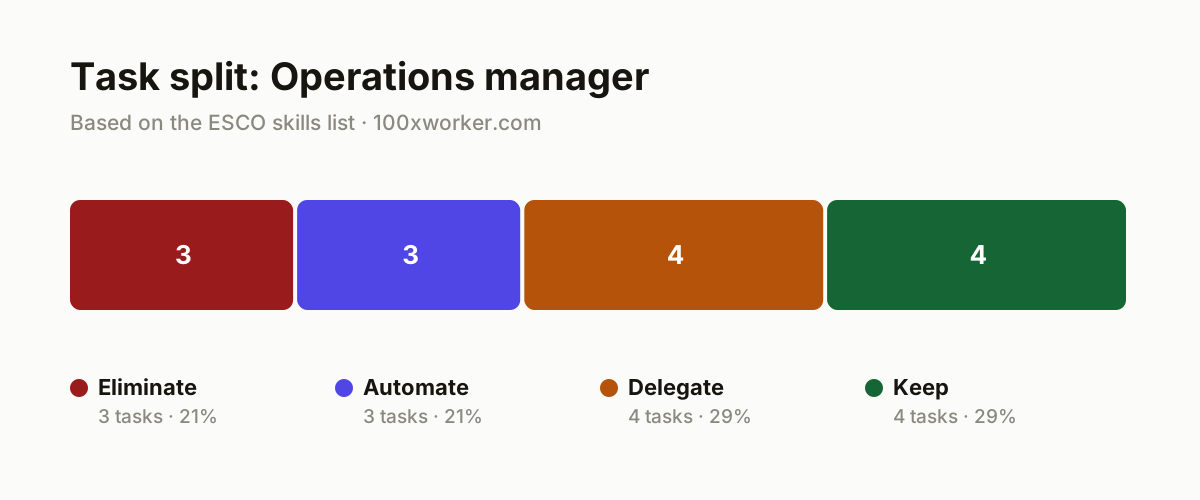
Not every task in a job changes the same way when AI enters the picture. Some tasks disappear because software now does them end to end. Some get automated into a template or workflow you still own. Some you delegate to AI as a first draft, then edit and decide. And some stay fully in your hands because they involve judgment, risk or relationships a model cannot carry. Anthropic's Economic Index applies a similar split, classifying AI use in millions of conversations as either automation-like or augmentation-like. For operations managers, the split looks roughly like this.
| Task | Bucket | Why |
|---|---|---|
| Manually assembling KPI dashboards from separate Excel exports across teams | eliminate | The data already lives in your systems; agents pull and merge it without a human touching a spreadsheet. |
| Writing separate weekly status reports for each team by hand | eliminate | One continuous AI-generated dashboard replaces siloed reports that repeat the same underlying numbers. |
| Manually typing up meeting minutes and action items after every meeting | eliminate | Transcription and summary tools do this faster and more consistently than someone taking notes live. |
| Structuring the first draft of a business plan or strategic plan | automate | Given inputs, numbers and templates, an agent produces a complete first version to edit from. |
| Running financial forecasts and scenarios from historical data | automate | Models process historical series faster and with fewer errors than a manually maintained spreadsheet. |
| Drafting job postings and doing first-pass screening of incoming resumes | automate | Text and initial filtering are standardized enough to hand fully to software. |
| Analyzing business processes and identifying bottlenecks | delegate | AI flags patterns in the data; you decide which fix is organizationally and humanly workable. |
| Preparing negotiation briefs with stakeholder positions, interests and scenarios | delegate | AI assembles the brief; you run the conversation and decide where to give ground. |
| Drafting health and safety policy documents and procedures | delegate | A compliant first draft saves hours; final sign-off responsibility stays with you. |
| Drafting org charts and restructuring scenarios | delegate | AI generates options against criteria you set; you weigh the human impact of each one. |
| Making strategic business decisions about investment, growth and direction | keep | These decisions set the company's course and affect people and resources directly. (Your edge: No tool takes on accountability and risk judgment for you.) |
| Managing staff and having difficult performance conversations | keep | Motivation, trust and conflict get resolved in a real conversation, not in a prompt. (Your edge: Trust is built only through direct, personal contact.) |
| Building business relationships and negotiating with partners and clients | keep | Relationships and credibility form through personal contact, not a generated email. (Your edge: Authority and trust only form through human presence.) |
| Carrying ethical and legal ultimate responsibility for company decisions | keep | Liability and ethical judgment cannot be outsourced to software. (Your edge: Liability rests legally and morally with a human, always.) |
What tasks will AI take over from operations managers?
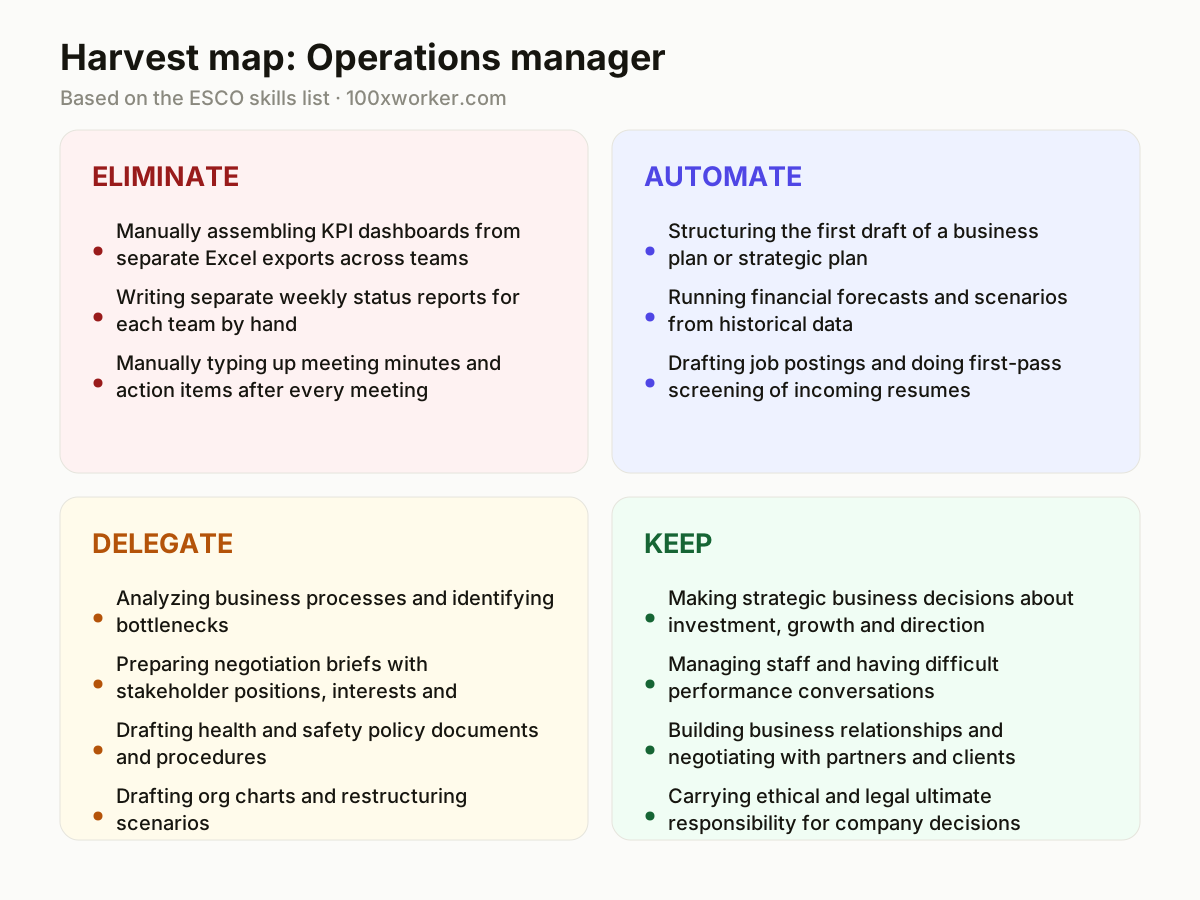
AI removes the manual grind first: pulling numbers from separate spreadsheets into a KPI dashboard, writing weekly status reports team by team, and typing up meeting minutes. It also automates well-templated work: a first-draft business plan, financial forecasts run against historical data, and drafting job postings with initial resume screening. Those tasks were already semi-structured. AI just does the assembly faster and more consistently than a person repeating the same steps every week.
Will AI replace operations managers?
No. Microsoft Research puts the AI applicability score for general and operations managers at only 11.0%, one of the lower scores among occupations it measured, well below translators at 49%. AI reaches into reporting, drafting and forecasting, but strategic decisions, staff management, negotiation and legal or ethical accountability stay with a human. The job changes shape rather than disappears: fewer hours on assembling numbers, more hours on judgment calls that AI cannot make for you.
What can you do this month to become the AI-savvy person on your team?
Pick one recurring report you build by hand and rebuild it once with an AI tool connected to your data source, then compare the output against your own version. Have AI draft your next policy document, org chart scenario or negotiation brief before you touch it yourself, so you start from an edited draft instead of a blank page. Track how much time you actually save over two weeks. That single habit, repeated across a few task types, is what separates people who use AI from people who just talk about it.
How does AI use among operations managers differ from other occupations?
At 11.0%, operations managers sit well below translators (49%) and closer to nurses (12%) on Microsoft Research's applicability scale, because so much of the job depends on judgment, negotiation and accountability rather than text or data transformation. Anthropic's Economic Index shows a similar pattern across occupations: roles with more augmentation-style use (AI assisting a human decision) skew toward management, while roles with more automation-style use skew toward content and data tasks. Adoption is still rising broadly: 32.7% of EU adults used generative AI in 2025, per Eurostat, but usage intensity varies sharply by job.
AI applicability measures where generative AI is demonstrably useful within a worker's tasks, not whether it can replace the job as a whole.
Microsoft Research, Working with AI (2025)
Become the AI person on your team
Rebuild one dashboard end to end
Connect an AI tool directly to the data sources your team already exports to Excel and let it generate the KPI dashboard automatically. Compare it against your manual version for a month before fully switching over.
Draft before you think
For your next business plan section, policy document or negotiation brief, generate a first draft with AI before opening a blank document. Edit from there instead of starting from zero.
Track your own time savings
Keep a simple log of which tasks you handed to AI and how many minutes they used to take versus now. Use that log to decide what to fully delegate next quarter.
Want this for your actual task list?
The free scan on the homepage builds your personal task map in 30 seconds, based on your role and industry.
Run the free task scanTools for this work
| Tool | For which tasks | The sober take |
|---|---|---|
| Microsoft Copilot | KPI dashboards, weekly status reports, meeting summaries | Works inside Excel, Teams and Outlook, which is where most of this reporting already lives. |
| Claude (Anthropic) | First drafts of business plans, policy documents, org chart scenarios | Strong at structuring long documents from bullet-point input, still needs your edit pass. |
| AI meeting transcription tools (e.g. Otter.ai, Fireflies) | Meeting minutes and action item lists | Replaces manual note-taking but you still need to check accuracy on names and numbers. |
| AI-enabled BI tools (e.g. Power BI Copilot) | Financial forecasts and scenario modeling from historical data | Speeds up scenario building but the assumptions you feed it still decide the output quality. |
Prompts to try today
First-draft business plan structure
Financial forecast scenarios
Negotiation brief prep
Related jobs
Frequently asked questions
Will AI eliminate operations manager jobs entirely?
No evidence supports that. Microsoft Research scored general and operations managers at 11.0% AI applicability, one of the lower scores in its dataset, meaning most of the job's activities are not currently reachable by generative AI. The role is shifting toward less time on manual reporting and more time on decisions, negotiation and staff management, which stay human.
How does the operations manager's AI applicability score compare to other jobs?
At 11.0%, operations managers score close to nurses (12%) and far below translators, who top Microsoft Research's list at 49%. This reflects how much of the job depends on judgment and relationships rather than text generation or data transformation, the areas where large language models perform best.
Should operations managers actively learn AI tools like Copilot or Claude?
Yes, because the tasks AI already handles well (reporting, drafting, forecasting) currently consume a large share of an operations manager's week. Learning to direct these tools and edit their output well is becoming a practical skill, even though the applicability score for the overall role stays modest.
Does AI reduce the value of management experience?
No. AI removes some of the administrative overhead around management, but the parts of the job tied to experience, judgment under uncertainty, negotiation, and accountability for outcomes remain fully human. If anything, freed-up time from automated reporting increases the relative value of experienced judgment.
Sources
- Microsoft Research, Working with AI: Measuring the Applicability of Generative AI to Occupations (2025)
- Anthropic Economic Index
- Eurostat, isoc_ai_iaiu (generative AI use, 2025)
- ESCO, European Commission occupation taxonomy
Hendrik De Winne, author of Becoming AI-Savvy, founder of VibeLab. Helps teams redesign their work with AI.
This article was drafted with AI assistance from public data sources and editorially reviewed.