100×worker · job analysis
Will AI Replace Travel Agents?

Travel agents spend a lot of their week on tasks that generative AI can now do faster: comparing supplier prices, pulling destination facts, drafting confirmations. Microsoft Research analyzed 200,000 real Copilot conversations and scored travel agents at 23.7% applicability for generative AI, a mid-low score on a scale where translators top out at 49% and nurses sit at 12%. That number is not a prediction of job loss. It is a rough map of which parts of the job AI can already touch.
Adoption is moving fast enough that this map matters now, not later. Eurostat found that 32.7% of the EU population aged 16 to 74 used generative AI in the three months before being surveyed in 2025. Anthropic's Economic Index, which classifies millions of Claude conversations against O*NET task lists, shows a consistent split across occupations between automation-like use (AI does the task) and augmentation-like use (AI helps you do it). For travel agents, that split runs roughly along the line between paperwork and advice. This article breaks the job into four buckets, eliminate, automate, delegate, and keep, using ESCO's own task list for the occupation.
A travel agent designs and sells travel programs, with personal advice as the core value.
The task split: what AI takes over and what stays yours
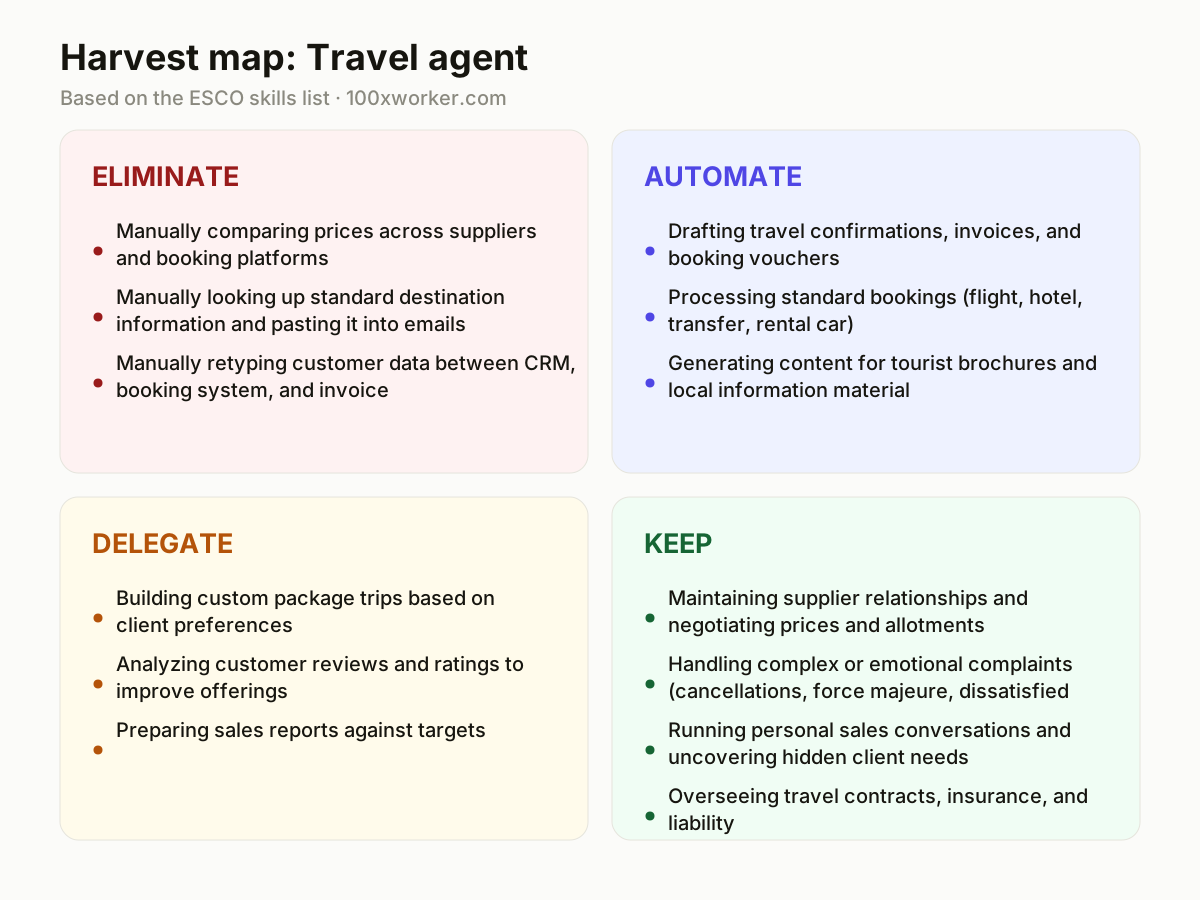
ESCO breaks the travel agent occupation down into dozens of concrete tasks, from processing bookings to advertising travel insurance to maintaining supplier relationships. Instead of asking whether the job as a whole disappears, it helps to sort each of those tasks into one of four buckets: tasks AI eliminates because the manual version no longer makes sense, tasks AI automates end to end for standard cases, tasks AI can draft or analyze first so you delegate and check the output, and tasks that stay with you because they depend on trust, negotiation, or liability. Below is that breakdown for travel agents.
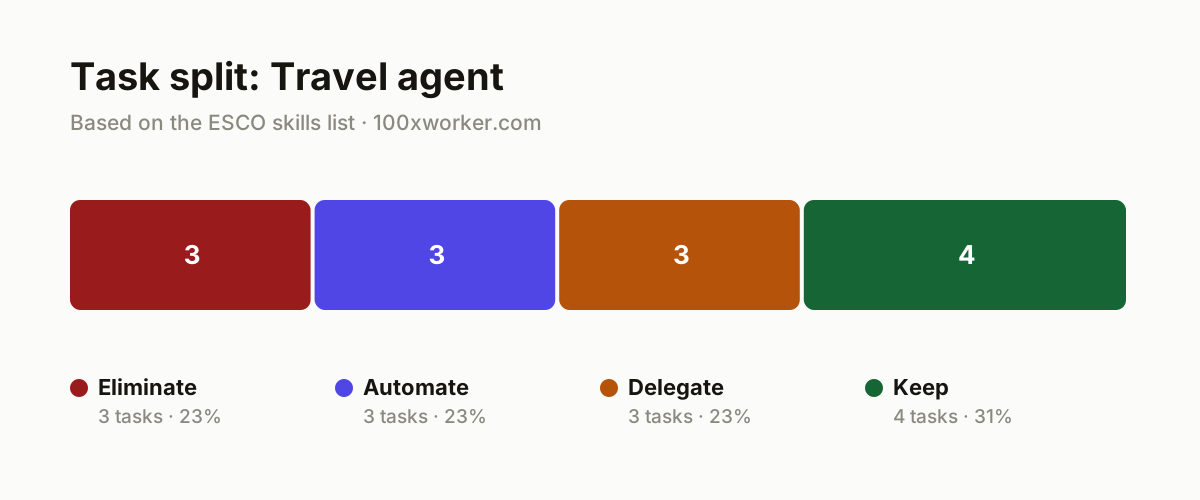
| Task | Bucket | Why |
|---|---|---|
| Manually comparing prices across suppliers and booking platforms | eliminate | AI tools scan dozens of suppliers' rates in seconds, faster and more consistently than manual searching. |
| Manually looking up standard destination information and pasting it into emails | eliminate | A language model pulls destination facts and drops them straight into a personalized email. |
| Manually retyping customer data between CRM, booking system, and invoice | eliminate | Integrations and AI autofill sync data automatically, removing error-prone copy work. |
| Drafting travel confirmations, invoices, and booking vouchers | automate | Templates filled with booking data produce a publication-ready document without manual input. |
| Processing standard bookings (flight, hotel, transfer, rental car) | automate | For straightforward bookings with no customization, an AI system can run the full transaction. |
| Generating content for tourist brochures and local information material | automate | AI writes brochure copy in house style, ready to publish after a quick check. |
| Building custom package trips based on client preferences | delegate | AI drafts a first itinerary from stated preferences and budget, you check it against taste and feasibility. |
| Analyzing customer reviews and ratings to improve offerings | delegate | AI clusters hundreds of reviews into patterns, you decide which pattern deserves action. |
| Preparing sales reports against targets | delegate | AI pulls figures from the CRM and writes a first draft of the report, you interpret the numbers. |
| Maintaining supplier relationships and negotiating prices and allotments | keep | Negotiation runs on trust, mutual interest, and history, none of which a model builds. (Your edge: You cannot build a long-term supplier relationship through a chat window.) |
| Handling complex or emotional complaints (cancellations, force majeure, dissatisfied customers) | keep | Empathy, judgment, and the right tone in a hard conversation require a person. (Your edge: You sense when a customer needs a gesture, not a script.) |
| Running personal sales conversations and uncovering hidden client needs | keep | What a client does not say out loud comes through in tone, hesitation, and posture during the conversation itself. (Your edge: Sensing what a client leaves unsaid stays human work.) |
| Overseeing travel contracts, insurance, and liability | keep | Legal and financial responsibility for the travel package rests with a person. (Your edge: The liability sits with you, not with the software.) |
Will AI replace travel agents?
No single tool replaces the travel agent job, but AI is already replacing specific tasks inside it. Microsoft Research's 2025 study of 200,000 real Copilot conversations scores travel agents at 23.7% applicability for generative AI, mid-low compared with 49% for translators and 12% for nurses. Roughly a quarter of the work, price lookups, standard confirmations, drafting brochure text, can be done by AI today. The rest, negotiating with suppliers, calming an angry client after a cancelled flight, reading what a couple actually wants for a honeymoon, still needs a person. The job does not disappear. The task list inside it changes.
Which travel agent tasks will AI take over?
AI takes over two kinds of tasks. First, work that disappears entirely: manually comparing supplier prices, copy-pasting destination facts into emails, and retyping customer data between CRM, booking system, and invoices. Second, work that gets automated but still needs a check: drafting booking confirmations, invoices, and vouchers, processing standard flight, hotel, transfer, or rental car bookings with no customization, and writing first drafts of brochure copy and local information sheets. Anthropic's Economic Index, which classifies AI conversations against O*NET task lists, finds this pattern across occupations: AI handles the repetitive, well-defined half of a job first and leaves the judgment-heavy half for later.
What can a travel agent do this month with AI?
Start with one AI tool connected to your booking system or CRM and use it for a single recurring task, for example generating booking confirmations or drafting a first version of a custom itinerary. Feed it your standard templates so output matches your house style. Use it to summarize customer reviews before a quarterly report instead of reading every review yourself. Keep a human check on anything involving money, a contract, or a customer's name before it goes out. Track the time this saves in a normal week, then decide which task to automate next. Small, one-task pilots work better than overhauling the whole booking process at once.
How do you become the AI person at your travel agency?
Learn which parts of your day AI already handles well (drafting, lookups, summaries) and which parts still need you (negotiating rates, reading a client's hesitation, resolving a complaint). Volunteer to test new tools on your own bookings before the agency rolls them out to everyone, and write up what worked in plain language colleagues can copy. Build a short reference sheet of prompts for common tasks (itinerary drafts, complaint responses, brochure copy) and share it. Being the person who can explain, in one sentence, what a tool is good for and where it fails matters more than being the fastest typist in the office.
Travel agents show a 23.7 percent applicability score for generative AI, well below translators at 49 percent and well above nurses at 12 percent.
Microsoft Research, Working with AI (2025)
Become the AI person on your team
Run a two-week pilot on one task
Pick booking confirmations or itinerary drafts and run AI on real bookings for two weeks. Compare output quality and time saved against doing it manually before rolling it out further.
Build a shared prompt library
Collect the prompts that work for itinerary drafts, complaint replies, and brochure copy in one document. Colleagues start from a working prompt instead of a blank page.
Keep an error log
Note every time AI output was wrong, a wrong price, a wrong visa rule, a wrong hotel category. Use the log to show management exactly where human review stays mandatory.
Want this for your actual task list?
The free scan on the homepage builds your personal task map in 30 seconds, based on your role and industry.
Run the free task scanTools for this work
| Tool | For which tasks | The sober take |
|---|---|---|
| General AI chat assistant (ChatGPT, Claude, Copilot) | Drafting brochure content, summarizing reviews, first-draft itineraries | Needs a human check before anything reaches a client, since prices and visa rules change faster than the model's training data. |
| GDS or booking platform with built-in AI features | Processing standard bookings, generating confirmations and vouchers | Works well for bookings with no customization; multi-leg or highly custom trips still need a person to assemble. |
| CRM with AI autofill and data sync | Eliminating manual data retyping between CRM, booking system, and invoice | Cuts copy errors, but someone still has to set up and periodically check the integration. |
| Review-analysis or feedback-summary tool | Analyzing customer reviews and ratings, preparing sales reports | Good at spotting patterns across hundreds of reviews, weak at judging which pattern deserves action. |
Prompts to try today
Draft a custom itinerary from client preferences
Summarize customer reviews before a report
Draft a complaint response for a cancelled trip
Related jobs
Frequently asked questions
Will AI take my job as a travel agent?
AI is unlikely to replace the whole job, but it is already handling a meaningful slice of it. Microsoft Research's applicability score for travel agents is 23.7%, which covers tasks like price comparisons, standard booking confirmations, and brochure drafts. Tasks that involve negotiation with suppliers, emotional complaint handling, and reading unspoken client needs stay with a person. Expect your task list to shift toward advice and judgment, not to disappear entirely.
How does the travel agent AI applicability score compare to other jobs?
Microsoft Research's 2025 study scores travel agents at 23.7% applicability for generative AI. That places the occupation in the middle of the range: translators score highest at 49%, since their work is almost entirely language transformation, and nurses score lowest at 12%, since their work is largely physical and interpersonal. Travel agents sit closer to the nurse end because so much of the job involves trust, negotiation, and reading a client in person.
How many people actually use generative AI right now?
Adoption varies by region but is rising quickly. Eurostat found that 32.7% of the EU population aged 16 to 74 used generative AI in the three months before being surveyed in 2025. That means a growing share of your customers already use AI chatbots to research trips before they contact an agent, which changes what they expect an agent to add on top.
Should I list AI skills on my resume as a travel agent?
Yes, if you can point to a concrete example. Naming a specific tool you used to draft itineraries, process reviews, or generate confirmations, and stating the time it saved, is more convincing than a generic line about being 'AI-savvy'. ESCO's occupational skill list for travel agents already centers on customer relationship management software and CRM tools, so AI fluency fits naturally into skills employers already expect.
Sources
- Microsoft Research, Working with AI: Measuring the Applicability of Generative AI to Occupations (2025)
- Anthropic Economic Index
- Eurostat, Individuals using generative AI (isoc_ai_iaiu)
- ESCO, European Commission occupational taxonomy
Hendrik De Winne, author of Becoming AI-Savvy, founder of VibeLab. Helps teams redesign their work with AI.
This article was drafted with AI assistance from public data sources and editorially reviewed.