100×worker · job analysis
Will AI Replace Warehouse Managers? What Changes Now
Warehouse managers spend their days on a mix of paperwork, scheduling, safety walks, and supplier calls. Some of that work is now within reach of generative AI. Microsoft Research analyzed 200,000 real Copilot conversations and scored occupations on an AI applicability scale. Transportation, storage, and distribution management roles, the closest US occupational match to warehouse manager, scored 20.5%. For comparison, translators topped the list at 49% and nurses sat near the bottom at 12%. Warehouse management lands in the middle: a meaningful share of tasks can shift, but most of the job stays put.
That 20.5% is not evenly spread across the job. It clusters in documentation, data entry, and repetitive calculation, the kind of work described in this article's eliminate and automate buckets below. Anthropic's Economic Index, which classifies millions of Claude conversations against O*NET task lists, finds a similar split industry-wide: some AI use replaces a task outright, and some augments a person doing it. For a warehouse manager, the practical question is not whether AI touches your job, but which of your specific ESCO-listed tasks it touches, and how you respond to each one.
A warehouse manager runs storage facilities, staff, and inventory flow so goods ship on time and safely.
The task split: what AI takes over and what stays yours
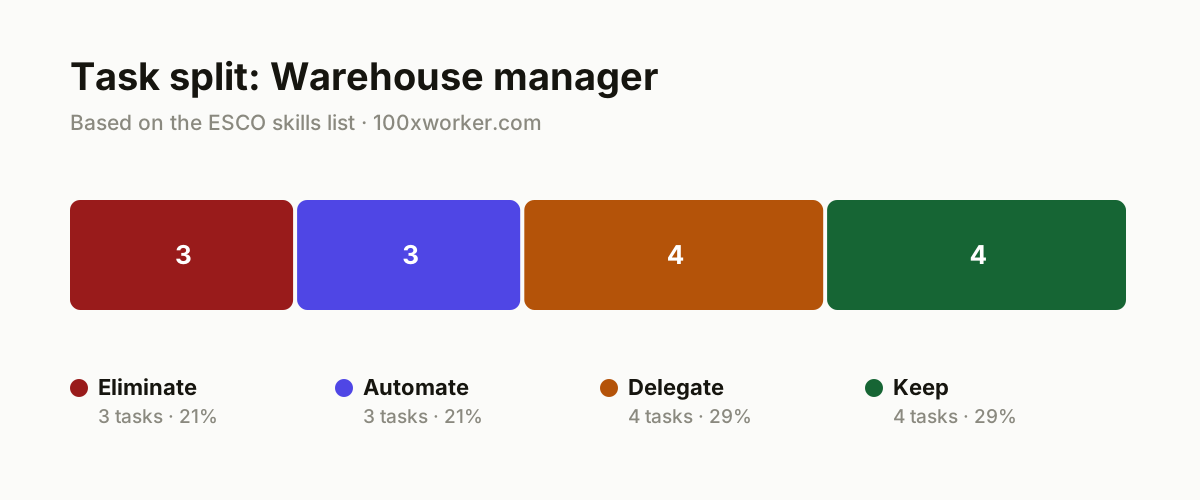
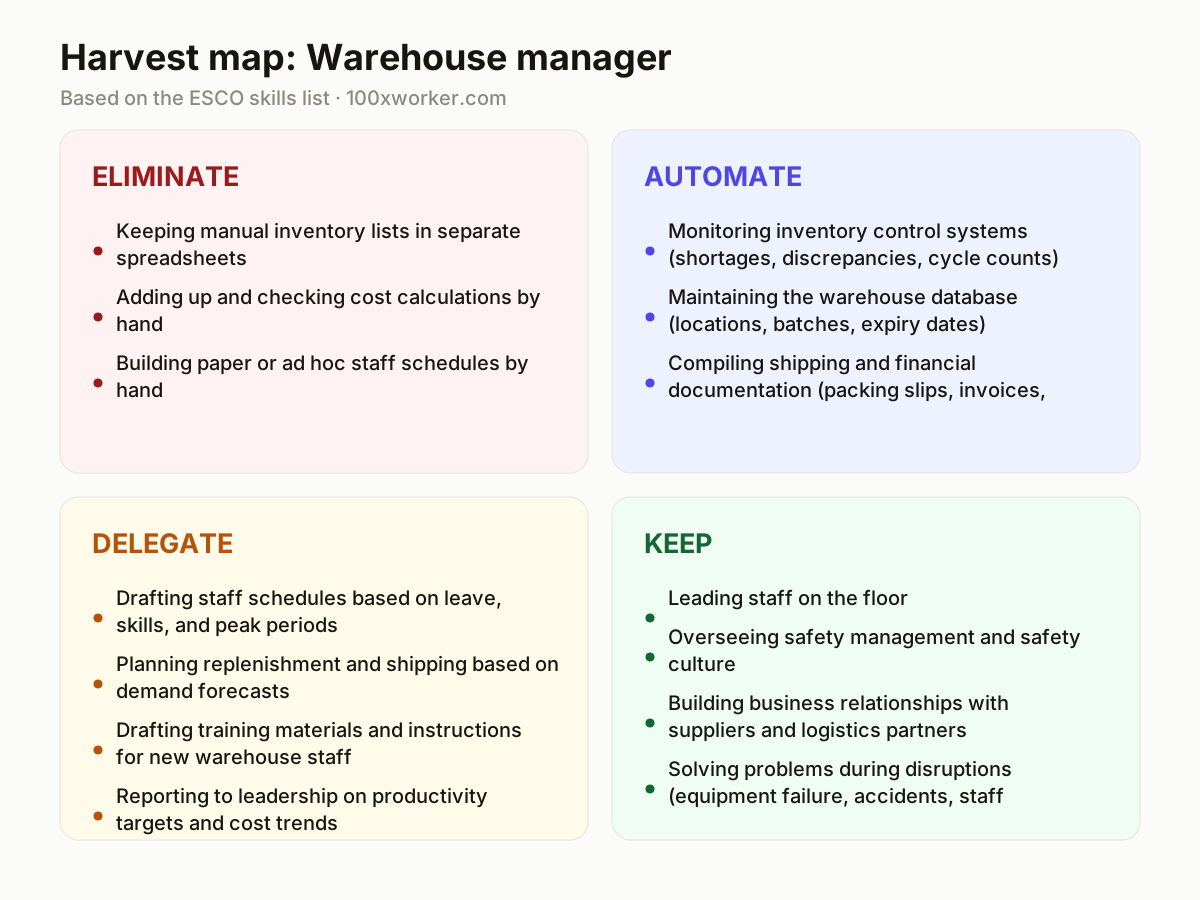
This article sorts a warehouse manager's core tasks (based on the ESCO occupational profile) into four buckets: eliminate, tasks AI makes pointless to do manually; automate, tasks AI or a connected system now runs with light oversight; delegate, tasks where AI drafts and you decide; and keep, tasks that stay with you because they need presence, judgment, or accountability that no model provides.
| Task | Bucket | Why |
|---|---|---|
| Keeping manual inventory lists in separate spreadsheets | eliminate | Real-time data from the warehouse management system replaces manual tally sheets and removes error-prone busywork. |
| Adding up and checking cost calculations by hand | eliminate | Software calculates cost per shipment or pallet automatically and without errors, faster than a spreadsheet full of formulas. |
| Building paper or ad hoc staff schedules by hand | eliminate | A bare schedule that ignores leave and peak periods is data entry, not a decision worth your time. |
| Monitoring inventory control systems (shortages, discrepancies, cycle counts) | automate | An agent compares count data against system records and flags discrepancies without anyone checking every row. |
| Maintaining the warehouse database (locations, batches, expiry dates) | automate | Scanners and sensors feed the system directly; an agent keeps the database consistent and current. |
| Compiling shipping and financial documentation (packing slips, invoices, customs paperwork) | automate | Documents with fixed fields and repeated structure get produced faster and with fewer errors by an agent than by hand. |
| Drafting staff schedules based on leave, skills, and peak periods | delegate | AI drafts a realistic first version; you rearrange it based on who's who and what's happening on the floor. |
| Planning replenishment and shipping based on demand forecasts | delegate | AI runs scenarios from historical data; you know the exceptions and make the final call. |
| Drafting training materials and instructions for new warehouse staff | delegate | AI writes a first draft of the procedure; you check it against the real floor and real hazards. |
| Reporting to leadership on productivity targets and cost trends | delegate | AI summarizes the numbers into a readable report; you add context and accountability to the decision. |
| Leading staff on the floor | keep | Directing people requires presence, timing, and authority you cannot get from a screen. (Your edge: Trust and presence build only in person.) |
| Overseeing safety management and safety culture | keep | Physically checking equipment and behavior on the floor requires someone who walks the floor and steps in. (Your edge: Physical inspection and direct intervention stay human work.) |
| Building business relationships with suppliers and logistics partners | keep | Negotiating and building trust with partners depends on relationship and context, not generated text. (Your edge: No model negotiates on trust.) |
| Solving problems during disruptions (equipment failure, accidents, staff shortages) | keep | Setting priorities under pressure and taking responsibility requires someone who personally carries the consequences. (Your edge: Taking responsibility under pressure stays with you.) |
Which tasks does AI take over for a warehouse manager?
AI takes over the parts of the job that are repetitive, rule-based, and document-heavy. That includes manual inventory tallies, cost calculations, and first drafts of schedules, which mostly disappear as separate manual steps. It also covers ongoing monitoring: cycle counts, database upkeep, and shipping paperwork now run through connected systems and AI agents with light human review. According to Microsoft Research, this applicability shows up in roughly one-fifth of work activities for the closest matching occupation, transportation, storage, and distribution managers. The tasks that remain manual (leadership, safety walks, supplier negotiation, crisis response) sit outside what generative AI can currently do on its own.
Will AI replace warehouse managers?
No single tool replaces the job, because most of a warehouse manager's value sits in tasks AI cannot do: supervising people directly, enforcing safety on the floor, negotiating with suppliers, and making judgment calls during a disruption. Microsoft Research's applicability score of 20.5% for the closest matching occupation confirms this: a meaningful slice of tasks shifts, but roughly four-fifths of the work stays with a person. What changes is the shape of the job. Fewer hours go to paperwork and manual tracking, more time goes to decisions, coaching, and relationships. Managers who ignore this shift risk falling behind peers who use AI to clear admin time for higher-value work.
How do you become the AI person on your warehouse team?
Start by mapping your own task list against the four buckets above, then pick one delegate task to try first, such as a draft weekly schedule or a draft shipping report. Show your team the before-and-after: how long a task took manually versus with an AI-assisted draft. Anthropic's Economic Index shows AI use splits between fully automating a task and augmenting a person doing it; aim to be the manager who demonstrates augmentation, not replacement. Document what worked in a short internal guide so schedulers, planners, and admin staff can reuse the same prompts and workflow.
What can you do this month with AI as a warehouse manager?
Pick one recurring document, such as a weekly productivity report or a training checklist, and draft it with a generative AI assistant instead of starting from a blank page. Compare the draft against your last three manual versions to check accuracy and tone. Next, ask your WMS or scheduling vendor whether an AI-based demand forecast or auto-scheduling module is already included in your license; many warehouse systems have added this without a separate rollout. Keep a short log of hours saved on paperwork versus hours you reinvest in floor supervision and supplier calls.
Across occupations, generative AI applicability varies widely, from 49% for translators down to 12% for nurses, showing how unevenly the technology maps onto different jobs.
Microsoft Research, Working with AI (2025)
Become the AI person on your team
Run a task audit against ESCO
List your daily and weekly tasks and match them against the ESCO warehouse manager skill list. Mark each one eliminate, automate, delegate, or keep, and share the result with your team so everyone understands what changes and what does not.
Pilot one delegate task for four weeks
Choose a low-risk task like a draft training document or a draft cost report. Use AI for the first draft every time for a month, then compare quality and time saved against the old manual process before rolling it out wider.
Protect the keep tasks explicitly
Block time on your calendar for floor supervision, safety walks, and supplier check-ins so admin work does not creep back into those hours as it shrinks elsewhere. Treat the freed-up time as a resource to reallocate, not a reason to add headcount elsewhere.
Want this for your actual task list?
The free scan on the homepage builds your personal task map in 30 seconds, based on your role and industry.
Run the free task scanTools for this work
| Tool | For which tasks | The sober take |
|---|---|---|
| Warehouse Management System (WMS) with built-in demand forecasting | automate (inventory monitoring, database upkeep), delegate (replenishment planning) | Many existing WMS licenses already include a forecasting or anomaly-flagging module worth checking before buying new software. |
| Generative AI assistant (e.g., Microsoft Copilot) | delegate (reports, training drafts), eliminate (manual tally sheets) | Useful for first drafts of documents and reports, still needs a human check before anything goes to leadership or a client. |
| AI-assisted staff scheduling software | delegate (staff schedules), eliminate (paper rosters) | Generates a first-pass schedule from leave and skills data; you still adjust for real team dynamics. |
| Document automation platform for shipping and customs paperwork | automate (packing slips, invoices, customs documentation) | Works best on standardized, repeated document types; exceptions still need manual review. |
Prompts to try today
Draft a weekly staff schedule
Summarize a productivity and cost report
Draft a training procedure for new staff
Related jobs
Frequently asked questions
What is an AI applicability score?
It is a measure Microsoft Research built from 200,000 real Copilot conversations, showing what share of an occupation's work activities generative AI can plausibly assist with or complete. Warehouse-adjacent roles (transportation, storage, and distribution managers) scored 20.5%, in the middle of the full occupation range, well below translators (49%) and well above nurses (12%). The score does not predict job loss; it flags which tasks are worth reviewing first.
Does using AI mean fewer warehouse manager jobs?
There is no verified data in this analysis showing job losses specifically for warehouse managers. What the applicability score shows is a shift in task composition: less time on manual documentation and tracking, more time on supervision, safety, and supplier relationships. How that plays out for headcount depends on company size and how the freed-up time gets used, which is a decision for each employer, not a fixed outcome of the technology.
How does warehouse management compare to other jobs on AI exposure?
At 20.5%, warehouse management sits below high-exposure roles like translation (49%) and above low-exposure roles like nursing (12%), based on Microsoft Research's occupation scoring. This places it in a middle band: enough task overlap with generative AI to be worth restructuring, but far from a role that generative AI can run end to end. Anthropic's Economic Index adds that AI use in this range tends to skew toward augmenting a task rather than fully automating it.
What skills should warehouse managers build for AI?
Prioritize skills that sit in the delegate and keep buckets from the ESCO task list: writing clear prompts for drafting schedules or reports, reviewing AI output for accuracy before it reaches leadership, and strengthening the parts of the job AI cannot touch, like safety oversight and supplier negotiation. Comfort with your WMS's forecasting or automation features also matters, since much of the relevant AI is already built into existing warehouse software rather than a separate tool you adopt.
Sources
- Microsoft Research, Working with AI: Measuring the Applicability of Generative AI to Occupations (2025)
- Anthropic Economic Index
- Eurostat, Individuals using generative AI (isoc_ai_iaiu)
- ESCO, European Commission occupational taxonomy
Hendrik De Winne, author of Becoming AI-Savvy, founder of VibeLab. Helps teams redesign their work with AI.
This article was drafted with AI assistance from public data sources and editorially reviewed.