100×worker · job analysis
Will AI Replace Logistics Managers? What Actually Changes
Logistics managers spend a lot of the day on calculation and coordination: checking reorder levels, comparing carrier rates, chasing shipment status, and writing reports. Microsoft Research analyzed 200,000 real Copilot conversations and mapped them to occupations. For transportation, storage, and distribution managers, the closest US match to a logistics manager, generative AI is applicable to about 20.5% of work activities. That is far below translators, who top the list at 49%, and well above nurses, near the bottom at 12%.
That 20.5% is not spread evenly across the job. It sits mostly in spreadsheet work, rate comparisons, and report drafting, the parts of the role that already run on structured data. Across the wider economy, adoption is climbing fast: Eurostat reports that 32.7% of the EU population aged 16 to 74 used generative AI in the three months before being surveyed in 2025. Anthropic's Economic Index shows a similar split in how people actually use AI, some of it automating routine steps, most of it augmenting a task a person still owns.
This article breaks the logistics manager role into four groups: tasks AI eliminates outright, tasks it automates end to end, tasks you delegate to AI for a first draft, and tasks you keep because they need your physical presence, authority, or judgment. The goal is a task-level view you can use this month, not a prediction about your job title.
A logistics manager directs goods flow, storage, and transport; AI mainly handles calculations and reporting.
The task split: what AI takes over and what stays yours
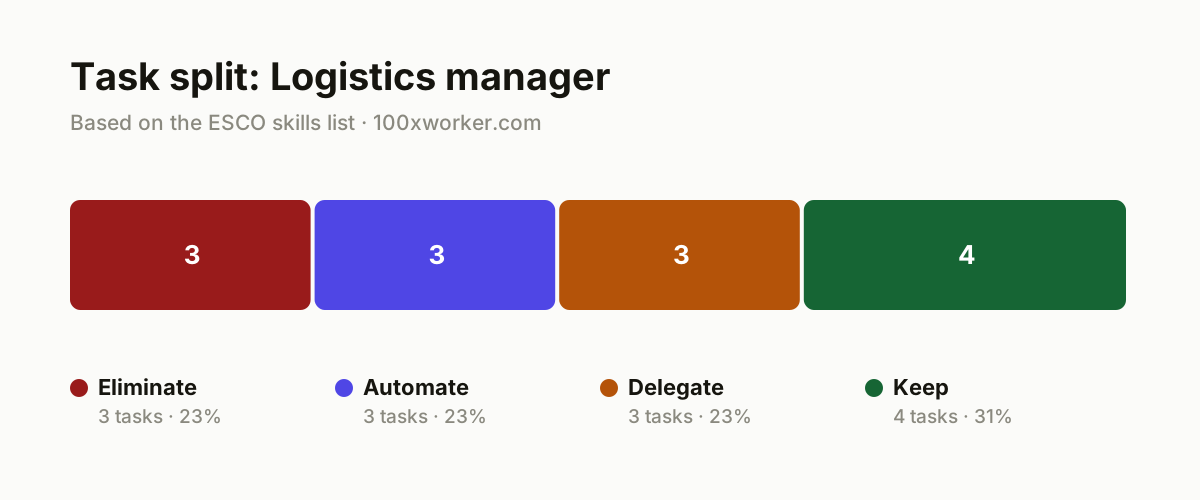
AI does not change a logistics manager's job title. It changes the task list underneath it. Sorting your tasks into four buckets, eliminate, automate, delegate, and keep, shows exactly where AI removes work, where it does the work for you, where it hands you a draft, and where your presence and judgment still decide the outcome.
| Task | Bucket | Why |
|---|---|---|
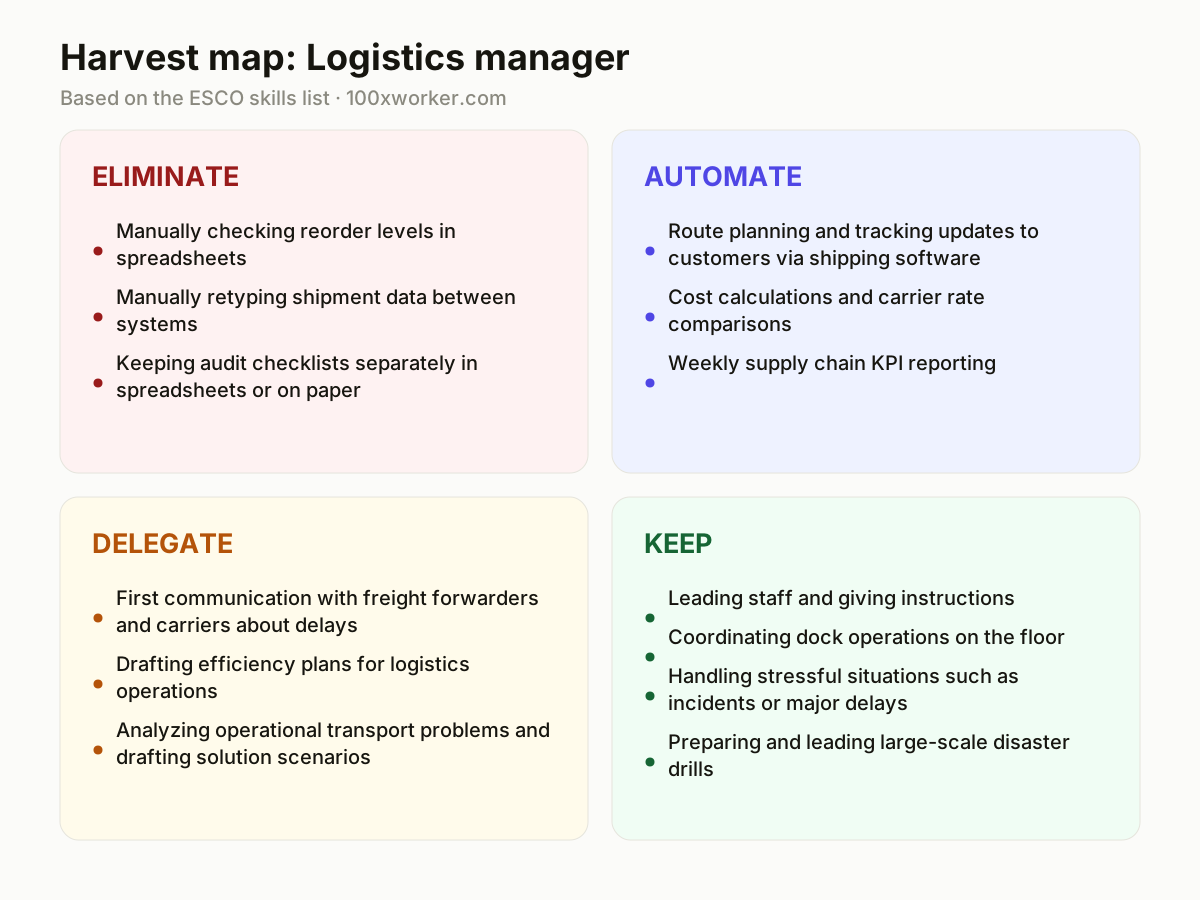
| Manually checking reorder levels in spreadsheets | eliminate | Modern WMS and ERP systems monitor thresholds automatically and trigger replenishment on their own. |
| Manually retyping shipment data between systems | eliminate | Electronic trading systems and EDI links sync data between platforms without manual re-entry. |
| Keeping audit checklists separately in spreadsheets or on paper | eliminate | Compliance dashboards track audit readiness continuously, so separate checklists are no longer needed. |
| Route planning and tracking updates to customers via shipping software | automate | Shipping software systems calculate routes and send status updates without a human step. |
| Cost calculations and carrier rate comparisons | automate | An AI agent pulls rates, compares them, and calculates total shipment cost automatically. |
| Weekly supply chain KPI reporting | automate | Dashboards generate reports from existing data, ready to send without manual work. |
| First communication with freight forwarders and carriers about delays | delegate | AI drafts the message from status data, you review and send whenever something looks off. |
| Drafting efficiency plans for logistics operations | delegate | AI produces a first version from historical data, you check it against the floor and decide. |
| Analyzing operational transport problems and drafting solution scenarios | delegate | AI lays out scenarios and trade-offs, you choose and own the final decision. |
| Leading staff and giving instructions | keep | Building trust and authority does not happen through a screen. (Your edge: People follow you, not a dashboard.) |
| Coordinating dock operations on the floor | keep | Real-time adjustments on the floor require physical presence and overview. (Your edge: You see and correct what data misses.) |
| Handling stressful situations such as incidents or major delays | keep | Making calls under pressure and owning the outcome stays human work. (Your edge: You make the call, not the model.) |
| Preparing and leading large-scale disaster drills | keep | Physically directing teams during a drill requires presence and authority. (Your edge: Authority is not practiced over chat.) |
Which tasks does AI take over from logistics managers?
AI removes the manual layer around three groups of tasks. It eliminates spreadsheet reorder checks, manual data re-entry between shipping and ERP systems, and separate audit checklists, because modern WMS platforms and EDI links already handle this automatically. It automates route planning, carrier rate comparison, and weekly KPI reporting, tasks that follow clear rules and existing data. For carrier communications, efficiency plans, or problem-solving scenarios, AI produces a first draft or option set, and you review, adjust, and decide. The pattern holds across the role: AI handles calculation and drafting, you handle judgment calls involving trade-offs, safety, or people.
Will AI replace logistics managers?
No. Microsoft Research's 2025 study of 200,000 real Copilot conversations puts generative AI's applicability at about 20.5% of work activities for transportation, storage, and distribution managers, the closest US occupational match. That is far below translators (49%) and roughly in the middle of the occupations Microsoft studied. The ESCO job description for this role centers on decisions: coordinating dock work, leading staff, managing fleets, and handling incidents. Those tasks involve physical presence, authority, and judgment under pressure, none of which current AI tools can perform. AI changes the task list inside the job. It does not remove the need for someone to run the operation.
How do you become the AI person on your logistics team?
Start by mapping your own task list against the ESCO skill list for this role, then mark which tasks are pure calculation (automate), which need a first draft (delegate), and which need your presence (keep). Pick one recurring report or one type of carrier email and build a template or prompt for it. Share that template with your team instead of keeping it to yourself. Track how much time it saves and use that number to justify rolling out the same approach to routing, cost calculations, or audit prep. Being the AI person means running these pilots first and teaching others, not knowing every tool on the market.
What can you do this month as a logistics manager?
List every recurring task you or your team does in a normal week. Sort each one into eliminate, automate, delegate, or keep using the four categories in this article. Pick the single most time-consuming automate or delegate task, usually a report or a routine email, and set up one AI-assisted workflow for it this month. Measure the hours saved after two weeks, then move to the next task on the list. Do not try to change everything at once, and do not skip the keep list: write down explicitly which tasks stay with you, so your team knows where the human decision sits.
Generative AI is applicable to roughly one in five work activities carried out by transportation, storage, and distribution managers.
Microsoft Research, Working with AI (2025)
Become the AI person on your team
Map tasks against ESCO skills
Take the ESCO skill list for logistics and distribution managers and tag each skill as eliminate, automate, delegate, or keep. This turns a vague sense that AI will change things into a concrete list you can act on.
Run one pilot before rolling out
Pick one report or one type of carrier communication and build a prompt or template for it. Test it for two weeks, measure time saved, then expand to similar tasks.
Teach the team the same prompts
Share your templates and prompts with the rest of the logistics team instead of keeping them as personal shortcuts. This spreads the time savings across the whole operation, not just your own desk.
Keep a written keep list
Write down which tasks stay human, such as dock coordination, incident response, and staff leadership. This makes the boundary clear when new AI tools get pitched to your department.
Want this for your actual task list?
The free scan on the homepage builds your personal task map in 30 seconds, based on your role and industry.
Run the free task scanTools for this work
| Tool | For which tasks | The sober take |
|---|---|---|
| Warehouse Management System (WMS) with automated replenishment | Eliminate: manual reorder level checks | Most current WMS platforms already trigger replenishment from stock thresholds without manual review. |
| Transportation Management System (TMS) with route optimization | Automate: route planning and tracking updates | TMS software calculates routes and pushes status updates to customers on its own. |
| AI copilot built into email and spreadsheet tools | Delegate: drafting carrier messages, efficiency plans, KPI summaries | Useful for first drafts, but every message and plan still needs your review before it goes out. |
| EDI and electronic trading system links | Eliminate: manual data re-entry between systems | Removes the copy-paste step between shipping software and ERP; most large carriers already support it. |
Prompts to try today
Draft a delay notice to a carrier
Build a weekly KPI summary
First draft of an efficiency plan
Related jobs
Frequently asked questions
Will AI take over logistics manager jobs completely?
No. Microsoft Research found generative AI applies to about 20.5% of the work activities in the closest matching US occupation, transportation, storage, and distribution managers. That leaves the majority of the role, decisions, staff leadership, incident response, and fleet coordination, outside what current AI tools can do on their own.
What percentage of a logistics manager's work can AI realistically handle?
Around one-fifth, based on Microsoft Research's 2025 analysis of real Copilot conversations mapped to occupations. That share concentrates in calculation-heavy and drafting tasks such as cost comparisons, route planning, and report writing, not in decisions that involve trade-offs, safety, or people management.
Do I need to learn to code to use AI in logistics management?
No. Most of the useful tools are already built into WMS, TMS, and office software you likely use today, plus general AI copilots for drafting text. The skill that matters is writing a clear prompt or setting up one workflow at a time, not programming.
Which logistics tasks should never go fully to AI?
Anything involving physical presence, authority over people, or a judgment call under pressure: leading staff, coordinating dock work in real time, handling incidents or major delays, and running disaster drills. These require someone accountable on the ground, not a model producing a recommendation.
Sources
- Microsoft Research, Working with AI: Measuring the Applicability of Generative AI to Occupations (2025)
- Anthropic Economic Index
- Eurostat, isoc_ai_iaiu
- ESCO, European Commission
Hendrik De Winne, author of Becoming AI-Savvy, founder of VibeLab. Helps teams redesign their work with AI.
This article was drafted with AI assistance from public data sources and editorially reviewed.