100×worker · job analysis
Will AI Replace Supply Chain Planners, and What Should You Do About It?
Supply chain planners spend a lot of time on work that doesn't require a planner's judgment: retyping inventory counts, chasing suppliers for order status, and rebuilding the same weekly report from five spreadsheets. That's the part AI is already good at. Microsoft Research analyzed 200,000 real Copilot conversations and scored how applicable generative AI is to different occupations. For the transportation, storage, and distribution management category closest to supply chain planning, the score came out to 20.5%, meaning roughly a fifth of typical work activities show clear AI applicability. Compare that to translators at 49% or nurses at 12%, and you get a sense of where this job sits: not a job at high risk of disappearing, but one where a meaningful slice of tasks will change hands.
That matches how researchers frame this shift generally. Anthropic's Economic Index, which classifies millions of Claude conversations against O*NET task categories, finds that AI use splits between automation (AI does the task) and augmentation (AI assists a human doing the task). For planners, most near-term AI use falls into the augmentation camp: drafting risk assessments, summarizing supplier news, running forecast scenarios. The eliminate/automate/delegate/keep breakdown below shows exactly which parts of the job move where.
A supply chain planner plans, monitors, and adjusts the flow of goods, from raw material to end customer.
The task split: what AI takes over and what stays yours
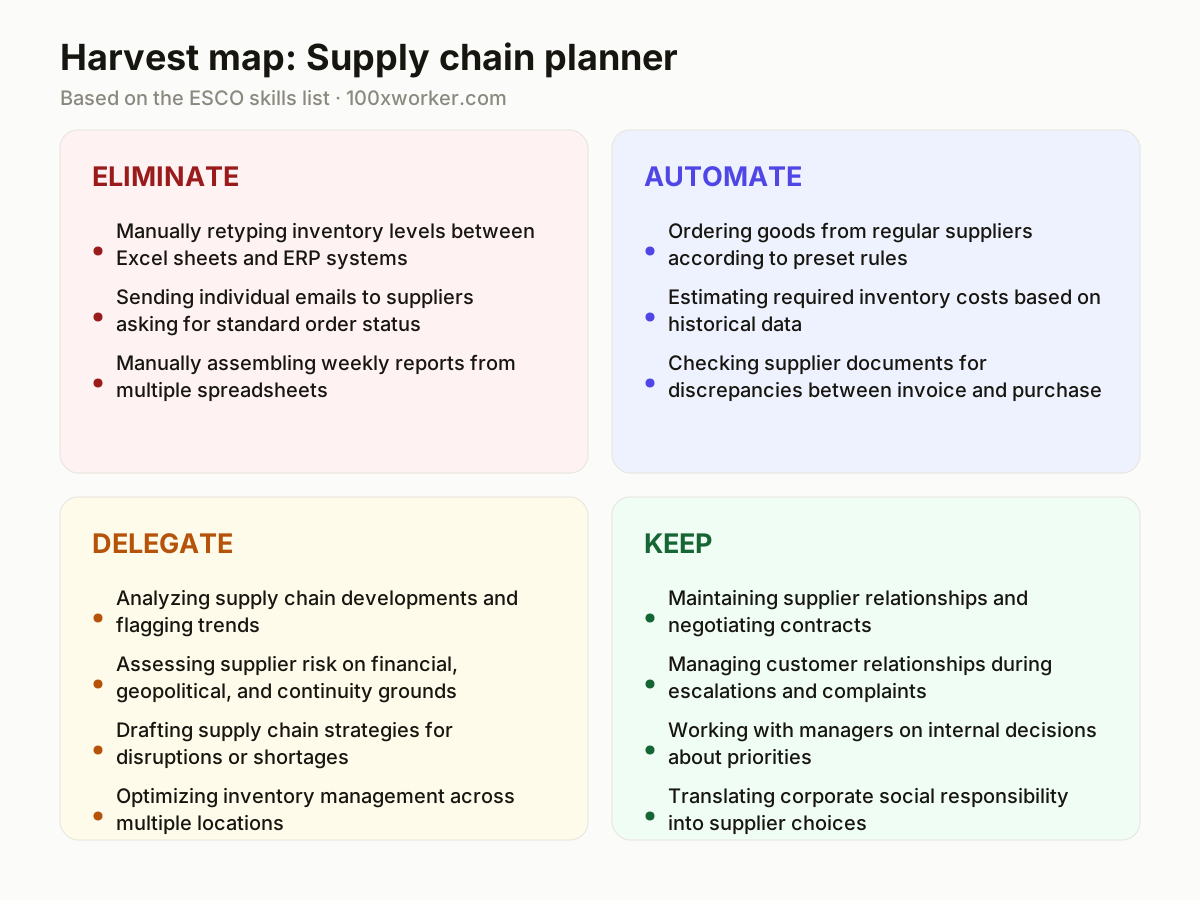
Not every task in a supply chain planner's job changes the same way. Some tasks disappear because they were only ever busywork. Others get fully automated because they follow clear rules. A third group gets delegated to AI as a first draft that you review and decide on. And a final group stays firmly human because it depends on trust, negotiation, or judgment calls that data alone can't make. Sorting your own task list into these four buckets is the fastest way to see where your time should actually go.
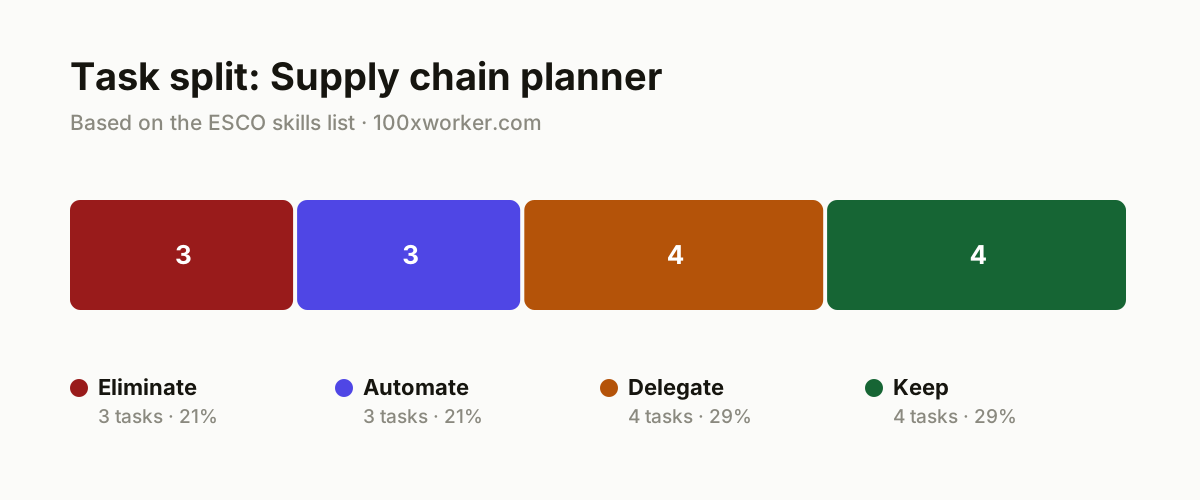
| Task | Bucket | Why |
|---|---|---|
| Manually retyping inventory levels between Excel sheets and ERP systems | eliminate | Retyping only adds error risk. Systems can talk to each other directly. |
| Sending individual emails to suppliers asking for standard order status | eliminate | Status updates flow automatically through portals and tracking links, no manual check-in needed. |
| Manually assembling weekly reports from multiple spreadsheets | eliminate | A dashboard pulls the data from source systems itself, no copy-paste required. |
| Ordering goods from regular suppliers according to preset rules | automate | An agent places orders once stock drops below a threshold, within agreed margins and budgets. |
| Estimating required inventory costs based on historical data | automate | Forecasting models calculate this faster and more consistently than a spreadsheet formula with manual overrides. |
| Checking supplier documents for discrepancies between invoice and purchase order | automate | Matching tools flag mismatches without anyone reading every line. |
| Analyzing supply chain developments and flagging trends | delegate | AI scans news and market data and produces a first-pass analysis; you judge its relevance to your chain. |
| Assessing supplier risk on financial, geopolitical, and continuity grounds | delegate | The model builds a risk profile; you decide whether to escalate or have the conversation. |
| Drafting supply chain strategies for disruptions or shortages | delegate | AI simulates scenarios and alternatives; you choose the option and negotiate with the parties involved. |
| Optimizing inventory management across multiple locations | delegate | The model proposes a reallocation based on demand patterns; you approve or override the exceptions. |
| Maintaining supplier relationships and negotiating contracts | keep | Trust and long-term relationships aren't built with a chatbot. (Your edge: Human trust and negotiation instinct) |
| Managing customer relationships during escalations and complaints | keep | Emotional nuance and context call for someone who can adapt quickly. (Your edge: Empathy and the right tone under pressure) |
| Working with managers on internal decisions about priorities | keep | Organizational and political tradeoffs stay human work inside a company. (Your edge: Organizational sense and persuasion) |
| Translating corporate social responsibility into supplier choices | keep | Ethical tradeoffs and value judgments go beyond what data alone can show. (Your edge: Value judgment that goes beyond numbers) |
Which tasks of a supply chain planner does AI take over?
AI takes over the mechanical parts of the job first: retyping inventory data between systems, chasing suppliers for routine status updates, and rebuilding recurring reports from scattered spreadsheets. It also handles rule-based ordering, invoice-to-purchase-order matching, and cost forecasting from historical data. What it doesn't take over yet is judgment-heavy work like deciding which supplier risk to act on or how to respond to a disrupted shipment. Microsoft Research's 20.5% applicability score for this occupation family reflects that split: a real but limited slice of tasks, concentrated in data handling and routine calculation rather than relationship or strategy work.
Will AI replace supply chain planners?
No. The core of the job, managing supplier relationships, negotiating contracts, judging risk, and coordinating across teams during disruptions, stays human. What changes is the task mix inside the role. Anthropic's Economic Index finds that most AI use in comparable occupations is augmentation (AI assists a person) rather than full automation (AI replaces the task entirely). Planners who let AI handle data entry, status checks, and first-draft risk analysis free up time for the negotiation and judgment work that actually needs a person. The job title stays, but a growing share of the day-to-day tasks inside it shift.
How do you become the AI-savvy person on your supply chain team?
Start by mapping your own tasks into eliminate, automate, delegate, and keep, rather than waiting for a company-wide AI policy. Learn to write clear prompts for scenario planning and supplier risk drafts, then treat the output as a first draft you correct, not a final answer. Build a habit of using AI dashboards for weekly reporting instead of spreadsheets. Share what works with your team; being the person who already tested the forecasting tool or the risk-summary prompt makes you the reference point when others start asking questions.
What can you do this month with AI as a supply chain planner?
Pick one recurring task, the weekly report or the supplier status email, and replace it with an automated dashboard or portal notification within two weeks. Test a forecasting tool on your next inventory cost estimate and compare it against your usual spreadsheet method. Draft a supplier risk assessment with an AI tool as a starting point, then revise it with your own judgment before it goes further. Small, concrete swaps like these show you where AI actually saves time and where it doesn't.
AI use in comparable occupations splits between automation, where AI performs the task, and augmentation, where AI assists a person doing it.
Anthropic Economic Index
Become the AI person on your team
Build a personal task map
List every recurring task you do in a normal week and sort each one into eliminate, automate, delegate, or keep. Review and update this list every quarter as tools change.
Pilot one automation end to end
Pick a single automatable task, like invoice matching or order status tracking, and run it through an AI tool for a full month before rolling it out further. Document the error rate so you can defend the decision to your team.
Turn AI drafts into faster decisions, not faster typing
Use AI to produce first-pass risk assessments or scenario simulations, but spend the time you save on the actual supplier call or negotiation, not on more spreadsheet work.
Want this for your actual task list?
The free scan on the homepage builds your personal task map in 30 seconds, based on your role and industry.
Run the free task scanTools for this work
| Tool | For which tasks | The sober take |
|---|---|---|
| Microsoft Copilot | Weekly report drafting, summarizing supplier news, first-pass risk assessment drafts | Works inside Excel and Outlook, useful for reducing manual report assembly. |
| SAP Integrated Business Planning | Inventory forecasting, rule-based reordering, multi-location stock optimization | Common ERP-linked planning tool; automation quality depends on data hygiene. |
| Anthropic Claude | Scenario simulation for supply disruptions, drafting supplier risk profiles | Anthropic's own Economic Index shows this kind of use falls mostly under augmentation, not full automation. |
| Invoice-matching software (e.g. Basware, Coupa) | Checking supplier documents for discrepancies between invoice and purchase order | Reduces manual line-by-line checking but still needs exception review. |
Prompts to try today
First-pass supplier risk assessment
Disruption scenario planning
Weekly report draft from raw data
Related jobs
Frequently asked questions
What percentage of a supply chain planner's job can AI handle?
Microsoft Research's applicability score for the closest occupation category, transportation, storage, and distribution managers, is 20.5%. That means roughly a fifth of typical work activities show clear generative AI applicability, based on analysis of 200,000 real Copilot conversations. It's a moderate score, well below translators (49%) but above nurses (12%), reflecting a job with real data-heavy tasks alongside relationship and judgment work AI doesn't handle.
Should supply chain planners worry about job security?
Not about the job disappearing, but the task list inside it is changing. Manual data entry, status-check emails, and repetitive reporting are shrinking. Negotiation, risk judgment, and stakeholder management are staying human. Planners who adapt their day-to-day work to reflect this shift, spending less time on data entry and more on the decisions AI can't make, are better positioned than those who ignore the change.
How widely is generative AI actually used at work in Europe?
Eurostat reports that 32.7% of the EU population aged 16 to 74 used generative AI in the last three months of 2025. Adoption in professional settings varies by country and role, but the trend across occupations analyzed by Microsoft Research and Anthropic's Economic Index shows steady growth in workplace use, particularly for drafting, summarizing, and analysis tasks rather than fully autonomous decision-making.
Which supply chain planner tasks are safest from automation?
Tasks that depend on trust, negotiation, or value judgment stay safest: maintaining supplier relationships, negotiating contracts, handling customer escalations, and translating corporate responsibility goals into supplier choices. These require reading people, building long-term relationships, and making ethical tradeoffs that data alone can't resolve, which is why they sit in the keep bucket rather than automate or delegate.
Sources
- Microsoft Research: Working with AI (2025)
- Anthropic Economic Index
- Eurostat, isoc_ai_iaiu
- ESCO, European Commission
Hendrik De Winne, author of Becoming AI-Savvy, founder of VibeLab. Helps teams redesign their work with AI.
This article was drafted with AI assistance from public data sources and editorially reviewed.