100×worker · job analysis
Will AI Replace Office Managers?
Office managers coordinate the administrative backbone of an organization: correspondence, supplies, room bookings, staff schedules, and reports. Generative AI is already reshaping which of these tasks need a human and which can run largely on their own. According to Microsoft Research, which analyzed 200,000 real Copilot conversations across occupations, the AI applicability score for office and administrative supervisors sits at 24.5 percent, meaning about a quarter of the work activities in this role show clear overlap with what generative AI can already do. That is well below translators (49 percent) but well above nurses (12 percent).
The number does not mean a quarter of office managers will lose their jobs. It means a quarter of the tasks inside the job are changing shape. Anthropic's Economic Index, which classifies millions of Claude conversations against the O*NET task taxonomy, finds a similar pattern across office-based roles: some AI use looks like automation, where the AI runs a task end to end, and some looks like augmentation, where a person and the AI work through it together. For office managers, most of the near-term change falls into the second category.
This article breaks the job into four buckets, tasks to eliminate, automate, delegate, or keep, so you can see exactly where AI changes your day-to-day work and where your judgment still carries the job.
An office manager coordinates administrative processes, staff, and office logistics so an organization runs smoothly day to day.
The task split: what AI takes over and what stays yours
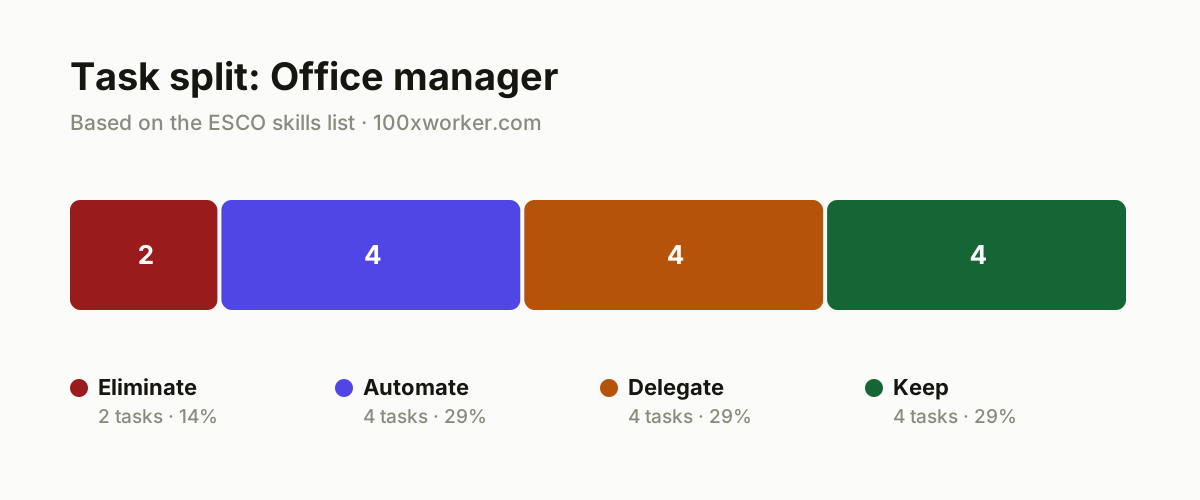
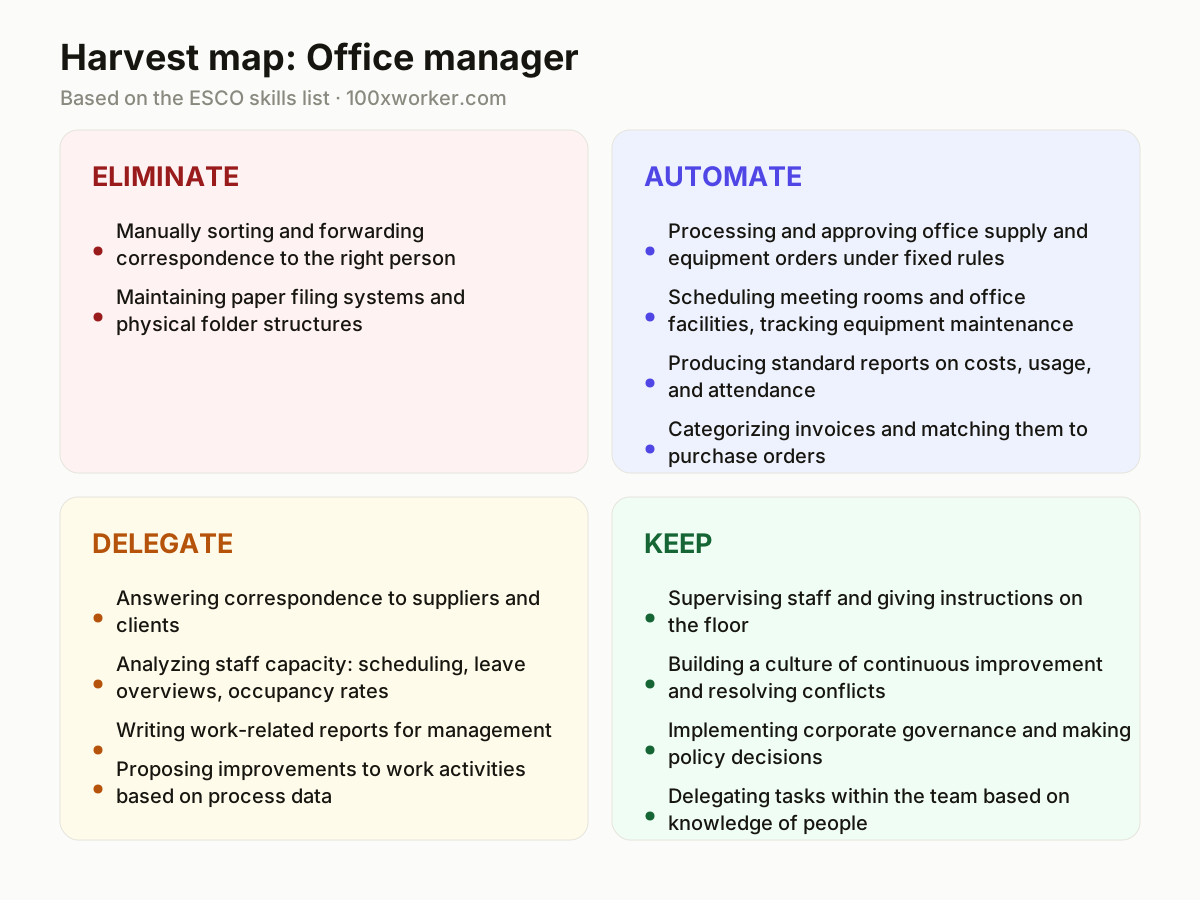
Not every office manager task reacts to AI the same way. Some tasks disappear because the underlying method (paper filing, manual sorting) becomes pointless once digital tools exist. Some tasks can run almost entirely on AI or a rules-based agent. Some tasks are best split, where AI produces a draft or an analysis and you make the final call. And some tasks depend on judgment, authority, or reading people, which stays firmly human. The four buckets below, eliminate, automate, delegate, keep, map the office manager role onto that logic using the ESCO skill list for this occupation.
| Task | Bucket | Why |
|---|---|---|
| Manually sorting and forwarding correspondence to the right person | eliminate | AI classifies messages by topic and urgency faster and more consistently than a person can. |
| Maintaining paper filing systems and physical folder structures | eliminate | Digital search and indexing make physical filing largely unnecessary. |
| Processing and approving office supply and equipment orders under fixed rules | automate | Clear thresholds and rules let an agent run the whole order flow without a person in the loop. |
| Scheduling meeting rooms and office facilities, tracking equipment maintenance | automate | Availability and maintenance schedules are repetitive and structured, ideal for automation. |
| Producing standard reports on costs, usage, and attendance | automate | An agent can pull data from existing systems and turn it into a readable report on its own. |
| Categorizing invoices and matching them to purchase orders | automate | Recognizable patterns in invoices can be processed automatically end to end. |
| Answering correspondence to suppliers and clients | delegate | AI drafts a strong first version, you adjust tone and detail before it goes out. |
| Analyzing staff capacity: scheduling, leave overviews, occupancy rates | delegate | AI flags bottlenecks in the data, you decide on the final schedule. |
| Writing work-related reports for management | delegate | A draft built from existing data saves time, the nuance stays your job. |
| Proposing improvements to work activities based on process data | delegate | AI finds patterns in turnaround times, you judge what is realistic in practice. |
| Supervising staff and giving instructions on the floor | keep | Managing people requires direct presence and adapting to each individual. (Your edge: People follow people, not a dashboard.) |
| Building a culture of continuous improvement and resolving conflicts | keep | Tension between colleagues requires a read on people no model has. (Your edge: No language model can read emotional context.) |
| Implementing corporate governance and making policy decisions | keep | Policy choices with legal and financial weight require human accountability. (Your edge: The responsibility for a decision stays with you.) |
| Delegating tasks within the team based on knowledge of people | keep | Knowing who can really take on a task requires trust and experience. (Your edge: You know your team, a system only knows the job title.) |
Will AI replace office managers?
No. The office manager role combines supervision, judgment, and coordination across people, not just document processing. Microsoft Research's applicability score for this occupation is 24.5 percent, meaning most of the work still falls outside what generative AI can do well on its own. What changes is the mix of tasks: routine correspondence, supply orders, and standard reporting move to AI, while managing people, resolving conflict, and making policy calls stay firmly human. Employers restructuring this role should expect fewer hours spent on paperwork and more time spent on staff supervision, governance, and process improvement, the parts of the job that depend on judgment rather than pattern matching.
Which office manager tasks will AI take over fastest?
The tasks that go first have clear rules and repeatable patterns: sorting and routing correspondence, processing supply and equipment orders against fixed budgets, scheduling rooms and tracking maintenance, and matching invoices to purchase orders. These sit in the automate bucket because an AI agent can run them end to end with limited oversight. Standard reports on costs, usage, or attendance also automate quickly, since the underlying data already lives in existing systems. What does not automate fast is anything involving a judgment call about a specific person or a specific policy exception, which is where the delegate and keep buckets take over.
What can you do with AI as an office manager this month?
Start small and specific. Pick one recurring task, drafting supplier emails or building a weekly attendance report, and run it through a tool like Microsoft Copilot or ChatGPT for two weeks. Compare the draft output to what you would have written yourself and adjust your prompts based on the gaps. Set up one automation, for example routing incoming supply requests through a rule-based workflow tool, so you can measure the time saved directly. Keep a short log of what worked and what needed heavy editing. That log becomes your evidence base for scaling AI use to the rest of your task list.
How do you become the AI person on your office team?
Document which of your tasks fall into each of the four buckets, eliminate, automate, delegate, keep, and share that breakdown with your manager and your team. Volunteer to pilot one AI tool on a low-risk task, like report drafting, before it becomes a mandate from above. Track time saved and error rates, and write a short internal guide showing colleagues how you prompt the tool and where you double-check its output. Being the person who already has a working method, rather than the person who resisted the change, is what makes you the reference point when the rest of the office starts asking questions.
Generative AI's applicability score measures overlap with tasks, not whole jobs, which is why most occupations change task by task rather than disappearing.
Microsoft Research, Working with AI (2025)
Become the AI person on your team
Map your own tasks against the four buckets
Before adopting any tool, list your weekly tasks and sort them into eliminate, automate, delegate, or keep. This tells you where AI actually saves time versus where it just adds a new step to check.
Pilot one automation with a measurable before and after
Pick a rule-based task like supply order approval and run it through an automation tool for a month. Track hours saved and error rate so you have real numbers when you propose expanding it.
Build the reporting habit early
Practice drafting management reports with AI on real data before you are asked to. Reviewers can tell a well-edited AI draft from a rushed one, and being fast and accurate builds trust.
Want this for your actual task list?
The free scan on the homepage builds your personal task map in 30 seconds, based on your role and industry.
Run the free task scanTools for this work
| Tool | For which tasks | The sober take |
|---|---|---|
| Microsoft Copilot | Drafting correspondence, summarizing meetings, building standard reports | Works inside Outlook and Word, which is where most office manager correspondence already lives. |
| ChatGPT or Claude | Drafting management reports, analyzing staff capacity data, proposing process improvements | Useful for drafts and analysis, you still verify numbers against source systems. |
| Zapier or Make | Automating supply order approvals, invoice matching, room booking notifications | Rule-based workflow tools, not AI models, but often the real automation layer behind AI-sounding tasks. |
| Room and facility booking software (e.g. Robin, Envoy) | Scheduling meeting rooms, tracking facility usage and maintenance | Common workplace tools that already automate the scheduling side of the job. |
Prompts to try today
Draft a supplier follow-up email
Summarize weekly staff capacity
Turn process data into an improvement proposal
Related jobs
Frequently asked questions
Will AI take over the office manager job completely?
No. Microsoft Research's applicability score for this occupation is 24.5 percent, moderate compared to translators (49 percent) or nurses (12 percent). Most of the job, supervising staff, resolving conflicts, making governance decisions, stays outside what generative AI can do on its own. What changes is the share of routine, rule-based tasks like correspondence sorting and supply approvals, which move to AI tools and automation workflows.
How many people actually use generative AI at work right now?
Adoption varies by region. Eurostat reports that 32.7 percent of the EU population aged 16 to 74 used generative AI in the three months before being surveyed in 2025. Adoption is higher among younger and more digitally active groups, which suggests office managers working alongside younger staff will see AI tools show up in daily workflows faster than the population average.
What is the difference between automating and delegating a task to AI?
Automating means the AI runs the task end to end with fixed rules and little to no review, like matching invoices to purchase orders. Delegating means AI produces a first draft or an analysis and you make the final call, like a management report or a staffing plan. Office managers should automate the rule-based tasks and delegate the judgment-based ones.
Where can I check what AI tools are relevant to my specific tasks?
The ESCO taxonomy from the European Commission lists the skills and tasks tied to over 3,000 occupations, including office manager, in 28 languages. Cross-referencing your task list against ESCO and against Microsoft Research's applicability data gives you a structured way to see which of your specific tasks show the most overlap with generative AI.
Sources
- Microsoft Research, Working with AI: Measuring the Applicability of Generative AI to Occupations (2025)
- Anthropic Economic Index
- Eurostat, isoc_ai_iaiu (2025)
- ESCO, European Commission
Hendrik De Winne, author of Becoming AI-Savvy, founder of VibeLab. Helps teams redesign their work with AI.
This article was drafted with AI assistance from public data sources and editorially reviewed.