100×worker · job analysis
Will AI Replace Veterinarians?
Vets ask this question a lot right now: will AI take over the job? Microsoft Research analyzed 200,000 real conversations with its Copilot assistant across occupations and published an AI applicability score for each one. For veterinarians, matched to the closest occupation category, that score is 15.5%, meaning that share of work activities where generative AI has demonstrably helped in real conversations. Translators top the list at 49%. Nurses sit near the bottom at 12%. Vets land much closer to nurses than to desk-bound information roles, because so much of the job depends on physical contact with an animal.
That does not make AI irrelevant to the clinic. Anthropic's Economic Index, which classifies millions of Claude conversations against the O*NET task taxonomy, shows AI use split between automation-like use, where AI does a task largely on its own, and augmentation-like use, where a person still makes the final call. Most veterinary AI use today falls in the second category: drafting, summarizing, and structuring information that a vet then checks and signs.
Across the EU, 32.7% of people aged 16 to 74 had used generative AI in the three months before being surveyed in 2025, according to Eurostat. Clients are already using AI to research symptoms before they walk in. A practice that has not worked out which of its own tasks AI can touch is behind its clients, not ahead of them.
A specialised veterinarian is a qualified veterinary specialist delivering complex animal healthcare within one clinical domain.
The task split: what AI takes over and what stays yours
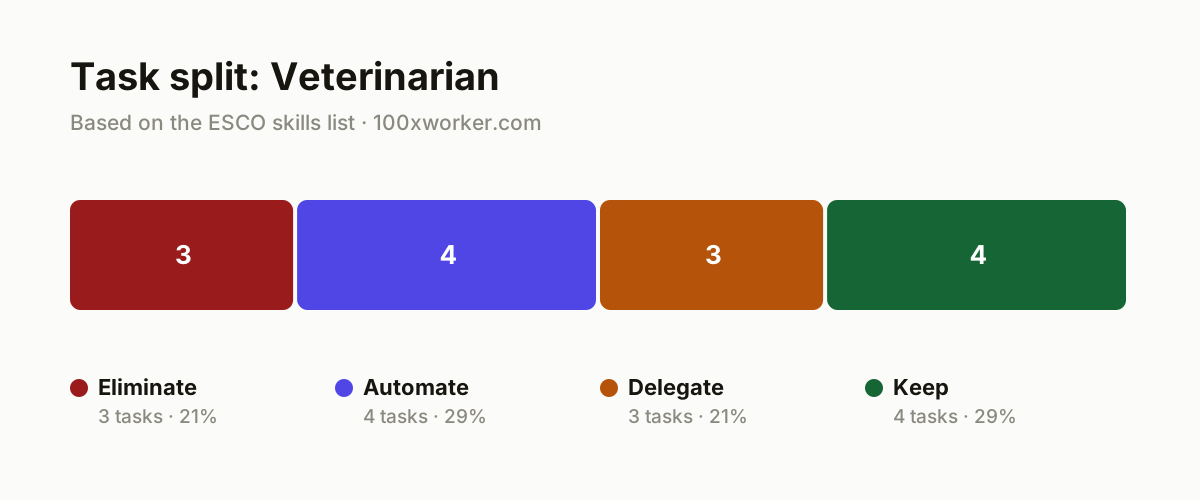
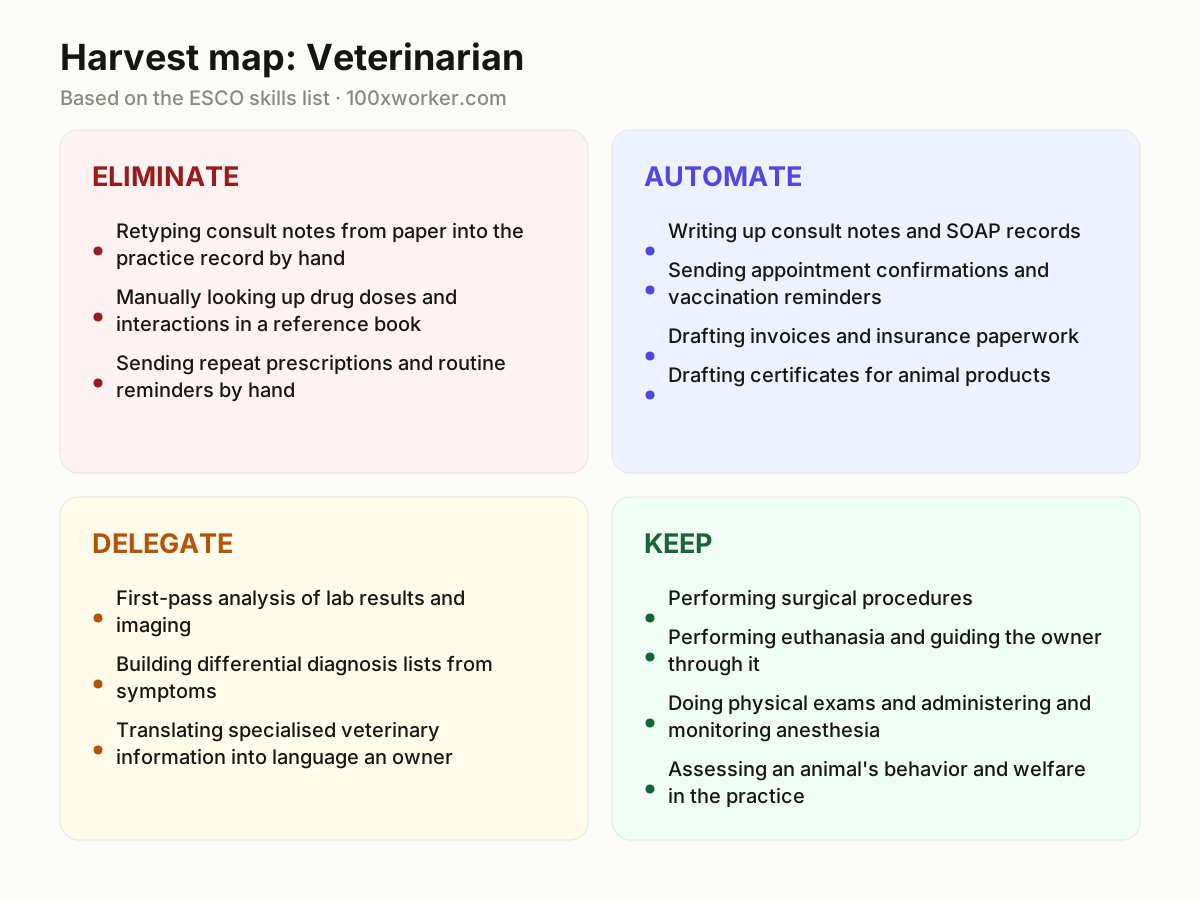
Not every task in a veterinary practice faces the same pressure from AI. Some tasks disappear entirely because software already handles them better than a manual process ever did. Some get automated end to end, with a person only checking the output before it goes out. Some get delegated, meaning AI produces a first draft or first read that a vet still verifies and finalizes. And some stay fully human, because they require hands, physical presence, or a judgment call with real consequences for an animal. Sorting the job this way, task by task, tells you more than asking whether the role of veterinarian survives.
| Task | Bucket | Why |
|---|---|---|
| Retyping consult notes from paper into the practice record by hand | eliminate | Voice-to-text and structured templates make double entry pointless; that work adds nothing anymore. |
| Manually looking up drug doses and interactions in a reference book | eliminate | A vetted database or AI assistant retrieves this faster and more consistently, as long as you verify the source yourself. |
| Sending repeat prescriptions and routine reminders by hand | eliminate | Practice software with AI triggers sends these automatically from the record, with no manual step needed. |
| Writing up consult notes and SOAP records | automate | An AI scribe turns the conversation into a structured note right away, and you read and correct it before it's filed. |
| Sending appointment confirmations and vaccination reminders | automate | This is pure system work driven by the existing record; no clinical judgment is involved. |
| Drafting invoices and insurance paperwork | automate | A template plus record data is enough for AI to fill in correctly; you just check the final amount. |
| Drafting certificates for animal products | automate | AI produces a ready draft of the form; the signature and final responsibility still sit with you. |
| First-pass analysis of lab results and imaging | delegate | AI organizes values and flags anomalies for review; you make the final diagnosis and decide what matters clinically. |
| Building differential diagnosis lists from symptoms | delegate | AI generates a ranked list of possibilities quickly; you weigh it against your own clinical experience and the specific animal. |
| Translating specialised veterinary information into language an owner understands | delegate | AI drafts a first version in plain language; you adjust tone and level of detail to fit the actual conversation. |
| Performing surgical procedures | keep | This requires physical skill, real-time adaptation during the procedure, and direct accountability for the outcome. (Your edge: Hands, eyes, and decisions under time pressure; nothing replaces that.) |
| Performing euthanasia and guiding the owner through it | keep | This is an ethical and emotional moment that needs human presence, timing, and judgment. (Your edge: Empathy and ethical judgment in an irreversible moment.) |
| Doing physical exams and administering and monitoring anesthesia | keep | This requires tactile assessment of the animal and continuous adjustment while the procedure is underway. (Your edge: Physical contact with the animal itself; no sensor replaces the hand.) |
| Assessing an animal's behavior and welfare in the practice | keep | This requires experience with species-specific behavior and context that a model does not observe directly. (Your edge: Direct observation of the animal, in the moment.) |
Will AI replace veterinarians?
No. Microsoft Research's applicability score for veterinarians is 15.5%, one of the lowest among occupations it measured, well below translators at 49% and closer to nurses at 12%. The reasons are structural: surgery, anesthesia, euthanasia, and physical exams all require hands-on contact with a living animal, real-time adjustment, and legal accountability that AI cannot carry. Anthropic's Economic Index shows most current AI use in professional work is augmentation, meaning a person stays in the loop and makes the final call. For veterinary medicine, that pattern is even more pronounced than average. AI changes what you spend your time on inside a shift, not whether the shift needs a vet.
Which veterinary tasks will AI take over first?
The tasks going first are the ones with no clinical judgment attached: writing up SOAP notes from a recorded consult, sending appointment confirmations and vaccination reminders, drafting invoices and insurance forms, and producing a first draft of certificates for animal products. These are already largely automatable with practice software and AI scribes. Right behind them are first-pass tasks like organizing lab values, flagging abnormal results, and building a ranked differential diagnosis list from symptoms. AI does the first pass; you still confirm the diagnosis, sign the certificate, and decide the treatment plan. Manual lookup tasks like drug interaction checks disappear fastest because a database was always going to beat a reference book.
How do you become the AI-savvy person at your veterinary practice?
Pick one recurring task, most practices start with consult notes or client explanations, and run it through an AI tool for two weeks before deciding if it stays. Build a small library of prompts that colleagues can reuse for differential diagnosis lists or owner-facing summaries, so the practice is not reinventing the wheel per vet. Set a clear rule for verification: every AI-drafted certificate, dose recommendation, or diagnosis gets checked against the source before it leaves your hands. Being the AI-savvy one in the practice is less about knowing every tool and more about owning the review process everyone else follows.
What can you do this month as a veterinarian?
Take one task from the automate or delegate bucket, consult notes are a good starting point, and trial an AI scribe or general assistant on it for real cases over two to three weeks. Time yourself before and after to see if it actually saves minutes once you include the review step. Write down one verification rule you will apply every time, for example never sending a certificate or dosage note without checking it against the record or a trusted database yourself. Skip anything from the keep bucket, surgery, anesthesia, and euthanasia are not places to experiment with AI drafting.
Veterinary work applies generative AI to about 15.5% of its tasks, closer to nursing than to translation or clerical office work.
Microsoft Research, Working with AI (2025)
Become the AI person on your team
Run a two-week scribe trial on real consults
Use an AI scribe or transcription assistant during actual appointments for two weeks, then compare the drafted SOAP notes against what you would have written yourself. Keep or drop the tool based on how much correction it actually needs, not on the demo.
Build a shared prompt library for the practice
Collect the two or three prompts that work well for differential diagnosis lists or owner explanations and put them somewhere every vet in the practice can reuse them. This turns one person's trial and error into a shared shortcut.
Set one non-negotiable verification rule
Decide on a single rule, for example that every AI-drafted certificate or dosage note gets checked against the source before signing, and apply it consistently. This is what makes AI use defensible if a client or regulator ever asks how a document was produced.
Want this for your actual task list?
The free scan on the homepage builds your personal task map in 30 seconds, based on your role and industry.
Run the free task scanTools for this work
| Tool | For which tasks | The sober take |
|---|---|---|
| General-purpose AI assistants (ChatGPT, Microsoft Copilot, Claude) | drafting differential diagnosis lists, owner-facing explanations, invoice and certificate drafts | Good for first drafts, but every clinical claim still needs to be verified before it enters the record. |
| AI medical scribe software for consults | writing SOAP notes and consult records | Turns a spoken consult into a structured note automatically, but drug names and doses still need a human check. |
| Practice management systems with automated messaging | appointment confirmations, vaccination reminders, repeat prescription sending | Runs on data already in your record, so setup of the record matters more than the AI feature itself. |
| Lab and imaging tools with AI-assisted flagging | first-pass review of lab results and imaging | Flags likely abnormalities for you to confirm; it does not sign off on a diagnosis. |
Prompts to try today
Build a differential diagnosis list
Turn a consult transcript into a SOAP note
Explain a diagnosis to an owner in plain language
Related jobs
Frequently asked questions
Will AI take over veterinary surgery?
No. Surgery requires physical dexterity, real-time adaptation to what is actually happening on the table, and direct legal accountability for the outcome. Microsoft Research's applicability data places veterinarians among the occupations least exposed to generative AI, largely because so much of the work is hands-on. AI can help with pre-surgical documentation, records, and follow-up notes, but the procedure itself stays entirely human for the foreseeable future.
What is an AI applicability score?
It is a measure Microsoft Research created by analyzing 200,000 real conversations with its Copilot assistant and mapping which occupations' work activities came up, and how successfully AI handled them. Each occupation gets a percentage showing how much of its work generative AI has demonstrably touched. Veterinarians score 15.5%, translators score 49%, and nurses score 12%. It measures applicability in observed use, not a prediction of job loss.
Is generative AI use already widespread among clients and colleagues?
Yes. Eurostat found that 32.7% of the EU population aged 16 to 74 had used generative AI in the three months before being surveyed in 2025. That means a meaningful share of pet owners walking into a clinic have already asked a chatbot about their animal's symptoms before the appointment. Practices that ignore this are working from an outdated assumption about what clients bring to the conversation.
Should a veterinary practice adopt an AI scribe tool?
It depends on volume and workflow, but a short trial is low-risk if you keep a human check on every drafted note. Time how long review and correction take against how long manual note-taking took before. If the scribe genuinely saves time once you include the review step, and drug names and doses come through accurately, it is worth keeping. If it needs heavy correction every time, it is not saving you anything yet.
Sources
- Microsoft Research, Working with AI: Measuring the Applicability of Generative AI to Occupations (2025)
- Anthropic Economic Index
- Eurostat, isoc_ai_iaiu (2025)
- ESCO, European Commission occupation and skills taxonomy
Hendrik De Winne, author of Becoming AI-Savvy, founder of VibeLab. Helps teams redesign their work with AI.
This article was drafted with AI assistance from public data sources and editorially reviewed.