100×worker · job analysis
Will AI Replace Tour Guides, and What Should You Do About It?

Tour guiding is built on presence: standing in front of a group, reading the room, and telling a story on the spot. That part of the job is hard for a language model to touch. But a large share of what happens around the tour, the prep work, the admin, the translated scripts, the follow-up emails, is exactly the kind of task generative AI is good at.
Microsoft Research analyzed 200,000 real Copilot conversations and scored occupations by how much of their work generative AI can plausibly touch. Tour and travel guides scored 31.6%, well below translators (49%, the highest scoring occupation in the study) but far above nurses (12%, one of the lowest). That places guiding in the middle: a job with real AI exposure, but not one where AI does the core work.
Anthropic's Economic Index, which classifies millions of Claude conversations against the O*NET task list, draws a similar line across occupations: some AI use replaces a task outright (automation), while other use extends what a person can do (augmentation). For guides, most of the useful AI use falls into the second category. This article breaks the job into four buckets: tasks to eliminate, automate, delegate, and keep, based on the ESCO occupational profile for guides (ESCO code 5113.1).
A tour guide leads visitors on site and interprets heritage, while AI mostly handles preparation and admin.
The task split: what AI takes over and what stays yours
Not every guiding task is affected by AI the same way. Some tasks disappear because the tool that replaced them already exists (a booking system, a payment app). Others get fully automated, some are worth delegating to AI with a human check afterward, and some stay entirely human because they depend on being physically present. Sorting the ESCO task list for guides into these four buckets shows where your time is actually worth spending.
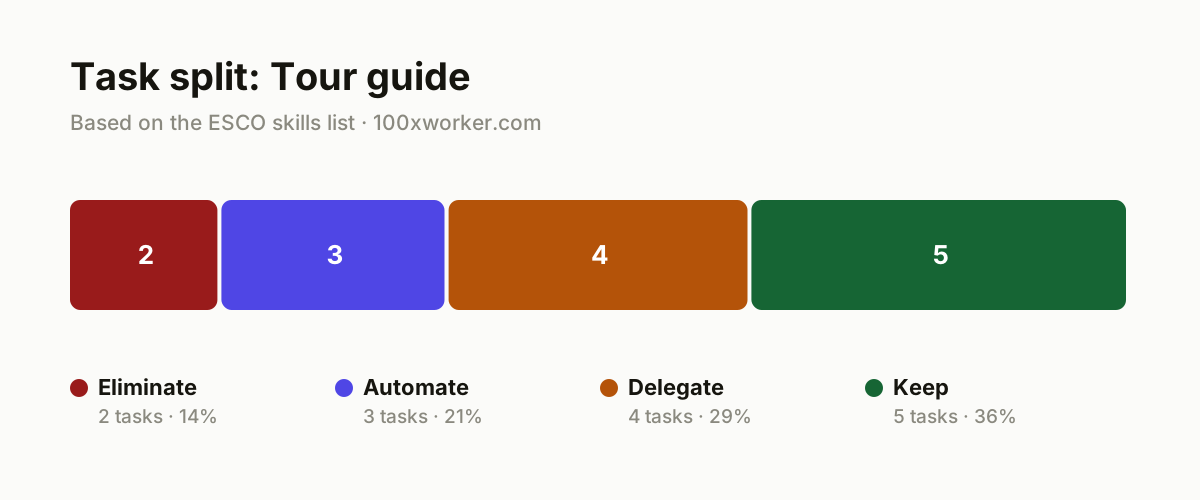
| Task | Bucket | Why |
|---|---|---|
| Manually registering visitors on paper lists | eliminate | Booking platforms register attendees automatically, so a separate manual list no longer serves a purpose. |
| Assembling one-off info sheets and brochures by hand for each visit | eliminate | AI generates a tailored info sheet on demand, so pre-printed handouts prepared in advance are no longer needed. |
| Invoicing and scheduling of bookings | automate | An automated system invoices, schedules and confirms bookings without intervention, from reservation to payment. |
| Receiving visitor payments | automate | Online payment systems process transactions instantly, so tracking cash or bank transfers by hand is unnecessary. |
| Providing standard visitor information (opening hours, accessibility, practical FAQ) | automate | A chatbot answers repeat questions around the clock, so you stop replying to the same email over and over. |
| Preparing routes and story content | delegate | AI drafts a first route outline and core facts, and you rewrite the tone and verify every fact. |
| Translating tour scripts into other languages | delegate | AI translates quickly, but you still need to check technical terms and local naming before using it. |
| Drafting teaching materials and quiz questions for school groups | delegate | AI writes a first lesson module, and you adapt it to the group's age and level. |
| Training new guides with training material | delegate | AI drafts a first training document and knowledge test, and you add real examples from the field. |
| Guiding visitors live during the tour | keep | This is what visitors actually pay for: presence, voice, and storytelling on site. (Your edge: Live presence and storytelling are things AI cannot deliver.) |
| Assisting visitors with special needs | keep | Judging what someone needs in the moment requires direct human contact. (Your edge: Empathy and physical assistance stay human work.) |
| Managing emergencies and safety on site | keep | In an emergency you decide yourself, on the spot, with no time to write a prompt. (Your edge: Decisions under pressure need a human who is physically present.) |
| Maintaining working relationships with local partners and institutions | keep | Building trust with a museum, a municipality, or a driver requires personal contact over time. (Your edge: Trust grows through repeated personal contact, not through a tool.) |
| Solving ad-hoc problems during the tour | keep | A missed bus, a sudden storm, or a visitor falling ill requires improvising on the spot. (Your edge: Improvising in the moment requires presence, not something scriptable in advance.) |
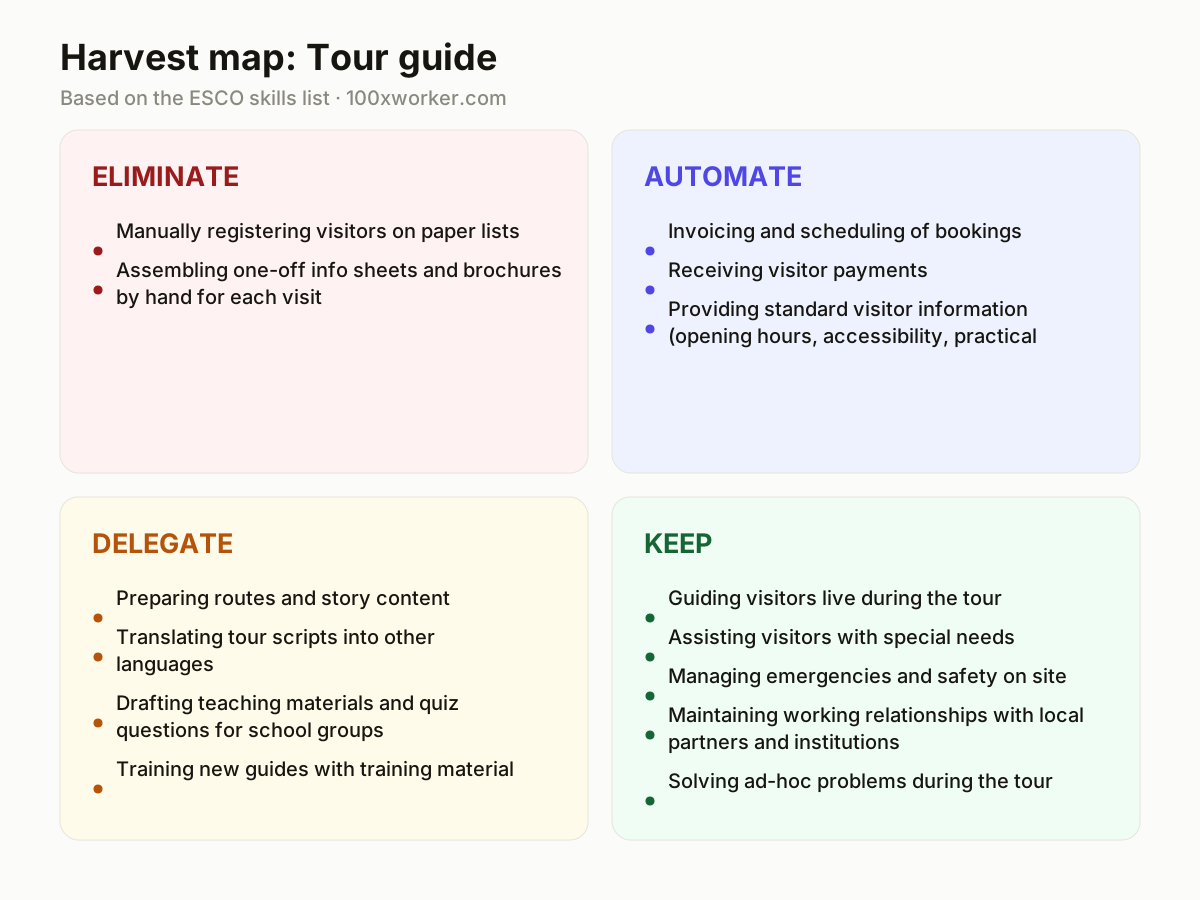
Which tour guide tasks does AI take over?
AI mostly takes over the tasks around the tour, not the tour itself. That means drafting route outlines and background facts, producing first-pass translations of scripts, writing training material for new guides, and answering routine questions such as opening hours or accessibility, usually through a chatbot. Payment processing and booking confirmations are already largely automated by the platforms guides use to sell tickets. Microsoft's applicability research puts guides at 31.6%, meaning roughly a third of the work touches tasks AI can plausibly assist with, concentrated in preparation and communication rather than in the live tour itself.
Will AI replace tour guides?
No single occupation with a 31.6% AI applicability score has been shown to disappear because of that score. What changes is the task mix inside the job, not the job title. The parts of guiding that require physical presence, real-time judgment, and improvisation (a missed bus, a sick visitor, a sudden safety issue) cannot be handed to a language model, because there is no time to write a prompt and no way to be physically present remotely. What disappears is the manual admin around the tour: paper registration lists, one-off handouts, and repetitive email replies that a chatbot now answers instead.
How do you become the AI person on your team as a guide?
Start by writing down every task you do in a week that is not standing in front of a group. Route research, translation, invoicing, training new colleagues, answering the same questions repeatedly. For each one, ask whether AI could produce a usable first draft. If yes, build a habit around it: use AI to draft the route brief before you personalize it, or to produce the first version of a translated script before you check it. Being the AI person on a team of guides usually just means being the one who has already tested which prompts save time and shares that with colleagues.
What can you do this month to start using AI as a guide?
Pick one recurring task and automate or delegate it this month. A realistic starting point: connect a chatbot to your booking page to answer opening hours, pricing and accessibility questions automatically, and use an AI tool to draft the next route brief or translated script you need, checking every fact before you use it on a tour. Do not try to change everything at once. One automated task and one delegated task, done consistently for a month, will show you where AI actually saves time in your specific job and where it does not.
Generative AI is applicable to an estimated 31.6% of the work activities of tour and travel guides, based on real usage patterns in Copilot conversations.
Microsoft Research, Working with AI (2025)
Become the AI person on your team
Build a personal fact-checked script library
Every time you use AI to draft a route brief or translated script, save the corrected final version. Over a few months you build a library of verified content you can reuse and adapt, instead of starting from scratch each time.
Set up a chatbot for pre-tour questions
Connect a simple chatbot to your booking confirmation email to handle opening hours, meeting points and accessibility questions. This removes the bulk of repetitive email traffic before the tour even starts.
Offer to train colleagues on AI-assisted prep
If you have already tested how to use AI for route research or translation, write up a short guide for other guides at your organization. This is a low-effort way to become the reference person on the team.
Want this for your actual task list?
The free scan on the homepage builds your personal task map in 30 seconds, based on your role and industry.
Run the free task scanTools for this work
| Tool | For which tasks | The sober take |
|---|---|---|
| ChatGPT or Claude | Drafting route outlines, background facts, lesson materials, and training documents (delegate bucket) | Useful for first drafts, but every historical or safety-related fact needs a manual check before use. |
| DeepL or a similar translation tool | Translating tour scripts into other languages (delegate bucket) | Fast for a first-pass translation, but technical terms and local names still need a native check. |
| A chatbot widget on your booking page | Answering standard visitor questions like hours and accessibility (automate bucket) | Reduces repetitive email volume, but should always offer a way to reach a human. |
| Booking and payment platforms with built-in invoicing | Scheduling, invoicing and receiving payments (automate and eliminate buckets) | Most of these platforms already remove the need for manual registration lists. |
Prompts to try today
Draft a route brief
First-pass translation check
Build a training module for a new guide
Related jobs
Frequently asked questions
What percentage of a tour guide's job can AI do?
Microsoft Research's applicability score, based on an analysis of 200,000 real Copilot conversations, puts tour and travel guides at 31.6%. That figure describes the share of work activities where generative AI is demonstrably useful, not the share of guides who will lose their jobs. For comparison, translators score highest in the same study at 49%, and nurses score low at 12%.
Which part of guiding is safest from AI?
Anything that requires physical presence and real-time judgment stays safest: live storytelling during the tour, handling emergencies, assisting visitors with special needs, and improvising when something goes wrong, like a missed bus or bad weather. These tasks depend on being there in person, which is exactly what AI cannot provide.
Should I use AI to write my tour scripts?
Using AI to produce a first draft of a route or script is reasonable and can save preparation time. The risk is factual accuracy: AI-generated historical or cultural claims need to be checked against a reliable source before you present them to visitors, since errors in a live tour damage trust immediately.
How common is AI use among the general public right now?
Eurostat reports that 32.7% of the EU population aged 16 to 74 used generative AI in the three months before being surveyed in 2025. That means a meaningful share of the visitors you guide have likely used AI tools themselves, which is worth keeping in mind when they ask AI-sourced questions during a tour.
Sources
- Microsoft Research, Working with AI: Measuring the Applicability of Generative AI to Occupations (2025)
- Anthropic Economic Index
- Eurostat, isoc_ai_iaiu (2025)
- ESCO, European Commission occupational taxonomy, guide (5113.1)
Hendrik De Winne, author of Becoming AI-Savvy, founder of VibeLab. Helps teams redesign their work with AI.
This article was drafted with AI assistance from public data sources and editorially reviewed.