100×worker · job analysis
What AI Changes for Training Managers

Will AI replace training managers? The short answer is no, though it is already reshaping large parts of the job. Microsoft Research analyzed 200,000 real Copilot conversations across occupations and found generative AI applicable to 19.3% of the work activities performed by training and development managers, the closest US occupational match. That figure sits far below translators (49%) and well above nurses (12%), placing training managers in the middle of the pack: enough disruption to change daily work, but not enough to remove the need for a person in the role.
This mirrors a broader pattern. Anthropic's Economic Index, which classifies millions of Claude conversations against O*NET task definitions, splits AI use into automation (the AI does the task) and augmentation (the AI helps a person do it), and augmentation still dominates for management-heavy roles. Across the EU, 32.7% of people aged 16 to 74 used generative AI in the last three months of 2025 (Eurostat). The tasks that make up a training manager's job, as mapped in the EU's ESCO taxonomy of 3,039 occupations, split cleanly into what AI eliminates, automates, delegates, and what stays human.
A training manager coordinates and designs corporate learning programs and keeps them aligned with business strategy.
The task split: what AI takes over and what stays yours
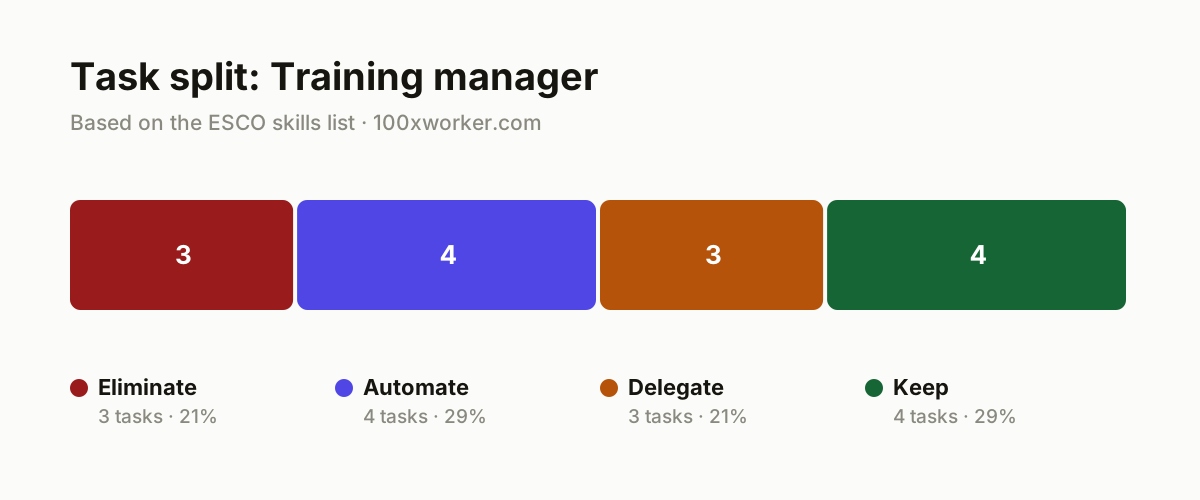
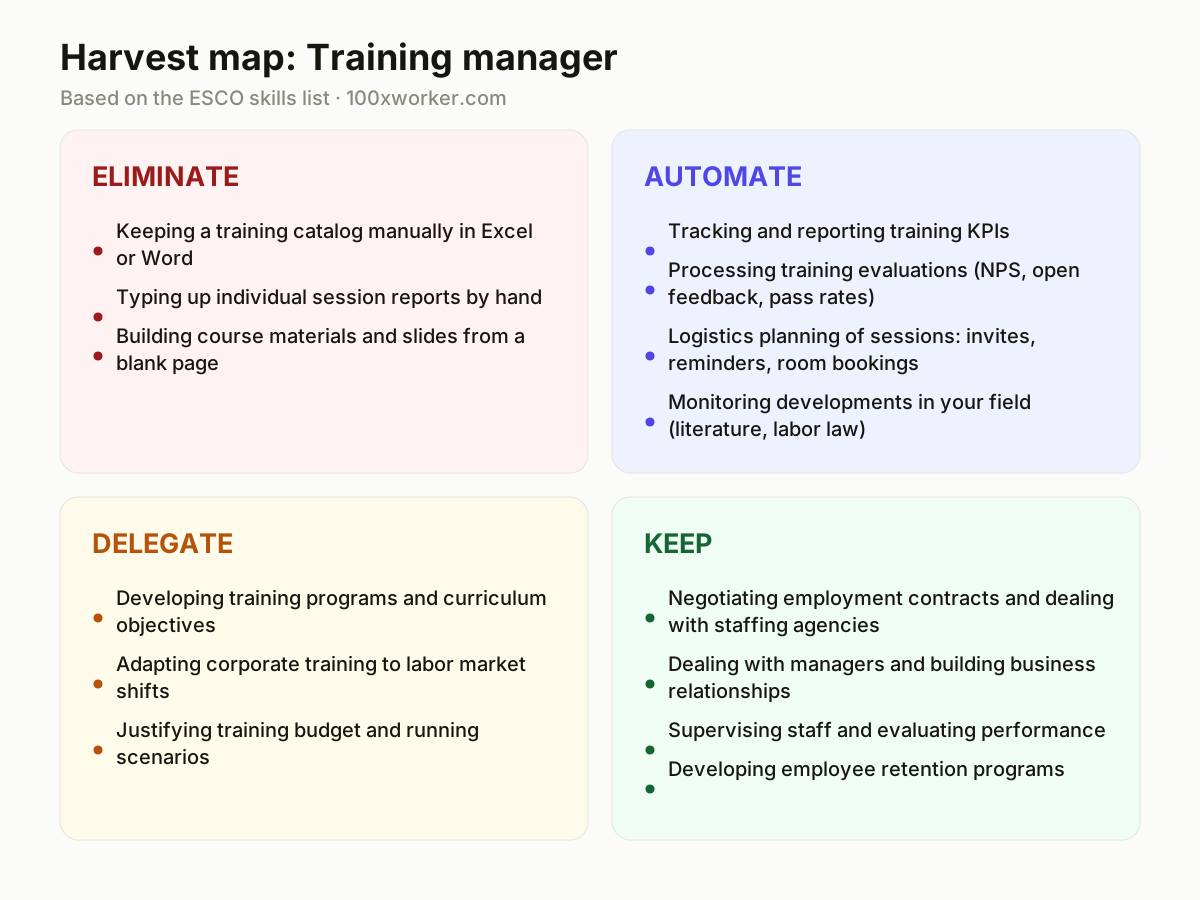
This article sorts every core task from the ESCO profile for training and development managers into four buckets: eliminate (manual work that disappears entirely), automate (a system or agent runs it with light oversight), delegate (AI drafts, you decide), and keep (work that stays human because it depends on judgment, trust, or accountability). Use it to figure out where to spend your time instead of your keyboard.
| Task | Bucket | Why |
|---|---|---|
| Keeping a training catalog manually in Excel or Word | eliminate | AI generates and updates the overview directly from your LMS data. |
| Typing up individual session reports by hand | eliminate | Summaries roll out automatically from attendance data and evaluation forms. |
| Building course materials and slides from a blank page | eliminate | A usable first draft exists in minutes; you edit from there. |
| Tracking and reporting training KPIs | automate | An agent pulls data from the LMS and HR system and builds the dashboard itself. |
| Processing training evaluations (NPS, open feedback, pass rates) | automate | An agent collects, clusters, and summarizes hundreds of responses. |
| Logistics planning of sessions: invites, reminders, room bookings | automate | Calendar and email agents handle this without intervention. |
| Monitoring developments in your field (literature, labor law) | automate | An agent scans sources and delivers a weekly briefing. |
| Developing training programs and curriculum objectives | delegate | AI proposes structure and learning objectives; you check them against strategy. |
| Adapting corporate training to labor market shifts | delegate | AI flags skills gaps from job posting and market data; you set the priority. |
| Justifying training budget and running scenarios | delegate | AI builds cost overviews and variants; you negotiate and decide. |
| Negotiating employment contracts and dealing with staffing agencies | keep | This requires legal judgment and advocacy in a specific, high-stakes situation. (Your edge: Trust and negotiation feel aren't built with a prompt.) |
| Dealing with managers and building business relationships | keep | Internal politics and relationship management run on context that isn't in any dataset. (Your edge: Political awareness stays human work; no agent handles this.) |
| Supervising staff and evaluating performance | keep | Judging people requires accountability and organizational knowledge no model carries. (Your edge: Judging someone is a responsibility, not a calculation.) |
| Developing employee retention programs | keep | Retention depends on understanding motivation, not recognizing patterns in data. (Your edge: Why someone stays or leaves gets learned in conversation, not spreadsheets.) |
Which training manager tasks will AI take over?
AI takes over the mechanical parts of the job first. Manual training catalogs in spreadsheets, one-off session write-ups, and first drafts of course slides can be eliminated outright because a system can generate and update them from existing LMS data. KPI tracking, evaluation processing, session logistics (invites, reminders, room bookings), and monitoring industry literature move into the automate bucket: an agent runs these with light supervision instead of you doing them by hand. Curriculum design, adapting training to labor-market shifts, and budget scenarios move to delegate, where AI drafts the first version and you decide. None of this removes the manager. What disappears is the repetitive part of the week.
Will AI replace training managers?
No single AI system does the full job of a training manager. Microsoft Research's applicability score of 19.3% for training and development managers means roughly one in five work activities can be meaningfully assisted by generative AI today, a moderate score compared to occupations like translation (49%) or nursing (12%). The role includes negotiating contracts, managing relationships with managers and staffing agencies, evaluating people's performance, and building retention programs, tasks that depend on trust, accountability, and reading a room. AI reshapes the tasks around that core. The job description changes; the need for a person who can judge, negotiate, and decide does not.
What can you do this month to start using AI as a training manager?
Start with one recurring task you already dread. Feed your LMS export and last quarter's evaluation forms into an AI tool and ask it to draft a KPI summary or training report, then check it against the raw numbers before you send it. Use an AI assistant to produce a first draft of a course outline or slide deck, then spend your editing time on accuracy and tone instead of the blank page. Set up a simple weekly briefing where an AI tool scans a handful of sources in your field, such as labor law updates or industry publications, and summarizes what changed. Track how many hours you get back after four weeks.
How do you become the AI champion of your training team?
Pick two or three tasks from your own catalog, evaluation processing and reporting are good starting points, and build a working AI setup for them before asking your team to use anything. Document the prompts and the checks you run so others can copy the process instead of guessing. Share the time saved in concrete numbers, hours per week, not vague statements, so colleagues see a reason to switch. Keep ownership of the tasks that involve negotiating, judging performance, or handling sensitive staff situations, and be explicit that AI drafts but you decide, so your team trusts the boundary you set.
Generative AI's applicability varies sharply by occupation, from 49% of work activities for translators down to 12% for nurses; training and development managers sit closer to the middle at 19.3%.
Microsoft Research, Working with AI (2025)
Become the AI person on your team
Automate the reporting loop first
Connect your LMS export to an AI tool that turns raw completion and evaluation data into a written KPI summary each month. Check the numbers once, then reuse the template going forward.
Build a prompt library, not a one-off trick
Save the prompts that work for course outlines, evaluation summaries, and skills-gap analysis in a shared document. Anyone on the team can reuse them without starting from zero.
Show, don't announce
Bring a finished AI-assisted dashboard or course draft to a team meeting instead of proposing a policy. People adopt tools they see working, not ones they're told to trust.
Want this for your actual task list?
The free scan on the homepage builds your personal task map in 30 seconds, based on your role and industry.
Run the free task scanTools for this work
| Tool | For which tasks | The sober take |
|---|---|---|
| Microsoft Copilot | KPI dashboards, reporting, drafting from LMS and HR data (automate, eliminate) | Useful if your organization already runs Microsoft 365; Microsoft's own research measured applicability for this role directly. |
| Claude (Anthropic) | Course outline drafts, evaluation summaries, skills-gap analysis (delegate) | Anthropic's own Economic Index tracks how these conversations split between automation and augmentation. |
| ChatGPT (OpenAI) | First drafts of course material, briefing summaries (eliminate, delegate) | General-purpose and works well for turning a blank page into a first draft. |
| Otter.ai | Session transcripts and write-ups (eliminate) | Turns recorded sessions into searchable notes, removing manual write-ups. |
Prompts to try today
Monthly KPI summary
Course outline draft
Skills gap scan
Related jobs
Frequently asked questions
Will AI take over training manager jobs entirely?
No. Microsoft Research's applicability score of 19.3% for training and development managers means a minority of work activities are within reach of current generative AI, well below occupations like translation. The tasks that stay human, negotiating contracts, evaluating people, managing relationships with managers and agencies, depend on judgment and accountability that current AI systems don't carry. What changes is the mix of tasks inside the job, not the existence of the role itself.
What is the AI applicability score for training managers?
Microsoft Research scored training and development managers at 19.3% applicability, based on an analysis of 200,000 real Copilot conversations mapped against occupational tasks. For comparison, translators scored highest at 49% and nurses scored 12%. The score measures how much of the work generative AI can meaningfully assist with today, not how many jobs will disappear.
Which AI tools should a training manager start with?
Start with tools you likely already have access to: Microsoft Copilot or ChatGPT for drafting reports, course outlines, and briefing summaries, and Claude for longer evaluation-summary or skills-gap tasks. Add a transcription tool like Otter.ai if you run a lot of live sessions. None of these need a special setup; the fastest path is feeding them real LMS and HR data instead of asking for generic content.
How is this different from older automation predictions?
Older automation forecasts, like the widely cited Frey and Osborne study from Oxford (2013), predicted robotization percentages per occupation before large language models existed and focused mostly on physical and rule-based automation. Newer research, including Microsoft's Copilot analysis and Anthropic's Economic Index, measures actual AI conversations task by task and shows a more mixed picture: generative AI assists with drafting and analysis but leaves judgment-heavy tasks largely untouched.
Sources
- Microsoft Research, Working with AI: Measuring the Applicability of Generative AI to Occupations (2025)
- Anthropic Economic Index
- Eurostat, isoc_ai_iaiu
- ESCO, European Commission
Hendrik De Winne, author of Becoming AI-Savvy, founder of VibeLab. Helps teams redesign their work with AI.
This article was drafted with AI assistance from public data sources and editorially reviewed.