100×worker · job analysis
Will AI Replace HR Advisors, and What Should You Do About It?
HR advisors write job postings, screen candidates, run interviews, manage payroll, negotiate contracts, and handle sensitive conversations about conflict or dismissal. Generative AI is now touching a real share of that list, but not evenly. Microsoft Research analyzed 200,000 real Copilot conversations and scored HR specialists at a 20.1% AI applicability rate, meaning about a fifth of typical work activities show clear, demonstrable AI use. That places HR roughly in the middle of the scale, well below translators (49%) and well above nurses (12%).
Across the wider labor market, adoption is climbing fast. Eurostat reports that 32.7% of the EU population aged 16 to 74 used generative AI in the three months before being surveyed in 2025. Anthropic's Economic Index, which classifies millions of Claude conversations against O*NET task categories, finds that AI use splits between automation (the model does the task directly) and augmentation (the model assists while a person still decides). For HR work, that split matters more than a single applicability score: the number tells you how much AI touches the job, not whether it replaces you in it.
This article breaks the HR advisor role into concrete tasks and sorts them into four buckets: eliminate, automate, delegate, and keep. The goal is not to guess at a robotization percentage for the whole occupation. Frey and Osborne's often-cited 2013 Oxford study, which produced those blanket percentages, predates large language models and does not reflect how generative AI is actually used today.
An HR advisor recruits, supports staff, and advises on employment conditions, labor law, and training.
The task split: what AI takes over and what stays yours
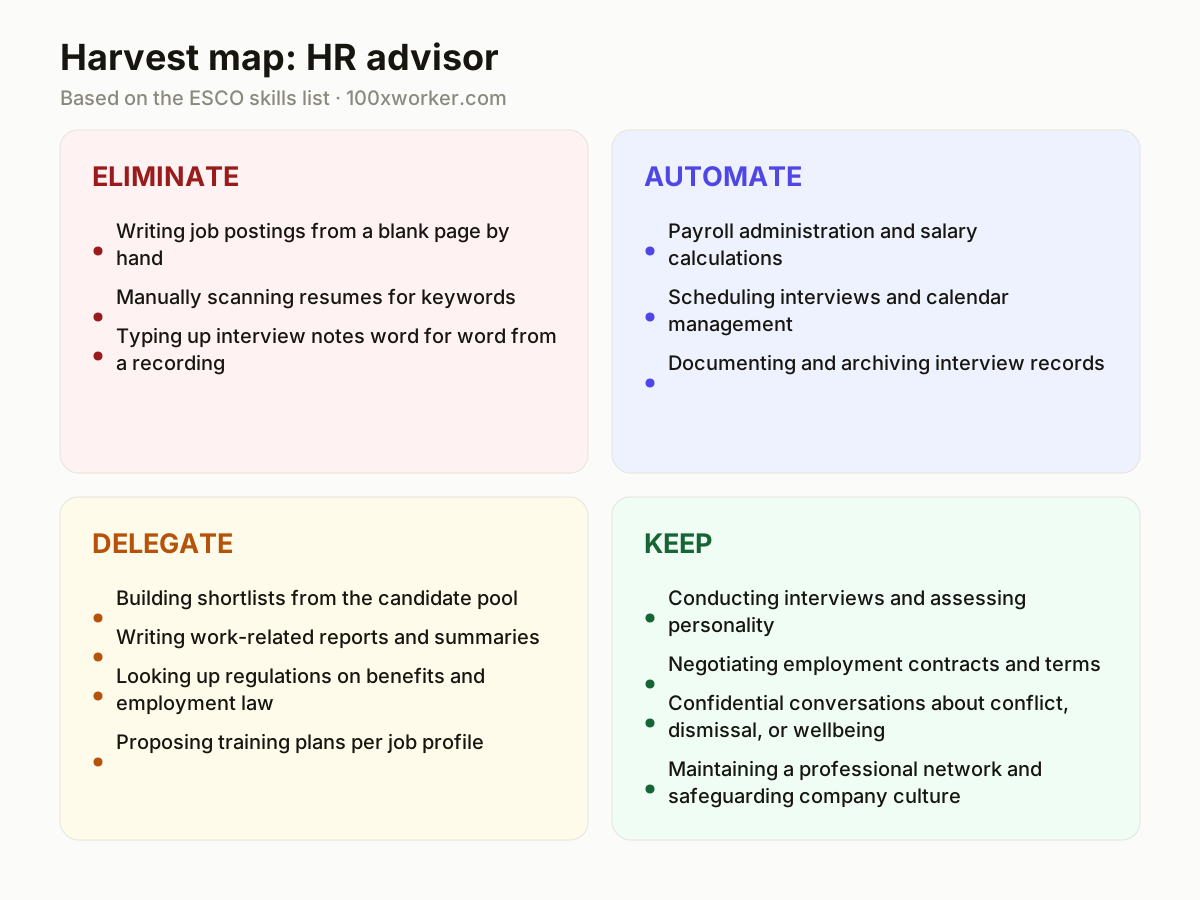
Not every HR task changes the same way. Some tasks disappear because a tool does them instantly and well. Some run on autopilot with light human oversight. Some are better split between AI doing a first pass and you finishing the judgment call. And some stay entirely human because they depend on trust, negotiation, or reading a room. Sorting your own task list this way, eliminate, automate, delegate, keep, is more useful than any single occupation-wide percentage.
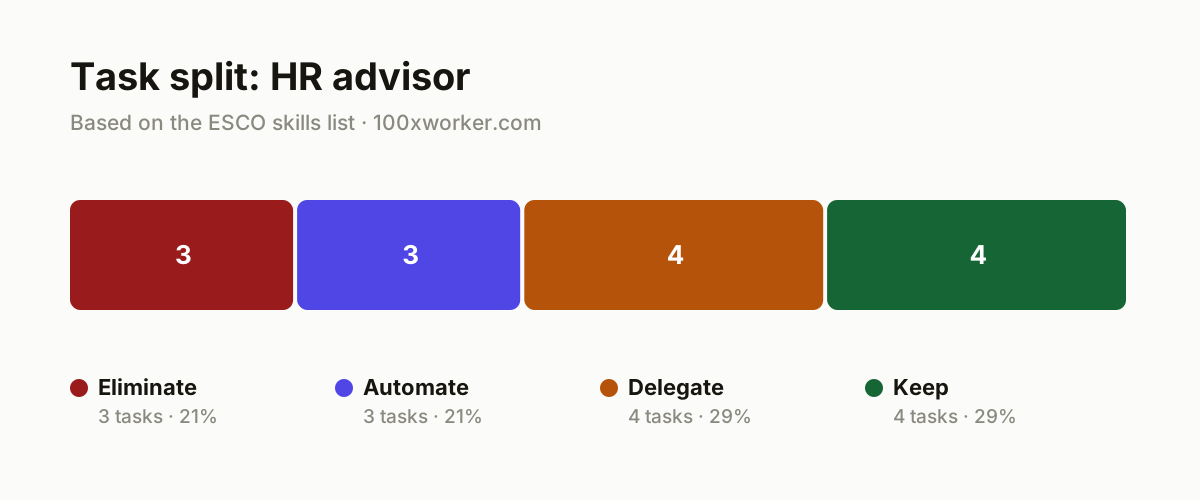
| Task | Bucket | Why |
|---|---|---|
| Writing job postings from a blank page by hand | eliminate | AI generates a usable first draft immediately from a job profile description. |
| Manually scanning resumes for keywords | eliminate | Screening tools do this faster and more consistently than a person reviewing hundreds of files. |
| Typing up interview notes word for word from a recording | eliminate | Transcription tools convert recordings to text automatically; manual typing adds no value. |
| Payroll administration and salary calculations | automate | Payroll workflows run on their own; you check via spot audits and exceptions. |
| Scheduling interviews and calendar management | automate | A scheduling agent matches calendars and sends confirmations without your involvement. |
| Documenting and archiving interview records | automate | Recordings are automatically structured and filed into the candidate record. |
| Building shortlists from the candidate pool | delegate | AI ranks candidates by profile and criteria; you decide who actually gets invited. |
| Writing work-related reports and summaries | delegate | AI turns raw data into a report draft; you rewrite the nuance and draw the conclusions. |
| Looking up regulations on benefits and employment law | delegate | AI finds the relevant provisions; you check them against the specific case and decide. |
| Proposing training plans per job profile | delegate | AI drafts an initial learning path; you adjust it for the person and the budget. |
| Conducting interviews and assessing personality | keep | AI can help prepare a conversation, but it cannot sense rapport or hesitation. (Your edge: Human intuition and building trust in real time) |
| Negotiating employment contracts and terms | keep | AI supplies market data, but the negotiation itself stays human work requiring tact and timing. (Your edge: Sensing what the other party truly wants) |
| Confidential conversations about conflict, dismissal, or wellbeing | keep | This requires trust and discretion that no model can build. (Your edge: Discretion and trust in sensitive cases) |
| Maintaining a professional network and safeguarding company culture | keep | Relationships and culture require personal presence, not generated text. (Your edge: Reading company culture and holding relationships) |
Which HR advisor tasks does AI take over?
AI takes over the mechanical front end of recruitment and admin: drafting job postings, scanning resumes for keywords, transcribing interviews, running payroll calculations, and scheduling. Microsoft Research's applicability data shows these repetitive, text-heavy tasks are where generative AI already shows measurable use. What it does not take over is the judgment layer: deciding who to hire, how to negotiate a contract, or how to handle a dismissal conversation. Those stay with you.
Will AI replace HR advisors?
No single number says otherwise. Microsoft Research's 20.1% applicability score for HR specialists means a fifth of typical work activities show clear AI use, not that a fifth of HR advisors lose their jobs. The role changes shape: less time drafting and screening, more time on negotiation, culture, and confidential decisions. Anthropic's Economic Index frames this as a split between automation (AI does it) and augmentation (AI assists, you decide), and HR work leans toward the augmentation side for its core, judgment-heavy tasks.
How do you become the AI-savvy person on the HR team?
Start by mapping your own week against the four buckets above and naming the tools you already have access to: an ATS with AI screening, a transcription tool built into your video calls, a writing assistant for job postings. Build two or three prompt templates you reuse for shortlisting and report drafting. Share what works with colleagues. Being the AI-savvy person in HR is less about mastering a new platform and more about consistently checking AI output against the candidate file, the contract, and the law before it goes anywhere.
What can you do this month as an HR advisor?
Pick one recurring task, job postings or interview transcription, and move it fully into an AI tool this month. Track how much time it saves and where you still had to correct the output. Then pick one delegate-bucket task, like shortlist building, and set a rule for when you review AI's ranking versus when you trust it. Small, tracked changes beat a blanket policy, and they give you concrete evidence for what to change next.
Generative AI's applicability ranges from 12% of work activities for nurses to 49% for translators, with most occupations, including HR roles, falling in between.
Microsoft Research, Working with AI: Measuring the Applicability of Generative AI to Occupations (2025)
Become the AI person on your team
Turn job profiles into ready-to-post drafts
Feed the job profile, required skills, and salary band into a writing tool and generate three draft postings in different tones. Edit the best one instead of starting from scratch.
Build a reusable shortlist prompt
Set clear ranking criteria (must-have skills, years of experience, location) and reuse the same prompt structure for every vacancy. Review the top ten yourself before inviting anyone.
Let transcription handle the paper trail
Turn on automatic transcription for every interview and let it file straight into the candidate record. This frees time for the actual conversation instead of note-taking.
Want this for your actual task list?
The free scan on the homepage builds your personal task map in 30 seconds, based on your role and industry.
Run the free task scanTools for this work
| Tool | For which tasks | The sober take |
|---|---|---|
| Generative AI writing assistants (e.g., ChatGPT, Microsoft Copilot) | Drafting job postings, writing reports, first-pass training plan proposals | Good for a first draft; you still need to edit for company voice and accuracy. |
| Applicant tracking systems with AI screening (e.g., Workday, Greenhouse) | Resume screening, keyword matching, candidate shortlisting | Speeds up filtering but can encode bias if the ranking criteria aren't checked. |
| Meeting transcription tools (e.g., Otter.ai, Microsoft Teams transcription) | Documenting and archiving interviews | Reliable for text conversion; confidentiality settings need checking before sensitive talks. |
| AI-assisted scheduling tools | Scheduling interviews and calendar management | Removes back-and-forth emails but still needs a human to confirm final invites. |
Prompts to try today
Draft a job posting from a profile
Rank a candidate pool against set criteria
Summarize an interview transcript for the file
Related jobs
Frequently asked questions
Does a 20.1% AI applicability score mean 20% of HR advisor jobs disappear?
No. The score measures the share of work activities where generative AI shows demonstrable use in real conversations, not the share of jobs at risk. Microsoft Research built this score from 200,000 actual Copilot conversations mapped to occupations. A task-level view (drafting, screening, transcribing) explains the number better than a job-loss interpretation does.
Which part of the HR advisor's job is safest from AI?
Negotiation, confidential conversations about conflict or dismissal, and reading candidate personality in an interview stay firmly human. These tasks depend on trust, discretion, and real-time judgment that generative AI tools are not built to replicate, regardless of how good they get at drafting text or ranking resumes.
How does Anthropic's Economic Index describe AI use in HR-type work?
Anthropic's Economic Index classifies AI conversations against O*NET task categories and splits usage into automation, where the AI performs a task directly, and augmentation, where it assists a person who still makes the decision. For roles like HR advisor, the judgment-heavy tasks (negotiating, deciding who to hire) lean toward augmentation rather than full automation.
Is the Frey and Osborne 'robotization percentage' still accurate for HR advisors?
No. That 2013 Oxford study predates large language models and generative AI entirely. It estimated automation risk from a different technological baseline. Site figures that still quote a single robotization percentage per occupation are working from outdated assumptions; the Microsoft Research and Anthropic data reflect actual generative AI use in 2025.
Sources
- Microsoft Research, Working with AI: Measuring the Applicability of Generative AI to Occupations (2025)
- Anthropic Economic Index
- Eurostat, isoc_ai_iaiu
- ESCO, European Commission
Hendrik De Winne, author of Becoming AI-Savvy, founder of VibeLab. Helps teams redesign their work with AI.
This article was drafted with AI assistance from public data sources and editorially reviewed.