100×worker · job analysis
Will AI Replace Career Coaches, and What Should You Do About It?

Career coaches spend a good part of their week on work that has little to do with sitting across from a client: scanning job boards, writing up notes after a session, checking scholarship rules, drafting a first version of a resume. That is the part of the job artificial intelligence is already changing.
Microsoft Research analyzed 200,000 real conversations with its Copilot assistant and scored how applicable generative AI is to the work activities of hundreds of occupations. For "Educational, Guidance, and Career Counselors and Advisors," the closest match to career coaching, the applicability score comes out at 32.5%. That places the job in the middle of the pack: well below translators (49%), and well above nurses (12%).
Adoption of the underlying tools is already broad. Across the EU, 32.7% of people aged 16 to 74 used generative AI in the three months before being surveyed in 2025, according to Eurostat. Clients increasingly arrive at a coaching session having already asked a chatbot about their career options. The real question for the profession is which parts of the job AI should be allowed to touch, and which parts stay in human hands.
A career coach guides people through career and study decisions; AI mostly takes over search and paperwork.
The task split: what AI takes over and what stays yours
To see where AI actually changes this job, it helps to sort tasks into four groups: work that disappears because software already does it better, work that runs largely on autopilot through an AI agent, work where AI drafts and you finish, and work that stays entirely with the coach. Below is that breakdown for career coaching, task by task.
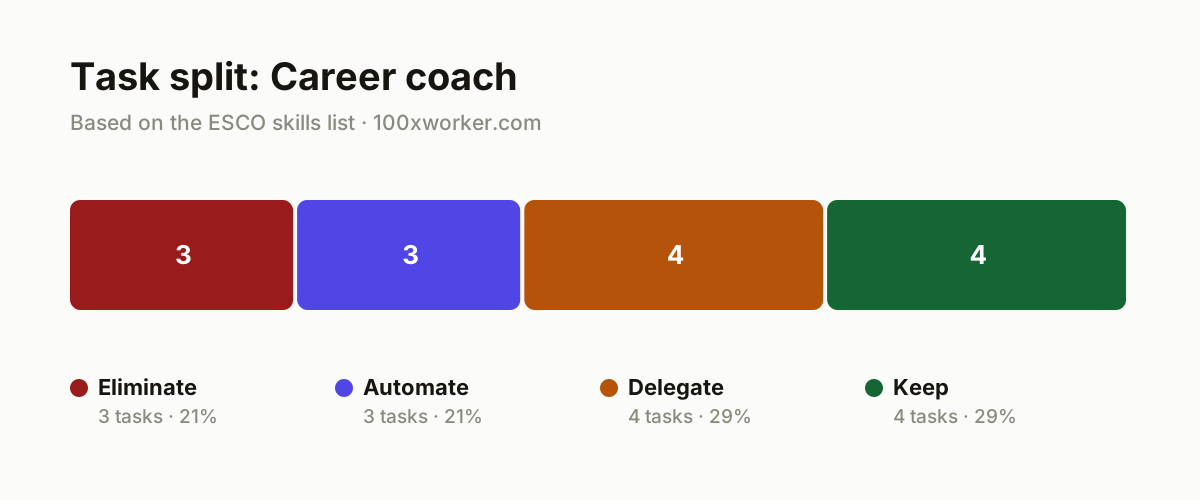
| Task | Bucket | Why |
|---|---|---|
| Collecting job postings by hand and copying them into spreadsheets | eliminate | Job aggregators and search engines cover more listings, faster, than manual copy-paste ever did. |
| Manually checking resume formatting and spelling | eliminate | Word processors and AI writing tools now catch formatting and spelling errors more reliably and faster. |
| Looking up course brochures and program fact sheets institution by institution | eliminate | That information is online already; a language model retrieves and compares it in seconds. |
| Scanning job postings and matching them to a client's profile | automate | An AI agent can monitor job sites continuously and filter automatically for relevance. |
| Writing up session notes and case file entries after each coaching conversation | automate | Transcription and summarization tools produce a usable write-up right after the session ends. |
| Compiling an overview of funding options and scholarships for a given situation | automate | Rules change often but are well documented, which makes this a good fit for automation. |
| Drafting a first version of a career plan based on intake information | delegate | AI turns raw intake notes into a structured draft; you revise it and check it against the client. |
| Writing a first draft of a resume and cover letter | delegate | AI produces a workable first version; you sharpen tone and detail together with the client. |
| Preparing a progress report or program evaluation | delegate | AI organizes the facts from your notes; you add judgment and recommendations. |
| Preparing an overview of training programs and courses for a given profile | delegate | AI gathers and ranks the options; you select what actually fits this client. |
| Running the coaching conversation itself: active listening and follow-up questions | keep | This is the core of the job and requires live, in-the-moment attunement to the client. (Your edge: Presence and trust are not built through a screen.) |
| Encouraging a client to examine their own ambitions and doubts | keep | This takes empathy and the ability to sense what someone has not said yet. (Your edge: You notice hesitation and silences that text cannot show.) |
| Supporting clients through difficult or emotional decisions | keep | A layoff, burnout, or a hard study choice calls for human judgment and tact. (Your edge: You carry that moment with the client, not after the fact.) |
| Choosing the right coaching method and approach for each individual client | keep | Every client needs a different combination of methods, drawn from experience. (Your edge: That choice rests on years of accumulated professional judgment.) |
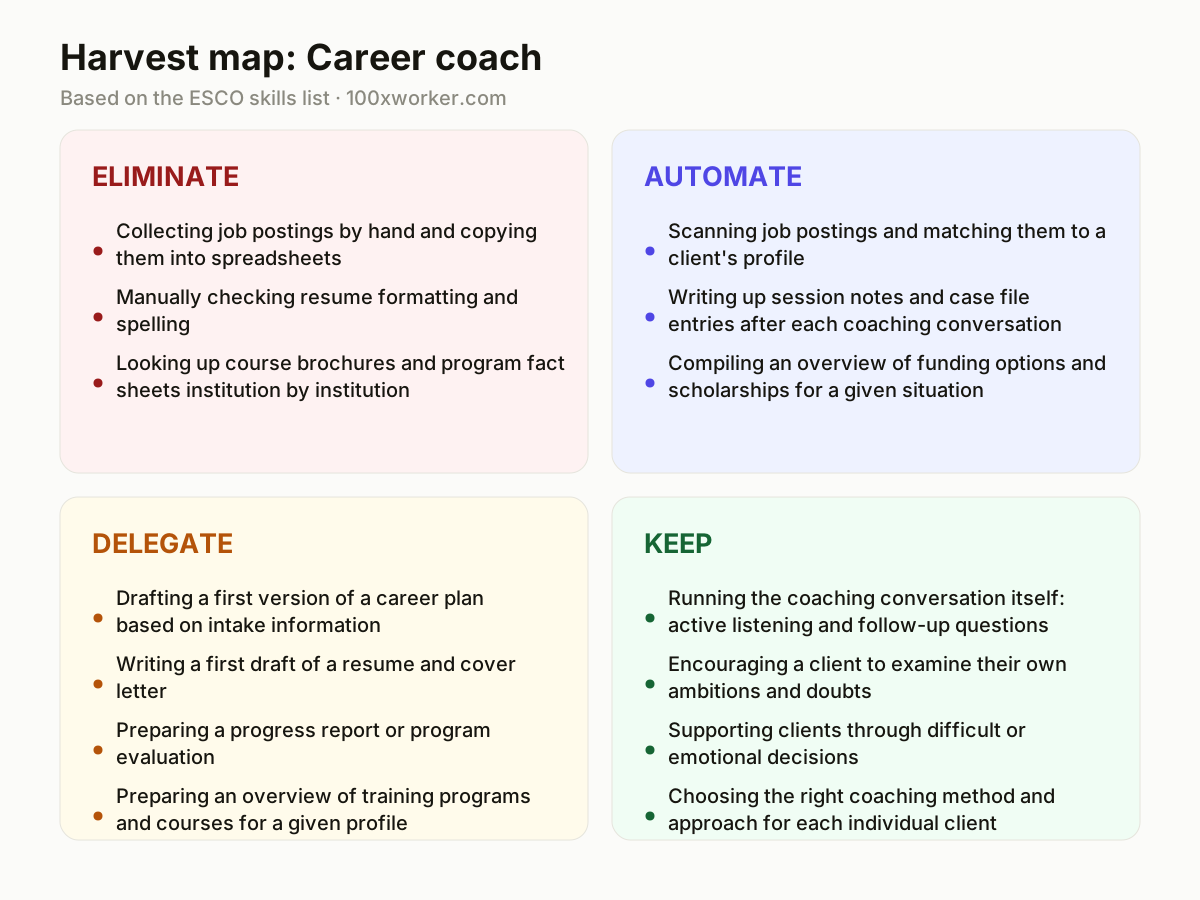
Which tasks of a career coach does AI take over?
AI now handles most of the searching and paperwork that surrounds a coaching relationship. It scans job boards and matches postings to a client's profile, pulls together funding and scholarship information, and turns a recorded session into a usable case note. It also produces first drafts: a resume, a cover letter, a career plan sketched from intake notes. None of this eliminates the coach's role, but it removes hours of manual work that used to fill the time between sessions. What AI does not do is decide which option fits a specific person, or notice the hesitation in someone's voice when they talk about a career change.
Will AI replace career coaches?
No single AI applicability score suggests career coaches will disappear. Microsoft Research puts generative AI's applicability to this occupation at 32.5% of work activities, a mid-range figure: far above nursing (12%) but well below translation (49%). That number describes tasks, not jobs. The coaching conversation, the judgment about which path fits a specific person, and the trust built over multiple sessions are not tasks a language model can carry out on its own. What changes is the shape of the job: less time on search and paperwork, more time available for the conversation itself, if coaches actively hand off the routine work.
Which tasks stay human work for a career coach?
The coaching conversation itself stays human: active listening, follow-up questions, and reading what a client does not say out loud. Helping someone examine their own ambitions, doubts, and fears about a career change requires empathy that current AI tools cannot supply. Supporting a client through a layoff, a burnout, or a difficult study choice calls for tact and judgment in the moment, not after it. Choosing which coaching method fits which client, built up over years of practice, also stays with the coach. AI can prepare material for these moments, but it cannot sit in the room.
What can you do this month with AI as a career coach?
Start by handing over one recurring task. Feed anonymized intake notes into an AI chat tool and ask for a first draft of a career plan or a resume, then edit it with the client rather than starting from a blank page. Use a transcription tool to generate a session summary immediately after each meeting instead of writing notes from memory later. Set up a saved search on a job aggregator for each active client so you are not scanning listings manually. Keep the actual conversation, the follow-up questions and the judgment calls, entirely for yourself.
Career counseling scores in the middle of the pack for AI applicability, well below translation work and well above nursing.
Microsoft Research, Working with AI (2025)
Become the AI person on your team
Hand off intake-to-draft work
Feed anonymized intake notes into an AI chat tool and ask for a structured first draft of a career plan or resume. Review it with the client instead of writing from scratch, and keep the parts that need your judgment for the actual session.
Automate the paperwork trail
Use a transcription or note-taking tool right after each session to generate a session summary and case file entry. Check it for accuracy before it goes into the file, but stop writing these notes from memory at the end of a long day.
Set up standing searches instead of manual scanning
Set a saved search or agent to monitor job boards for each active client's profile so new matches come to you. Spend the time you save on preparing for the actual conversation instead of scrolling listings.
Want this for your actual task list?
The free scan on the homepage builds your personal task map in 30 seconds, based on your role and industry.
Run the free task scanTools for this work
| Tool | For which tasks | The sober take |
|---|---|---|
| General-purpose AI chat tools (e.g. ChatGPT, Claude) | Drafting resumes, cover letters, and first-pass career plans from intake notes | Useful as a drafting assistant, not a substitute for the coaching conversation. |
| Transcription and meeting-summary tools | Session notes and case file entries after each coaching conversation | Cuts note-writing time but still needs a human check for accuracy and tone. |
| Job aggregator and job-alert platforms | Scanning and matching job postings to a client's profile | Already filters and monitors listings more thoroughly than manual searching. |
| AI-assisted writing checkers (e.g. Grammarly-style tools) | Resume formatting and spelling checks | Handles the mechanical cleanup so you can focus on content with the client. |
Prompts to try today
Turn intake notes into a first career plan draft
Summarize a coaching session into a case file entry
Match a client profile to relevant openings
Related jobs
Frequently asked questions
Is career coaching at high risk of automation?
Not according to the most recent data. Microsoft Research's 2025 analysis puts the applicability of generative AI to this occupation at 32.5% of work activities, a mid-range figure. Older studies on job automation, such as Frey and Osborne's 2013 Oxford paper, predate large language models and are widely considered outdated for judging AI's actual effect on this kind of work.
Do clients already use AI chatbots for career advice?
Very likely, yes. Eurostat reports that 32.7% of the EU population aged 16 to 74 used generative AI in the three months before being surveyed in 2025. Many clients now research career options, resume phrasing, or salary ranges with a chatbot before or between sessions, which changes what they expect a coach to add during the meeting itself.
Are the old robot-job-loss percentages for this occupation still accurate?
No. Widely cited automation-risk percentages for many professions trace back to Frey and Osborne's 2013 Oxford study, done years before generative AI existed. It measured a different kind of automation risk (task substitution by rule-based software and robotics), not the drafting and search capabilities of today's language models. Treat any older robotization percentage for career coaching with caution.
Which skills from the ESCO taxonomy still matter most for career coaches?
ESCO lists active listening, encouraging clients to examine themselves, identifying client needs, coaching clients, and assessing client progress as essential skills for this role. These are exactly the tasks that stay human as AI takes over searching and drafting. ESCO (European Commission) describes 3,039 occupations with associated skills in 28 languages.
Sources
- Microsoft Research, Working with AI: Measuring the Applicability of Generative AI to Occupations (2025)
- Anthropic Economic Index
- Eurostat, Individuals using generative AI (isoc_ai_iaiu)
- ESCO (European Commission occupation and skills taxonomy)
Hendrik De Winne, author of Becoming AI-Savvy, founder of VibeLab. Helps teams redesign their work with AI.
This article was drafted with AI assistance from public data sources and editorially reviewed.