100×worker · job analysis
Will AI Replace School Principals? What Actually Changes

School principals run schools, not documents, but a large share of their week still involves writing, reporting, and scheduling. That is where generative AI is starting to show up. Microsoft Research analyzed 200,000 real conversations with its Copilot assistant and built an applicability score for hundreds of occupations. For education administrators at the K-12 level, the closest match to a principal's role, that score is 13.5%. For comparison, translators score 49% and nurses score 12%. Principals sit near the low end, which fits a job built around people, not text.
That does not mean AI is irrelevant. Across the EU, 32.7% of people aged 16 to 74 used generative AI in the last three months of 2025, according to Eurostat. Many principals are already using chatbots for first drafts of letters, meeting notes, or reports, even without a formal school policy. The useful move is not asking whether AI will replace the job, but sorting which parts of the job it can already touch.
A school principal leads a school's teaching and operations, using AI mainly for reports, scheduling, and drafting.
The task split: what AI takes over and what stays yours
Not every task a principal does belongs in the same AI bucket. Some tasks can be eliminated because AI now does them faster than typing from scratch. Some can be automated end to end inside existing school systems. Some are best delegated to AI for a first draft, with the principal reviewing and deciding. And some tasks need to stay entirely with a person, because they depend on presence, trust, or judgment that no model has. Sorting a principal's task list this way, instead of asking a vague question about the whole job, gives a clearer picture of what actually changes.
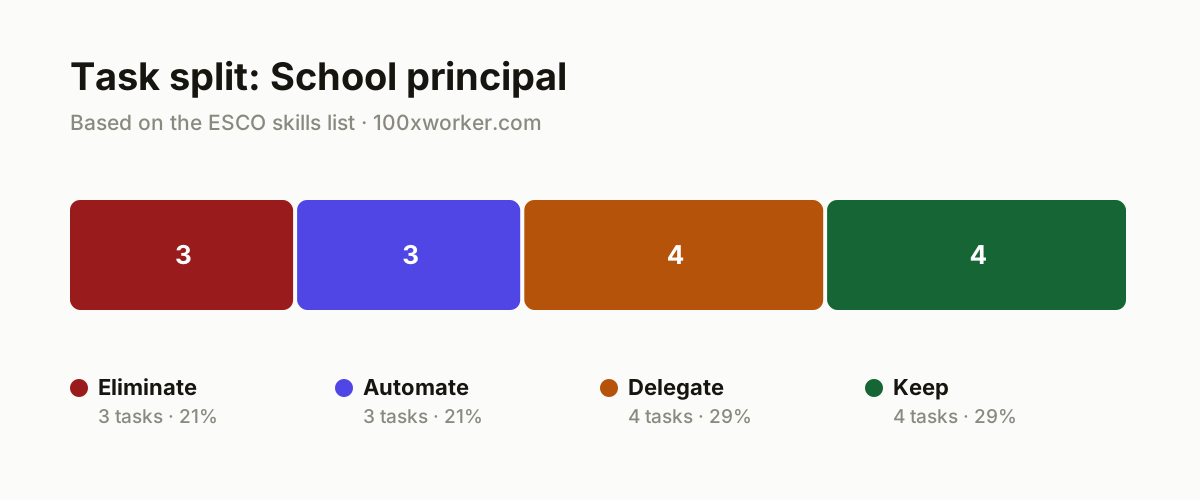
| Task | Bucket | Why |
|---|---|---|
| Writing standard parent letters and newsletters from scratch | eliminate | AI produces a usable first draft from a few bullet points, faster than starting from a blank page. |
| Typing up meeting notes by hand | eliminate | Transcription and summary now happen automatically during or right after the meeting. |
| Manually checking a spreadsheet for scheduling conflicts | eliminate | AI-assisted scheduling tools detect and resolve basic timetable conflicts on their own. |
| Attendance tracking and automatic notifications to parents | automate | The system recognizes patterns, logs absences, and sends messages without manual entry. |
| Generating standard reports for the school board or education authorities | automate | AI pulls from existing data on attendance, results, and staffing to assemble the report itself. |
| Logistical planning of school events | automate | Timing, rooms, and assigned staff follow a fixed template that an AI agent can fill in. |
| Drafting policy documents and curriculum updates based on education regulations | delegate | AI summarizes the regulation and writes a first version, you check it against your school's context. |
| Preparing feedback forms and notes ahead of teacher performance reviews | delegate | AI organizes observations into concrete feedback points, you lead the conversation and make the call. |
| Briefing yourself on education research and inspection reports | delegate | AI reads and condenses long documents, you decide what actually applies to your school. |
| Drafting a first version of crisis communication after a safety incident | delegate | AI gets facts and tone onto the page quickly, you edit, and responsibility for sending stays with you. |
| Supervising teaching staff and coaching them in the classroom | keep | This requires direct classroom observation and a working relationship, not a document. (Your edge: Trust and nuance only build through in-person contact.) |
| Handling individual student discipline cases | keep | Every incident carries context a system has no access to. (Your edge: Authority and judgment require someone who knows the child.) |
| Working with counselors, parents, and specialists on sensitive student cases | keep | These conversations require reading emotion and interests in the room, in real time. (Your edge: Trust in a sensitive case is not built with a prompt.) |
| Talking directly with students in hallways, classrooms, or during conflicts | keep | Children respond to a present adult, not a screen. (Your edge: A student reads a person, not an interface.) |
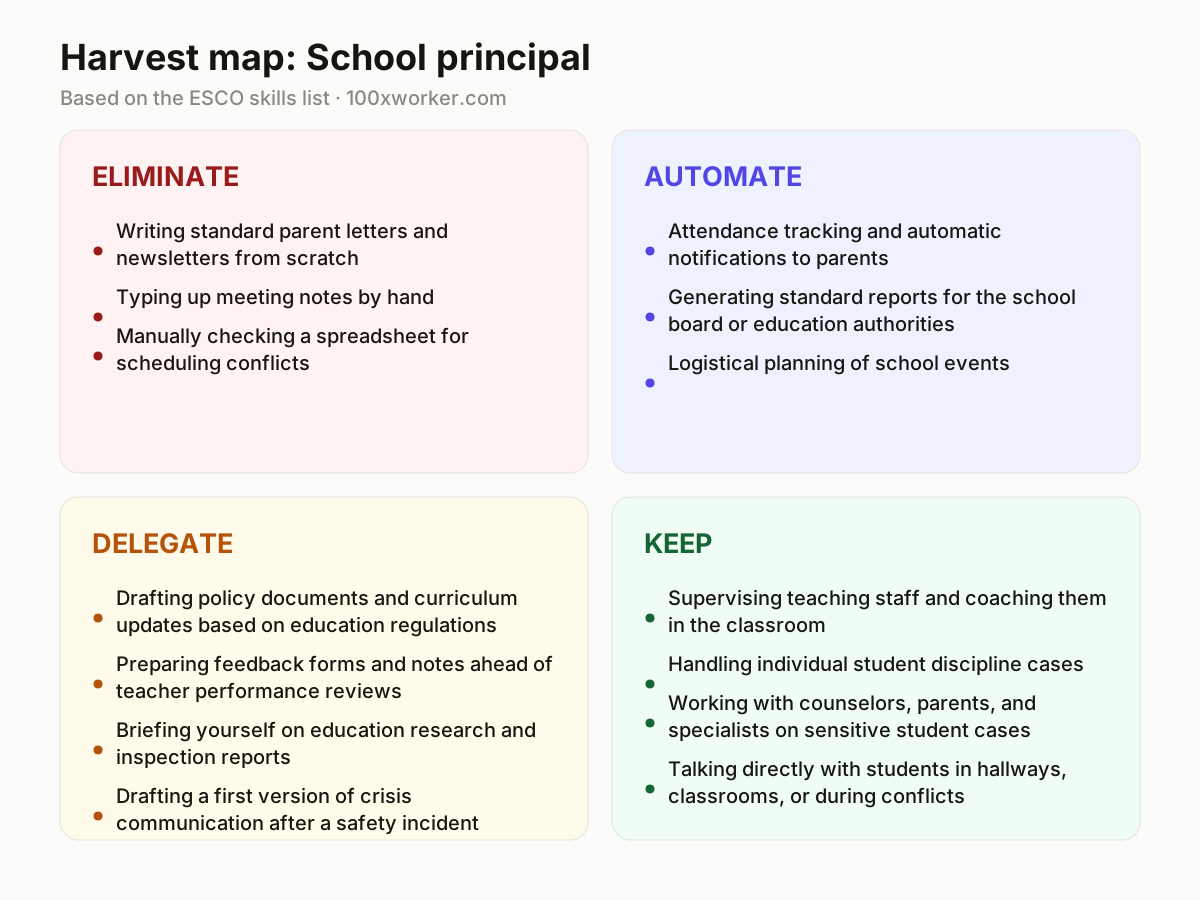
What tasks can AI take over from a school principal?
AI is strongest on the paperwork side of the job: first drafts of parent letters, meeting summaries, standard reports for a school board, and routine scheduling. These are language-heavy, template-driven tasks, which is exactly where generative AI performs well according to Microsoft Research's applicability scoring. It is weaker on anything that requires being physically present, reading a room, or making a judgment call about a specific child or staff member. Principals who separate these two categories can free up hours each week without changing what the job actually is.
Will AI replace school principals?
No. The Microsoft Research applicability score for K-12 education administrators is 13.5%, one of the lower scores among occupations studied, well below roles like translation at 49%. That reflects how much of a principal's real work depends on supervision, discipline decisions, and relationships with staff, students, and families, none of which reduce to a document. AI will keep taking over drafting and reporting tasks, which changes the shape of the job, but it does not replace the leadership and presence a principal provides on site.
How do you become the AI-savvy person on your school team?
Start by using AI visibly on your own paperwork, letters, reports, meeting notes, so staff see it in daily use, not as a mystery tool. Write a one-page policy for teachers on what AI use is fine for lesson prep or admin and what is not, especially around student data. Share which tools you actually use and why. Being the AI-savvy person on a school team is less about technical skill and more about setting a clear, workable example that reduces confusion for everyone else.
What can you do this month with AI as a school principal?
Pick one recurring task, board reports, parent newsletters, or meeting notes, and run it through an AI tool for two weeks to see the time saved. Draft a short internal policy on which student and staff data can and cannot go into an AI chatbot. Ask two teachers what they already use informally, since most staff experiment quietly before any policy exists. These three steps give you real information instead of a guess about where AI fits in your school.
Generative AI's usefulness for an occupation tracks closely with how much of the job is language-based drafting and analysis rather than in-person judgment.
Microsoft Research, Working with AI (2025)
Become the AI person on your team
Run your own paperwork through AI first
Use a chatbot for your next parent letter or board report before asking staff to try anything. Seeing you use it removes the mystery and gives you a concrete example to point to.
Write a one-page AI policy for your school
Cover what is fine (lesson planning support, drafting, summarizing) and what is off-limits (entering identifiable student data). Keep it short enough that teachers actually read it.
Map your own week into the four buckets
List your recurring tasks and sort them into eliminate, automate, delegate, and keep. This turns a vague worry about AI into a short, specific to-do list.
Want this for your actual task list?
The free scan on the homepage builds your personal task map in 30 seconds, based on your role and industry.
Run the free task scanTools for this work
| Tool | For which tasks | The sober take |
|---|---|---|
| Microsoft Copilot | Drafting parent letters, newsletters, and board reports | Integrates with Word and Outlook, which most school admin systems already use. |
| ChatGPT or Claude | Summarizing policy documents, drafting crisis communication, briefing yourself on new regulations | Useful for a fast first draft, but review before anything goes out under your name. |
| Otter.ai or similar meeting transcription tools | Turning staff meetings into notes and action items | Check your data retention settings before recording meetings that involve student information. |
| School scheduling software with AI features | Detecting and resolving timetable conflicts | Most modern platforms now flag conflicts automatically, reducing manual checking. |
Prompts to try today
Draft a parent newsletter
Summarize an education policy document
Prepare notes for a teacher performance conversation
Related jobs
Frequently asked questions
Will AI replace school principals?
No. Microsoft Research's applicability score for K-12 education administrators is 13.5%, one of the lower scores across occupations studied, well below roles built entirely on text work. The job depends heavily on supervision, discipline decisions, and relationships that cannot be handed to software. AI changes how much time principals spend on paperwork, not whether the role itself is needed.
What is the biggest AI risk for school principals right now?
The main risk is not job loss but data handling. Entering identifiable student or staff information into a public AI chatbot without a school policy can create privacy problems. A short internal guideline on what data can go into which tool matters more, right now, than any concern about AI replacing the role.
How many school staff are already using AI tools informally?
There is no exact figure specific to school principals, but general adoption is rising fast. Across the EU, 32.7% of people aged 16 to 74 used generative AI in the last three months of 2025, according to Eurostat. It is reasonable to assume a meaningful share of teaching and admin staff are already experimenting with these tools without a formal policy in place.
Which principal tasks should never go to AI?
Anything involving individual student discipline, staff supervision, or sensitive conversations with families should stay with a human. These situations depend on context, trust, and judgment built through direct contact, which no chatbot has access to. AI can help you prepare notes beforehand, but the conversation and the decision belong to you.
Sources
- Microsoft Research, Working with AI: Measuring the Applicability of Generative AI to Occupations (2025)
- Anthropic Economic Index
- Eurostat, Individuals using generative AI (isoc_ai_iaiu)
- ESCO, European Commission occupation taxonomy
Hendrik De Winne, author of Becoming AI-Savvy, founder of VibeLab. Helps teams redesign their work with AI.
This article was drafted with AI assistance from public data sources and editorially reviewed.