100×worker · job analysis
Will AI Replace Teachers, and What Should You Do About It?

Teaching keeps showing up near the bottom of every list ranking jobs by AI exposure, and that is not an accident. Microsoft Research analyzed 200,000 real Copilot conversations and scored occupations by how much of their actual work AI can plausibly do. Secondary school teachers came in at 17.6%, far below translators (49%) and only just above nurses (12%). That number tells you something concrete: most of what makes teaching hard to automate, live classroom management, reading a struggling student, building trust over a school year, has nothing to do with generating text.
But a low applicability score does not mean nothing changes. Across the EU, 32.7% of people aged 16 to 74 used generative AI in the past three months in 2025, according to Eurostat. Teachers are already using tools like ChatGPT, Claude, or Copilot to draft quizzes, rewrite explanations for different reading levels, and generate parent emails. The job description in ESCO (code 2330.1) still lists preparing lesson content, assessing students, and managing classroom discipline as core tasks. AI touches the first two. It does not touch the third.
A secondary school teacher is a subject specialist who teaches, guides, and assesses teenagers within a school.
The task split: what AI takes over and what stays yours
Not every teaching task changes the same way. Some tasks disappear because the tools that created the need for them (paper worksheets, manual quiz assembly) are becoming obsolete. Others get fully automated, handled end to end by a tool with no teacher input. A third group gets delegated: AI drafts, you edit and decide. And a fourth group stays entirely human, because it depends on live presence, trust, or judgment that no model has. Sorting your own task list into these four buckets is the fastest way to see where your time actually goes.
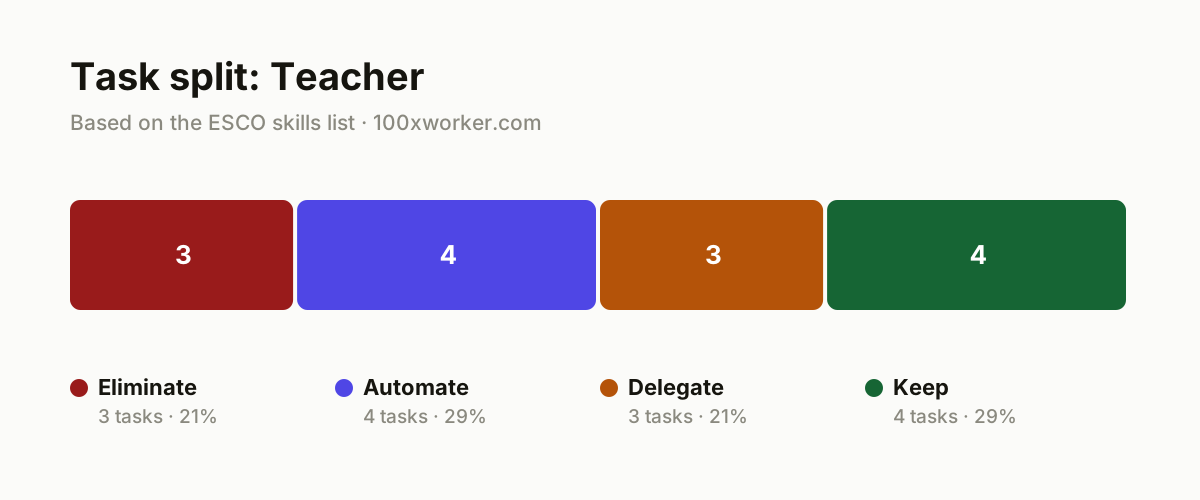
| Task | Bucket | Why |
|---|---|---|
| Rewriting the same lesson materials from a blank document every school year | eliminate | AI variants and templates make a full rewrite unnecessary, the base version already exists. |
| Manually cutting and pasting quiz questions from old exams into a new document | eliminate | Question banks can be generated faster and more consistently than assembled by hand. |
| Physically photocopying, stapling, and sorting worksheets for each class | eliminate | Digital distribution through the school's learning platform removes most of this paperwork. |
| Generating practice questions and quiz items from a learning objective | automate | An AI tool produces a usable question set, you just check accuracy and level. |
| Auto-grading multiple choice and fill-in-the-blank exercises | automate | The learning platform or an AI tool handles this fully without human involvement. |
| Drafting a first lesson plan from curriculum objectives | automate | An AI agent turns standards into a concrete lesson structure you can adjust immediately. |
| Creating differentiated versions of existing material for different reading levels | automate | AI produces an easier or harder version of the same text in seconds. |
| Giving feedback on essays and writing assignments | delegate | AI produces a first layer of feedback on structure and language, you refine tone, content, and grading. |
| Drafting report card comments for each student | delegate | AI writes a draft from scores and notes, you rewrite it to sound personal and add nuance. |
| Drafting parent communication (emails, invitations, reminders) | delegate | AI produces a draft message, you adjust approach and tone for sensitive situations. |
| Classroom management and discipline during a live lesson | keep | This requires live presence, authority, and reading group dynamics in the moment. (Your edge: Classroom authority happens in the room, no AI stands there.) |
| Building student relationships and one-on-one support for learning difficulties | keep | Trust and reading a child only happen through real human contact. (Your edge: Trust is not built through a screen.) |
| Judging a student's growth, attitude, and character beyond grades | keep | This requires context about the child that AI never fully has. (Your edge: Only you know this child's full story.) |
| Handling conflicts and sensitive intercultural or pedagogical situations | keep | Human judgment and empathy are irreplaceable, every situation is different. (Your edge: Judgment and empathy, delivered in the moment itself.) |
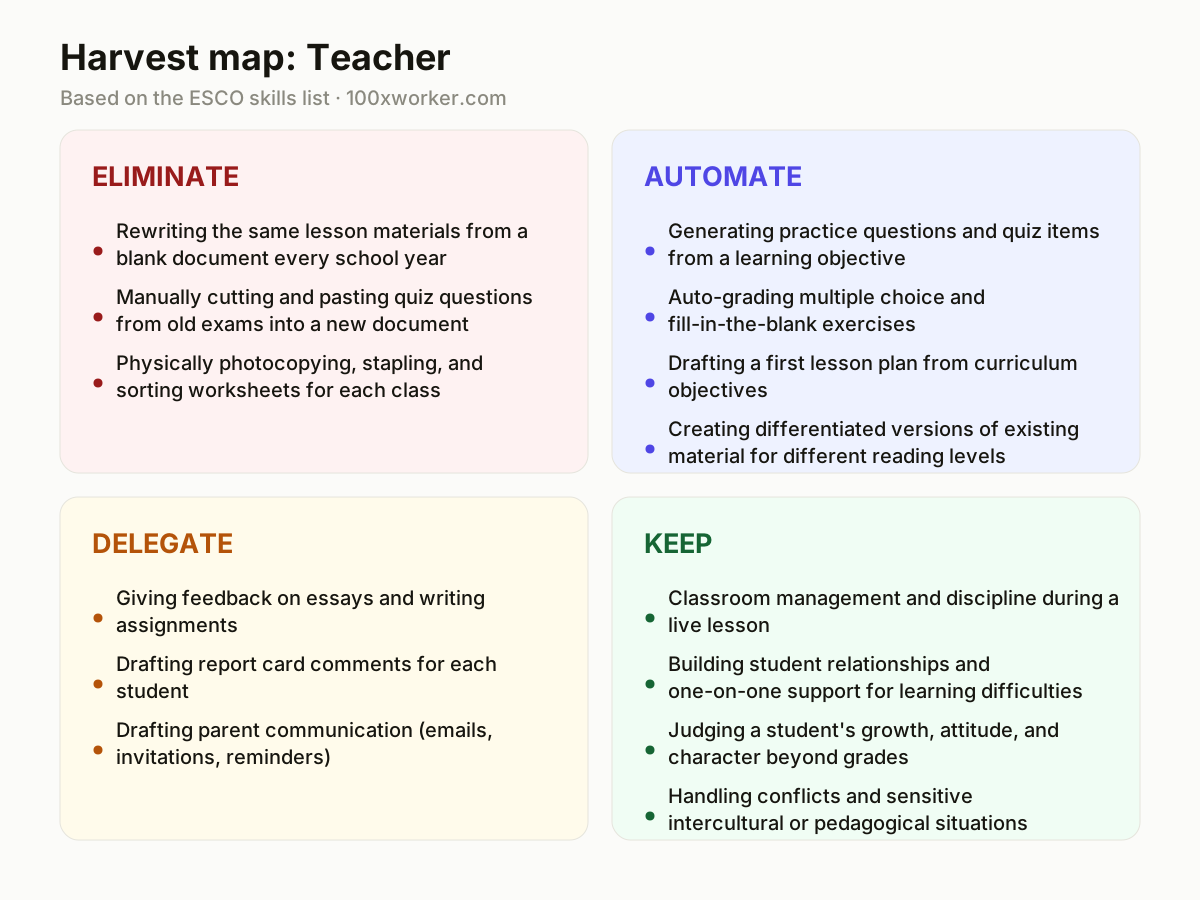
Which teaching tasks does AI take over?
AI takes over the repetitive, text-heavy parts of teaching: generating quiz questions from a learning objective, auto-grading multiple choice and fill-in-the-blank work, drafting a first version of a lesson plan from curriculum standards, and producing easier or harder versions of the same reading passage. These are tasks with a clear input and a checkable output. AI does not take over classroom management, live discipline, or judging a student's character and growth. Microsoft Research's applicability score of 17.6% for secondary teachers reflects exactly this split: administrative and content-generation work is exposed, relational and in-person work is not.
Will AI replace teachers?
No. The 17.6% applicability score from Microsoft Research is one of the lowest of any occupation the researchers measured, well below translators (49%) and closer to nurses (12%). AI can draft a lesson plan or grade a multiple choice test, but it cannot hold classroom authority, read a room of teenagers, or build the trust that makes a struggling student open up. Schools that try to replace teaching staff with AI tools run into this immediately: the parts of the job that actually take up emotional energy, discipline, mentoring, judgment calls, have no automatable equivalent. What changes is the task mix inside the job, not the need for the teacher.
How do you become the AI person at your school?
Start by mapping your own weekly tasks into the four buckets above: what you can stop doing, what a tool can fully handle, what you can draft with AI and then edit, and what stays entirely yours. Pick one recurring task, like writing quiz questions or drafting report comments, and build a repeatable process around an AI tool for it. Document the prompt and the checking steps you use, then share it with colleagues in your department. Being the AI person at your school is less about knowing every tool and more about being the one who has already tested what works and what doesn't.
What can you do this month with AI in your classroom?
Pick one task from the automate or delegate bucket and run it for two weeks. A realistic starting point: use an AI tool to generate a first draft of differentiated worksheets for your next unit, then spend your saved time on one-on-one check-ins with students who are behind. Or draft report card comments with AI from your grade notes, then rewrite each one in your own voice before sending. Track roughly how much time you saved. That number is what you bring to a department meeting when deciding whether to standardize the approach across your team.
Generative AI is applicable to just 17.6% of the work activities of secondary school teachers, one of the lowest shares among all occupations we measured.
Microsoft Research, Working with AI: Measuring the Applicability of Generative AI to Occupations (2025)
Become the AI person on your team
Build a personal prompt library
Save the prompts that actually produce usable lesson plans, quiz sets, or feedback drafts for your subject. Reuse and adjust them each term instead of starting from scratch every time.
Pilot one tool for one recurring task
Instead of adopting five AI tools at once, pick one task like auto-grading or differentiated worksheets and run it consistently for a full term before deciding whether to expand its use.
Turn saved time into visible teaching time
When AI cuts your grading or prep time, redirect that time to one-on-one student support or classroom feedback. Make the trade visible so colleagues and administrators see the point of using these tools.
Want this for your actual task list?
The free scan on the homepage builds your personal task map in 30 seconds, based on your role and industry.
Run the free task scanTools for this work
| Tool | For which tasks | The sober take |
|---|---|---|
| Microsoft Copilot | Drafting lesson plans, parent emails, and quiz questions | Already built into many school Microsoft 365 accounts, so adoption often needs no new procurement. |
| Claude or ChatGPT | Generating differentiated worksheets and first-draft feedback on essays | Useful for drafts, but every output needs a teacher's edit pass before it reaches students. |
| Learning management system quiz tools (e.g. Google Forms, Canvas, Moodle) | Auto-grading multiple choice and fill-in-the-blank exercises | These handle grading without AI in many cases, the automation opportunity here predates generative AI. |
| AI-assisted rubric and comment generators | Drafting report card comments from grades and notes | Speeds up the first draft, but personalizing the tone for each student remains manual work. |
Prompts to try today
Generate a differentiated worksheet
Draft report card comments from notes
Build a quiz from a learning objective
Related jobs
Frequently asked questions
Is teaching one of the safest jobs from AI?
According to Microsoft Research's applicability scoring, yes, relatively. Secondary teaching scored 17.6%, close to the bottom of the scale and far below high-exposure jobs like translation (49%). That said, low overall exposure does not mean zero change. Grading, lesson prep, and administrative writing are shifting toward AI assistance even as the core teaching role stays intact.
Should teachers learn to use AI tools now or wait?
Start now with low-stakes tasks. Drafting quiz questions, generating differentiated worksheets, or writing a first pass at parent emails are all tasks where an AI tool saves real time with low risk if you check the output. Waiting means colleagues who start now build a working process before you do, and school policies around AI use are still forming, so early, careful use also helps shape those policies.
Can AI grade student essays fairly?
AI can give a first layer of feedback on structure, grammar, and clarity, but it should not be the final grade. Essay grading involves judging argument quality, originality, and context specific to a student's growth, which requires a teacher's judgment. Treat AI feedback as a draft layer you review and adjust, not a replacement for your assessment.
What part of teaching will never be automated?
Live classroom management, discipline, and building trust with individual students are the parts least touched by AI. These require physical presence, authority in the moment, and a read on group dynamics and individual context that no current AI system has. Microsoft Research's low applicability score for teaching reflects exactly how much of the job depends on this in-person, relational work.
Sources
- Microsoft Research, Working with AI: Measuring the Applicability of Generative AI to Occupations (2025)
- Anthropic Economic Index
- Eurostat, Individuals using generative AI (isoc_ai_iaiu)
- ESCO, European Commission occupation taxonomy
Hendrik De Winne, author of Becoming AI-Savvy, founder of VibeLab. Helps teams redesign their work with AI.
This article was drafted with AI assistance from public data sources and editorially reviewed.