100×worker · job analysis
Will AI Replace Special Education Teachers?
Special education teachers spend a large share of their week on paperwork: individualized education programs (IEPs), progress reports, adapted materials, and parent communication. Microsoft Research analyzed 200,000 real Copilot conversations and scored how applicable generative AI is to different occupations. For roles closest to special education teaching, the applicability score is 19.5%, meaning roughly one in five work activities can plausibly be handled with AI assistance. That is a modest number compared to translation work (49%) but still enough to change how the job feels day to day.
The European Commission's ESCO taxonomy lists over two dozen core skills for this occupation, from managing classroom behavior to applying specialized teaching strategies for children with disabilities. Most of those skills involve direct contact with a student and cannot be handed to software. Anthropic's Economic Index, which classifies AI conversations against standard occupational task lists, shows a similar pattern across knowledge work: AI use splits between tasks it can fully automate and tasks where it only augments a person's judgment. For special education, the second category dominates.
A special education teacher supports students with intellectual or physical disabilities toward maximum independence and social inclusion.
The task split: what AI takes over and what stays yours
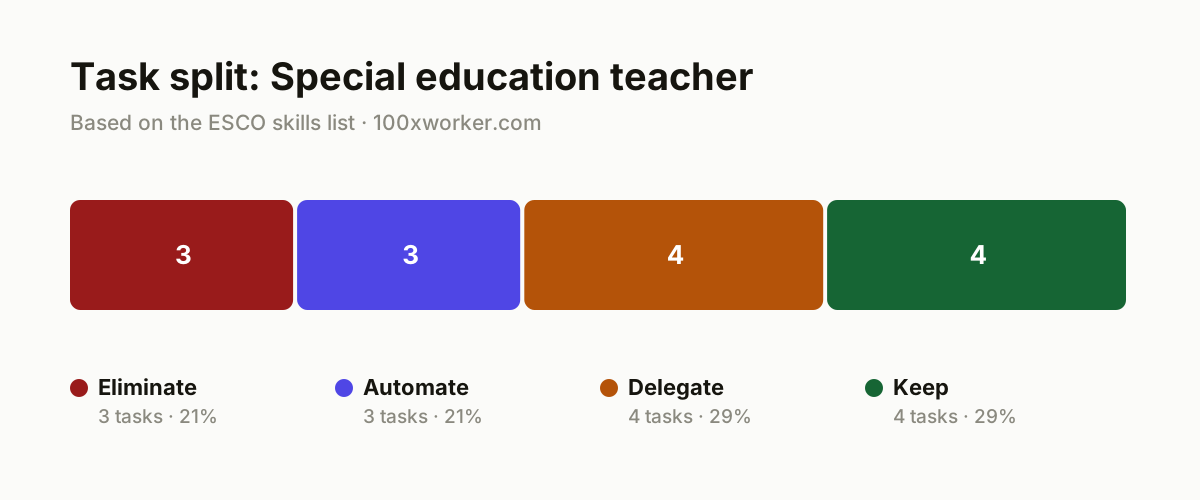
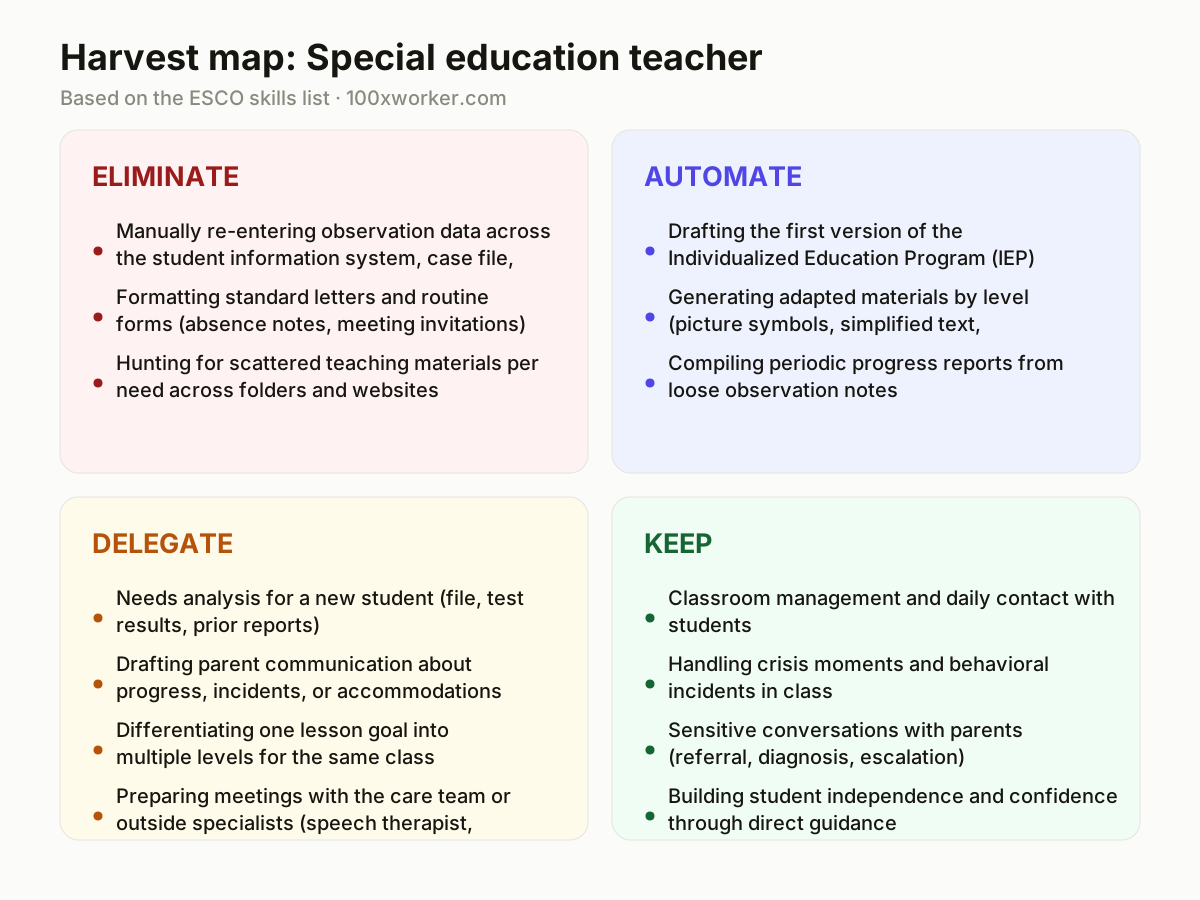
Not every task in this job responds to AI the same way. Some tasks disappear once systems talk to each other. Some get a full first draft from an AI agent. Some are best handled by asking AI to prepare the groundwork while you make the final call. And some depend entirely on physical presence and trust, so they stay with you. Sorting the job into these four buckets, rather than asking whether the whole role gets replaced, gives a more honest picture of what changes.
| Task | Bucket | Why |
|---|---|---|
| Manually re-entering observation data across the student information system, case file, and parent communication log | eliminate | Systems can sync data automatically; duplicate typing serves no remaining purpose. |
| Formatting standard letters and routine forms (absence notes, meeting invitations) | eliminate | Templates generate themselves from fixed fields; formatting no longer needs a human. |
| Hunting for scattered teaching materials per need across folders and websites | eliminate | AI searches and combines sources in seconds, so manual searching disappears. |
| Drafting the first version of the Individualized Education Program (IEP) | automate | An AI agent turns observations and goals into a structured draft, ready for your review. |
| Generating adapted materials by level (picture symbols, simplified text, motor-skill variants) | automate | One lesson goal converts automatically into several ready-to-use versions. |
| Compiling periodic progress reports from loose observation notes | automate | The agent rewrites your notes into the school's report format; you check the result. |
| Needs analysis for a new student (file, test results, prior reports) | delegate | AI drafts a first synthesis of the file; you check it against what you see in class. |
| Drafting parent communication about progress, incidents, or accommodations | delegate | AI writes a draft in the right tone; you adjust nuance and relationship. |
| Differentiating one lesson goal into multiple levels for the same class | delegate | AI supplies variants; you pick what fits the specific child you know. |
| Preparing meetings with the care team or outside specialists (speech therapist, physical therapist, school psychologist) | delegate | AI summarizes files into discussion points; you set the agenda and tone. |
| Classroom management and daily contact with students | keep | Trust and structure get built in the moment, not through a screen. (Your edge: No agent builds physical presence and trust.) |
| Handling crisis moments and behavioral incidents in class | keep | Every incident differs and needs an immediate, safe, human response. (Your edge: Real-time safety judgment needs a person on site.) |
| Sensitive conversations with parents (referral, diagnosis, escalation) | keep | These conversations need nuance, trust, and responsibility you do not outsource to a tool. (Your edge: Trust in a hard conversation needs a human.) |
| Building student independence and confidence through direct guidance | keep | Growth for these students comes from a personal bond built over months. (Your edge: A personal bond enables slow, steady growth.) |
Which tasks does AI take over for a special education teacher?
AI handles the paperwork layer first: retyping data between systems, formatting standard letters, and searching for materials across folders. It moves further into drafting, producing first versions of IEPs, adapted materials by level, and progress reports from your raw notes. It cannot take over direct student contact, behavior management, or the judgment calls that come from knowing a specific child. Microsoft Research puts the total applicable share at about 19.5% of work activities, concentrated almost entirely in documentation and prep rather than in-classroom work.
Will AI replace special education teachers?
No. The applicability score from Microsoft Research (19.5%) is one of the lower scores among occupations studied, closer to nursing (12%) than to translation (49%), a job that involves heavy text processing. Special education depends on physical presence, real-time behavior judgment, and long-term trust with students and families, none of which a model can supply. What changes is the task mix: less time on forms and drafts, more time available for direct instruction and family contact, if schools and teachers actually use the freed-up time that way.
What can you do this month to start using AI in your classroom?
Pick one recurring paperwork task, most likely IEP drafts or progress reports, and test an AI tool on last month's notes. Compare the draft to what you would have written and note where it gets the tone or specifics wrong. Set up one adapted-materials workflow, feed a lesson goal to an AI tool and ask for three difficulty levels plus a picture-symbol version. Keep a simple log of time saved versus time spent correcting output, so you have real numbers before deciding to expand use.
How does AI change the way individualized education plans (IEPs) get written?
Instead of starting from a blank template, you feed an AI tool your observation notes, prior test results, and stated goals. It returns a structured first draft with proposed accommodations and measurable objectives, organized in the format your school requires. You then revise it against what you actually observe in the classroom, adjust the goals, and add the professional judgment a document generator cannot supply. The writing time shrinks; the review and sign-off responsibility stays fully with you.
Generative AI applies to about one in five work tasks in special education teaching, concentrated almost entirely in paperwork, not classroom work.
Microsoft Research, Working with AI (2025)
Become the AI person on your team
Run one IEP through AI before your next writing cycle
Take a student file you know well and ask an AI tool to draft the first section (present levels, goals, accommodations). Compare it line by line to what you would write unaided, and note the three biggest gaps.
Build a reusable prompt library for differentiated materials
Save the exact prompt structure that gets you usable picture-symbol and simplified-text versions of a lesson goal. Reuse it weekly instead of rebuilding materials from scratch each time.
Track time saved, not just output quality
Log minutes spent drafting reports and IEPs before and after adding AI to the workflow for four weeks. Bring that log to a team meeting to decide whether to formalize the tool use school-wide.
Want this for your actual task list?
The free scan on the homepage builds your personal task map in 30 seconds, based on your role and industry.
Run the free task scanTools for this work
| Tool | For which tasks | The sober take |
|---|---|---|
| Microsoft Copilot | Drafting IEP sections, progress reports, and parent letters | Useful for a first draft, but every clinical or legal detail needs your review before it goes in a student's file. |
| Claude (Anthropic) | Summarizing student files before a care-team meeting, drafting parent communication | Good at condensing long documents into discussion points, but check names, dates, and diagnoses for accuracy. |
| Symbol-based content tools (e.g., Widgit, Boardmaker) | Generating picture-symbol and simplified-text material variants | These predate generative AI but increasingly add AI-assisted content generation on top of their symbol libraries. |
| Meeting transcription and summary tools | Preparing overlegmomenten and multi-disciplinary meetings with therapists or school psychologists | Useful for turning long case discussions into action points, but sensitive content still needs a human check before sharing. |
Prompts to try today
First-draft IEP goal section
Three-level material differentiation
Parent update email
Related jobs
Frequently asked questions
How much of a special education teacher's job can AI actually do?
Microsoft Research scored special education teaching roles at about 19.5% AI applicability, based on analysis of 200,000 real Copilot conversations mapped to work activities. That share covers documentation tasks like report writing, material differentiation, and first IEP drafts. Direct instruction, behavior management, and crisis response fall outside that applicable share because they depend on physical presence and real-time judgment that current AI systems cannot provide.
Is AI adoption among teachers actually widespread yet?
Adoption of generative AI is growing across the general population. Eurostat reports that 32.7% of the EU population aged 16 to 74 used generative AI in the three months before being surveyed in 2025. Teacher-specific adoption data for special education is not separately tracked in the sources available here, so treat classroom-level AI use as still uneven across schools and regions.
Should special education teachers worry about job security because of AI?
The Microsoft Research applicability score for this occupation (19.5%) sits closer to nursing (12%) than to high-exposure roles like translation (49%). That suggests low risk of the role disappearing, though the daily task mix will shift toward less paperwork and, ideally, more direct student time. The bigger practical risk is a school adopting AI tools without training staff on where human review is non-negotiable.
What is the difference between AI automating a task and AI augmenting it?
Anthropic's Economic Index, which classifies large numbers of AI conversations against standard occupational task lists, distinguishes automation-like use (AI produces a finished output with little human input) from augmentation-like use (AI supports a person who still makes the final judgment). For special education teachers, most realistic AI use falls into the augmentation category: drafts, summaries, and material variants that still require your review and adjustment.
Sources
- Microsoft Research, Working with AI: Measuring the Applicability of Generative AI to Occupations (2025)
- Anthropic Economic Index
- Eurostat, isoc_ai_iaiu
- ESCO, European Commission
Hendrik De Winne, author of Becoming AI-Savvy, founder of VibeLab. Helps teams redesign their work with AI.
This article was drafted with AI assistance from public data sources and editorially reviewed.