100×worker · job analysis
Will AI Replace Driving Instructors, and What Should You Do About It?
Driving instructors spend a lot of their working week on things that have nothing to do with sitting next to a learner behind the wheel: booking lessons, chasing payments, filling in exam forms, and writing up how a student did. Microsoft Research analyzed 200,000 real Copilot conversations across occupations and published an applicability paper showing that generative AI already handles a large share of routine planning, writing, and admin tasks across many jobs (Working with AI: Measuring the Applicability of Generative AI to Occupations, 2025). Eurostat data confirms the underlying adoption trend: 32.7% of the EU population aged 16 to 74 used generative AI in the three months before being surveyed in 2025, a figure that keeps climbing year over year.
For a driving instructor, that trend does not mean the job disappears. The European Commission's ESCO taxonomy lists the core skills of the role: teaching traffic law, correcting driving practices, monitoring vehicle performance, defensive driving, and judging student readiness for exams. Most of those skills depend on being physically present in a moving vehicle. What AI changes is everything around those moments, the theory explanations, the scheduling, the paperwork, and the write-ups that eat into evenings.
This article breaks the job into four buckets: tasks to eliminate, automate, delegate to AI with oversight, and keep entirely human. The goal is not to defend the job against AI, but to show exactly where the tools already save time and where a person behind the wheel still matters.
A driving instructor teaches learners to control a vehicle safely and prepares them for the driving test.
The task split: what AI takes over and what stays yours
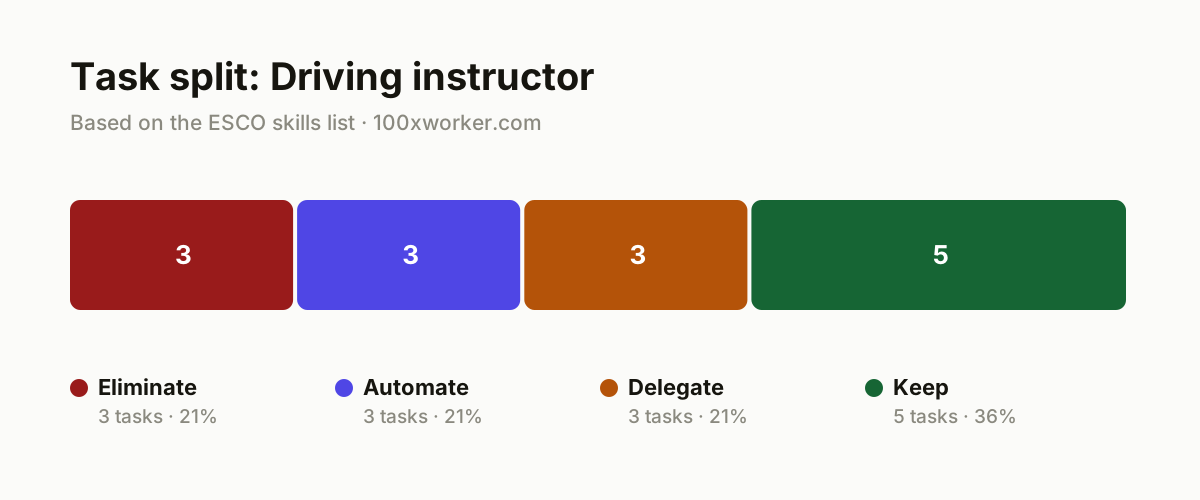
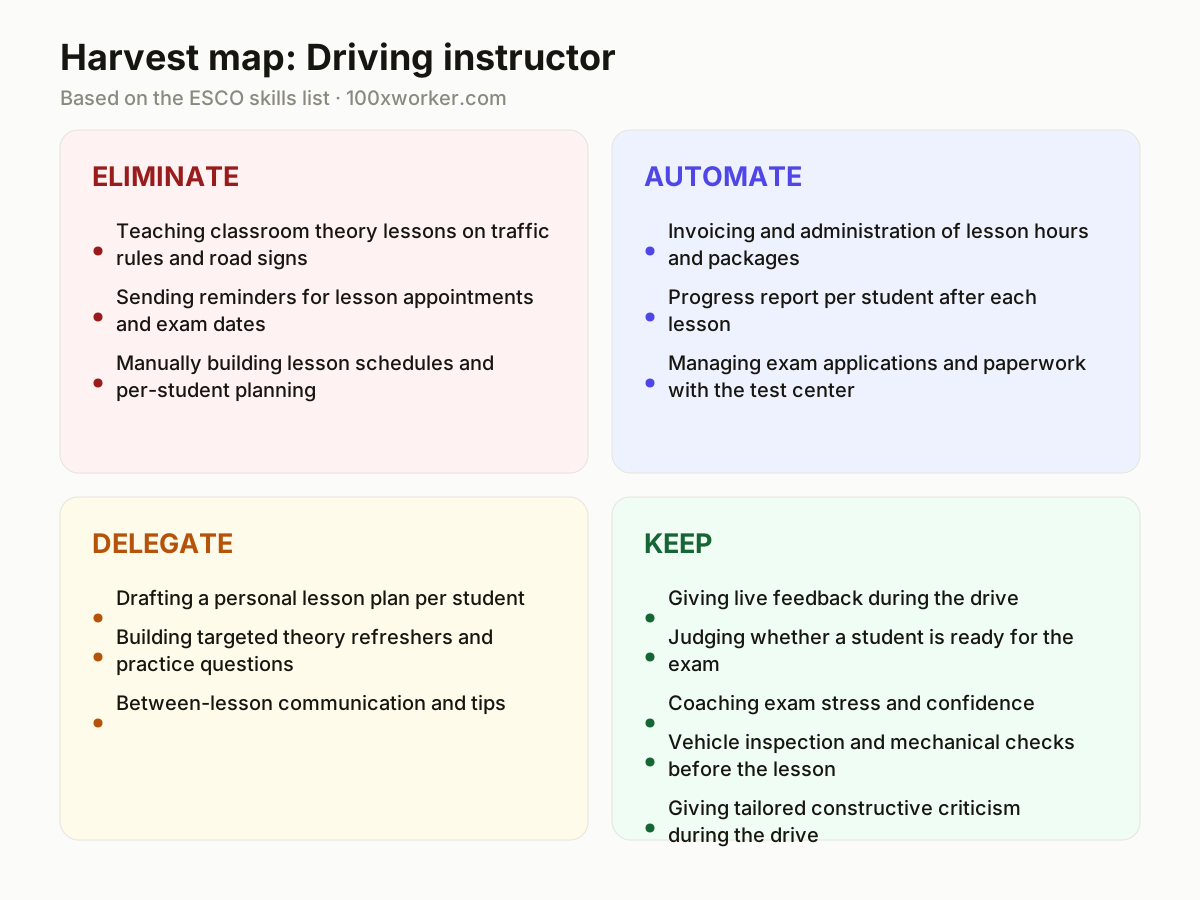
The four buckets sort a driving instructor's actual task list by how much a person still needs to be involved. Eliminate covers tasks that software already does better than manual work, so doing them yourself is wasted effort. Automate covers tasks a system can run without your input once it's set up. Delegate means AI drafts the work and you review it before it reaches a student. Keep means the task depends on being physically in the vehicle, reading a person in real time, or carrying responsibility for a judgment call, and no tool changes that.
| Task | Bucket | Why |
|---|---|---|
| Teaching classroom theory lessons on traffic rules and road signs | eliminate | Apps and AI tutors already explain theory in a personalized way anytime, repeating it in person adds little. |
| Sending reminders for lesson appointments and exam dates | eliminate | Automated text and email flows from booking software do this faster and with fewer errors than manual messages. |
| Manually building lesson schedules and per-student planning | eliminate | Booking systems now schedule lesson hours, vehicles, and instructors automatically based on availability and exam dates. |
| Invoicing and administration of lesson hours and packages | automate | Accounting software links driven hours to invoices and payment reminders automatically, without manual entry. |
| Progress report per student after each lesson | automate | An AI agent turns lesson notes and scored skills into a structured report, ready to send. |
| Managing exam applications and paperwork with the test center | automate | An agent fills in forms, registrations, and files correctly based on existing student data. |
| Drafting a personal lesson plan per student | delegate | AI turns skill scores and weak points into a lesson plan, you check it against what you saw on the road. |
| Building targeted theory refreshers and practice questions | delegate | AI generates a practice set on the exact topic a student is stuck on, you choose the focus. |
| Between-lesson communication and tips | delegate | A chatbot answers standard questions about procedure and scheduling, you step in when there's doubt or anxiety. |
| Giving live feedback during the drive | keep | Traffic changes every second, only a person next to the student can correct in that moment. (Your edge: Immediate intervention in danger can't come from a screen.) |
| Judging whether a student is ready for the exam | keep | This is a final judgment call with responsibility, based on hundreds of small observations across lessons. (Your edge: You carry responsibility for that decision.) |
| Coaching exam stress and confidence | keep | Fear and doubt in a student call for sensing and adapting in the moment, not a script. (Your edge: Empathy in the car can't be automated.) |
| Vehicle inspection and mechanical checks before the lesson | keep | You check tire condition, brakes, and mirrors physically, not through an app. (Your edge: Physical checks in the garage stay human work.) |
| Giving tailored constructive criticism during the drive | keep | Tone and timing of feedback determine whether a student accepts and remembers it. (Your edge: Sensing when and how to say something.) |
Which tasks of a driving instructor does AI take over?
AI already covers the parts of the job that happen outside the car. Theory instruction on traffic law and road signs moves to apps and AI tutors that adjust to each learner's pace. Scheduling software books lessons, vehicles, and exam slots without a phone call. Invoicing and payment reminders run through accounting tools linked to logged hours. Progress reports, once handwritten after each session, can be generated from lesson notes in minutes. None of this touches actual driving instruction, it removes the admin layer that used to eat evenings and weekends.
Will AI replace driving instructors?
No. ESCO's skill list for the occupation centers on things AI cannot do from outside the vehicle: interpreting traffic signals in real time, controlling a vehicle, adapting teaching to a specific student's ability, and judging exam readiness. Microsoft Research's applicability work shows generative AI reaching deep into writing, planning, and admin tasks across occupations, but physical, real-time, high-stakes supervision resists that pattern. The job shrinks in its paperwork and theory-delivery parts and stays intact where a person has to sit in the passenger seat and react to traffic as it happens.
How do you become the AI-savvy driving instructor at your school?
Start by moving all scheduling, reminders, and invoicing into one booking system so none of it happens manually. Use an AI tool to draft progress reports from your lesson notes, then edit and send. Let AI generate theory refreshers and practice questions targeted at each student's weak spot instead of building worksheets from scratch. Keep every minute you free up for the driving seat: more live coaching time, sharper feedback, and calmer handling of nervous students before their test. Being the AI-savvy instructor means using tools for admin, not for judgment calls.
What can you do this month as a driving instructor?
Pick one recurring admin task, such as writing progress reports or answering scheduling questions, and set up an AI tool or booking system to handle it this week. Draft one lesson plan with AI support and compare it against what you actually observed in the car, adjusting where the tool got it wrong. Track how many hours that frees up over a month. Use that time for extra live practice sessions or for reviewing your feedback style with harder students, since that's the part of the job no tool touches.
Applicability scores show which tasks within an occupation are exposed to generative AI, not whether the occupation itself disappears.
Microsoft Research, Working with AI: Measuring the Applicability of Generative AI to Occupations (2025)
Become the AI person on your team
Automate the admin trail before it piles up
Set up booking software to handle reminders, scheduling, and invoicing the same week a student signs up. This removes the evening admin session most instructors currently do by hand.
Turn lesson notes into reports automatically
Feed short notes from each lesson into an AI tool that drafts a structured progress report. Review and personalize it before sending, rather than writing it from a blank page.
Use AI to spot patterns across students
Ask an AI tool to summarize recurring weak points across your student roster, such as parallel parking or roundabout entry. Use that summary to plan group refreshers or adjust your standard curriculum.
Want this for your actual task list?
The free scan on the homepage builds your personal task map in 30 seconds, based on your role and industry.
Run the free task scanTools for this work
| Tool | For which tasks | The sober take |
|---|---|---|
| Driving school booking and scheduling software | Eliminate: lesson scheduling, reminders, exam date tracking | Most driving schools already run one, the gain comes from using its automation fully. |
| Accounting or invoicing software with automatic hour tracking | Automate: invoicing and payment reminders | Links logged lesson hours directly to invoices without manual entry. |
| General-purpose AI chatbot (e.g., ChatGPT, Claude) | Automate/Delegate: progress reports, theory refreshers, lesson plan drafts | Works well as a drafting tool, but every output needs your review before it reaches a student. |
| AI-based theory learning apps | Eliminate: classroom theory instruction | Already widely used by learners on their own time, before or between driving lessons. |
Prompts to try today
Turn lesson notes into a progress report
Build a targeted theory refresher
Draft a personalized lesson plan
Related jobs
Frequently asked questions
Can AI teach someone to drive a car or bus on its own?
No. AI can teach the theory behind driving, such as traffic law and road signs, through apps and tutors. It cannot supervise a learner behind the wheel, react to real traffic in real time, or judge whether someone is safe to drive. ESCO's skill list for driving and bus driving instructors centers on live supervision, vehicle control checks, and defensive driving instruction, all of which require a person physically present in the vehicle.
Which part of a driving instructor's job disappears first because of AI?
Admin and repetitive communication go first: sending appointment reminders, building lesson schedules, handling invoices, and delivering standard theory content. These are the tasks booking software and AI tutors already do reliably. Live driving instruction, feedback during the lesson, and the final call on exam readiness stay with the instructor, since they depend on real-time observation and responsibility for a safety-related judgment.
Do driving instructors need to learn new AI tools to stay relevant?
Basic familiarity helps. Instructors who use AI to draft progress reports, generate targeted practice questions, and automate scheduling free up hours for actual coaching. This isn't about becoming a technical expert, it's about using existing booking and writing tools instead of doing that work by hand. The core teaching and evaluation skills remain the main value an instructor offers.
How reliable are AI applicability scores for a role like driving instructor?
Microsoft Research's applicability study is based on 200,000 real Copilot conversations and covers many occupations, but it does not publish a specific score for driving or bus driving instructors, since there's no exact US occupational match for this ESCO role. Older estimates like the Frey and Osborne (2013) automation-risk study predate large language models and should be treated with caution rather than as current predictions.
Sources
- Microsoft Research, Working with AI: Measuring the Applicability of Generative AI to Occupations (2025)
- Anthropic Economic Index
- Eurostat, isoc_ai_iaiu dataset
- ESCO, European Commission occupation taxonomy
Hendrik De Winne, author of Becoming AI-Savvy, founder of VibeLab. Helps teams redesign their work with AI.
This article was drafted with AI assistance from public data sources and editorially reviewed.