100×worker · job analysis
Will AI Replace Language Teachers?

Language teachers spend their days doing far more than explaining grammar. They plan lessons, correct essays, run oral exams, and manage a room of teenagers who would rather be anywhere else. So when a new AI tool promises to grade essays or generate worksheets in seconds, it is fair to ask how much of the job is actually at risk.
The numbers suggest less than headlines imply. Microsoft Research analyzed 200,000 real conversations with its Copilot assistant across occupations and found that generative AI applies to just 17.6% of the work activities of secondary school teachers. That places teaching near the low end of the scale, far below translators (49%) and well above the lowest-scoring occupation in the study, nurses (12%). The gap matters: it tells you AI is useful for specific, bounded tasks, not the whole job.
Adoption is still climbing everywhere, though. Eurostat reports that 32.7% of the EU population aged 16 to 74 used generative AI in the three months before being surveyed in 2025. The European Commission's ESCO taxonomy, which classifies work across 3,039 occupations in 28 languages, groups language teaching under skills like classroom management, curriculum design, and assessing student progress, exactly the areas where the eliminate/automate/delegate/keep framework below draws the line between what AI can absorb and what stays with you.
A language teacher teaches modern languages to secondary school students and assesses their language proficiency.
The task split: what AI takes over and what stays yours
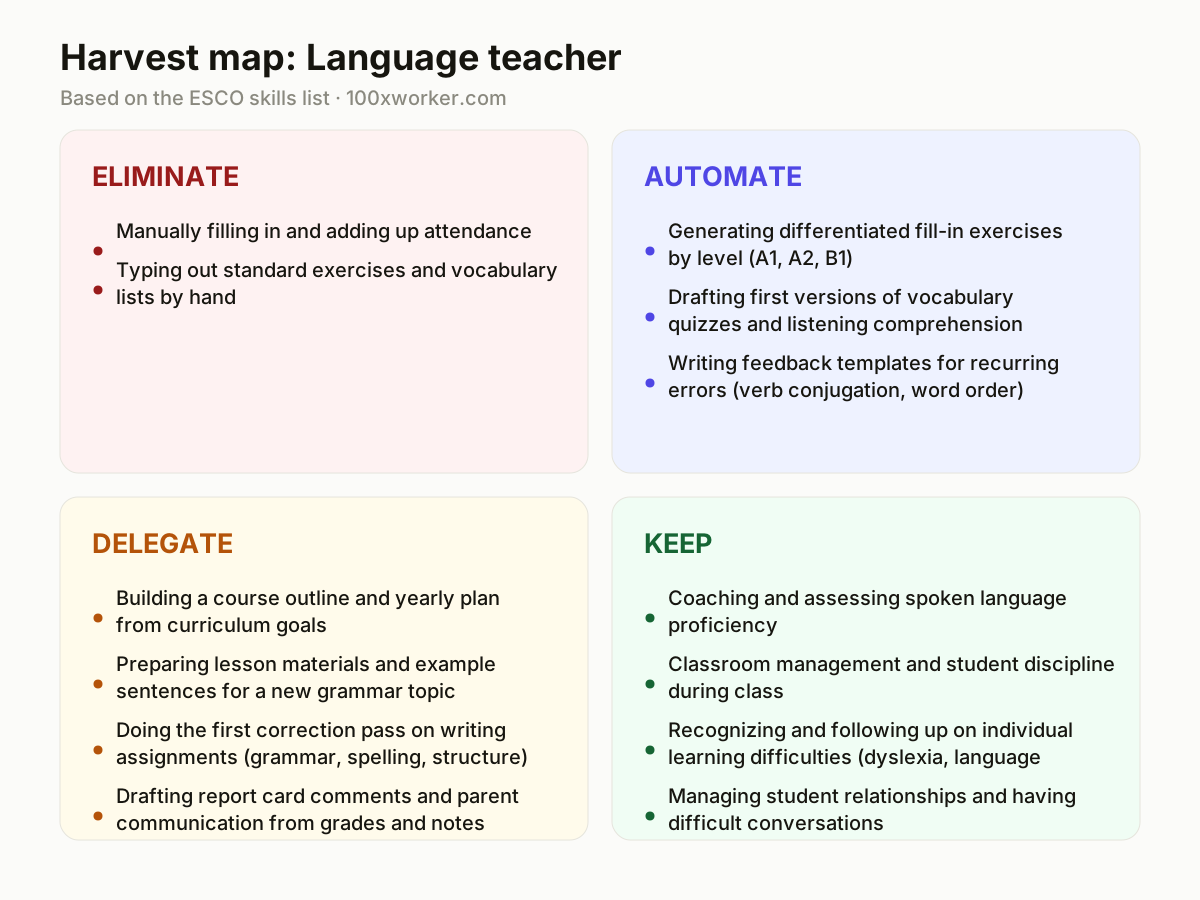
Not every task in a language teacher's job responds to AI the same way. Some tasks disappear because software already does them better. Some get fully automated: AI produces a usable draft with no need to write it manually. Others get delegated, meaning AI creates a first version and you refine it before it reaches students or parents. And some tasks stay entirely with you, because they depend on being physically present, reading a room, or building trust over months. The four buckets below sort a language teacher's actual task list into these categories.
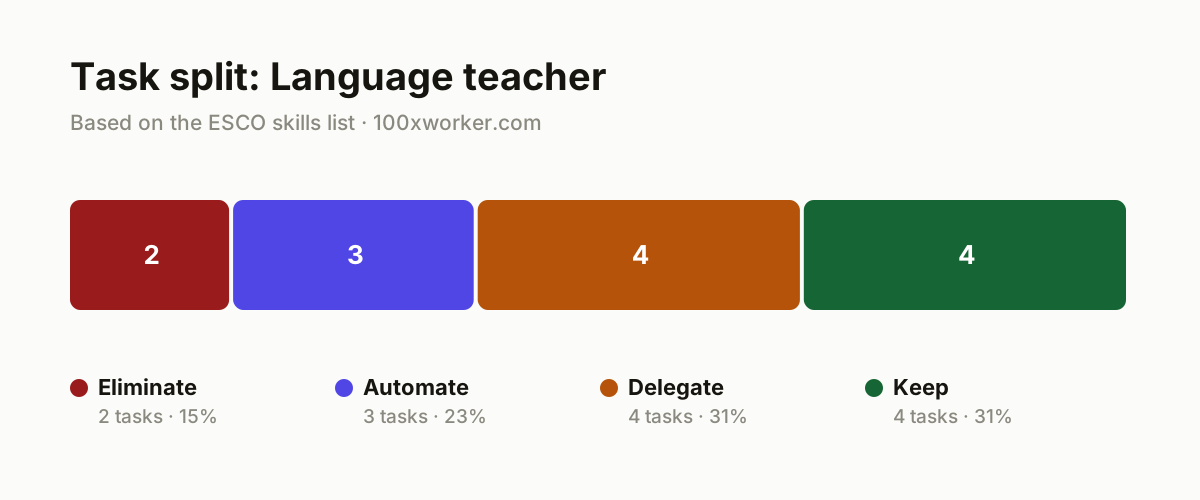
| Task | Bucket | Why |
|---|---|---|
| Manually filling in and adding up attendance | eliminate | Digital class registers and student tracking systems already automate this; manual tallying adds no value. |
| Typing out standard exercises and vocabulary lists by hand | eliminate | A language model generates verb conjugation tables and word lists faster and more accurately than retyping an old worksheet. |
| Generating differentiated fill-in exercises by level (A1, A2, B1) | automate | An AI agent turns one curriculum goal into three difficulty levels without you typing each worksheet separately. |
| Drafting first versions of vocabulary quizzes and listening comprehension questions for a text | automate | The format, multiple choice, fill-in-the-blank, true or false, is standard work an AI agent delivers ready to use. |
| Writing feedback templates for recurring errors (verb conjugation, word order) | automate | The same mistake shows up in ten students' work; AI writes the explanation once so you can reuse it. |
| Building a course outline and yearly plan from curriculum goals | delegate | AI turns curriculum objectives into a lesson sequence; you reorder it and check it against your actual class. |
| Preparing lesson materials and example sentences for a new grammar topic | delegate | AI drafts the first version with examples and context; you check whether it fits your students. |
| Doing the first correction pass on writing assignments (grammar, spelling, structure) | delegate | AI flags errors and gives initial feedback; you judge content, style, and whether the argument holds up. |
| Drafting report card comments and parent communication from grades and notes | delegate | AI writes a first draft from your notes; you adjust tone and nuance for each student. |
| Coaching and assessing spoken language proficiency | keep | Judging pronunciation, spontaneous conversation, and interaction requires live judgment that no tool does reliably. (Your edge: You hear hesitation and nerves; a scoring algorithm doesn't.) |
| Classroom management and student discipline during class | keep | Redirecting group dynamics and behavior happens on the spot, in the room, in real time. (Your edge: Physical presence and authority can't be automated.) |
| Recognizing and following up on individual learning difficulties (dyslexia, language delay) | keep | Spotting signals in a specific student takes sustained personal contact, not a single conversation. (Your edge: Building trust takes time; no prompt replaces that.) |
| Managing student relationships and having difficult conversations | keep | Motivation problems, conflicts, and parent meetings require empathy and context a chatbot doesn't have. (Your edge: Empathy in a hard conversation stays human work.) |
What tasks does AI take over from a language teacher?
AI takes over the repetitive, format-driven parts of the job first. Attendance tracking is already automated by school systems, so manual tallying disappears. For anything with a predictable structure, vocabulary quizzes, fill-in-the-blank grammar exercises, listening comprehension questions, generative AI produces a usable first draft in seconds. It also handles differentiation, turning one curriculum objective into three versions for A1, A2, and B1 learners, and writing reusable feedback templates for errors that show up across many students, like verb conjugation or word order. This matches what Microsoft Research found: generative AI applies to a real but limited slice, 17.6%, of a secondary teacher's actual work activities. It compresses drafting time; it does not replace lesson planning judgment or grading of nuanced writing.
Will AI replace language teachers?
No, not based on current evidence. Microsoft Research's 2025 study of 200,000 Copilot conversations placed secondary school teachers at 17.6% AI applicability, near the bottom of the occupations measured and far below roles like translation (49%). The job includes tasks that resist automation: reading a classroom, judging spoken fluency in real time, noticing a student who is struggling to keep up, and having a difficult conversation with a parent. AI changes what a teacher spends time on, shifting hours away from drafting worksheets and towards planning, coaching, and assessment design. The Anthropic Economic Index frames this as augmentation rather than automation for most teaching tasks: AI supports the work, a person still does it.
How do you become the AI-savvy person on your language team?
Start by building a shared library of AI-generated worksheets, quizzes, and feedback templates that colleagues can reuse and adapt, instead of everyone prompting from scratch. Test one tool for differentiation, turning a single text into A1/A2/B1 versions, and document the prompts that work so others don't repeat the trial and error. Bring one concrete example to a department meeting: a lesson plan built with AI assistance and the edits you made to it, so colleagues see both the time saved and where you still had to intervene. Volunteer to review AI output for factual and grammatical accuracy in the target language, since errors slip through in less common languages more than in English or French.
What can you do this month with AI as a language teacher?
Pick one recurring task and hand it to AI for a month: generating differentiated worksheets, drafting quiz questions from a reading text, or writing first-draft feedback comments for common grammar mistakes. Keep your own review step, since AI output in a foreign language still needs a native or near-native check for tone and accuracy. Save the prompts that produce usable drafts in a shared document with colleagues. Track how much correction time you save on one class over four weeks, so you have a concrete number instead of a general impression when you decide whether to expand the habit to other tasks.
Only 17.6% of the work activities of secondary school teachers overlap with what generative AI can currently do.
Microsoft Research, Working with AI (2025)
Become the AI person on your team
Build a shared prompt library
Collect the prompts that reliably generate usable worksheets, quizzes, and feedback templates for your language and level. Store them where colleagues can copy and adjust them instead of starting from a blank prompt each time.
Run a differentiation pilot
Take one text or grammar topic and use AI to produce A1, A2, and B1 versions in one sitting. Compare the time this takes against manually rewriting three versions, then share the workflow with your department.
Set a review checklist for AI drafts
Write a short checklist for what to check before using AI-generated exercises or feedback in class: factual accuracy, register, and whether examples fit your students' level. Use it consistently so quality doesn't depend on who prompted the tool.
Want this for your actual task list?
The free scan on the homepage builds your personal task map in 30 seconds, based on your role and industry.
Run the free task scanTools for this work
| Tool | For which tasks | The sober take |
|---|---|---|
| ChatGPT or Claude (general-purpose language model) | Drafting worksheets, quiz questions, feedback templates, report comments | Works well for structured drafts, but every output in the target language needs a native-level check. |
| Diffit | Generating differentiated reading materials and questions by level | Built specifically for turning one text into multiple reading levels, saves manual rewriting. |
| Quizlet AI tools | Vocabulary lists, flashcards, and practice quizzes | Good for vocabulary drills, less useful for open-ended writing feedback. |
| Grammarly or similar grammar checkers | First correction pass on student writing | Catches surface errors fast, but doesn't judge argument quality or content. |
| Kahoot or Blooket with AI question generation | Turning a text or unit into a quick class quiz | Speeds up quiz creation, but questions still need a teacher's review for accuracy. |
Prompts to try today
Differentiated grammar worksheet
Listening comprehension questions from a transcript
Feedback template for a recurring error
Related jobs
Frequently asked questions
How much of a language teacher's job can AI actually do?
According to Microsoft Research's 2025 analysis of 200,000 Copilot conversations, generative AI applies to 17.6% of the work activities of secondary school teachers. That covers drafting worksheets, generating quiz questions, and writing feedback templates for common errors. It does not cover classroom management, assessing spoken fluency, or recognizing when a specific student is struggling. The comparison point matters: translators score 49% on the same scale, nurses score 12%. Teaching sits closer to the low end, meaning most of the job stays with the teacher.
Which language teaching tasks should you stop doing manually?
Stop manually typing standard grammar exercises and vocabulary lists from scratch; a language model produces these faster and with fewer typos. Stop manually tallying attendance if your school has a digital register, since that data already exists elsewhere. These are low-value, repetitive tasks where AI output needs almost no correction. Keep doing manual work where nuance matters: judging whether a student's essay argument makes sense, or noticing a change in a student's classroom behavior. Those tasks depend on context AI doesn't have.
Is AI use among teachers and students already common?
Yes, adoption is rising broadly. Eurostat reports that 32.7% of the EU population aged 16 to 74 used generative AI in the three months before being surveyed in 2025. Younger age groups and students use it at much higher rates than the general population. For language teachers, this means many students are already using AI tools for homework and translation, which changes how you design assignments and assess whether work reflects a student's actual level.
What should a language department do about AI policy?
Start by mapping which tasks in your department's workflow fall into automate, delegate, or keep, rather than adopting a single blanket rule for or against AI. Agree on where AI-assisted drafts need a mandatory human check, especially for grading and parent communication in a foreign language. Decide together how students may use AI for homework and how you'll design assessments, like oral exams and in-class writing, that measure a student's own ability rather than an AI-generated draft.
Sources
- Microsoft Research, Working with AI: Measuring the Applicability of Generative AI to Occupations (2025)
- Anthropic Economic Index
- Eurostat, isoc_ai_iaiu
- ESCO, European Commission
Hendrik De Winne, author of Becoming AI-Savvy, founder of VibeLab. Helps teams redesign their work with AI.
This article was drafted with AI assistance from public data sources and editorially reviewed.