100×worker · job analysis
Will AI Replace Corporate Trainers?

Corporate trainers spend their days writing course material, running sessions, and coaching employees one on one. Some of that workload is about to shift, and some of it is already shifting. The question is not whether the job survives, but which tasks inside it change first.
Microsoft Research analyzed 200,000 real conversations people had with Copilot and scored how applicable generative AI is to different occupations. For training and development roles, the applicability score came out at 24.2%, well below translators (49%, the highest score in the study) and above nurses (12%, one of the lowest). That places corporate trainers in the middle: real change, not a wholesale replacement.
The useful move is to stop asking "will AI take my job" and start asking which specific tasks on your weekly list get eliminated, automated, delegated to AI with your review, or kept because only a person can do them. That is the framework this article uses.
A corporate trainer teaches and coaches employees to build the skills and knowledge the company needs.
The task split: what AI takes over and what stays yours
Not every task a corporate trainer does is affected by AI in the same way. Some tasks disappear because a tool now does them outright (eliminate). Some run inside an automated workflow that needs almost no human input (automate). Some get a solid first draft from AI that you then check and adjust (delegate). And some stay entirely human because they depend on trust, timing, and reading a room (keep). Sorting your own task list into these four buckets is more useful than asking a vague question about job security.
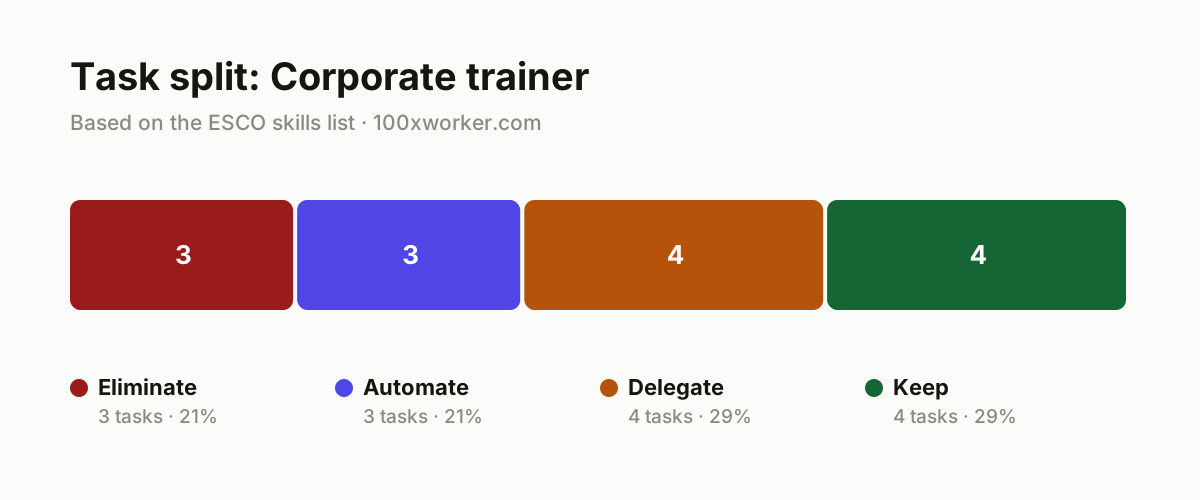
| Task | Bucket | Why |
|---|---|---|
| Transcribing and summarizing training session recordings into reports | eliminate | Speech-to-text and summarization tools do this faster and with fewer errors than manual note-taking. |
| Manually writing quiz and knowledge-check questions | eliminate | AI generates question sets from course material in seconds, including wrong answers and explanations. |
| Translating training materials into multiple languages for a global rollout | eliminate | Translation models produce usable first drafts, useful for multinational teams and distributed workforces. |
| Building a first draft of an e-learning module from existing material | automate | An AI agent turns a slide deck or manual into a structured module with questions, ready for review. |
| Sending follow-up emails and reminders after a session | automate | Workflow tools automatically send summaries and action items to participants without manual work. |
| Generating and sending certificates of completion | automate | A system links attendance records to templates and sends the certificate automatically afterward. |
| Preparing lesson content based on a job profile and learning goals | delegate | AI drafts a first version of modules and exercises, you check it against how the company actually works. |
| Adapting instruction to the audience (role, seniority, language) | delegate | AI produces variants of the same lesson per level, you pick the right tone and examples. |
| Setting up assessment rubrics and evaluation forms | delegate | AI proposes criteria and scoring points, you decide what actually matters for this role. |
| Summarizing industry literature and trends in your subject area | delegate | AI searches and condenses articles, you judge which insights are actually useful. |
| Coaching and mentoring employees one on one | keep | Coaching needs trust and tailoring that only grows out of an ongoing relationship. (Your edge: Building trust and asking the right question at the right moment.) |
| Giving constructive feedback during and after a session | keep | Feedback only lands when tone, timing, and relationship fit this specific person. (Your edge: Sensing how much someone can handle hearing right now.) |
| Applying cross-cultural teaching strategies in the room | keep | Reading how a mixed-background group reacts live requires being physically present. (Your edge: Reading nonverbal cues and adjusting instantly.) |
| Facilitating group dynamics during a live session | keep | Managing energy, resistance, and discussion in the room takes improvisation no model predicts. (Your edge: Improvising on the floor when the group goes a different direction.) |
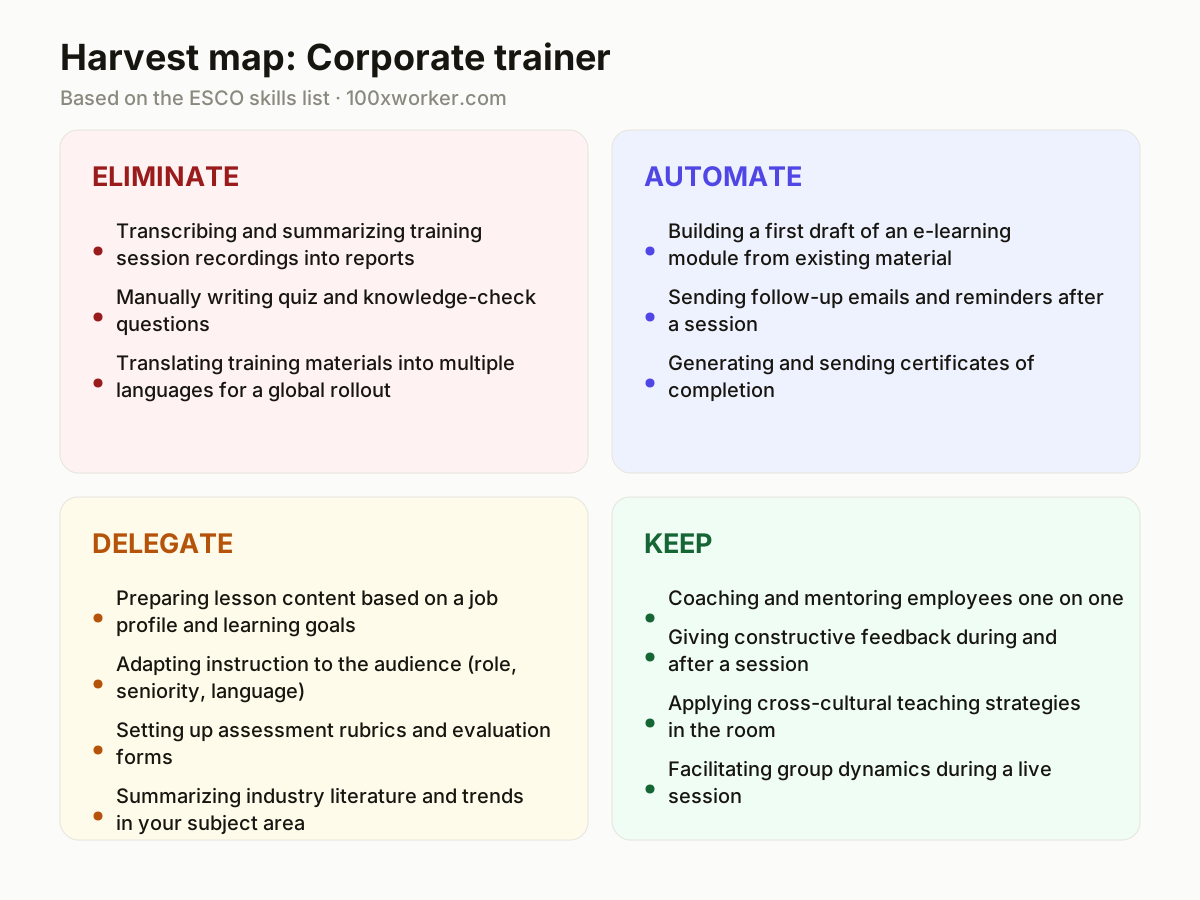
Which corporate trainer tasks does AI take over?
AI already handles the mechanical parts of the job: transcribing session recordings into reports, drafting quiz questions from course material, and producing first-pass translations of training documents. Slightly further along, workflow tools automate what happens after a session, sending follow-up emails, summaries, and certificates without anyone typing them manually. What AI does not do on its own is decide what a group actually needs to learn or how to phrase feedback for one specific employee. Those tasks move to the delegate and keep buckets instead.
Will AI replace corporate trainers?
No single AI tool replaces the role, but it reshapes the task list inside it. Microsoft Research's 2025 analysis put training and development roles at a 24.2% AI applicability score, meaning about a quarter of the work involves tasks generative AI can plausibly do. That leaves most of the job, coaching, live facilitation, and judgment calls about what a specific team needs, in human hands. Companies are more likely to expect one trainer to produce more content and run more sessions with AI support than to remove the role outright.
How do you become the AI-savvy person on your training team?
Start by listing every task you do in a typical month and sorting it into eliminate, automate, delegate, or keep. Pick one delegate task, such as drafting lesson content, and run it through an AI tool for a month, tracking how much editing it actually needs. Document what works in a short internal guide and share it with colleagues. Being the person who tested the tools first, rather than the person who avoided them, is what makes you useful when leadership asks who should evaluate the next one.
What can you do this month with AI as a corporate trainer?
Take one existing training deck and feed it into an AI tool to generate a first-draft module outline with quiz questions. Review it, fix what is wrong, and note how long the review took compared to building from scratch. Do the same with one recorded session: run it through a transcription and summarization tool instead of taking manual notes. These two small tests give you real numbers on time saved, which is more convincing to a manager than a general claim about AI.
Across 200,000 real conversations, generative AI applies to a measurable slice of most jobs, and training and development work sits in the middle of that range, not at either extreme.
Microsoft Research, Working with AI (2025)
Become the AI person on your team
Map your task list first
Before picking a tool, list every task you do in a week and mark it eliminate, automate, delegate, or keep. This turns AI adoption into a task-level decision instead of a vague worry about the job disappearing.
Build a module library with AI drafts
Feed existing manuals, decks, or recordings into an AI tool to generate first-draft modules. Review and adjust each draft, then reuse the same workflow for future courses so drafting time keeps shrinking.
Own the rollout inside your team
Volunteer to test tools like transcription apps or AI authoring assistants, document what works, and share a short internal guide with colleagues. Being the first person to test something builds credibility with peers and managers.
Want this for your actual task list?
The free scan on the homepage builds your personal task map in 30 seconds, based on your role and industry.
Run the free task scanTools for this work
| Tool | For which tasks | The sober take |
|---|---|---|
| ChatGPT or Claude | Drafting lesson content, rubrics, and literature summaries (delegate) | Useful for first drafts, but check accuracy against internal policy and terminology before using it live. |
| Otter.ai or a similar transcription tool | Transcribing and summarizing session recordings (eliminate) | Cuts manual note-taking, though the summary still needs a quick human read before filing. |
| Articulate 360's AI features | Building a first draft e-learning module from a slide deck (automate) | Speeds up structuring a module, but tone and branding usually need a human pass. |
| Zapier or Make | Sending follow-up emails and generating certificates (automate) | Handles the repetitive admin around a session without you touching a spreadsheet. |
Prompts to try today
Turn a slide deck into a module outline
Adapt a lesson to a different audience
Summarize new research for your field
Related jobs
Frequently asked questions
Do corporate trainers need to learn to use AI tools to keep their jobs?
Not to keep the job itself, since coaching and live facilitation stay human work. But trainers who can draft a module outline or summarize a recording with AI produce more output in the same time, which matters when a manager compares performance. Learning to use one or two tools well, rather than every tool available, is enough to stay competitive inside a training team.
Will AI replace junior training and development roles first?
Junior tasks that are mostly mechanical, like drafting quiz questions or formatting slide decks, are the ones most exposed, since AI handles them directly. That does not mean junior trainer roles disappear, but the content of those roles shifts toward reviewing AI output and running sessions rather than producing first drafts from scratch. Employers are more likely to expect fewer people doing more oversight than to cut the roles entirely.
How many people actually use generative AI at work right now?
Adoption varies by region and survey. Eurostat found that 32.7% of the EU population aged 16 to 74 used generative AI in the three months before the 2025 survey. A separate Google/Ipsos survey found 61% of Belgians had used an AI chatbot in 2025. These numbers show generative AI use is common but far from universal, and workplace use likely sits somewhere in that range depending on the sector.
Does the ESCO skill list for corporate trainers change because of AI?
The European Commission's ESCO taxonomy lists skills like adapting teaching to a target group, giving constructive feedback, and applying intercultural teaching strategies for the corporate trainer occupation. None of those core skills disappear with AI. What changes is the supporting work around them, like preparing materials or building assessments, where AI now produces a usable first draft that a trainer edits rather than starting from a blank page.
Sources
- Microsoft Research, Working with AI: Measuring the Applicability of Generative AI to Occupations (2025)
- Anthropic Economic Index
- Eurostat, isoc_ai_iaiu (2025)
- ESCO, European Commission
Hendrik De Winne, author of Becoming AI-Savvy, founder of VibeLab. Helps teams redesign their work with AI.
This article was drafted with AI assistance from public data sources and editorially reviewed.