100×worker · job analysis
Will AI Replace Lecturers, and What Should You Do About It?

Lecturers spend their week on a mix of teaching, grading, admin, and research, and generative AI touches each of those unevenly. Some tasks disappear quietly into automated systems, some get a first draft from an AI assistant, and some stay firmly with the person standing in front of the room.
Microsoft Research analyzed 200,000 real Copilot conversations in 2025 and found that AI applicability varies by task type within a job, not by job title as a whole (Microsoft Research, 2025). That distinction matters for a role like higher education lecturer (ESCO code 2310.1), which mixes classroom teaching, assessment, mentoring, and academic research under one title.
Adoption is already broad. Eurostat reports that 32.7% of the EU population aged 16 to 74 used generative AI in the three months before being surveyed in 2025 (Eurostat, isoc_ai_iaiu). This article breaks the lecturer's task list into four buckets: eliminate, automate, delegate, and keep, so you can see exactly where AI changes your workload.
Higher education lecturer: ESCO occupation 2310.1 combining academic teaching, assessment, and research.
The task split: what AI takes over and what stays yours
Not every task in a lecturer's job responds to AI the same way. Some administrative steps can disappear entirely (eliminate), some can run largely on their own with a quick check (automate), some are best drafted by AI and then reviewed by you (delegate), and some depend on your judgment, presence, or relationships and should stay with you (keep). Sorting your own task list into these four buckets is more useful than asking whether 'the job' will be automated.
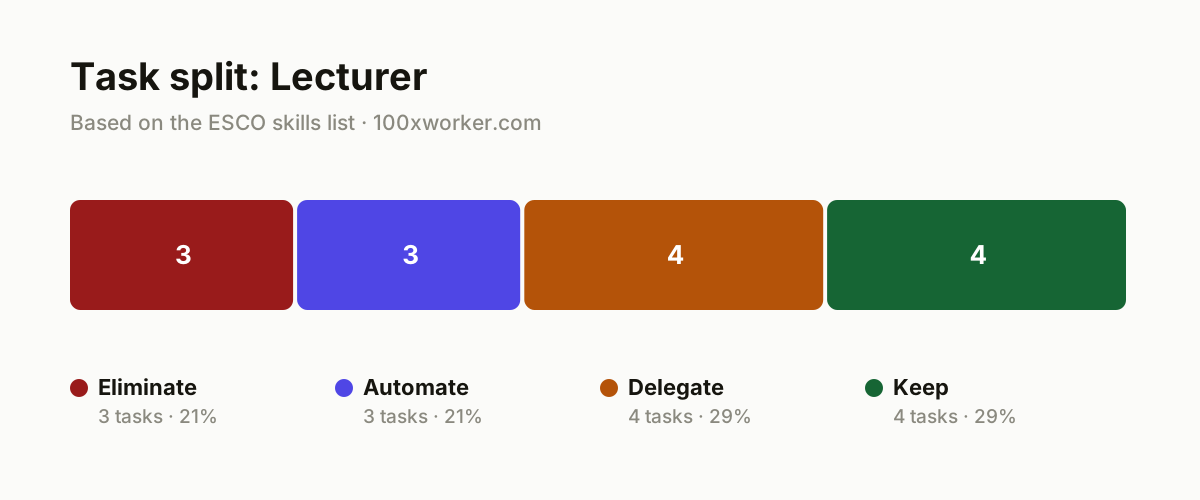
| Task | Bucket | Why |
|---|---|---|
| Sorting papers and exams by hand, physically or digitally | eliminate | Learning management systems and scanning apps now sort this administrative work automatically. |
| Manually retyping grades between spreadsheets, the LMS, and the university records system | eliminate | System integrations move this data without errors, so manual retyping adds nothing. |
| Answering the same routine student questions one by one via email | eliminate | An FAQ page or chatbot on the course portal handles repeat procedural questions at scale. |
| Transcribing and summarizing lectures | automate | Speech-to-text and summarization tools produce a usable transcript within minutes of class ending. |
| Generating a first set of practice questions and quizzes from course material | automate | AI tools turn existing slides and notes into draft test questions you only need to check. |
| Coordinating scheduling for feedback sessions and lab practicals | automate | Scheduling tools match student, teaching assistant, and lab room availability automatically. |
| Drafting a first version of a course outline and lesson content | delegate | AI structures material around curriculum objectives, while you check depth and academic rigor. |
| First-pass feedback on essays and papers (language, structure, citation format) | delegate | AI flags weak argumentation and formatting errors, while you give the substantive academic critique. |
| Drafting work reports, such as accreditation and annual reports | delegate | A language model turns raw data and notes into a readable first draft. |
| Literature reviews and summaries of research papers | delegate | AI screens and summarizes large volumes of papers, while you select what is actually relevant. |
| Assessing students on exams and final theses | keep | The assessment process determines degrees and academic standing. (Your edge: Responsibility for a grade is not something you outsource.) |
| Managing the classroom and student safety during lectures or lab work | keep | Supervising a lab practical and holding authority in a full room require physical presence. (Your edge: Presence and authority in a room do not automate.) |
| Supporting students in their learning and giving constructive critique | keep | Mentorship depends on a personal relationship built with each student over time. (Your edge: Most students trust a person over a chatbot for feedback.) |
| Maintaining contact with academic and pedagogical colleagues | keep | Collaboration in research networks and curriculum meetings stays relationship-driven. (Your edge: Trust between colleagues is not built through a prompt.) |
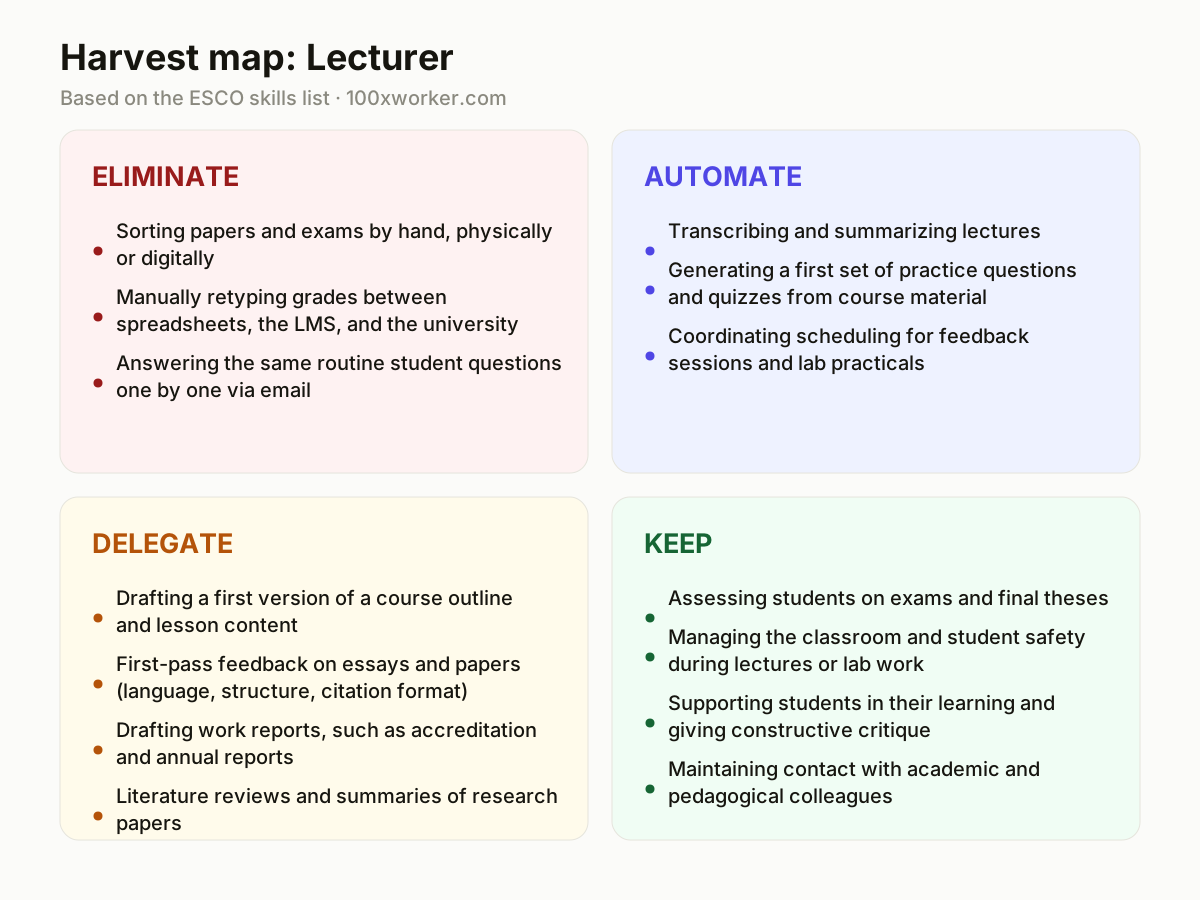
Which tasks of a lecturer can AI take over?
AI takes over the parts of the job that are repetitive and low-judgment first. Sorting exams, retyping grades between systems, and answering identical procedural emails can be eliminated with basic automation. Lecture transcription, quiz generation from existing slides, and scheduling for labs and feedback sessions can run largely on their own with a quick check. Drafting course outlines, giving first-pass feedback on essays, writing accreditation reports, and summarizing literature can be delegated to AI as a starting draft. What stays with you is grading, classroom authority, mentoring, and academic collaboration, the parts that depend on judgment, presence, and trust rather than pattern-matching.
Will AI replace lecturers?
No single tool replaces the lecturer role, because the job combines teaching, assessment, mentoring, and research under one ESCO occupation code (2310.1), and these tasks respond to AI very differently. Microsoft Research's analysis of real Copilot conversations found that AI applicability depends on the specific task, not the job title (Microsoft Research, 2025). Administrative and drafting tasks shift to AI quickly. Grading decisions, in-person classroom authority, and personal mentoring stay with the lecturer, because they carry legal, academic, and relational weight that a model cannot hold. The realistic outcome is a changed task list, not an eliminated position.
What can you do this month as a lecturer?
Start by listing your own recurring tasks and sorting them into eliminate, automate, delegate, and keep. Set up automatic transcription for one recorded lecture and check the summary quality before relying on it for all classes. Try an AI draft of a course outline or accreditation report section, then edit it rather than writing from a blank page. Keep grading, classroom management, and one-on-one mentoring exactly as they are for now. Reviewing your task list this way takes an afternoon and tells you more about your actual workload than any general prediction about the profession.
How many people already use generative AI at work and in study?
Eurostat found that 32.7% of the EU population aged 16 to 74 used generative AI in the three months before the 2025 survey (Eurostat, isoc_ai_iaiu). Anthropic's Economic Index, which classifies millions of Claude conversations against O*NET task categories, splits usage into automation-like patterns, where AI does the task directly, and augmentation-like patterns, where AI assists a person doing it (Anthropic, 2025). The ESCO taxonomy, maintained by the European Commission, catalogs 3,039 occupations and their associated skills across 28 languages, which is how tasks in this article are matched to the lecturer occupation (ESCO, esco.ec.europa.eu).
Generative AI use splits into automation-like and augmentation-like patterns across occupations, not a single replacement switch.
Anthropic Economic Index
Become the AI person on your team
Split syllabus prep into draft and review
Feed your curriculum objectives and existing notes into an AI tool to get a first structured outline. Spend your own time checking academic depth and rigor instead of formatting from scratch.
Turn essay feedback into a two-pass system
Let AI flag language, structure, and citation issues in a first pass. You then focus your written comments entirely on the argument and the ideas, which is the part students actually value most.
Use lecture transcripts to reclaim office hours
Post an AI-generated summary and transcript of each lecture so students can self-serve on missed content. Spend the office hours you free up on students who need actual guidance, not repeated explanations.
Want this for your actual task list?
The free scan on the homepage builds your personal task map in 30 seconds, based on your role and industry.
Run the free task scanTools for this work
| Tool | For which tasks | The sober take |
|---|---|---|
| Otter.ai | Transcribing and summarizing lectures (automate) | Turns a recorded lecture into a searchable transcript and summary within minutes. |
| Microsoft Copilot | Drafting course outlines and administrative reports (delegate) | This is the same assistant Microsoft Research's occupation applicability study is built on. |
| Claude (Anthropic) | Summarizing literature and research papers (delegate) | Powers the Anthropic Economic Index, which tracks how conversations map to real O*NET tasks. |
| Turnitin | First-pass feedback on essays (delegate) | Already common in universities for language, structure, and citation checks before human review. |
| University LMS scheduling tools | Coordinating labs and feedback sessions (automate) | Matches student, assistant, and room availability without manual back-and-forth email. |
Prompts to try today
Draft a course syllabus outline
First-pass feedback on a student essay
Summarize a batch of research papers
Related jobs
Frequently asked questions
Can AI replace the essay-grading part of a lecturer's job?
No. AI can give a fast first pass on language, structure, and citation format, which saves time on mechanical feedback. The actual grade and the substantive academic critique stay with the lecturer, because they determine degree outcomes and require judgment about argument quality that current tools cannot be held accountable for. Universities that use AI feedback tools like Turnitin still route final grading decisions through a human instructor.
Which AI tools are lecturers already using for lecture prep?
Common starting points are transcription tools like Otter.ai for turning recorded lectures into text, assistants like Microsoft Copilot or Claude for drafting course outlines and reports, and existing plagiarism and writing tools like Turnitin for a first pass on student essays. These tools are widely available through university software licenses in many institutions, though the exact usage rate among lecturers specifically has not been separately measured in the cited sources.
Is there a US Bureau of Labor Statistics or O*NET score that quantifies AI risk for lecturers?
No verified equivalent exists in the sources behind this article. Microsoft Research's applicability scores are built around Copilot conversation data rather than a single per-occupation risk number, and the ESCO occupation used here (2310.1, higher education lecturer) does not map to a confirmed US SOC code in the available data. Older 'automation percentage' figures circulating online, such as those from Frey and Osborne (2013), predate large language models and should be treated with caution.
What is ESCO and why does it matter for this occupation?
ESCO is the European Commission's taxonomy of occupations and skills, covering 3,039 occupations described across 28 languages (esco.ec.europa.eu). It defines higher education lecturer as ESCO code 2310.1 and lists its essential skills, including course overview development, classroom management, and constructive feedback. This article uses that skill list as the basis for sorting tasks into the eliminate, automate, delegate, and keep buckets.
Sources
- Microsoft Research, Working with AI: Measuring the Applicability of Generative AI to Occupations (2025)
- Anthropic Economic Index
- Eurostat, isoc_ai_iaiu (2025)
- ESCO, European Commission
Hendrik De Winne, author of Becoming AI-Savvy, founder of VibeLab. Helps teams redesign their work with AI.
This article was drafted with AI assistance from public data sources and editorially reviewed.