100×worker · job analysis
Will AI Replace Primary School Teachers, and What Should You Do About It?

If you teach elementary school, you've probably already used a chatbot to draft a worksheet or a parent email without thinking twice about it. The question isn't whether AI touches your job, it already does. The question is which parts of your job it actually changes.
Microsoft Research analyzed 200,000 real Copilot conversations and scored how applicable generative AI is to each occupation's actual tasks. Elementary school teachers scored 18.9%, near the low end of the scale (translators topped the list at 49%, nurses sat at just 12%). That gap matters: teaching is a job built on live, unpredictable interaction with children, and that's exactly what current AI cannot replicate. Anthropic's Economic Index, which classifies millions of real Claude conversations against standardized task lists, shows a similar pattern across professions: AI use in drafting and structuring text (report comments, worksheets, plans) leans toward augmentation, meaning a human still edits and decides, rather than full automation.
This article breaks the job down task by task: what disappears, what runs on autopilot, what you hand off with review, and what stays yours no matter how good the models get.
A primary school teacher guides children's knowledge, skills, and social development within a set curriculum.
The task split: what AI takes over and what stays yours
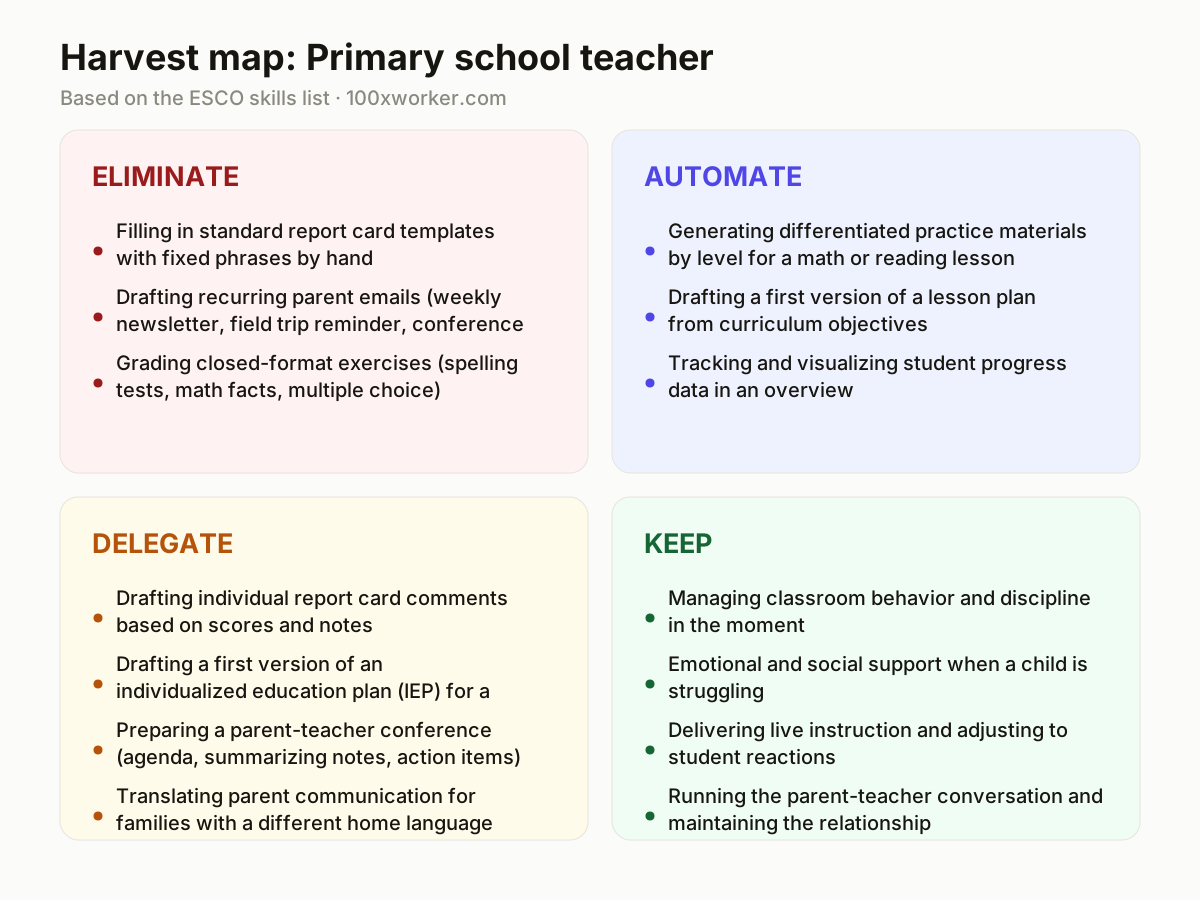
Not every task in a teaching job changes the same way. Some tasks disappear because AI does them without any real loss. Some run almost fully on autopilot with light supervision. Some get a first draft from AI, but you check and finish them. And some stay entirely yours, because they depend on presence, judgment, and trust that no model has. Sorting your actual weekly workload into these four buckets is a more useful exercise than asking whether AI will replace you.
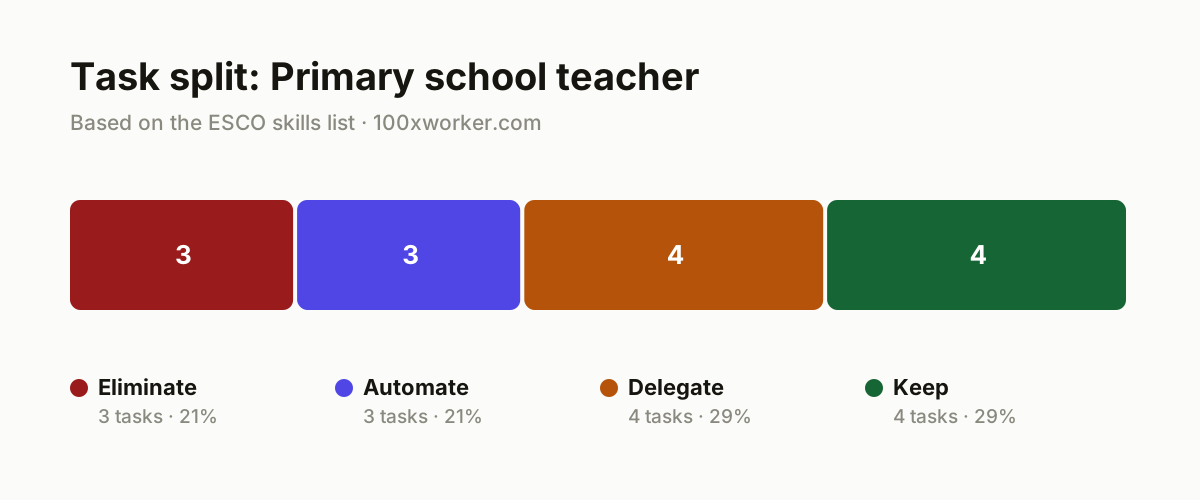
| Task | Bucket | Why |
|---|---|---|
| Filling in standard report card templates with fixed phrases by hand | eliminate | AI generates this without errors from scores and observations, retyping it manually adds nothing. |
| Drafting recurring parent emails (weekly newsletter, field trip reminder, conference invite) | eliminate | A template with variables does this faster and more consistently than you can. |
| Grading closed-format exercises (spelling tests, math facts, multiple choice) | eliminate | Automated grading has existed for decades; this shouldn't be on your desk anymore. |
| Generating differentiated practice materials by level for a math or reading lesson | automate | An AI tool produces three versions of a worksheet from your learning objectives, ready to print. |
| Drafting a first version of a lesson plan from curriculum objectives | automate | AI turns objectives into a concrete lesson structure with timing and materials, you refine it. |
| Tracking and visualizing student progress data in an overview | automate | Scores from tests and observations get merged automatically into a per-student or per-class dashboard. |
| Drafting individual report card comments based on scores and notes | delegate | AI writes a first version per student; you check tone, nuance, and factual accuracy. |
| Drafting a first version of an individualized education plan (IEP) for a struggling student | delegate | AI structures a draft from observations; the special education coordinator and you decide the approach. |
| Preparing a parent-teacher conference (agenda, summarizing notes, action items) | delegate | AI turns scattered notes into a clear structure; you still run the actual meeting. |
| Translating parent communication for families with a different home language | delegate | AI gives a first translation; you check whether tone and message land correctly. |
| Managing classroom behavior and discipline in the moment | keep | A room full of children reacts unpredictably, that needs someone reading the situation live. (Your edge: Only a human reads the mood in a classroom.) |
| Emotional and social support when a child is struggling | keep | A child being bullied or dealing with something at home needs a trusted adult present. (Your edge: Trust only builds through real presence.) |
| Delivering live instruction and adjusting to student reactions | keep | You notice mid-lesson who isn't following and pivot immediately. (Your edge: No model can improvise for 25 faces at once.) |
| Running the parent-teacher conversation and maintaining the relationship | keep | A conversation about a struggling child requires empathy and sometimes hard truths. (Your edge: Delivering difficult news needs a human across the table.) |
Will AI replace primary school teachers?
No, not based on current evidence. Microsoft Research found generative AI applicable to just 18.9% of tasks performed by elementary teachers, one of the lower scores among the occupations studied (translators sit at 49%, nurses at 12%). Teaching a room of young children means live classroom management, emotional support, and constant improvisation, none of which current AI can do. What changes is the task mix: paperwork shrinks, while direct teaching time and student relationships stay central. ESCO's occupational description still lists managing student relationships and safety as core skills, and those remain firmly human work.
Which primary school teacher tasks does AI already handle?
Generative AI already handles repetitive drafting work: first drafts of report card comments, differentiated worksheets across reading or math levels, weekly parent newsletters, and lesson plans built from curriculum objectives. Anthropic's Economic Index shows this kind of use, drafting and structuring text from your input, falls mostly under augmentation rather than full automation: you still edit and approve the output. Grading closed questions (multiple choice, spelling lists) has been automated for years and needs no generative AI at all. Live instruction, behavior management, and the actual parent conversation remain untouched.
What can you do this month with AI as a teacher?
Start small. Pick one recurring task, like report card comments or your weekly parent newsletter, and build a reusable prompt with your class list, learning objectives, and typical phrasing. Test it on five students and compare the draft to what you'd write yourself. Then try generating three leveled versions of a single worksheet for an upcoming lesson. Keep a short log of what needed heavy editing, so you know which tasks are safe to hand off next month. Don't use AI yet for anything tied to a formal support plan without your coordinator's sign-off.
How do you become the AI person on your teaching team?
Document which tasks you've tested, which prompts worked, and where AI drafts needed correction, then share that with colleagues instead of keeping it to yourself. Volunteer to pilot one tool, like a lesson planning assistant or a differentiation generator, for a term and report back with concrete before/after examples. Build shared prompt templates for common tasks like parent emails or progress reports so the whole team saves time. Being the AI person means testing carefully and sharing honestly, not adopting every new tool first.
Across 200,000 real Copilot conversations, generative AI showed applicability to just 18.9% of elementary teachers' work activities, one of the lowest scores among the occupations studied.
Microsoft Research, Working with AI: Measuring the Applicability of Generative AI to Occupations (2025)
Become the AI person on your team
Build a shared prompt library
Collect the prompts that actually worked for report comments, worksheets, and parent emails into one shared document for your grade team. Update it each term based on what needed heavy editing.
Run a one-term tool pilot
Pick one AI tool and use it for a single recurring task, like differentiated worksheets, for one full term. Track time saved and quality issues, then present real numbers at a staff meeting instead of opinions.
Set the line with your coordinator
Agree explicitly with your special education coordinator on which parts of an IEP draft AI can touch (structuring notes) and which parts require human judgment only (the actual recommendations).
Want this for your actual task list?
The free scan on the homepage builds your personal task map in 30 seconds, based on your role and industry.
Run the free task scanTools for this work
| Tool | For which tasks | The sober take |
|---|---|---|
| Microsoft Copilot | Drafting parent emails, first-draft lesson plans, report comments | Often already included in school Microsoft 365 licenses, worth checking before buying anything new. |
| MagicSchool AI | Generating differentiated worksheets, drafting IEP sections | Built specifically for K-12 teachers; confirm your district's student data policy before uploading names. |
| Diffit | Producing leveled reading passages and differentiated practice materials | Useful for turning one text into multiple reading levels quickly. |
| Claude or ChatGPT (general assistant) | Translating parent communication, summarizing conference notes | General-purpose tools work well here but need a clear, specific prompt with context. |
Prompts to try today
Differentiated worksheet generator
Report card comment draft
Parent-teacher conference prep
Related jobs
Frequently asked questions
Can AI grade my students' homework?
AI can grade closed-format questions like multiple choice and spelling lists, but that's been automated for years without generative AI involved. For open-ended answers or writing, AI can draft feedback suggestions, but you should review them since it can miss context about a specific student's progress or a classroom rule you've set. Treat any AI grading output as a first draft, not a final grade.
Is AI reliable enough to write an IEP or support plan for a student?
No, not on its own. AI can structure a first draft from your observations and test scores, which saves drafting time, but decisions about a student's support plan need sign-off from your special education coordinator and should reflect classroom knowledge AI doesn't have. Use it to organize notes into a template, not to generate the actual recommendations.
Will AI replace lesson planning?
AI speeds up the first draft of a lesson plan by turning curriculum objectives into a structured outline with timing and materials. It doesn't replace the judgment needed once you're in the room and see how students respond. Microsoft Research's applicability data puts teaching among the lower-scoring occupations for AI applicability at 18.9%, which matches this pattern: drafting help, not classroom replacement.
How much of my time could AI actually save?
There's no single verified figure for time saved specifically by primary teachers. What the data shows is that a meaningful share of paperwork (reports, worksheets, newsletters) is a strong fit for AI drafting, while classroom-facing work isn't. Track your own time on a few tasks before and after using AI to get a number that's accurate for your school and your students.
Sources
- Microsoft Research, Working with AI: Measuring the Applicability of Generative AI to Occupations (2025)
- Anthropic Economic Index
- Eurostat, Individuals using generative AI (isoc_ai_iaiu)
- ESCO occupational taxonomy, European Commission
Hendrik De Winne, author of Becoming AI-Savvy, founder of VibeLab. Helps teams redesign their work with AI.
This article was drafted with AI assistance from public data sources and editorially reviewed.