100×worker · job analysis
Will AI Replace Psychologists?
If you are a psychologist wondering whether a chatbot could do your job, the short answer is no, at least not the parts that define your work. Microsoft Research analyzed 200,000 real conversations with its Copilot assistant across occupations and found that generative AI is applicable to only 21.1% of the work activities of clinical and counseling psychologists (Microsoft Research, Working with AI, 2025). That places psychology near the bottom of the entire ranking. Translators scored highest at 49%, and nurses scored even lower at 12%.
What is changing is the layer around the clinical work: scoring standardized tests, drafting progress reports, summarizing long session notes, and scheduling. Anthropic's Economic Index, which classifies millions of Claude conversations against O*NET task lists, shows that in fields like this one, most AI use looks like augmentation (a professional checking and editing AI output) rather than full automation. Meanwhile adoption keeps climbing: 32.7% of the EU population aged 16-74 used generative AI in the last three months of 2025, according to Eurostat. Psychologists are adopting these tools too, just not for the parts of the job that require a person in the room.
The rest of this article breaks the job down by task, using the same four-bucket framework applied across 100xworker.com: what disappears, what gets automated, what you delegate to AI with review, and what stays firmly yours.
Psychologist: a professional who studies behavior and mental processes and supports people through mental health and life difficulties.
The task split: what AI takes over and what stays yours
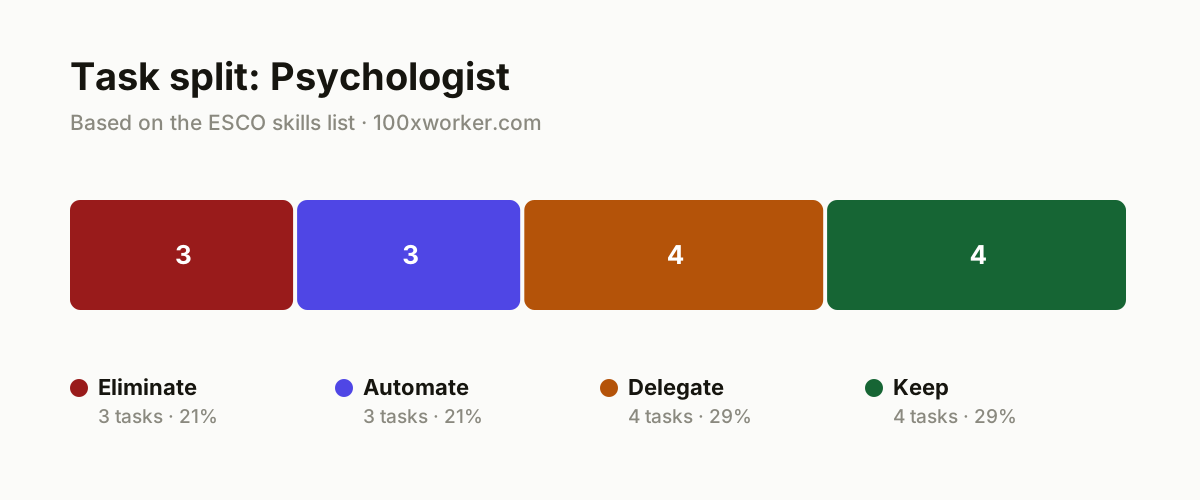
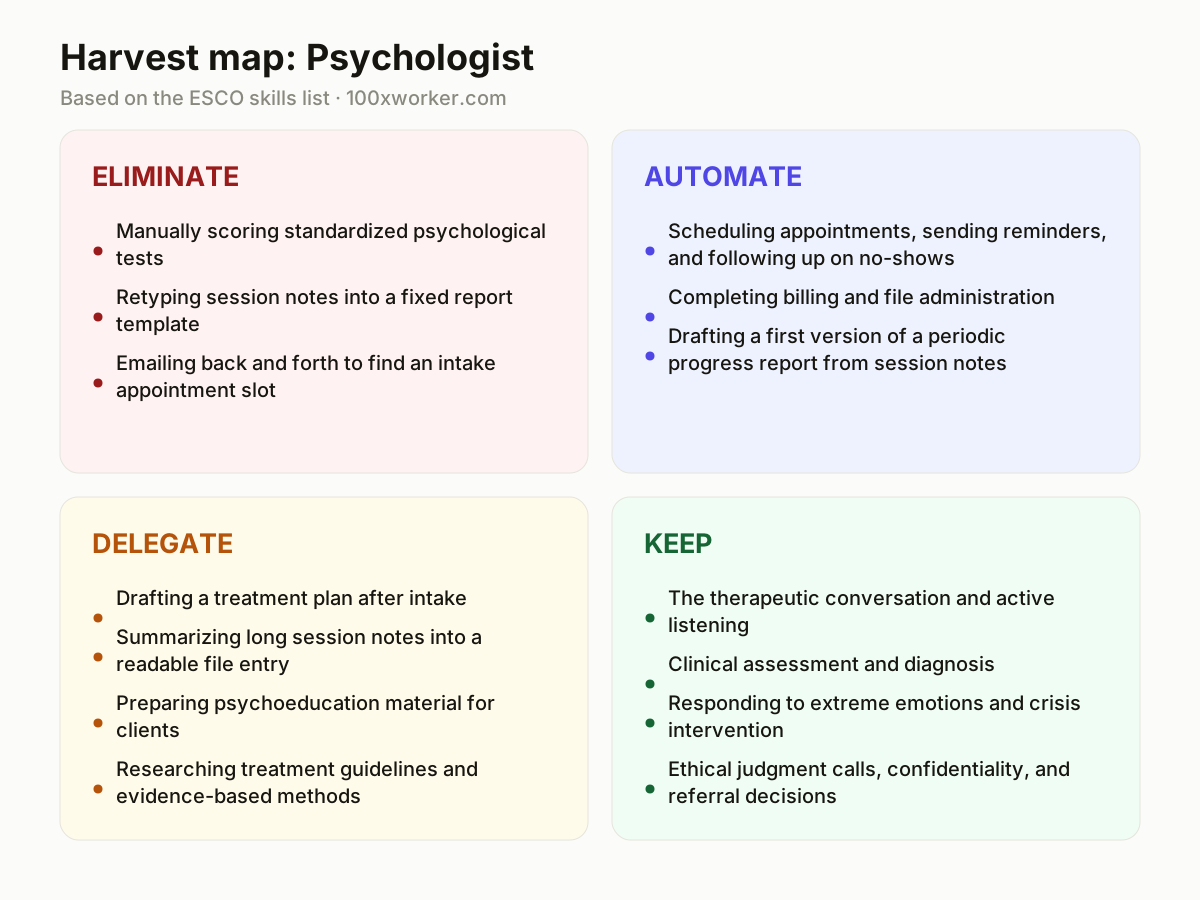
Instead of asking whether AI will replace psychologists, it helps to look at the actual tasks that make up the job, the way the ESCO taxonomy lists them: clinical assessment, psychological testing, therapeutic guidance, referral, documentation, and administration. Four buckets sort these tasks by what AI does to them. Eliminate covers steps that disappear entirely once an agent handles the whole loop. Automate covers rule-based work AI can run with little oversight. Delegate covers tasks AI can draft but you must review and finalize. Keep covers the clinical core that requires your presence, judgment, and accountability.
| Task | Bucket | Why |
|---|---|---|
| Manually scoring standardized psychological tests | eliminate | Software scoring is faster, more consistent, and less error-prone than hand-tallying and checking norm tables. |
| Retyping session notes into a fixed report template | eliminate | An agent converts raw notes directly into the required format, so the extra manual step disappears. |
| Emailing back and forth to find an intake appointment slot | eliminate | A scheduling agent sends matching proposals based on your open calendar slots right away. |
| Scheduling appointments, sending reminders, and following up on no-shows | automate | Standard work with no clinical judgment involved; a calendar agent handles it around the clock without errors. |
| Completing billing and file administration | automate | Fixed fields and fixed rules leave little room for interpretation, so this runs on its own. |
| Drafting a first version of a periodic progress report from session notes | automate | The structure is fixed, so an agent fills it in automatically based on your existing notes. |
| Drafting a treatment plan after intake | delegate | AI puts goals and interventions on paper based on intake information, while you set the clinical priorities. |
| Summarizing long session notes into a readable file entry | delegate | AI compresses ten pages of raw notes into a usable summary, and you check for nuance and context. |
| Preparing psychoeducation material for clients | delegate | AI writes a first explanation of a condition or exercise, and you review it before sharing it with the client. |
| Researching treatment guidelines and evidence-based methods | delegate | AI searches and summarizes literature faster, and you judge whether it fits this specific client. |
| The therapeutic conversation and active listening | keep | Building trust and reading nonverbal signals requires a human presence in the room. (Your edge: No one confides their deepest fear to software.) |
| Clinical assessment and diagnosis | keep | This requires final responsibility, clinical judgment, and context that a model does not carry. (Your edge: You carry the liability; a model carries none.) |
| Responding to extreme emotions and crisis intervention | keep | Assessing safety in the moment requires experience and immediate human action. (Your edge: In a crisis, every second of human contact counts.) |
| Ethical judgment calls, confidentiality, and referral decisions | keep | These decisions carry legal and moral weight that stays with the treating professional. (Your edge: You can never hand this responsibility off to a tool.) |
Will AI replace psychologists?
No. Microsoft Research measured generative AI applicability across occupations by analyzing 200,000 real Copilot conversations, and clinical and counseling psychologists scored just 21.1%, one of the lowest scores in the study. The ESCO taxonomy lists dozens of core skills for this occupation, including active listening, responding to extreme emotions, clinical judgment, and working within multicultural care settings. Most of these skills depend on presence, trust, and accountability, none of which a model can supply. AI reshapes the administrative and documentation layer of the job. The clinical core, the relationship, the diagnosis, the crisis response, stays with the psychologist.
Which psychologist tasks does AI take over?
AI takes over the paperwork layer first: scoring standardized tests, drafting progress reports from session notes, handling scheduling and reminders, and closing out billing. Anthropic's Economic Index shows this kind of use tends to be augmentation, meaning a professional edits and approves AI output rather than letting it run unsupervised. Treatment plan drafts, note summaries, psychoeducation handouts, and literature searches move into a delegate category: AI produces a usable first draft, and you check it against your clinical read of the client before it goes anywhere near a file or a session.
What can you do this month to bring AI into your practice?
Pick one task from the delegate list, such as summarizing session notes or drafting psychoeducation material, and test it for two weeks with a general-purpose tool or one built for clinical documentation. Compare the AI draft against what you would have written, and track how much editing it needs. Separately, check your practice's data handling policy: confirm what a tool does with any text you paste in before you use it with real client information. Bring both the time saved and the privacy question to your next supervision or practice meeting so the decision is documented, not informal.
Can you use AI for client records and test results?
Only with caution. Client records and test results are sensitive personal data, and in the EU that means GDPR obligations apply regardless of which AI tool you use. General-purpose chatbots are not built for clinical confidentiality by default, so pasting raw session notes or full client histories into a consumer-grade tool creates real risk. Before using AI on client material, anonymize identifying details where possible, confirm your tool's data retention and training policies, and check whether your professional body or local regulator has specific guidance. When in doubt, keep the AI step limited to de-identified drafts you review and finalize yourself.
Across occupations, generative AI's reach varies task by task rather than job by job; for clinical and counseling psychology, that reach covers roughly a fifth of the work.
Based on findings in Microsoft Research, Working with AI (2025)
Become the AI person on your team
Map your week onto the four buckets
Write down every task you did last week and sort it into eliminate, automate, delegate, or keep. Most psychologists find the administrative half of their week is where the time actually goes, not the sessions themselves.
Pilot one delegate task before trusting the rest
Start with note summarization or treatment plan drafting, since both have a clear right answer you can check against your own notes. Once you trust the output quality, expand to psychoeducation material and literature searches.
Put a written AI policy in your practice file
Document which tools you use, what data goes into them, and who reviews AI-generated content before it reaches a client file. This protects you and gives colleagues or supervisors something concrete to check.
Keep supervision and case review fully human
Use AI to prepare summaries or draft material ahead of supervision, but keep the actual case discussion, risk assessment, and ethical reasoning between people in the room.
Want this for your actual task list?
The free scan on the homepage builds your personal task map in 30 seconds, based on your role and industry.
Run the free task scanTools for this work
| Tool | For which tasks | The sober take |
|---|---|---|
| Otter.ai | Transcribing and summarizing session notes (delegate) | Check your practice's confidentiality and data retention rules before recording any client session with a cloud transcription tool. |
| Microsoft Copilot | Drafting progress reports and psychoeducation material (automate, delegate) | Enterprise versions typically offer stronger data handling guarantees than consumer accounts, worth checking before clinical use. |
| Claude (Anthropic) | Summarizing literature and drafting treatment plan skeletons (delegate) | Anthropic's own usage data suggest most clinical-adjacent use is augmentation, meaning you still edit and approve the output. |
| SimplePractice / TherapyNotes | Scheduling, reminders, no-show follow-up, and billing (eliminate, automate) | Built for the administrative layer of a practice, not for any part of clinical judgment. |
Prompts to try today
Draft a treatment plan skeleton from intake notes
Summarize long session notes into a file entry
Write plain-language psychoeducation material
Related jobs
Frequently asked questions
Will AI take over psychology as a profession?
No. Microsoft Research's applicability score for clinical and counseling psychologists is 21.1%, one of the lowest scores measured across occupations in its analysis of 200,000 Copilot conversations. The ESCO skill list for this occupation is dominated by human-dependent skills such as active listening, responding to extreme emotions, and clinical judgment. AI changes the documentation and scheduling side of the job, not the core relationship and decision-making that define it.
What percentage of psychologists' work can AI currently handle?
Microsoft Research puts the figure at 21.1% of work activities for clinical and counseling psychologists, based on analysis of real Copilot usage across occupations. For comparison, translators scored 49% and nurses scored 12%. This is a measure of applicability across tasks, not a prediction that a fifth of psychologists' jobs will disappear; it mostly reflects administrative and documentation tasks rather than clinical ones.
Is it safe to use AI tools with client data?
Only with real caution. In the EU, GDPR applies to any personal data you process, including through a third-party AI tool, and client records and test results count as sensitive data. Before using any general-purpose AI tool with client material, anonymize identifying details where you can, check the tool's data retention and training policy, and confirm what your professional body or local regulator requires. Jurisdiction-specific rules vary, so verify local requirements before relying on any tool with real client data.
Which AI skill should a psychologist learn first?
Start by learning to write clear, specific prompts for summarization and drafting tasks, such as turning session notes into a progress entry or generating a first-draft treatment plan. Equally important is learning to critically review AI output for clinical accuracy and to understand what happens to any data you paste into a tool. These two skills, prompting and critical review, matter more than any single piece of software.
Sources
- Microsoft Research, Working with AI: Measuring the Applicability of Generative AI to Occupations (2025)
- Anthropic Economic Index
- Eurostat, isoc_ai_iaiu (generative AI use, EU population 16-74)
- ESCO, European Commission occupation and skills taxonomy
Hendrik De Winne, author of Becoming AI-Savvy, founder of VibeLab. Helps teams redesign their work with AI.
This article was drafted with AI assistance from public data sources and editorially reviewed.