100×worker · job analysis
Will AI Replace Recruiters?
Recruiting has always been a mix of paperwork and people work. You screen resumes, write job postings, schedule interviews, and chase down references. Then you sit across from a candidate and try to work out whether they will actually fit the role and the team. AI is now good at the first kind of work and still weak at the second.
Microsoft Research put a number on this. Its analysis of 200,000 real Copilot conversations found that generative AI applies to about 20.1% of work activities for HR specialists, the closest US occupational category to recruiter. That places recruiting well below translators (49%) but above nurses (12%), meaning a meaningful slice of the job is exposed, but most of it is not.
This article sorts recruiter tasks into four groups: eliminate, automate, delegate, and keep. It follows the same task-level logic that the European Commission's ESCO taxonomy uses to describe over 3,000 occupations and their skills. The goal is not a headline about job loss. It is a working map of where your time should actually go.
A recruiter matches candidates to employers through profiling, interviews, screening, and ongoing client advice.
The task split: what AI takes over and what stays yours
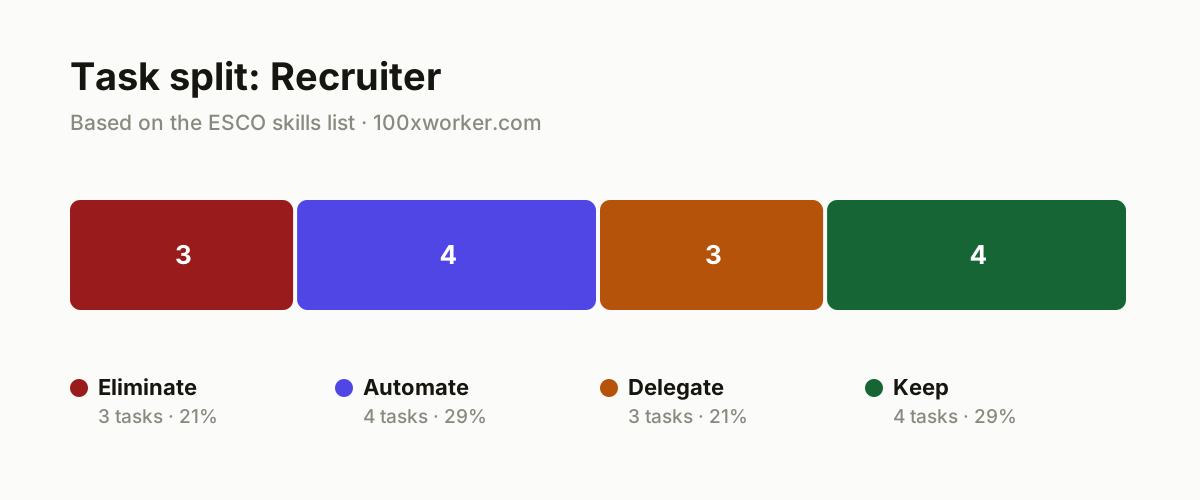
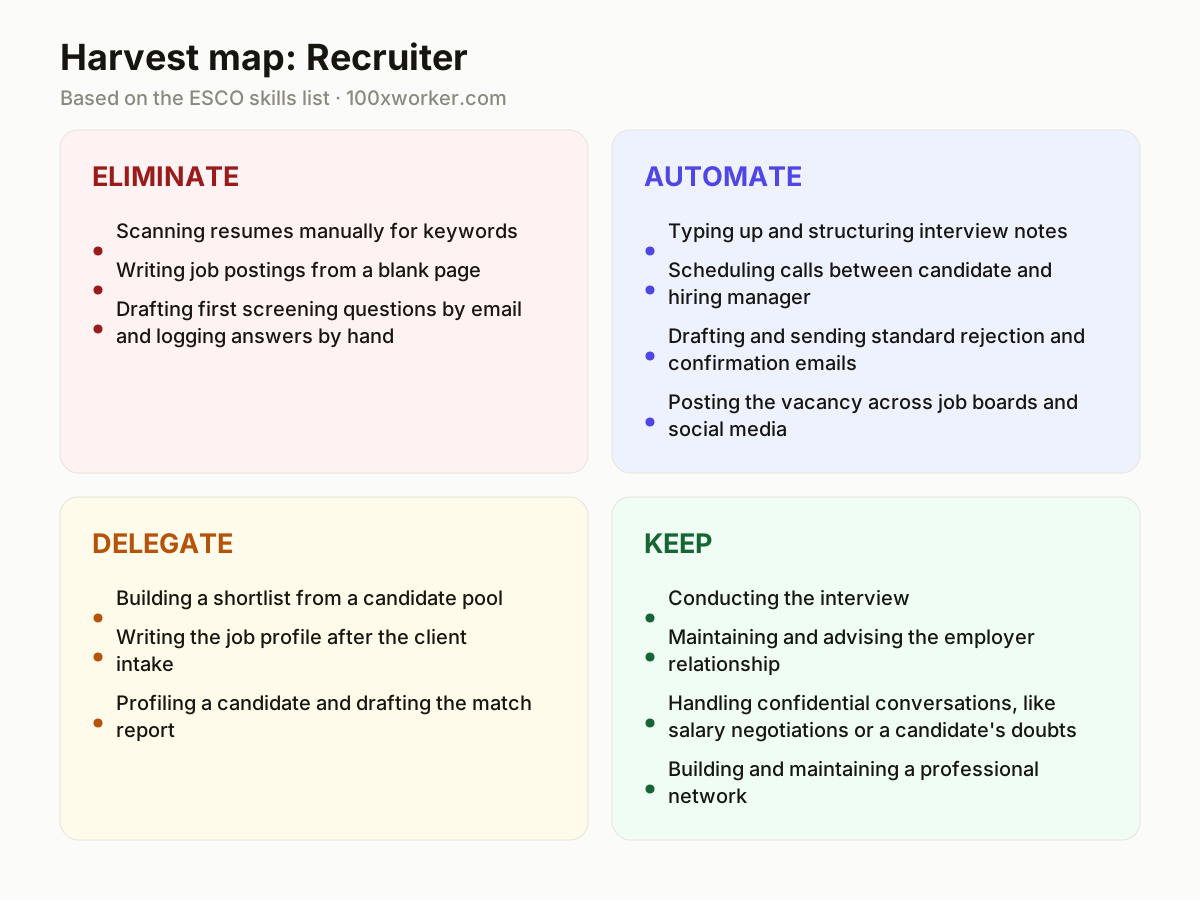
Not every recruiter task carries the same AI exposure. Some tasks can disappear entirely because a system now does them end to end. Some run in the background with almost no oversight needed. Some need AI to do the first pass while you make the final call. And some depend on judgment, trust, or discretion that no model reproduces. Sorting your week into these four buckets, eliminate, automate, delegate, and keep, shows you exactly where to spend the hours AI frees up.
| Task | Bucket | Why |
|---|---|---|
| Scanning resumes manually for keywords | eliminate | AI screens and ranks candidates faster and more consistently than a manual first pass. |
| Writing job postings from a blank page | eliminate | A first draft based on the job profile and past postings comes out in seconds. |
| Drafting first screening questions by email and logging answers by hand | eliminate | Chatbots handle the intake and hand you structured answers. |
| Typing up and structuring interview notes | automate | Transcription and summary run automatically during or after the call. |
| Scheduling calls between candidate and hiring manager | automate | A scheduling agent matches availability without back-and-forth email. |
| Drafting and sending standard rejection and confirmation emails | automate | Sending fixed text under set rules needs no human judgment call by call. |
| Posting the vacancy across job boards and social media | automate | Distributing to multiple channels on a set schedule is a system task, not a judgment task. |
| Building a shortlist from a candidate pool | delegate | AI ranks candidates by profile, you check the fit against the client's real need and decide who makes the cut. |
| Writing the job profile after the client intake | delegate | AI structures the intake conversation into a profile, you validate it with the client yourself. |
| Profiling a candidate and drafting the match report | delegate | AI pulls together resume, interview, and test data, you judge whether the fit is real. |
| Conducting the interview | keep | Reading motivation, hesitation, and chemistry in a live conversation is not an output you can automate. (Your edge: Sensing genuine trust in a conversation stays a human skill.) |
| Maintaining and advising the employer relationship | keep | Long-term client relationships are built on repeated personal contact, not automated touchpoints. (Your edge: Trust built over years stays personal.) |
| Handling confidential conversations, like salary negotiations or a candidate's doubts | keep | Keeping confidentiality and discretion is something a system cannot guarantee. (Your edge: Emotional nuance and discretion cannot be automated.) |
| Building and maintaining a professional network | keep | A network runs on reputation and goodwill, built through repeated personal contact. (Your edge: Reputation and goodwill are yours to build, not a tool's.) |
Which recruiter tasks does AI take over?
AI is strongest on the repetitive, high-volume parts of the job: resume screening, first-draft job postings, intake questions, interview note-taking, scheduling, and standard emails. Anthropic's Economic Index, which classifies millions of chatbot conversations against O*NET task lists, distinguishes automation-style use (AI does the task end to end) from augmentation-style use (AI assists while you decide). Recruiting shows both patterns: screening and scheduling lean toward automation, while shortlisting and candidate profiling lean toward augmentation, where AI drafts and you sign off.
Will AI replace recruiters?
No single occupation gets fully automated by generative AI right now. Microsoft Research put recruiting-adjacent work at about 20.1% applicability, meaning roughly a fifth of typical activities, well below translators (49%) and above nurses (12%). That leaves most of the job, interviewing, client relationships, negotiation, and confidential conversations, firmly with you. Older estimates you may have seen about recruiters facing high 'automation risk' usually trace back to Frey and Osborne's 2013 Oxford study, done before large language models existed, and should be treated with caution.
What can you do this month to put AI to work?
Pick one task from each bucket and change how you do it. Turn on AI screening in your applicant tracking system for the eliminate bucket. Set up automatic transcription for interviews and automatic distribution for job postings in the automate bucket. Ask AI to draft a candidate match report before you review it in the delegate bucket. Then track your calendar for two weeks. If screening and scheduling now take less time, put those hours into interviews, client calls, and network building, the tasks that actually determine placements.
Which skills matter most as AI takes over more tasks?
ESCO's skill list for recruiters includes interviewing people, active listening, maintaining confidentiality, identifying client needs, and developing a professional network. None of these show up in AI applicability scores because they depend on live judgment, discretion, and relationship-building rather than document production. As AI absorbs screening and paperwork, these interpersonal and negotiation skills become the part of the job clients are actually paying for. Sharpening interview technique and client advisory skills matters more, not less, as the routine work shrinks.
Generative AI is applicable to roughly a fifth of the work activities in HR-specialist roles, based on analysis of real workplace conversations.
Microsoft Research, Working with AI (2025)
Become the AI person on your team
Audit your week by task, not by job title
List every task you did last week and sort each one into eliminate, automate, delegate, or keep. Most recruiters find that screening and admin eat far more hours than they expect, which is exactly where AI should take over first.
Put AI in front of the client, not behind them
Show clients the AI-drafted job profile or match report before it goes final. It speeds up sign-off and makes your judgment visible, since you are the one deciding what changes.
Protect confidential conversations from any tool
Keep salary negotiations, reference checks, and candidate concerns out of AI transcription tools unless you have explicit consent and a clear data policy. Discretion is part of the service you sell.
Want this for your actual task list?
The free scan on the homepage builds your personal task map in 30 seconds, based on your role and industry.
Run the free task scanTools for this work
| Tool | For which tasks | The sober take |
|---|---|---|
| AI screening module inside your ATS | Eliminate: scanning resumes manually for keywords | Most modern applicant tracking systems now ship with a built-in ranking feature rather than requiring a separate tool. |
| Automated interview transcription and summary tool | Automate: typing up and structuring interview notes | Runs during the call, so you can focus on listening instead of typing. |
| AI scheduling assistant | Automate: scheduling calls between candidate and hiring manager | Removes the multi-email back-and-forth over availability. |
| Conversational intake chatbot | Eliminate: drafting screening questions and logging answers by hand | Useful for high-volume roles, less suited to senior or confidential searches. |
| AI sourcing and matching platform | Delegate: building a shortlist, profiling a candidate | Speeds up ranking, but you still need to check fit against the client's real brief. |
Prompts to try today
Draft a job posting from a profile
Build a candidate match report
Rank a shortlist with reasoning shown
Related jobs
Frequently asked questions
Will recruiters lose their jobs to AI?
Unlikely as a wholesale replacement. Microsoft Research found generative AI applies to about 20.1% of HR specialist work activities, meaning most of the role, interviewing, client relationships, and confidential conversations, still needs a person. What changes is the task mix: less time on screening and admin, more time on judgment calls and relationship management.
What percentage of recruiting work is automatable?
There is no single official percentage specific to the recruiter role. The closest data point is Microsoft Research's 20.1% applicability score for HR specialists in the US, based on 200,000 real Copilot conversations. That figure covers where AI is shown to be useful, not a guarantee that those tasks are fully removed from human oversight.
Do recruiters need to learn AI tools now?
Yes, at a basic level. Eurostat reports that 32.7% of the EU population aged 16 to 74 used generative AI in the last three months of 2025, and recruiting clients increasingly expect faster turnaround on screening and shortlisting. Learning to use an AI screening feature, a transcription tool, and a drafting assistant is becoming a baseline skill, not an advanced one.
How is AI changing candidate screening specifically?
AI now handles the first pass: parsing resumes, ranking candidates against a job profile, and flagging strong matches. Anthropic's Economic Index shows this kind of task, matching structured data against criteria, is one of the clearest automation-style uses of AI chatbots. The recruiter's role shifts to reviewing AI's shortlist, checking for bias or missed context, and deciding who actually gets a call.
Sources
- Microsoft Research, Working with AI: Measuring the Applicability of Generative AI to Occupations (2025)
- Anthropic Economic Index
- Eurostat, isoc_ai_iaiu (2025)
- ESCO, European Commission occupation taxonomy
Hendrik De Winne, author of Becoming AI-Savvy, founder of VibeLab. Helps teams redesign their work with AI.
This article was drafted with AI assistance from public data sources and editorially reviewed.