100×worker · job analysis
Will AI Replace Retail Managers?
Retail managers run stores full of paperwork: sales reports, staff rosters, price labels, supplier orders, customer feedback. Much of that paperwork is now a target for generative AI, but the core of the job, running a team and a shop floor, is not. Microsoft Research analyzed 200,000 real Copilot conversations across occupations and found that roles close to retail management score an AI applicability score of only 13%. That places retail supervision near the low end of the scale, well below translators (49%) and closer to nurses (12%), occupations built on physical presence and human judgment.
That doesn't mean nothing changes. Anthropic's Economic Index, which classifies millions of Claude conversations against standardized task lists, shows that AI use in most jobs splits between automation (AI does the task) and augmentation (AI helps you do it faster). For retail management, most of the applicable work falls into report writing, data summarizing, and first-draft text, exactly the tasks covered in the eliminate and automate buckets below. The ESCO taxonomy lists 27 core skills for this role, from managing budgets to preventing theft, and only a handful of them are things a language model can do on its own.
A retail manager runs the daily operations and staff of a specialized store.
The task split: what AI takes over and what stays yours
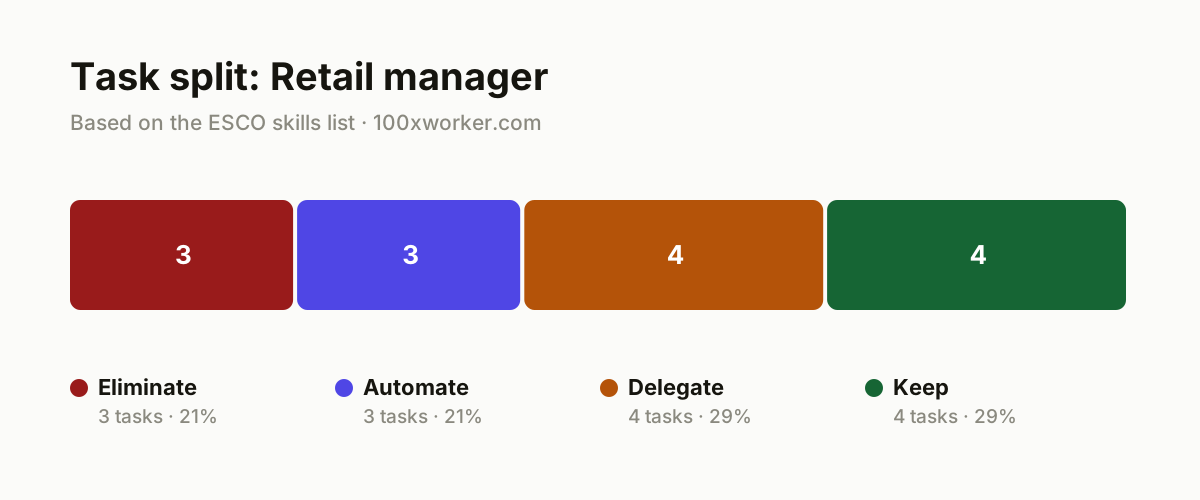
Not every task in a retail manager's job changes the same way. Some tasks disappear because a system already does them better (eliminate). Some get done by an AI agent that you supervise and approve (automate). Some get a first draft or first pass from AI, but you finish the job (delegate). And some stay entirely yours, because they need presence, trust, or judgment on the spot (keep).
| Task | Bucket | Why |
|---|---|---|
| Manually retyping sales figures into spreadsheets for head office | eliminate | POS systems already feed real-time dashboards, so manual retyping adds no value. |
| Rewriting price tags by hand for every promotion | eliminate | Pricing engines and electronic shelf labels update prices automatically once a promotion rule is set. |
| Compiling the standard weekly head-office report by hand | eliminate | This is pure repetition of data the system already holds, with no judgment required. |
| Drafting reorder proposals from sales history and stock levels | automate | An AI agent combines sales data and inventory into a concrete order proposal, you just confirm it. |
| Building staff schedules based on predicted footfall | automate | Customer traffic patterns are predictable enough for AI to generate a draft schedule automatically. |
| Summarizing customer reviews and ratings by product or department | automate | Condensing large volumes of text into usable signals is exactly what generative AI does well. |
| Writing job ads and doing first-pass candidate screening when hiring staff | delegate | AI writes and filters quickly, but the personal fit with a candidate stays your call. |
| Preparing the negotiation file for supplier purchase terms | delegate | AI gathers numbers, price history, and arguments, you run the conversation and decide. |
| Working out pricing strategy and promotion scenarios | delegate | AI runs the margin math and scenarios, you choose what fits your store and customers. |
| Drafting the first version of customer communications, like promotional newsletters | delegate | AI delivers a usable first draft, you rework it into your store's own tone. |
| Supervising staff on the floor, coaching, and resolving conflicts | keep | This requires presence, trust, and context that no tool can supply. (Your edge: People skills and daily presence on the shop floor.) |
| Maintaining relationships with customers at the till and on the floor | keep | Personal contact builds the loyalty that numbers alone can't explain. (Your edge: Personal trust built up across repeat visits.) |
| Negotiating sales contracts with suppliers and partners | keep | The final deal depends on relationship, timing, and negotiating feel. (Your edge: Negotiating instinct and the long-term supplier relationship.) |
| Watching over theft prevention and safety in the store | keep | This requires physical presence and on-the-spot judgment. (Your edge: Direct judgment and presence at the moment it matters.) |
Will AI replace retail managers?
No. Microsoft Research's AI applicability score for retail supervisor roles sits at 13%, one of the lower scores across occupations they studied, well below jobs like translation (49%) and close to nursing (12%). The job depends on staff supervision, supplier negotiation, and customer relationships built on the shop floor, none of which a language model can do. What does change is the paperwork around the job: reports, rosters, and price updates, which is exactly where AI applies today.
Which retail manager tasks does AI take over?
AI takes over the repetitive, data-heavy parts of the job first. Retyping sales figures into spreadsheets, rewriting price tags for every promotion, and compiling standard weekly reports are already handled by POS systems, pricing engines, and reporting dashboards, so doing them manually just adds wasted time. Slightly more complex tasks, like drafting reorder proposals from sales history or building draft staff schedules from footfall predictions, now run through an AI agent that you review and approve rather than build from scratch.
What can you do this month with AI as a retail manager?
Start small and concrete. Feed last month's customer reviews into an AI tool and ask for a summary by product or department. Use it to draft a first version of your next promotional newsletter, then rewrite it in your store's voice. Ask it to prepare a negotiation brief for an upcoming supplier meeting, listing price history and talking points. None of these replace your judgment, but they cut the time you spend on the first draft, leaving more time for the floor and the team.
How much of a retail manager's work can AI handle?
Based on Microsoft Research's applicability score, about 13% of the tasks tied to retail supervisor roles are ones where generative AI clearly applies, a modest share compared to occupations like translation. Anthropic's Economic Index adds nuance: even within that applicable share, most AI use in management-type roles is augmentation (AI helps you write or analyze faster) rather than full automation (AI does the task alone). In practice, that means AI handles drafts and summaries, while decisions, negotiations, and people management stay with you.
Working with AI: Measuring the Applicability of Generative AI to Occupations shows most jobs sit far from full automation, with applicability scores concentrated well below the top occupations like translation.
Microsoft Research, 2025
Become the AI person on your team
Let AI draft the reorder, you set the judgment call
Connect your POS and stock data to an AI reordering tool and let it propose quantities. Review the proposal against upcoming promotions or local events before confirming, since the model doesn't know about the school fair down the street.
Use AI to prep the negotiation, not to run it
Before a supplier meeting, ask an AI assistant to pull together price history, competitor terms, and past agreements into a one-page brief. Walk into the room with the numbers ready and spend your energy on the actual conversation.
Turn reviews into a weekly signal, not a chore
Instead of reading every customer review, have AI summarize them weekly by department and flag recurring complaints. Use that summary in your team briefing so staff hear the pattern directly from you.
Want this for your actual task list?
The free scan on the homepage builds your personal task map in 30 seconds, based on your role and industry.
Run the free task scanTools for this work
| Tool | For which tasks | The sober take |
|---|---|---|
| Microsoft Copilot | Weekly reporting, summarizing customer reviews, drafting supplier negotiation briefs | Built into many Microsoft 365 setups already used for head-office reporting. |
| Claude (Anthropic) | Drafting job ads, first-pass candidate screening notes, customer newsletter drafts | Anthropic's own usage data shows this kind of drafting work is mostly augmentation, not full automation. |
| AI-enabled workforce scheduling software | Building draft staff rosters based on predicted footfall | Generates a starting schedule; you still adjust for staff preferences and exceptions. |
| Dynamic pricing / promotion engines | Updating price tags and running promotion scenarios | Removes manual re-labeling, but margin strategy still needs your sign-off. |
Prompts to try today
Reorder proposal check
Customer review summary
Supplier negotiation brief
Related jobs
Frequently asked questions
Is a retail manager's job at risk from AI?
Not the job as a whole. Microsoft Research's applicability score for retail supervisor roles is 13%, one of the lower scores among occupations studied. The job's core, managing people and customer relationships on the shop floor, doesn't map onto what generative AI does well. The tasks at risk are the paperwork tasks: reports, price labels, and rosters.
What's the difference between automation and augmentation for a retail manager?
Anthropic's Economic Index defines automation as AI completing a task on its own, and augmentation as AI helping a person do the task faster. For retail managers, most current AI use is augmentation: drafting a newsletter, summarizing reviews, or prepping a negotiation brief, all steps where you still make the final call.
Do I need to learn to code or use complex AI tools?
No. Most useful tools for this job are chat-based assistants like Copilot or Claude, used through a normal text prompt. The skill that matters is knowing which tasks to hand over (reports, drafts, summaries) and which to keep (staff coaching, negotiations, customer relationships).
How many people are already using AI at work like this?
Eurostat reports that 32.7% of the EU population aged 16 to 74 used generative AI in the three months before being surveyed in 2025. Adoption is uneven by age and role, but the trend across retail and other sectors is toward using AI as a daily support tool rather than a replacement for judgment-heavy work.
Sources
- Microsoft Research, Working with AI: Measuring the Applicability of Generative AI to Occupations (2025)
- Anthropic Economic Index
- Eurostat, Individuals using generative artificial intelligence tools (isoc_ai_iaiu)
- ESCO, European Commission occupation taxonomy
Hendrik De Winne, author of Becoming AI-Savvy, founder of VibeLab. Helps teams redesign their work with AI.
This article was drafted with AI assistance from public data sources and editorially reviewed.