100×worker · job analysis
Will AI Replace Podcast Producers?
Podcast production used to mean hours of manual work: logging tape, typing up interviews word for word, hunting for the right ten-second clip to promote on social media. Generative AI has already automated much of that grind. Microsoft Research analyzed 200,000 real Copilot conversations and scored occupations by how much of their daily work overlaps with what generative AI can currently do. Producers and directors, the closest US occupational match to podcast producer, scored 16.7% (Microsoft Research, Working with AI: Measuring the Applicability of Generative AI to Occupations, 2025). That is far below translators (49%) and roughly in line with many creative and management roles.
That number does not mean 16.7% of your job disappears. It means a slice of specific tasks, mostly transcription, audio cleanup, and formatting text, can be handed to a tool. Anthropic's Economic Index, which classifies millions of real Claude conversations against the O*NET task list, finds that most AI use at work looks more like augmentation (helping with a task) than full automation (replacing a task outright). That pattern holds for podcast production: AI helps you produce more, faster, but the direction of the show still comes from you.
This article breaks the job into four buckets: tasks AI already makes obsolete, tasks worth automating with a tool, tasks worth delegating to an AI assistant with your review, and tasks that stay firmly human.
A podcast producer plans, directs, and publishes audio programs, from concept to release.
The task split: what AI takes over and what stays yours
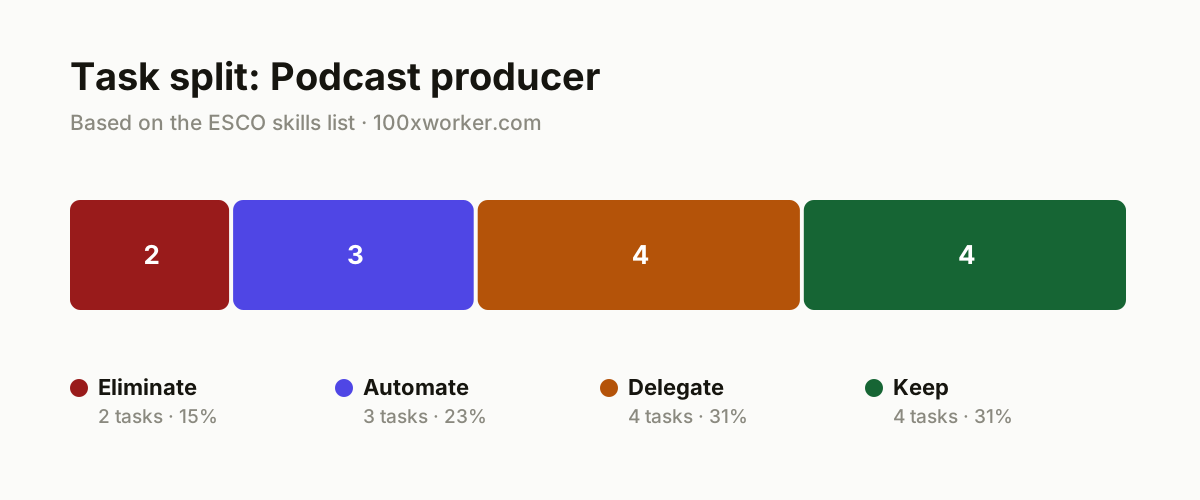
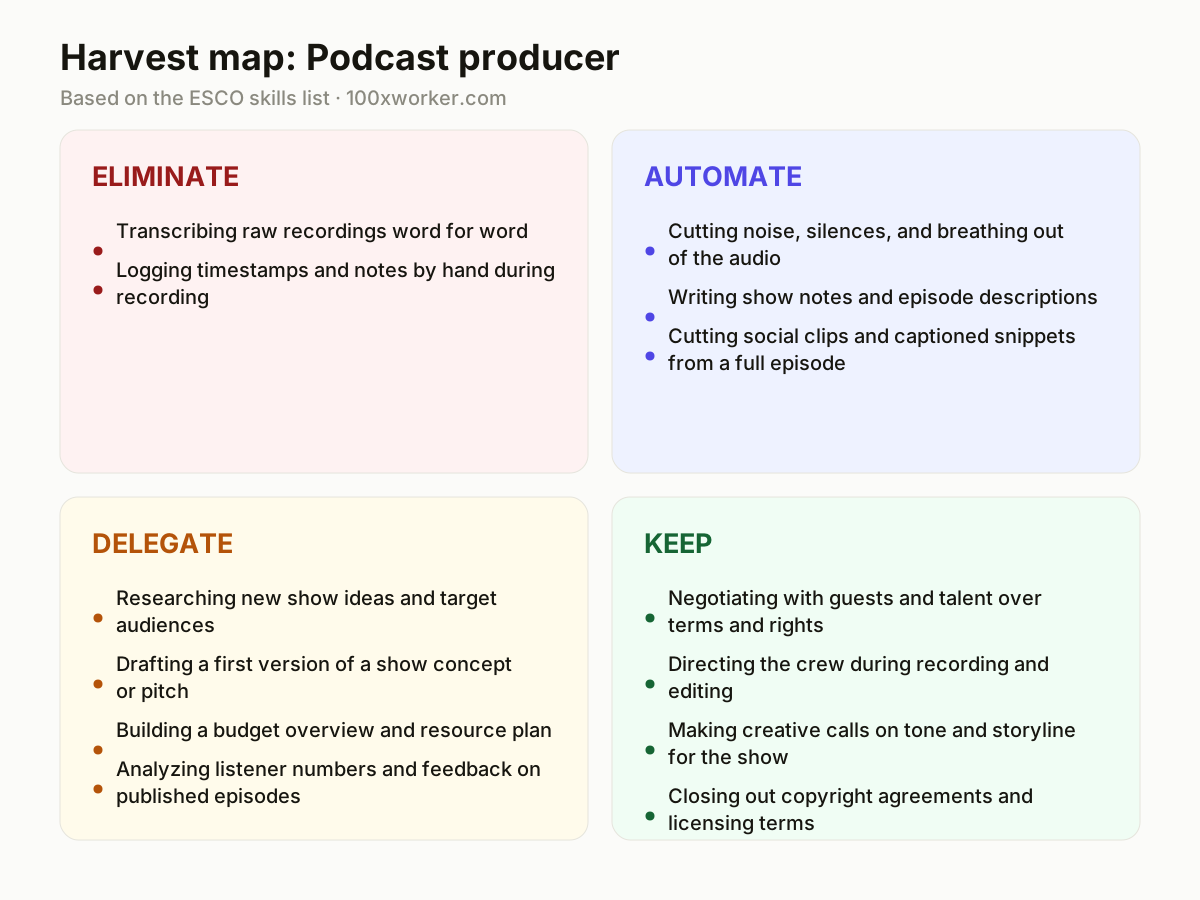
Not every task in a job disappears at the same rate. This framework sorts a podcast producer's work into four buckets: tasks to eliminate because AI does them better and cheaper, tasks to automate with a tool running in the background, tasks to delegate to an AI assistant that you still review, and tasks to keep because they depend on judgment, relationships, or creative taste. Sorting the job this way gives you a concrete plan instead of a vague worry about being replaced.
| Task | Bucket | Why |
|---|---|---|
| Transcribing raw recordings word for word | eliminate | AI transcribes audio instantly and accurately now; typing it out by hand serves no purpose. |
| Logging timestamps and notes by hand during recording | eliminate | Generated automatically from the transcript and audio file; manual logging duplicates the work. |
| Cutting noise, silences, and breathing out of the audio | automate | Audio tools clean up tracks to broadcast quality automatically, without review of every clip. |
| Writing show notes and episode descriptions | automate | An AI agent turns the transcript into publish-ready text with timestamps and a summary, ready to post. |
| Cutting social clips and captioned snippets from a full episode | automate | An AI agent finds the strong moments and cuts captioned clips for social media automatically. |
| Researching new show ideas and target audiences | delegate | AI gathers trends, competitors, and numbers; you decide the angle and the format. |
| Drafting a first version of a show concept or pitch | delegate | AI provides structure and a format proposal; you refine the tone, voice, and the hook that makes it distinct. |
| Building a budget overview and resource plan | delegate | AI drafts a first budget based on scope and hours; you negotiate and make the final call. |
| Analyzing listener numbers and feedback on published episodes | delegate | AI summarizes data and reactions into patterns; you draw the conclusions for what comes next. |
| Negotiating with guests and talent over terms and rights | keep | AI can draft contract language, but the deal itself depends on trust and negotiation instinct. (Your edge: Personal rapport and reading the other side.) |
| Directing the crew during recording and editing | keep | AI can schedule and remind, but running people in the room stays human work. (Your edge: Motivating, redirecting, and resolving conflict in real time.) |
| Making creative calls on tone and storyline for the show | keep | AI generates ideas, but the final voice and taste of the show remain your choice. (Your edge: A recognizable style that keeps listeners coming back.) |
| Closing out copyright agreements and licensing terms | keep | AI can check clauses, but final responsibility and the relationship with rights holders stays with you. (Your edge: Accountability and long-term trust with rights holders.) |
What tasks does AI take over for a podcast producer?
AI takes over the mechanical parts of production first. Transcription is essentially solved: tools convert raw audio to text in minutes, so nobody needs to type interviews by hand or log timestamps manually during a session. Audio cleanup, removing noise, silence, and stray breaths, now runs automatically inside editing tools without a human checking every cut. Further along the workflow, an AI agent can draft show notes and episode descriptions straight from the transcript, and cut short, captioned clips for social media from a two-hour episode. None of this eliminates the producer's job. It removes repetitive steps so more time goes to booking guests, shaping the format, and editing for story rather than for logistics.
Will AI replace podcast producers?
No, not as a role. Microsoft Research's applicability score for producers and directors sits at 16.7%, meaning most of the daily work still falls outside what current generative AI does well. The job is a bundle of tasks: booking talent, negotiating contracts, running a recording session, and shaping a show's identity. AI is strong at the parts of that bundle that involve text and audio processing. It is weak at the parts that involve persuasion, judgment under pressure, and taste. What changes is the mix of hours: less time on transcription and editing logistics, more time on decisions only a person can make well.
How many professionals already use AI at work?
Adoption is already broad and growing fast. Eurostat reports that 32.7% of the EU population aged 16 to 74 used generative AI in the three months before being surveyed in 2025. Anthropic's Economic Index, built from millions of real Claude conversations mapped to the O*NET task list, shows that most of that use looks like augmentation: people asking AI to help with a task rather than to fully complete it on its own. For a podcast producer, that pattern matches the buckets above. You are far more likely to use AI to draft show notes or summarize research than to run an entire episode end to end without touching it.
What can you do this month as a podcast producer with AI?
Start small and specific. Pick one recurring task, transcription or show notes are the easiest wins, and route it through an AI tool for two weeks before touching anything else. Keep a human check on every output before it goes public: a wrong name in a transcript or a flat episode description costs more than the time it saves. Once that workflow is stable, add clip-cutting for social media. Do not hand over guest negotiations, budget decisions, or the final edit for tone and story; those stay with you. The goal is fewer hours on repetitive steps, not a hands-off production process.
Most AI use in real work looks like augmentation, helping with a task, rather than automation that replaces it outright.
Anthropic Economic Index
Become the AI person on your team
Automate the transcript pipeline first
Route every recording through an AI transcription tool the moment you finish recording. Use the clean transcript as the base for show notes, social posts, and timestamped chapters instead of writing each from scratch.
Keep a human pass on anything public-facing
AI-generated show notes and clip captions can misquote a guest or misread a joke. Read every AI output before it goes to your feed or your host's inbox.
Spend the time you save on guest relationships
Every hour you claw back from transcription and editing logistics is an hour you can spend booking better guests or negotiating better terms. A show's growth comes from those relationships, not from faster editing.
Want this for your actual task list?
The free scan on the homepage builds your personal task map in 30 seconds, based on your role and industry.
Run the free task scanTools for this work
| Tool | For which tasks | The sober take |
|---|---|---|
| Descript | Transcription, noise/silence cleanup, and clip-cutting | Edits audio by editing the text transcript, which speeds up the automate-bucket tasks. |
| Adobe Podcast (Enhance Speech) | Audio cleanup, removing noise and echo | One-click cleanup tool, useful for raw remote recordings before editing. |
| Otter.ai | Transcription and timestamped notes | Handles the eliminate-bucket transcription task directly during or right after recording. |
| Claude or ChatGPT | Drafting show notes, episode descriptions, and research summaries | Best used as a first draft that you edit for voice, not as a final output. |
| Riverside.fm | Recording and basic AI-assisted editing | Combines remote recording with built-in transcription and clip tools in one workflow. |
Prompts to try today
Draft show notes from a transcript
Turn research into pitch angles
Find clip-worthy moments in a transcript
Related jobs
Frequently asked questions
Will AI take over podcast production entirely?
No. Microsoft Research's applicability score for producers and directors, the closest US occupational match, is 16.7%, meaning most daily tasks fall outside what current generative AI handles well. The tasks that go are mechanical: transcription, audio cleanup, and drafting text like show notes. The tasks that stay involve negotiation, directing people, and creative judgment about a show's voice, none of which current tools do reliably on their own.
Which podcast production tasks should I automate first?
Start with transcription and audio cleanup. Both are largely solved problems: tools transcribe audio in minutes and strip out noise, silence, and stray breaths without a human reviewing every clip. Show notes and social clips are the natural next step, since an AI agent can draft both from a clean transcript. Save your review time for accuracy checks, not for doing the first draft yourself.
Do I need to learn to code or use complex AI tools?
No. Most of the useful tools for podcast producers, transcription apps, audio cleanup software, and chat-based assistants like Claude or ChatGPT, work through a normal interface: upload a file or paste text, then review the output. The skill that matters is knowing which tasks to hand over and how to check the result, not technical setup.
How fast is AI adoption growing among professionals generally?
Fast. Eurostat reports that 32.7% of the EU population aged 16 to 74 used generative AI in the three months before the 2025 survey. Anthropic's Economic Index, based on millions of real Claude conversations, shows this use concentrated in augmentation, people using AI to help with parts of a task rather than to complete it fully. Podcast production is following the same pattern: AI as an assistant on specific steps, not a replacement for the producer role.
Sources
- Microsoft Research, Working with AI: Measuring the Applicability of Generative AI to Occupations (2025)
- Anthropic Economic Index
- Eurostat, isoc_ai_iaiu (2025)
- ESCO, European Commission
Hendrik De Winne, author of Becoming AI-Savvy, founder of VibeLab. Helps teams redesign their work with AI.
This article was drafted with AI assistance from public data sources and editorially reviewed.