100×worker · job analysis
Will AI Replace HR Managers?
HR management is a mix of paperwork, process, and people problems, and generative AI is only good at the first of those. Microsoft Research analyzed 200,000 real Copilot conversations and mapped generative AI applicability across occupations. Human Resources Managers scored 13.7%, well below translators (49%) but above nurses (12%), which fits a job built on structured administrative tasks layered under judgment-heavy people decisions.
That number does not mean 13.7% of HR managers lose their jobs. It measures the share of daily work activities where AI tools already show up doing something useful, based on actual usage patterns rather than survey guesses. Anthropic's Economic Index runs a parallel analysis on Claude conversations, mapping them against the O*NET task taxonomy and splitting usage into automation-like patterns (AI does the task directly) versus augmentation-like patterns (AI assists while a person stays in control). For HR work, most of the visible AI use falls on the augmentation side: drafting, summarizing, and structuring, not deciding.
Across the EU, 32.7% of people aged 16 to 74 used generative AI in the three months before being surveyed in 2025, according to Eurostat. HR managers who have not touched a chatbot yet are now a minority in their own workforce, which changes what employees expect from HR processes as much as it changes HR's own workflow.
An HR manager plans hiring, development, and employee wellbeing, with AI as a first-line assistant.
The task split: what AI takes over and what stays yours
Not every HR task reacts to AI the same way. Some tasks disappear because a system should have handled them all along. Some get fully automated because they are structured matching or scheduling work. Some get delegated to AI for a first draft that you then correct and approve. And some stay entirely with you because they depend on trust, power dynamics, or a person's presence in the room. Sorting HR work into these four buckets, rather than asking whether 'AI will replace HR', gives you something you can actually act on this quarter.
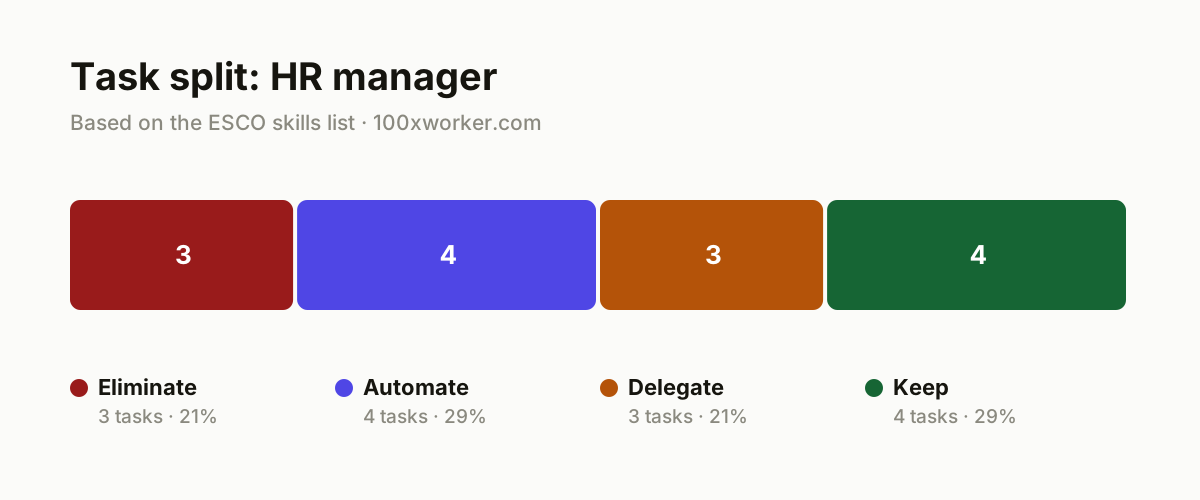
| Task | Bucket | Why |
|---|---|---|
| Manually scanning resumes for keywords | eliminate | Slow and error-prone; structured matching against job profiles does this faster and more consistently. |
| Tracking leave balances and attendance by hand in spreadsheets | eliminate | Pure administration that belongs in a system, not in a file you update yourself. |
| Rewriting standard contracts from scratch each time | eliminate | A template with variables beats copy-pasting a contract file by file. |
| Drafting job postings from a role profile | automate | An AI agent turns requirements and company context into a publish-ready draft; you review and post. |
| First-pass screening of applications against job requirements | automate | Matching listed skills and experience against a role's requirements is structured work AI handles well. |
| Scheduling interviews and onboarding logistics | automate | Coordinating calendars, sending invites, and prepping documents is rule-based work, no judgment required. |
| Generating dashboards on turnover, absence, and time-to-hire | automate | Pulling numbers from existing HR systems and visualizing them is faster and more consistent with an agent. |
| Designing training programs | delegate | AI produces a first draft based on role requirements and skills gaps; you decide on content and priority. |
| Drafting HR policy documents and procedures | delegate | A first version based on existing policy and employment law, checked by you against your actual organization. |
| Salary benchmarking and compensation data analysis | delegate | AI gathers and compares figures; you decide what is affordable and defensible within budget. |
| Negotiating employment terms with unions or staffing agencies | keep | This requires reading trust and power dynamics, and adjusting in real time. (Your edge: Trust and negotiating instinct do not come from a dataset.) |
| Handling conflicts between employees | keep | Every situation is emotional and context-dependent; no two cases are alike. (Your edge: Empathy and timing stay human skills.) |
| Conducting termination and outplacement conversations | keep | The human impact of this conversation requires presence, not a script. (Your edge: Looking someone in the eye is not an agent's job.) |
| Aligning strategic workforce planning with leadership | keep | Medium- and long-term goals require political context and trust inside the management team. (Your edge: Internal politics and trust are not built with a prompt.) |
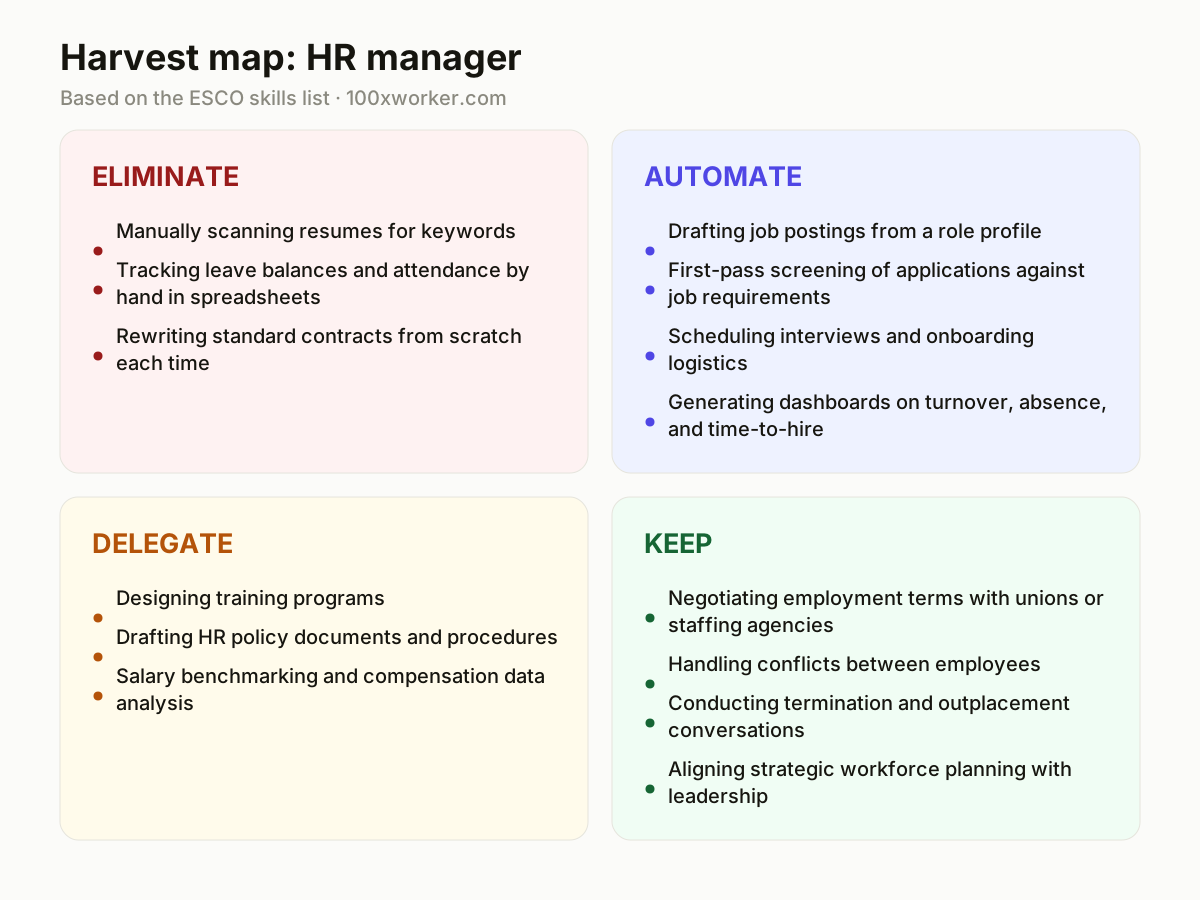
What tasks can AI take over from an HR manager?
AI is strongest on the structured, repeatable parts of HR: drafting job postings from a role profile, doing a first screening pass on applications against listed requirements, scheduling interviews, and generating turnover or time-to-hire dashboards from existing data. It is also useful for first drafts of training programs, policy documents, and salary benchmarking, all of which still need your review. What it cannot do is negotiate, mediate a conflict, or sit across from someone during a termination conversation. Microsoft Research's 13.7% applicability score for HR managers reflects exactly this split: real usage clusters around drafting and structuring, not deciding.
Will AI replace HR managers?
Unlikely as a wholesale replacement. Microsoft Research's applicability score of 13.7% for HR managers is far below occupations built almost entirely around text transformation, like translators at 49%. HR work includes negotiation, conflict resolution, and legally sensitive decisions that require a person accountable for the outcome. What is changing is the task mix: less time on screening and scheduling, more time on the judgment calls AI cannot make. Anthropic's Economic Index finds that most visible AI use in professional work is augmentation, meaning a person stays in the loop, rather than full automation, which matches what HR managers are reporting in practice.
What can you do this month to start using AI in HR work?
Pick one recurring task, ideally the first screening pass on applications or drafting job postings, and run it through an AI tool for two weeks before deciding whether to keep it in your workflow. Write down the prompts that worked so a colleague can reuse them. Separate your own task list into the four buckets (eliminate, automate, delegate, keep) and eliminate the spreadsheet-based tracking first, since that is the lowest-risk win. Do not start with anything touching termination, compensation decisions, or union negotiation; those stay manual until you have a clear governance process in place.
How many HR professionals already use AI?
There is no HR-specific usage figure in the current data, but general adoption gives a useful floor. Eurostat found that 32.7% of the EU population aged 16 to 74 used generative AI in the three months before being surveyed in 2025. Anthropic's Economic Index shows office and administrative work, which includes much of HR's task list, among the categories with the highest concentration of AI conversations mapped against O*NET tasks. Given that HR managers spend a large share of their week on drafting, screening, and reporting, actual usage inside HR departments is plausibly at or above the general population average.
AI applicability scores measure the share of work activities where generative AI shows up in real use, not whether a job disappears.
Microsoft Research, Working with AI (2025)
Become the AI person on your team
Run screening as a two-pass process
Let AI do the first pass matching resumes against listed requirements, then review the shortlist yourself before scheduling anything. This keeps the volume work off your desk while you stay accountable for who gets an interview.
Turn policy drafts into a standing template
Use AI to produce a first draft of any new HR policy against your existing handbook and current employment law, then have legal or a senior HR colleague check it against your specific organization. Reuse the same prompt structure for every new policy so drafts stay consistent.
Keep a written log of what you did not automate
When you decide a task like a termination conversation or union negotiation stays fully manual, write down why. This becomes useful documentation if leadership asks why HR headcount is not shrinking as fast as other departments.
Want this for your actual task list?
The free scan on the homepage builds your personal task map in 30 seconds, based on your role and industry.
Run the free task scanTools for this work
| Tool | For which tasks | The sober take |
|---|---|---|
| ChatGPT or Claude | Drafting job postings, policy documents, and salary benchmarking summaries | Good for first drafts; still needs a human check against your organization's actual policy and law. |
| Applicant tracking systems with AI-assisted screening (e.g. Greenhouse, Workday) | First-pass screening of applications against job requirements | Reduces manual keyword search but should not be the sole filter for a shortlist. |
| Scheduling assistants (e.g. Calendly with AI routing) | Scheduling interviews and onboarding logistics | Handles the back-and-forth of calendar coordination without needing your involvement. |
| HR analytics dashboards (e.g. Visier, HiBob reporting) | Generating dashboards on turnover, absence, and time-to-hire | Pulls from existing HR data automatically; check the underlying data quality first. |
Prompts to try today
Draft a job posting from a role profile
Screen a batch of resumes against requirements
First draft of an HR policy
Related jobs
Frequently asked questions
Is HR management a high-risk job for AI automation?
Not by the current best available measure. Microsoft Research's applicability score for HR managers is 13.7%, well below occupations dominated by text transformation like translation (49%), though above lower-scoring roles like nursing (12%). Older automation-risk studies, such as Frey and Osborne's 2013 Oxford paper, predate large language models and used a different methodology entirely, so comparing an HR manager's 'robotization percentage' from that era to today's generative AI tools is not a fair comparison.
Which HR tasks should I automate first?
Start with tasks that are structured, repetitive, and low-risk if AI gets something wrong on a first pass: drafting job postings, a first screening pass on applications against listed requirements, and interview scheduling. These give you a clear time saving with a human review step still in place. Avoid starting with anything touching compensation decisions, termination, or legal compliance until you have a review process you trust.
Do I need to tell candidates or employees that AI is involved in HR decisions?
This depends on your jurisdiction's employment and data protection law, which varies by country and is outside the verified facts here. As a general practice, disclose where AI assists with screening or drafting, and make sure a human reviews and is accountable for any decision that affects a candidate's or employee's status. Check local requirements before relying on AI output for hiring or termination decisions.
How does ESCO classify the HR manager role, and does that change with AI?
ESCO, the European Commission's occupation taxonomy, lists 'human resources manager' (code 1212.1) with skills including workforce planning, employment law, salary administration, and conflict handling, across 3,039 occupations described in 28 languages. The taxonomy itself has not been rewritten for AI, but its skill list already separates administrative tasks (salary administration, staffing calculations) from judgment tasks (conflict handling, negotiation), which lines up closely with the eliminate/automate/delegate/keep split AI adoption is now forcing in practice.
Sources
- Microsoft Research, Working with AI: Measuring the Applicability of Generative AI to Occupations (2025)
- Anthropic Economic Index
- Eurostat, isoc_ai_iaiu (generative AI use, EU population 16-74)
- ESCO, European Commission occupation and skills taxonomy
Hendrik De Winne, author of Becoming AI-Savvy, founder of VibeLab. Helps teams redesign their work with AI.
This article was drafted with AI assistance from public data sources and editorially reviewed.