100×worker · job analysis
Will AI Replace Sound Engineers, and What Should You Do About It?
If you mix live shows for a living, you have probably seen the AI headlines and wondered where you fit. The short answer: not much, at least not yet. Microsoft Research studied 200,000 real Copilot conversations and scored occupations by how much of their work generative AI can plausibly touch. Sound engineering technicians scored 7.2%, one of the lowest scores in the whole dataset, compared to 49% for translators and 12% for nurses.
That low score makes sense once you break the job into tasks. A large share of sound engineering is physical: loading in a PA system, taping cables, climbing a rig, reading a room's acoustics in real time. None of that runs through a chatbot. But a smaller, still real, share of the job is paperwork and repetitive planning: input lists, technical riders, frequency coordination, maintenance logs. That part is exactly where generative AI already helps.
This article breaks the sound engineer's task list into four groups: tasks worth eliminating outright, tasks AI can automate, tasks you can delegate to AI with a human check, and tasks you should keep doing yourself because the job still needs your ears, hands, and judgment.
A sound engineer builds, mixes, and safeguards live show audio, from load-in to final downbeat.
The task split: what AI takes over and what stays yours
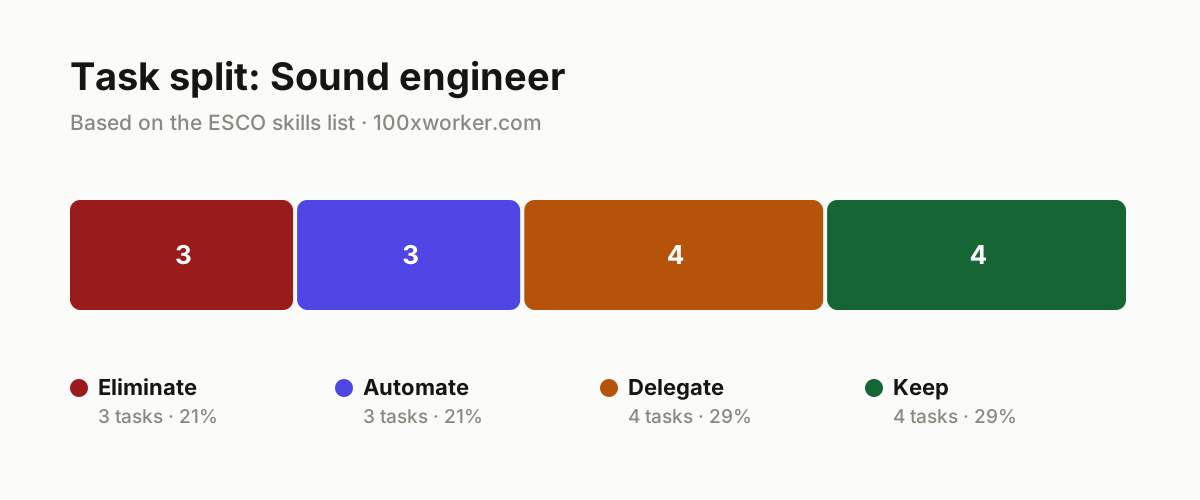
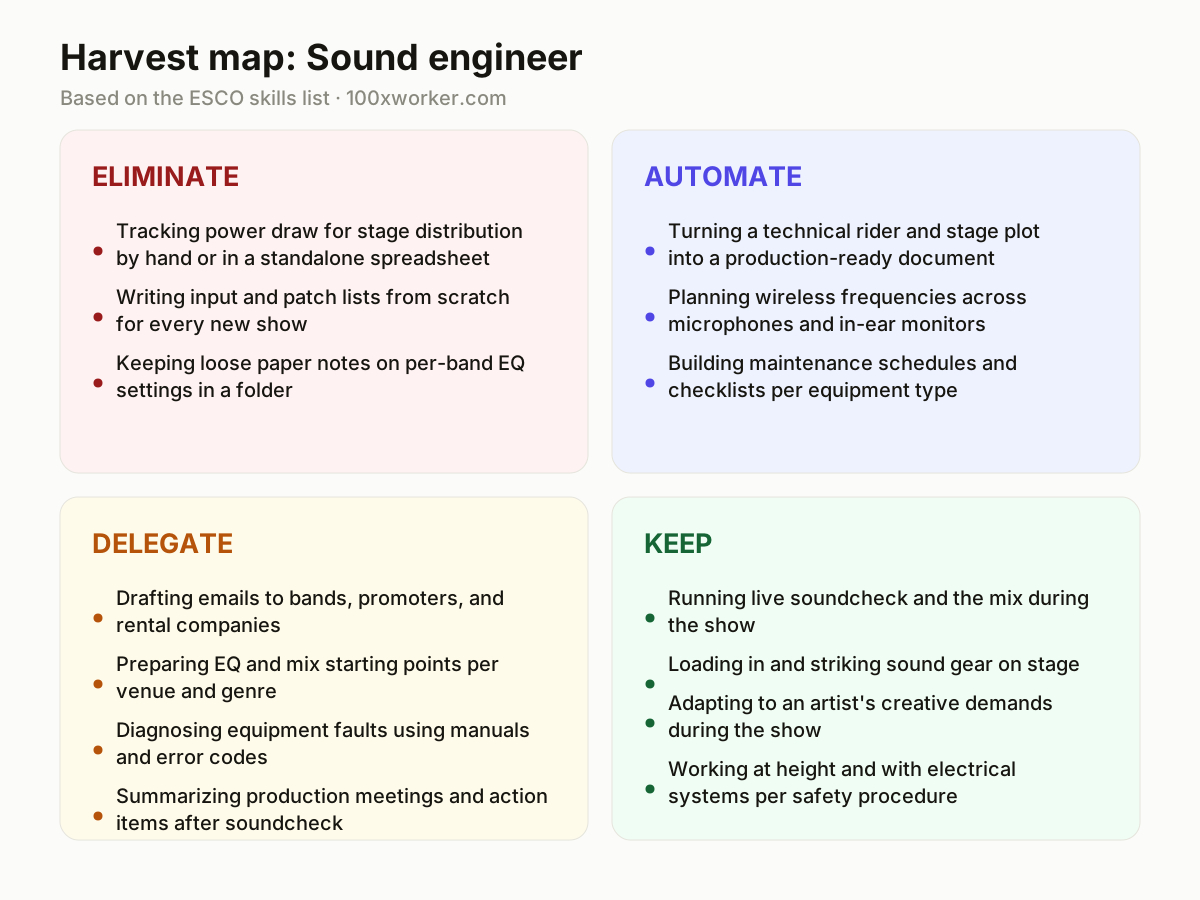
Not every task in a sound engineer's day carries the same AI exposure. Some manual busywork can simply disappear once you adopt a template or tool (eliminate). Some planning work can run largely on its own once set up (automate). Some tasks work best as an AI draft that you check and finish (delegate). And some tasks, mostly physical, safety-related, or judgment-heavy, stay firmly with you (keep). Sorting your own task list this way tells you where to spend an afternoon setting something up, versus where to stop looking for a shortcut.
| Task | Bucket | Why |
|---|---|---|
| Tracking power draw for stage distribution by hand or in a standalone spreadsheet | eliminate | A calculation tool does this faster, with fewer errors, and doesn't need rebuilding each show. |
| Writing input and patch lists from scratch for every new show | eliminate | Templates and AI generate these from a stage plot or setlist in seconds. |
| Keeping loose paper notes on per-band EQ settings in a folder | eliminate | A structured digital log with AI summaries replaces the paper memory system. |
| Turning a technical rider and stage plot into a production-ready document | automate | AI converts a list of gear and requests into a complete, readable document. |
| Planning wireless frequencies across microphones and in-ear monitors | automate | Coordination software with automated calculation catches intermodulation issues faster than manual math. |
| Building maintenance schedules and checklists per equipment type | automate | A scheduling tool plans preventive maintenance from usage hours and manufacturer data. |
| Drafting emails to bands, promoters, and rental companies | delegate | AI writes a first draft; you check tone, details, and confirmed arrangements. |
| Preparing EQ and mix starting points per venue and genre | delegate | AI proposes a baseline from past shows; you refine it live in the room. |
| Diagnosing equipment faults using manuals and error codes | delegate | A chatbot searches manuals faster than you can locate the right PDF. |
| Summarizing production meetings and action items after soundcheck | delegate | AI condenses notes so no one loses track of a task or agreement. |
| Running live soundcheck and the mix during the show | keep | This requires real-time listening to the room and immediate adjustment. (Your edge: Your ear and reflexes on the actual live sound.) |
| Loading in and striking sound gear on stage | keep | Physical work under time pressure, weight, and safety risk that AI cannot sense. (Your edge: Physical precision and on-the-spot safety judgment.) |
| Adapting to an artist's creative demands during the show | keep | Reading in real time what a performer needs at that exact moment. (Your edge: Sensing what no one could write down in advance.) |
| Working at height and with electrical systems per safety procedure | keep | On-site safety judgment remains a human responsibility. (Your edge: Accountability you don't hand off to a tool.) |
Which sound engineer tasks can AI take over?
AI is good at the paperwork side of the job: converting a rider into a formatted document, drafting patch lists from a setlist, summarizing a production meeting, or searching a manual for an error code. These are structured, text-heavy tasks with a clear right answer. AI is far weaker at anything that depends on hearing the room, reading an artist's mood mid-song, or making a safety call about a rig at height. Those tasks stay human. In practice, most sound engineers will use AI to clear paperwork faster, not to change what happens at the mixing desk during a show.
Will AI replace sound engineers?
No, not based on current data. Microsoft Research's applicability score of 7.2% for sound engineering technicians is one of the lowest across the occupations it studied, far below roles built around drafting and translating text. The job leans heavily on physical setup, live listening, and split-second judgment calls, none of which current generative AI systems can do. What changes is the share of desk time: less spent on riders, patch lists, and frequency math, more available for the parts of the job that actually require you on site.
What can a sound engineer do with AI this month?
Start small. Feed a chatbot your next show's equipment list and artist requests, and ask it to draft a formatted technical rider. Use it to summarize your next production meeting transcript into action items. Try an AI draft for a routine promoter or rental-company email before you write it yourself. None of this requires new hardware or a budget request, just a chat tool you already have access to and 20 minutes to test it against a real, upcoming show.
How does sound engineering compare to other jobs in AI impact?
On Microsoft Research's scale, sound engineering technicians score 7.2%, close to the low end of the range it measured. Translators sit at the top with 49%, reflecting how much of their work is pure text conversion. Nurses score 12%, still low because their work is physical and interpersonal. Sound engineering sits even lower than nursing, mostly because more of the job (rigging, live mixing, physical load-in) has no text-based equivalent an AI system can process. It is one of the more AI-resistant trades measured so far.
Generative AI's applicability varies enormously by occupation, from about 49% of work activities in translation down to roughly 7% in sound engineering.
Based on Microsoft Research, Working with AI: Measuring the Applicability of Generative AI to Occupations (2025)
Become the AI person on your team
Build a rider-to-document template once
Save a prompt that turns a raw equipment list and artist notes into your standard technical rider format. Reuse it for every show instead of rebuilding the document from scratch each time.
Let AI clear your inbox backlog
Draft routine emails to promoters and rental houses with AI, then edit for accuracy before sending. This frees up load-in time for actual gear checks instead of typing.
Turn meeting notes into a shared checklist
Record or transcribe your post-soundcheck production meeting and ask AI to extract action items with owners. Share the list with the crew before doors open.
Want this for your actual task list?
The free scan on the homepage builds your personal task map in 30 seconds, based on your role and industry.
Run the free task scanTools for this work
| Tool | For which tasks | The sober take |
|---|---|---|
| ChatGPT or Claude | Drafting technical riders, promoter emails, and equipment fault troubleshooting from manual text | General-purpose; always check technical specs against the actual gear before relying on it. |
| Wireless frequency coordination software (e.g. Shure Wireless Workbench) | Planning wireless mic and in-ear monitor frequencies without manual intermodulation math | Industry-standard for RF planning, not a generative AI chatbot but automates the calculation. |
| Meeting transcription and summary tools (e.g. Otter.ai) | Summarizing production meetings into action items after soundcheck | Useful for touring crews juggling multiple venues and quick turnarounds. |
| Maintenance scheduling software | Building preventive maintenance checklists per equipment type based on usage hours | Reduces reliance on memory or paper logs for gear servicing. |
Prompts to try today
Turn a gear list into a production-ready rider
Summarize a production meeting into action items
Draft a load-in confirmation email
Related jobs
Frequently asked questions
Can AI mix a live show on its own?
No. Live mixing requires listening to how sound behaves in a specific room, with a specific crowd, in real time, and adjusting instantly. No current AI system processes live acoustic feedback and artist cues fast enough or reliably enough to run a live mix unsupervised. AI can help you prepare a starting EQ or mix template before the show, but the actual mixing during the performance stays a human task.
Should I worry about AI taking my sound engineering job?
Based on the data available, no. Sound engineering technicians scored 7.2% on Microsoft Research's AI applicability scale, one of the lowest scores measured, well below jobs built around drafting or translating text. The physical, safety-critical, and real-time listening parts of the job have no current AI equivalent. Expect AI to change your paperwork and planning tasks, not to replace your role on the crew.
What AI skills are worth learning as a sound engineer?
Start with prompt-writing for document generation: turning a gear list or setlist into a formatted rider or patch list. Learn to use a chatbot to search manuals for troubleshooting instead of hunting for PDFs. Get comfortable feeding meeting transcripts into a summarizer. These are low-effort skills that save real time without requiring any technical AI background.
Does frequency coordination software count as AI?
Most RF coordination tools use rules-based calculation rather than generative AI, but they automate the same kind of repetitive math that generative AI targets elsewhere: preventing intermodulation between wireless channels. Whether you call it AI or automation, the practical effect is the same: less manual number-crunching before a show and fewer dropped signals during one.
Sources
- Microsoft Research, Working with AI: Measuring the Applicability of Generative AI to Occupations (2025)
- Anthropic Economic Index
- Eurostat, isoc_ai_iaiu (2025)
- ESCO, European Commission
Hendrik De Winne, author of Becoming AI-Savvy, founder of VibeLab. Helps teams redesign their work with AI.
This article was drafted with AI assistance from public data sources and editorially reviewed.