100×worker · job analysis
Will AI Replace QA Testers?
QA testing sits in the middle of the AI applicability scale. Microsoft Research analyzed 200,000 real Copilot conversations and scored occupations by how much of their work generative AI can plausibly handle. Software QA analysts and testers landed at 32.8%, well below translators (49%, the highest-scoring occupation) but far above nurses (12%, one of the lowest). That places testing squarely in a zone where AI changes the job without eliminating it.
The European Commission's ESCO taxonomy lists software tester (code 2519.6) as a role that plans, designs, executes, and reports on software tests, and sometimes debugs and repairs code alongside developers. None of those core responsibilities disappear. What changes is how much manual repetition sits underneath them. Anthropic's Economic Index, which classifies millions of Claude conversations against O*NET task lists, separates AI use into automation-like use (AI does the task) and augmentation-like use (AI assists while you decide). Testing work splits across both categories, and that split is the real story for anyone doing this job today.
This article breaks the software tester role into four buckets: tasks to eliminate, tasks to automate, tasks to delegate to AI with your review, and tasks to keep for yourself. The goal is not a prediction about job counts. It is a practical map of where your time should go next.
A QA tester checks software for defects and quality before it reaches users.
The task split: what AI takes over and what stays yours
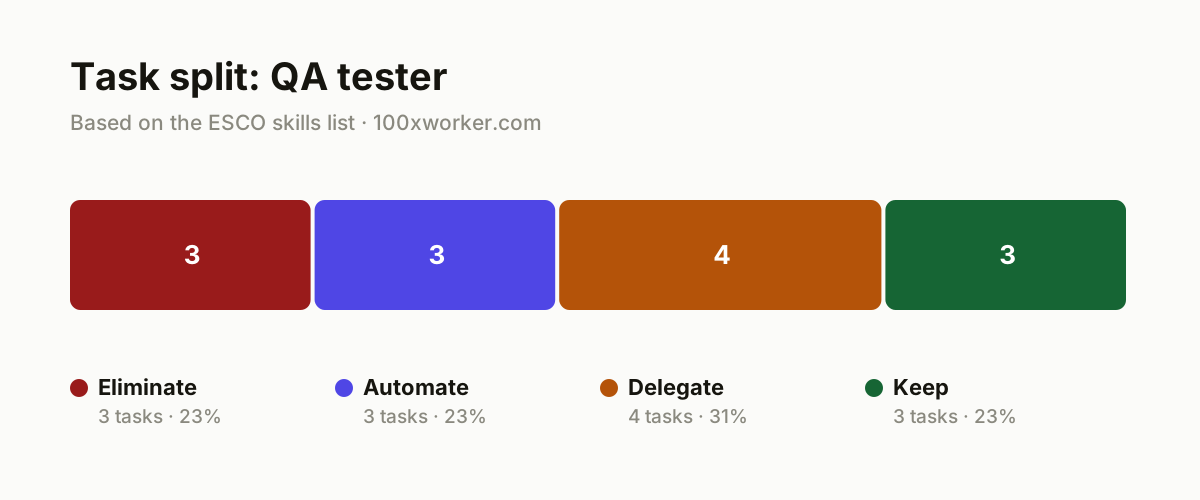
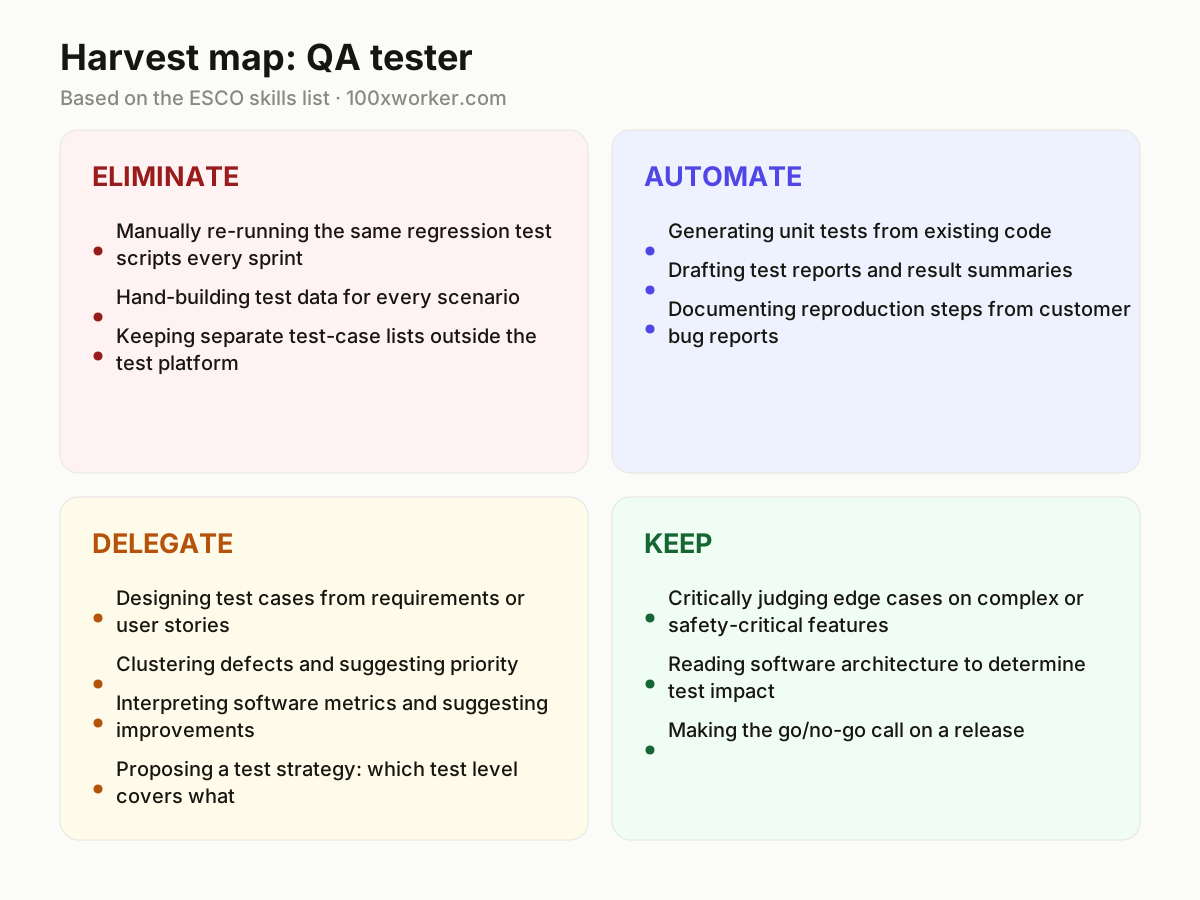
Not every testing task responds to AI the same way. Some tasks were already pointless busywork and AI just makes that obvious (eliminate). Some tasks AI can run end to end with light review (automate). Some tasks AI can draft a strong first version of, but you still decide (delegate). And some tasks stay with you because they require judgment about risk, architecture, and consequences that no model carries (keep). Sorting your own task list into these four buckets is more useful than asking whether 'testing' as a job survives.
| Task | Bucket | Why |
|---|---|---|
| Manually re-running the same regression test scripts every sprint | eliminate | Test agents run fixed scripts faster and without slip-ups; repetition without judgment doesn't need a person. |
| Hand-building test data for every scenario | eliminate | Generative tools produce realistic datasets and edge cases on request, faster than copy-pasting rows into spreadsheets. |
| Keeping separate test-case lists outside the test platform | eliminate | Integrated AI test tools track coverage automatically; a parallel spreadsheet is redundant bookkeeping. |
| Generating unit tests from existing code | automate | An agent reads the function and writes coverage tests; you review the logic and the edge cases it picked. |
| Drafting test reports and result summaries | automate | AI turns raw test logs into a readable report for stakeholders; you check the conclusions before it ships. |
| Documenting reproduction steps from customer bug reports | automate | AI rewrites a messy ticket into clear, reproducible steps a developer can act on immediately. |
| Designing test cases from requirements or user stories | delegate | AI proposes an initial set of test cases from the spec; you add missing scenarios and risk cases. |
| Clustering defects and suggesting priority | delegate | AI groups similar bugs and proposes an order to fix them; you decide what actually gets fixed first. |
| Interpreting software metrics and suggesting improvements | delegate | AI reads coverage and failure rates and flags patterns; you turn that into an actual action plan. |
| Proposing a test strategy: which test level covers what | delegate | AI suggests a risk-based split across unit, integration, and acceptance tests; you validate the approach. |
| Critically judging edge cases on complex or safety-critical features | keep | Risk assessment on financial, medical, or safety-critical software needs context a model doesn't carry. (Your edge: You know the business impact of a failure that AI cannot weigh.) |
| Reading software architecture to determine test impact | keep | Understanding how a change ripples through a whole system requires oversight across teams and past decisions. (Your edge: You see the connections between components that no one fully documented.) |
| Making the go/no-go call on a release | keep | This is a responsibility with consequences for customers and colleagues, not a task to hand off. (Your edge: You carry the accountability, not the tool that wrote the report.) |
Will AI replace QA testers?
No. Microsoft Research's applicability score puts software QA analysts and testers at 32.8%, meaning roughly a third of the work activities in this role show measurable AI applicability, not the whole job. For comparison, translators score 49% (the highest of any occupation analyzed) and nurses score 12% (one of the lowest). A third of a job changing is significant, but it means your role shifts rather than disappears. The tasks most exposed are repetitive: script execution, data generation, report drafting. The tasks least exposed involve judgment: risk assessment, architecture understanding, and release decisions. Testers who move their time toward the second group stay valuable.
Which QA tester tasks does AI take over?
AI now handles unit test generation from existing code, turning raw test logs into readable reports, and rewriting chaotic customer bug tickets into clear reproduction steps. These are the automate-bucket tasks: AI runs them largely on its own, and you review output rather than produce it from scratch. Anthropic's Economic Index describes this as automation-like AI use, where the model completes the task rather than assisting you through it. It differs from tasks like test case design or defect prioritization, where AI drafts a starting point but a person still makes the call, what Anthropic classifies as augmentation-like use.
How do you become the AI-savvy person on your test team?
Start by mapping your own task list against the four buckets: eliminate, automate, delegate, keep. Pick one repetitive task this week, such as regression script execution, and set up an AI tool to run it, then measure how much time that frees up. Bring that freed-up time to test strategy and risk analysis, the work in the keep bucket. Document what you learn and share it with your team; someone who can explain which AI tool handles which testing task well becomes the person others ask before management does.
What can you do this month as a QA tester?
Pick two tasks from the eliminate and automate buckets, for example test data generation and test report drafting, and try an AI tool on each for one sprint. Track how much manual time you save and where the AI output still needs correction. Then spend that saved time on one keep-bucket task you've been rushing, such as edge-case review on a critical feature. Write down what worked. That short exercise gives you a concrete, evidence-based answer the next time someone asks how AI affects your job, instead of a guess.
Generative AI is demonstrably applicable to about a third of the work activities performed by software QA analysts and testers, based on real usage data.
Microsoft Research, Working with AI: Measuring the Applicability of Generative AI to Occupations (2025)
Become the AI person on your team
Run a one-sprint AI pilot on regression tests
Pick your most repetitive regression suite and let an AI testing tool execute and flag results for one sprint. Compare time spent versus your usual manual run, and document the gap for your team lead.
Build a prompt library for test case generation
Save the prompts that reliably turn a user story into a solid first draft of test cases. Share the library with the team so everyone starts from the same quality baseline instead of reinventing prompts each time.
Own the metrics dashboard interpretation
Ask AI to summarize coverage and failure-rate trends weekly, then add your own read on what's driving them. Presenting that combined view in sprint reviews makes you the go-to person for quality signals.
Want this for your actual task list?
The free scan on the homepage builds your personal task map in 30 seconds, based on your role and industry.
Run the free task scanTools for this work
| Tool | For which tasks | The sober take |
|---|---|---|
| GitHub Copilot | Unit test generation from existing code (automate) | Works inline in your editor, so review still happens where you already write code. |
| ChatGPT or Claude | Test case design from requirements, reproduction step documentation (delegate/automate) | Good first drafts from messy tickets or specs, but check for missed edge cases every time. |
| Testim / Applitools | Automated regression execution and visual test maintenance (eliminate/automate) | Reduces script maintenance overhead, but setup and calibration still take real time upfront. |
| Postman AI assistant | Generating API test data and request variations (eliminate) | Faster than manually building payloads, though generated edge cases still need a sanity check. |
Prompts to try today
Generate test cases from a user story
Turn a messy bug report into reproduction steps
Summarize a test run for stakeholders
Related jobs
Frequently asked questions
What percentage of a QA tester's job can AI do?
Microsoft Research's applicability score puts software QA analysts and testers at 32.8%, based on analysis of 200,000 real Copilot conversations. That figure measures how much of the work activities in the role show demonstrable AI applicability, not how many jobs will disappear. For comparison, translators score 49% and nurses score 12%, so testing sits in a middle range where AI changes daily tasks without replacing the role.
Do I need to learn to code to use AI tools as a QA tester?
Basic familiarity helps but isn't mandatory for most AI testing tools. Tools like GitHub Copilot assume some code reading ability to review generated unit tests, while chat-based tools like ChatGPT or Claude work from plain-language prompts for test case design and report writing. The more useful skill is being able to judge whether AI output actually covers the risk you care about, which comes from testing experience, not programming.
Which testing tasks should I NOT hand to AI?
Keep the go/no-go release decision, risk judgment on safety-critical or financial features, and any analysis that requires understanding how a change ripples through your system's architecture. These require context about business impact and cross-team consequences that no model carries. AI can draft supporting analysis for these decisions, but the decision itself, and the accountability for it, should stay with a person.
Is AI use in testing widespread yet, or still early?
Adoption of generative AI tools is growing but uneven. Eurostat reports that 32.7% of the EU population aged 16-74 used generative AI in the three months before being surveyed in 2025. Adoption inside specific professional workflows like QA testing tends to run ahead of general population figures, since testers already use tooling-heavy workflows where AI features get added directly into existing platforms.
Sources
- Microsoft Research, Working with AI: Measuring the Applicability of Generative AI to Occupations (2025)
- Anthropic Economic Index
- Eurostat, Use of generative artificial intelligence by individuals (isoc_ai_iaiu)
- ESCO, European Commission occupation taxonomy: software tester (2519.6)
Hendrik De Winne, author of Becoming AI-Savvy, founder of VibeLab. Helps teams redesign their work with AI.
This article was drafted with AI assistance from public data sources and editorially reviewed.