100×worker · job analysis
Will AI Replace Production Managers?
Plenty of headlines suggest AI is coming for every management job at once. The data tells a more specific story. Microsoft Research analyzed 200,000 real conversations with its Copilot assistant and built an 'AI applicability score' for occupations, measuring how much of the actual work generative AI can plausibly touch. Translators top the list at 49%. Industrial production managers, the closest match for a production manager role, land at just 12.0%, roughly the same low score as registered nurses.
That low number does not mean nothing changes. Anthropic's Economic Index tracks how people already use AI models against detailed occupational task lists, and splits that use into automation-like work (AI does the task) and augmentation-like work (AI helps you do it faster). For production managers, the augmentation side is where most of the near-term change will land: report drafting, data aggregation, and scenario math, not the core job of running a plant floor.
The ESCO taxonomy from the European Commission lists 18 essential skills for this occupation, from managing raw materials to overseeing assembly work and leading staff. Most of those skills sit outside what current AI models can do unsupervised.
A production manager plans, monitors, and steers output from raw material to finished product within budget, quality, and safety.
The task split: what AI takes over and what stays yours
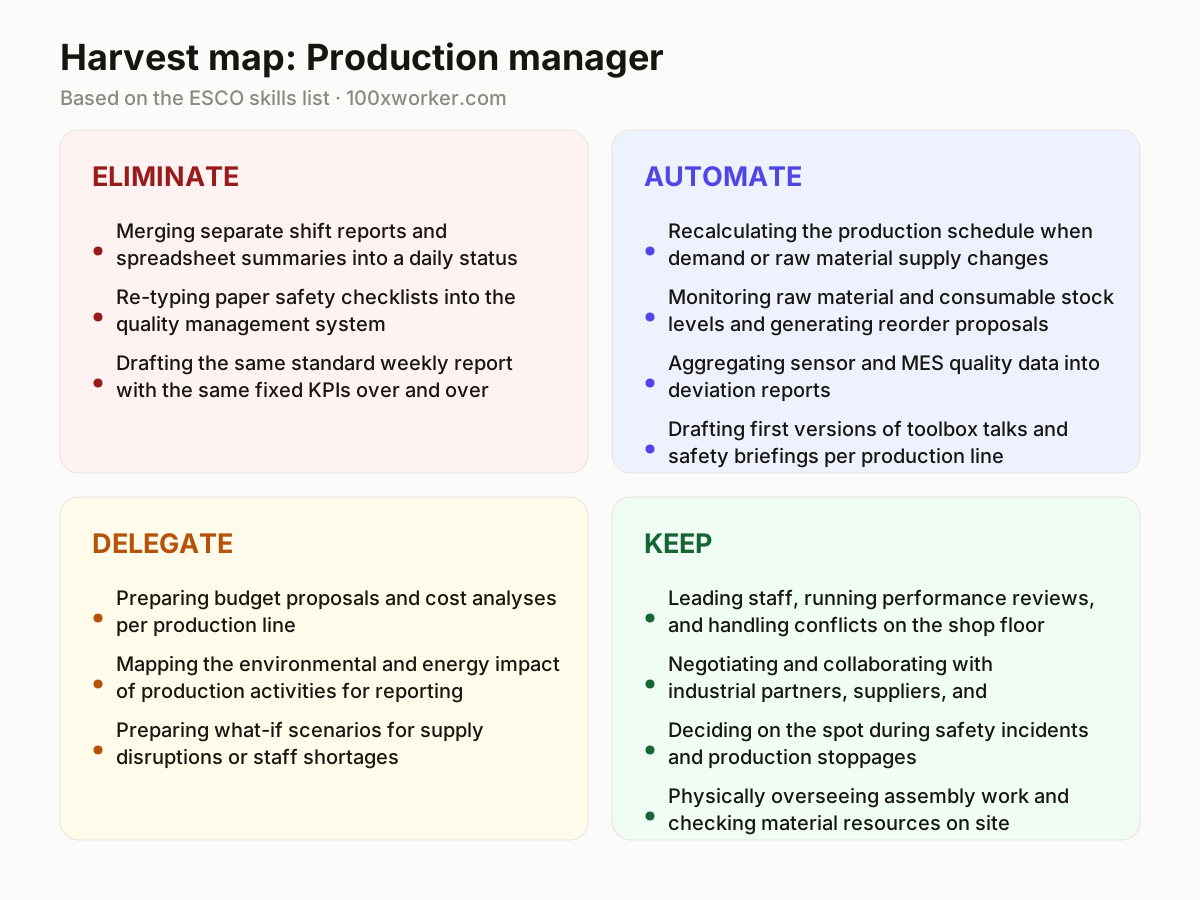
Instead of asking whether AI replaces production managers, it helps to break the job into its actual tasks and sort them into four groups: tasks AI makes unnecessary (eliminate), tasks AI can run largely unsupervised (automate), tasks AI can draft while you decide (delegate), and tasks that stay with you because they require presence, authority, or judgment (keep). Sorting your own task list this way, rather than debating the job title in the abstract, is the more useful exercise.
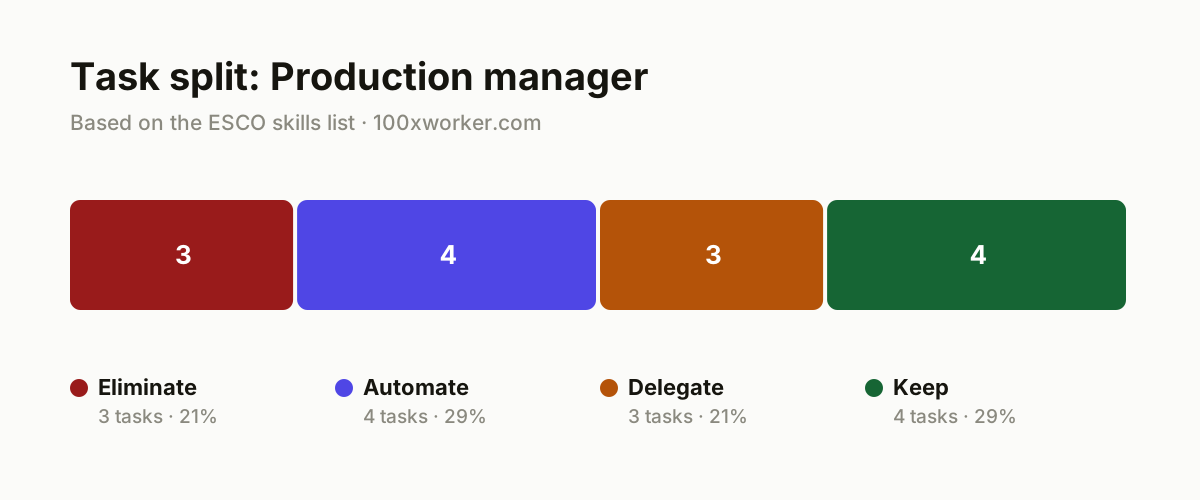
| Task | Bucket | Why |
|---|---|---|
| Merging separate shift reports and spreadsheet summaries into a daily status update by hand | eliminate | Software pulls production data directly from ERP and MES systems, so manual retyping adds nothing. |
| Re-typing paper safety checklists into the quality management system | eliminate | Digital forms with built-in validation make this re-typing unnecessary. |
| Drafting the same standard weekly report with the same fixed KPIs over and over | eliminate | A template agent fills in numbers, charts, and deviations automatically, every week. |
| Recalculating the production schedule when demand or raw material supply changes | automate | A planning agent reruns capacity and sequencing the moment inputs change, with no waiting time. |
| Monitoring raw material and consumable stock levels and generating reorder proposals | automate | Threshold values and consumption patterns are regular enough to automate fully. |
| Aggregating sensor and MES quality data into deviation reports | automate | Pattern recognition on measurement data is a task AI systems already handle well. |
| Drafting first versions of toolbox talks and safety briefings per production line | automate | Fixed structure and familiar risks make this a good fit for a template agent. |
| Preparing budget proposals and cost analyses per production line | delegate | AI turns numbers into a readable draft, and you check assumptions and set priorities. |
| Mapping the environmental and energy impact of production activities for reporting | delegate | AI gathers and structures data fast, while interpretation and accountability stay with you. |
| Preparing what-if scenarios for supply disruptions or staff shortages | delegate | AI runs the variants, and you decide which scenario is workable on the floor. |
| Leading staff, running performance reviews, and handling conflicts on the shop floor | keep | Trust and authority get built on the floor, not through a screen. (Your edge: People follow a manager, not a language model.) |
| Negotiating and collaborating with industrial partners, suppliers, and customers | keep | Relationships and trade-offs require reading interests, not just data. (Your edge: Negotiation stays human work involving interests and emotion.) |
| Deciding on the spot during safety incidents and production stoppages | keep | Fast, accountable decisions with consequences for people need a manager who is present. (Your edge: You cannot delegate responsibility to software.) |
| Physically overseeing assembly work and checking material resources on site | keep | Seeing, feeling, and hearing things on the floor gives signals no sensor captures. (Your edge: Floor experience does not show up on a dashboard.) |
Will AI replace production managers?
No, not as a full job. Microsoft Research's applicability score puts industrial production managers at 12%, meaning generative AI can plausibly help with only a small slice of the actual work. That work is heavy on coordinating people, negotiating with suppliers, and making safety-critical calls on a live production floor, none of which current AI systems can do on their own. What AI can do is take over the reporting, scheduling math, and data aggregation that eat up hours each week, freeing time for the parts of the job that require a person present.
Why does the production manager role score low on AI applicability?
The ESCO skill list for this occupation includes leading staff, managing budgets, overseeing assembly work, and assessing the impact of industrial activity, tasks that depend on physical presence, authority, and negotiation rather than text or data processing. Compare that to translators, who score 49% on Microsoft's scale because their core task is converting text, exactly what large language models are built for. Production management sits at the opposite end: most of the job happens in conversations, on the floor, and in decisions with real consequences, not in documents an AI model can draft or summarize.
Does AI change my job even if my title stays the same?
Yes. A low applicability score at the occupation level does not mean nothing changes at the task level. Anthropic's Economic Index shows that AI use splits into automation-like use, where the model does a task outright, and augmentation-like use, where it speeds up a task you still control. For production managers, expect more of the second: AI drafts your weekly report or budget analysis, and you still decide what goes in the final version. The job title stays the same. The mix of hours spent on drafting versus deciding shifts.
What can you do this month to start using AI in this role?
List every recurring report, checklist, and spreadsheet you touch in a normal week and mark which ones follow a fixed template. Pick one, such as the weekly status report or a toolbox talk, and test whether a general-purpose AI assistant can produce a usable first draft from your raw data. Keep a human review step before anything goes out. Do the same for one scheduling or budget task next month. Small, reviewed automations beat a big rollout you have not tested on your own data.
Generative AI applies to a measurable share of an occupation's work activities rather than to entire jobs.
Microsoft Research, Working with AI (2025)
Become the AI person on your team
Audit your own task list before choosing tools
Write down what you actually did last week, hour by hour, and sort it into eliminate, automate, delegate, and keep. Most managers overestimate how much of their week is genuinely irreplaceable and underestimate how much is repetitive reporting.
Automate the weekly report first
It is low risk, fully templated, and easy to check against the source data in your ERP or MES. Getting this one task off your plate is the fastest way to free hours for floor time.
Keep decision rights, delegate the drafting
Let AI produce the first version of budget proposals, scenario plans, and impact assessments. You still set the assumptions, catch the errors, and sign off, so authority never actually leaves your hands.
Want this for your actual task list?
The free scan on the homepage builds your personal task map in 30 seconds, based on your role and industry.
Run the free task scanTools for this work
| Tool | For which tasks | The sober take |
|---|---|---|
| AI-enabled advanced planning and scheduling (APS) software | Automate: recalculating production schedules when demand or supply changes | Rescheduling quality depends heavily on how clean your existing MES and ERP data is. |
| MES or ERP reporting copilots (e.g., Microsoft Copilot integrated into manufacturing dashboards) | Eliminate: merging shift reports; Automate: quality deviation reports | Useful for pulling numbers together, but someone still needs to sanity-check the output. |
| Digital checklist and EHS software with built-in validation | Eliminate: re-typing paper safety checklists into the quality system | Removes a manual step that added no real value even before AI. |
| General-purpose AI assistants (ChatGPT, Claude, Copilot) | Delegate: budget proposals, scenario planning; Automate: draft toolbox talks | Good for first drafts, weak on plant-specific context unless you feed it your own data. |
Prompts to try today
Weekly production report draft
Schedule what-if scenario
Toolbox talk draft
Related jobs
Frequently asked questions
Which production management tasks does AI handle best right now?
AI is strongest on tasks with regular structure and clear inputs: recalculating schedules when demand shifts, monitoring stock levels and flagging reorders, aggregating sensor and MES data into deviation reports, and drafting routine documents like weekly reports or toolbox talks. These are tasks with predictable patterns and low ambiguity. AI is weakest on tasks involving negotiation, staff leadership, and safety decisions made under time pressure, which is exactly why the occupation's overall AI applicability score stays low even as these specific tasks change quickly.
Will AI reduce the number of production manager jobs?
The available data does not point to job losses at scale. Microsoft Research's 12% applicability score for industrial production managers is one of the lowest measured across occupations, similar to registered nurses. That suggests the job is more resistant to automation than most white-collar roles, including translators at 49%. The more likely outcome is a shift in how time gets spent within the role rather than fewer roles overall, though this is a projection based on task-level data, not a direct employment forecast.
How does AI use in production management compare to other occupations?
Microsoft Research's applicability scale puts translators at the top, 49%, because their core task is converting text, a strength of current language models. Industrial production managers sit at 12%, in the same range as registered nurses, because the job centers on physical presence, staff leadership, and safety-critical decisions rather than text or document processing. This puts production management closer to hands-on, people-facing occupations than to desk-based, document-heavy ones on the applicability spectrum.
What is the difference between automation and augmentation in this role?
Anthropic's Economic Index classifies AI conversations against detailed occupational tasks and splits usage into automation-like use, where AI completes a task with little human input, and augmentation-like use, where AI speeds up a task a person still controls. For production managers, most near-term AI use falls into the augmentation category: drafting reports, running budget scenarios, or summarizing quality data, with the manager reviewing and deciding. Fully automated tasks are limited to narrow, rule-based work like stock threshold monitoring.
Sources
- Microsoft Research, Working with AI: Measuring the Applicability of Generative AI to Occupations (2025)
- Anthropic Economic Index
- Eurostat, isoc_ai_iaiu dataset on generative AI use
- ESCO (European Skills, Competences, Qualifications and Occupations), European Commission
Hendrik De Winne, author of Becoming AI-Savvy, founder of VibeLab. Helps teams redesign their work with AI.
This article was drafted with AI assistance from public data sources and editorially reviewed.