100×worker · job analysis
Will AI Replace Policy Advisors? A Task-by-Task Breakdown
A policy advisor, especially one working on environmental policy, researches, analyzes, drafts and implements policy for governments, companies and project developers. The European Commission's ESCO taxonomy lists this role (code 2422.10.5) among more than 3,000 occupations described across 28 languages, with core skills ranging from assessing environmental impact to advising on legislative decisions and managing implementation of government policy.
Generative AI is already changing how much of that work gets done by hand. Microsoft Research analyzed 200,000 real Copilot conversations and built an applicability score for different jobs. For Environmental Scientists and Specialists, the closest US occupational match, that score sits at 17.2 percent, well below translators (49%) and above nurses (12%). That number does not mean one in five advisors loses their job. It means a measurable slice of daily tasks, mostly document search, drafting and monitoring, can shift to AI tools now.
Adoption is broad and moving fast. Eurostat found that 32.7% of the EU population aged 16 to 74 had used generative AI in the three months before being surveyed in 2025. For a desk-based, document-heavy role like policy advising, that adoption curve tends to move faster than in most manual trades.
A policy advisor researches, drafts and enforces policy, translating law and data into decisions for governments and organizations.
The task split: what AI takes over and what stays yours
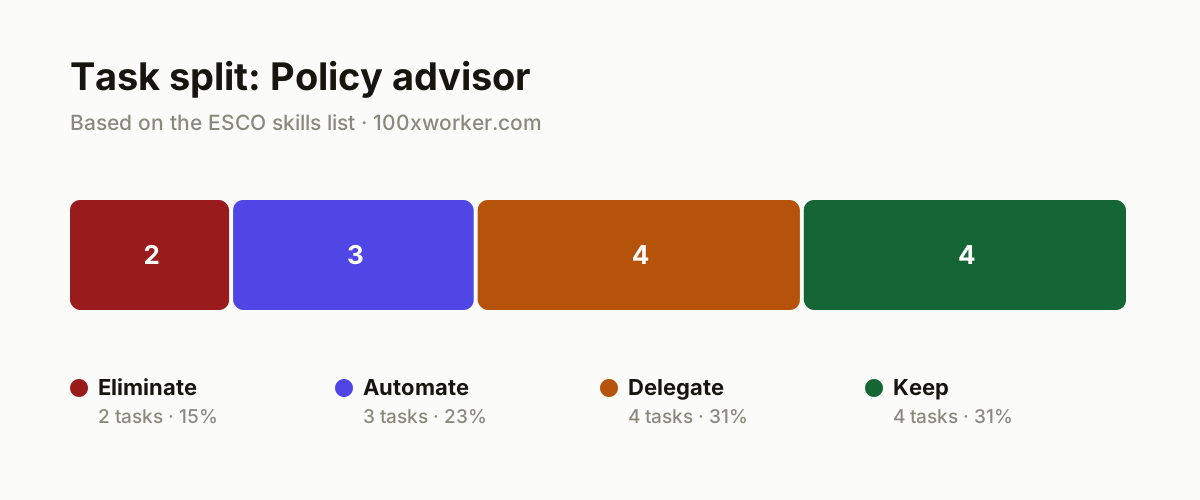
Not every task in a policy advisor's job changes the same way. Some tasks disappear because AI does them faster with no real loss. Others get automated almost end to end by an agent, with occasional spot checks from you. A third group gets delegated: AI produces a first draft or first analysis, you review, correct and sign off. The last group stays fully with you, because it needs political judgment, trust-building or a human presence a model cannot fake.
| Task | Bucket | Why |
|---|---|---|
| Manually searching legislative databases for relevant articles and clauses | eliminate | AI searches and filters source documents in seconds, faster and more consistently than manual browsing. |
| Retyping or summarizing reports and case files for colleagues internally | eliminate | A language model produces a usable summary straight from the source file, no extra step needed. |
| First-pass screening of permit applications against environmental law | automate | An agent checks files against statutory text and flags deviations, ready for your review. |
| Drafting standard letters and acknowledgment-of-receipt notices to companies and citizens | automate | Template plus agent fills in case details automatically, output ready with no manual step. |
| Monitoring new EU directives and national regulatory updates | automate | An agent scans official gazettes and sends alerts the moment something touches your case files. |
| Analyzing environmental data such as emissions readings and water quality | delegate | AI processes the dataset and drafts a first conclusion, you check it against the context. |
| Drafting policy advice on legislative decisions | delegate | AI writes a first version from case documents, you rewrite it and own the reasoning. |
| Preparing environmental studies: research design, questionnaires, literature review | delegate | AI assembles a structure and a source list, you validate the method and the assumptions. |
| Reporting environmental problems to management or a higher authority | delegate | AI turns raw data into a readable report, you check the facts and the tone. |
| Building contacts with government officials and other stakeholders | keep | Building trust and reading political sensitivities needs a person in the room. (Your edge: You can't train political instinct from a dataset.) |
| Promoting environmental awareness among companies and citizens | keep | Persuasion needs live adjustment to whoever is in front of you, not a fixed script. (Your edge: Persuasive power shifts with every listener, live.) |
| Assessing environmental impact for complex, unique projects | keep | Weighing economic, ecological and community interests stays a politically loaded call. (Your edge: That trade-off remains your responsibility, always.) |
| Ensuring compliance with environmental law in gray areas | keep | Enforcement in unclear cases needs discretion and knowledge of local context. (Your edge: Gray areas need judgment, not an automatic rule.) |
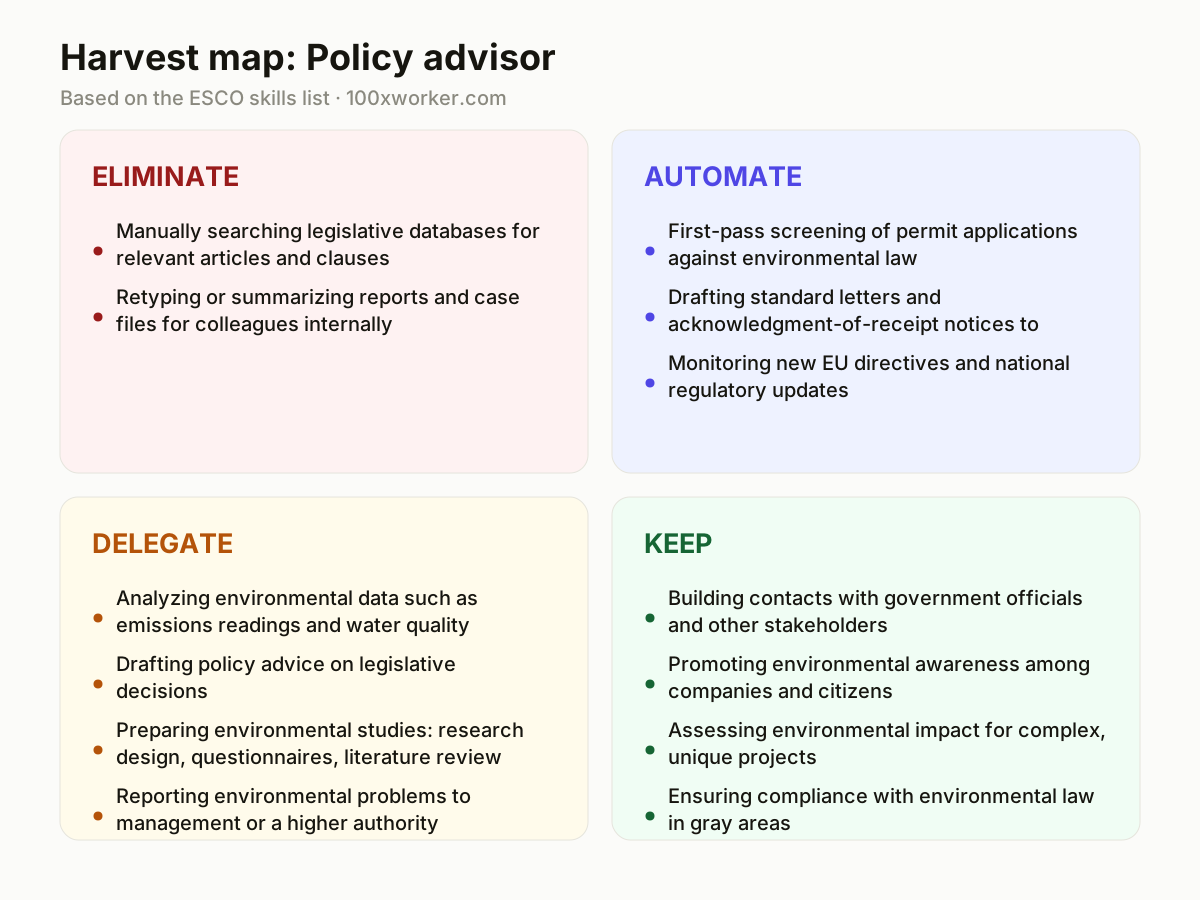
Which tasks will AI take over from a policy advisor?
AI takes over the search-and-summarize layer first: scanning legislative databases, pulling relevant clauses, and turning long case files into internal summaries. It also handles first-pass screening of permit applications against statutory text, drafting standard letters, and monitoring new EU directives or national regulatory updates so nothing slips past you. None of this removes your role. It removes the manual labor around finding and formatting information, so your time shifts toward reviewing flagged issues and deciding what to do with them.
Will AI replace policy advisors?
No single occupational score suggests that. Microsoft Research puts generative AI's applicability to environmental specialist work at 17.2 percent, meaning most of the job stays outside what current tools handle well. Anthropic's Economic Index, which classifies millions of Claude conversations against O*NET tasks, distinguishes automation-like use (AI does the task) from augmentation-like use (AI supports a person's judgment). Policy advising leans toward augmentation: drafting, analysis and monitoring shift to AI, while stakeholder negotiation, discretionary enforcement and political trade-offs stay with the advisor. The job changes shape more than it disappears.
How do you become the AI point person on your policy team?
Start by mapping your own task list against the eliminate, automate, delegate and keep buckets above, then pick one automate-bucket task (letter drafting or regulatory monitoring) and set up a working agent or template for it this quarter. Document the prompts and checks that work, share them with colleagues, and volunteer to pilot new tools before they get mandated. Being the person who already knows the failure modes, the checks and the shortcuts makes you the go-to reference when management asks who should evaluate the next AI tool.
What can you do this month as a policy advisor?
Pick one recurring task, such as drafting conceptual advice on a legislative decision, and run it through an AI tool for two weeks, comparing the draft against what you'd normally write from scratch. Time both versions. Set up one monitoring alert for a regulatory source you check manually today. Keep a short log of where the AI draft got facts or nuance wrong. That log becomes your evidence for what to delegate safely and what to keep doing yourself, instead of guessing.
Across millions of conversations, AI use splits between automating a task outright and augmenting a person's judgment, and those are two different shifts for a job.
Anthropic Economic Index
Become the AI person on your team
Run a two-week draft comparison
Take one policy advice document you'd normally write from scratch and have an AI tool draft it instead, using the same source files. Compare accuracy, tone and time spent on the rewrite, and use that comparison to decide whether the task belongs in your delegate bucket.
Build one regulatory monitoring alert
Set up an agent or scheduled search that scans a specific gazette or EU publication feed for terms tied to your active files. Test it against a manual check for a month before trusting it fully.
Document your prompts and checks
Keep a shared file of prompts that reliably produce usable first drafts for your team's recurring documents, along with the specific facts you always verify by hand. This becomes the reference other advisors use when they start automating the same tasks.
Want this for your actual task list?
The free scan on the homepage builds your personal task map in 30 seconds, based on your role and industry.
Run the free task scanTools for this work
| Tool | For which tasks | The sober take |
|---|---|---|
| Microsoft Copilot | Legislative database search, internal report summaries, first-pass letter drafting | Directly studied by Microsoft Research's applicability scoring, so its strengths map closely to the 17.2% figure. |
| Claude (Anthropic) | Drafting conceptual policy advice, structuring environmental study proposals | Anthropic's own Economic Index tracks how conversations like these split between automation and augmentation use. |
| ChatGPT | First drafts of standard letters, summarizing long case files | Useful for quick drafts, but still needs a human check on legal specifics before sending anything out. |
| Perplexity or similar research assistants | Monitoring new EU directives and national regulatory changes | Good for surfacing sources fast, weak at judging which changes actually matter to your open files. |
Prompts to try today
First-draft policy advice
Permit application screening
Regulatory monitoring digest
Related jobs
Frequently asked questions
Will AI reduce the number of policy advisor jobs?
There is no verified figure showing job losses in this occupation. Microsoft Research's 17.2% applicability score describes how much of the work activity generative AI can plausibly assist with, not a headcount reduction. Most of the analyzed use splits toward augmenting judgment rather than fully automating decisions, based on Anthropic's Economic Index methodology. The realistic expectation is a changed task mix: less manual document work, more review and stakeholder-facing work, rather than fewer roles overall.
What skills should a policy advisor build now?
Focus on skills the ESCO taxonomy already lists as core to the role: assessing environmental impact, advising on legislative decisions, and ensuring compliance with legislation, all applied in situations with genuine ambiguity. Add practical AI literacy: knowing how to prompt for a first draft, how to check an AI-generated analysis against source data, and where a model's confidence does not match its actual accuracy. These skills combine so you can supervise AI output instead of just consuming it.
Which policy advisor tasks should I automate first?
Start with the automate bucket: first-pass screening of permit applications, drafting standard letters and acknowledgment notices, and monitoring new regulations. These tasks have clear right-or-wrong criteria and a defined output format, which makes them easier to hand to an agent with confidence. Save analysis, advice-writing and stakeholder-facing tasks for later, once you've built trust in how the automated tasks perform.
How is this different from older automation predictions for policy jobs?
Earlier widely cited automation-risk percentages for many desk jobs come from Frey and Osborne's 2013 Oxford study, published before large language models existed. Current sources like Microsoft Research's applicability scoring and Anthropic's Economic Index are based on actual AI conversation logs from 2025, which makes them a more current read on what generative AI can and cannot do inside a role like policy advising today.
Sources
- Microsoft Research, Working with AI: Measuring the Applicability of Generative AI to Occupations (2025)
- Anthropic Economic Index
- Eurostat, Use of AI by individuals (isoc_ai_iaiu)
- ESCO, European Commission occupation taxonomy
Hendrik De Winne, author of Becoming AI-Savvy, founder of VibeLab. Helps teams redesign their work with AI.
This article was drafted with AI assistance from public data sources and editorially reviewed.