100×worker · job analysis
Will AI Replace Environmental Consultants?
Environmental consultants spend a lot of time on tasks that follow a predictable pattern: searching regulations, filling in checklists, writing reports against a fixed template. That is exactly the kind of work generative AI handles well. Microsoft Research analyzed 200,000 real Copilot conversations and scored how applicable generative AI is to different occupations. For environmental scientists and specialists, the closest matching category, that score is 17.2% of work activities, well below translators (49%) but well above nurses (12%).
That number does not mean one in six environmental consultants loses their job. It means a share of the tasks inside the role can be handed to AI, while the rest stays firmly human. Anthropic's Economic Index, which classifies millions of real Claude conversations against the O*NET task taxonomy, draws the same line: it separates AI use into automation-like patterns (AI does the task) and augmentation-like patterns (AI supports a person doing the task). Most environmental work falls into the second category.
Adoption is already widespread enough to matter. Eurostat reports that 32.7% of the EU population aged 16 to 74 used generative AI in the three months before being surveyed in 2025. Your colleagues, your regulators, and your clients are already using these tools, whether or not your organization has a policy on it.
An environmental consultant develops policy, monitors legal compliance, and runs audits and inspections for organizations.
The task split: what AI takes over and what stays yours
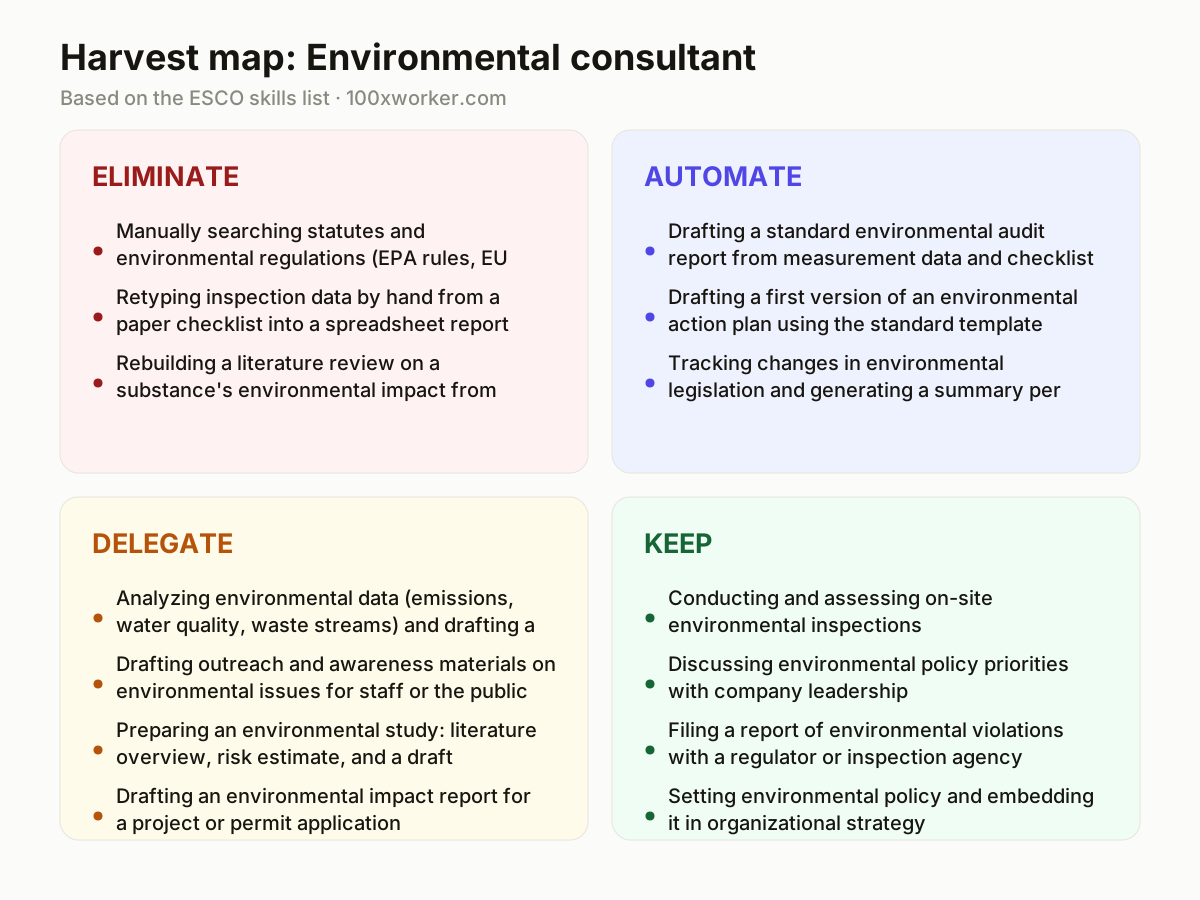
The clearest way to see what AI changes in this role is to sort the job's actual tasks into four buckets: tasks AI eliminates because they no longer need to be done the old way, tasks AI can fully automate under your review, tasks you delegate to AI as a first draft, and tasks that stay with you because they require physical presence, judgment, or legal responsibility. This is not a theoretical exercise. It maps directly onto the ESCO task list for this occupation.
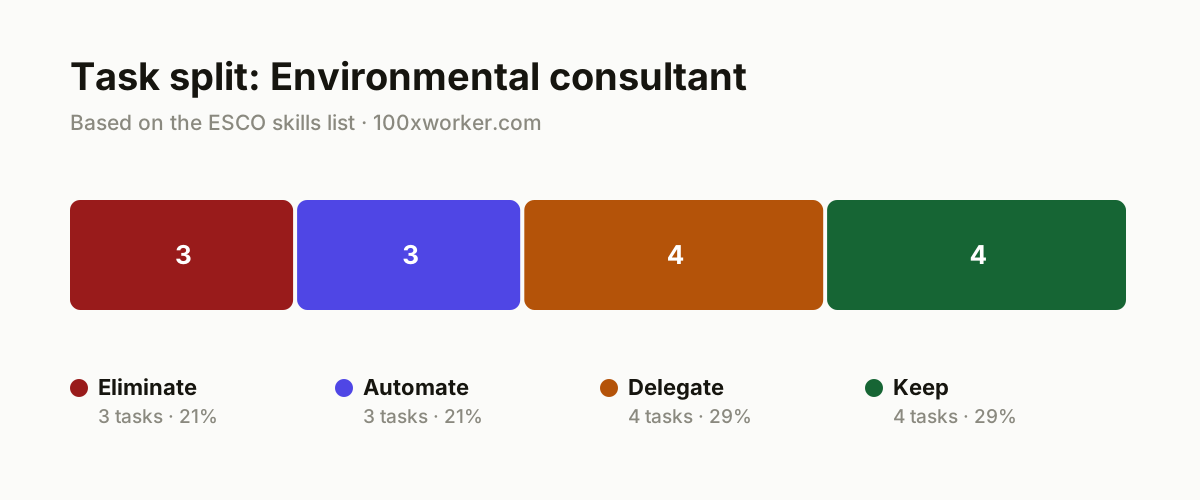
| Task | Bucket | Why |
|---|---|---|
| Manually searching statutes and environmental regulations (EPA rules, EU directives, local codes) for relevance to a case file | eliminate | AI searches and filters regulatory text faster and more completely than a manual search through PDFs. |
| Retyping inspection data by hand from a paper checklist into a spreadsheet report | eliminate | Structured digital intake forms make retyping unnecessary, since AI fills the report in directly. |
| Rebuilding a literature review on a substance's environmental impact from scratch each time | eliminate | AI summarizes existing studies and past case files immediately, so starting over is no longer needed. |
| Drafting a standard environmental audit report from measurement data and checklist answers | automate | An agent fills in the fixed template with figures, conclusions, and action items, ready for your final check. |
| Drafting a first version of an environmental action plan using the standard template | automate | An agent generates goals, KPIs, and a timeline from your input, and you refine the priorities. |
| Tracking changes in environmental legislation and generating a summary per case file | automate | A monitoring agent reads new regulation and flags automatically what is relevant to your organization. |
| Analyzing environmental data (emissions, water quality, waste streams) and drafting a first conclusion | delegate | AI processes the numbers and proposes an interpretation, and you test it against conditions on site. |
| Drafting outreach and awareness materials on environmental issues for staff or the public | delegate | AI writes a first version in plain language, and you rewrite tone and facts where needed. |
| Preparing an environmental study: literature overview, risk estimate, and a draft questionnaire | delegate | AI supplies the building blocks, and you set the research question and check the methodology. |
| Drafting an environmental impact report for a project or permit application | delegate | A first draft based on project data saves hours, and the final judgment call stays with you. |
| Conducting and assessing on-site environmental inspections | keep | Physical observation of a site requires presence; smell, noise, and context do not show up in a report. (Your edge: physical observation and judgment on site) |
| Discussing environmental policy priorities with company leadership | keep | Buy-in and trust get built in conversation, and generated text does not do that. (Your edge: building trust and negotiating) |
| Filing a report of environmental violations with a regulator or inspection agency | keep | This decision carries legal responsibility that does not get handed off to a language model. (Your edge: carrying legal responsibility) |
| Setting environmental policy and embedding it in organizational strategy | keep | Strategic choices require reading the politics inside the organization, and you weigh budget and priorities yourself. (Your edge: strategic judgment within the organization) |
What tasks does AI take over from environmental consultants?
AI takes over the repetitive, document-heavy layer of the job: searching regulatory text for relevance, transcribing checklist data into reports, and rebuilding literature reviews from prior studies. It also drafts a first version of recurring documents, such as audit reports, action plans, and regulation-change summaries, built from your data against a fixed template. You still set the scope, check the numbers, and sign off. What AI does not touch is anything requiring a physical site visit, a legal filing, or a strategic conversation with leadership.
Will AI replace environmental consultants?
No. Microsoft Research scores generative AI's applicability for the closest matching US occupation category at 17.2% of work activities, a meaningful chunk but far from most of the job. The tasks that remain, such as physically inspecting a site, negotiating policy priorities with leadership, and filing violation reports that carry legal weight, are not tasks a language model can take on. What changes is the mix of your day: less manual searching and drafting, more review, judgment, and in-person work.
How many environmental consultants and colleagues use AI today?
There is no dedicated survey for this specific role, but the surrounding numbers give a strong signal. Eurostat found that 32.7% of the EU population aged 16 to 74 used generative AI in the three months before the 2025 survey. Anthropic's Economic Index tracks millions of real conversations mapped to O*NET tasks, showing AI use spread across research, drafting, and analysis work similar to what environmental consultants do daily. ESCO, the EU's occupation taxonomy covering 3,039 roles, lists the exact task set (compliance checks, audits, impact assessments) that this adoption is landing on.
What can you do this month as an environmental consultant with AI?
Pick one recurring document, such as a standard audit report or action plan, and build a template prompt that turns your checklist data and measurements into a first draft. Test a regulation-monitoring workflow on one piece of legislation you track regularly and see whether the summary catches what matters. Run one literature review through an AI tool before you start from scratch, and check the output against sources you trust. Keep every inspection, filing, and leadership conversation exactly as it is.
AI use in real conversations splits into automation-like patterns, where AI does the task, and augmentation-like patterns, where AI supports a person doing it.
Anthropic Economic Index
Become the AI person on your team
Build one template, not ten prompts
Take your most-used report format (audit report, action plan, impact assessment) and turn it into a single reusable prompt template with placeholders for data. Reuse it every time instead of writing instructions from scratch.
Let AI do the first regulatory scan
Before you read new legislation line by line, have an AI tool produce a summary and flag sections relevant to your current case files. Verify the flagged sections yourself before citing them in a report.
Keep a verification step for numbers
Any AI-generated conclusion about emissions, water quality, or waste data gets checked against the raw dataset before it goes into a client-facing document. Treat the AI output as a draft interpretation, not a finding.
Want this for your actual task list?
The free scan on the homepage builds your personal task map in 30 seconds, based on your role and industry.
Run the free task scanTools for this work
| Tool | For which tasks | The sober take |
|---|---|---|
| Microsoft Copilot | Drafting audit reports and action plans (automate bucket) | Useful for filling a fixed template from data you provide, less useful without a template to start from. |
| Claude (Anthropic) | Analyzing environmental data and drafting outreach materials (delegate bucket) | Strong at producing a readable first draft from raw numbers, still needs a fact check against source data. |
| NotebookLM | Literature review synthesis (eliminate/delegate bucket) | Works from documents you upload, which keeps the summary tied to sources you actually trust. |
| Enhesa | Tracking regulatory changes (automate bucket) | A compliance-focused platform rather than a general chatbot; check current feature coverage before relying on it. |
Prompts to try today
Summarize new regulation for a specific case file
Draft an environmental audit report from checklist data
Draft public-facing outreach material on an environmental issue
Related jobs
Frequently asked questions
Will AI replace environmental consultants?
No. AI takes over document-heavy, repetitive parts of the job, such as regulation searches, data entry, and first drafts of reports. Physical site inspections, legal filings, and policy negotiations with leadership stay with the human consultant. Microsoft Research scores AI's applicability for the closest matching occupation at 17.2% of work activities, which points to task-level change rather than job elimination.
What is the biggest risk of using AI in this job?
The main risk is treating an AI-generated conclusion about environmental data as final without checking it against the raw measurements. AI can misread context, such as a spike in emissions data caused by a known maintenance event. Every AI-drafted analysis or report needs a human check before it goes into a compliance document or gets used in a legal filing.
Do I need to learn to code to use AI in this role?
No. Most useful AI applications for environmental consultants involve writing clear prompts and checking outputs, not coding. Tools like Copilot, Claude, and NotebookLM work through plain-language instructions and document uploads. Some organizations layer in monitoring agents for regulation tracking, but setting those up is typically an IT or vendor task, not something the consultant builds from scratch.
How does the ESCO taxonomy relate to this AI shift?
ESCO, the European Commission's occupation taxonomy covering 3,039 roles, lists the specific tasks that make up the environmental programme coordinator role: compliance checks, policy development, audits, impact assessments. Comparing that task list against Microsoft Research's and Anthropic's applicability data shows which of those specific ESCO tasks are already being automated or augmented in practice, rather than guessing at the role level.
Sources
- Microsoft Research, Working with AI: Measuring the Applicability of Generative AI to Occupations (2025)
- Anthropic Economic Index
- Eurostat, isoc_ai_iaiu (individuals using generative AI)
- ESCO, European Commission occupation taxonomy
Hendrik De Winne, author of Becoming AI-Savvy, founder of VibeLab. Helps teams redesign their work with AI.
This article was drafted with AI assistance from public data sources and editorially reviewed.