100×worker · job analysis
Will AI Replace Landscape Architects? What Changes in the Job

Landscape architects plan, design, and oversee the construction of parks, gardens, campuses, and public green spaces. The job mixes site analysis, technical drawing, permitting paperwork, and client meetings. Generative AI is starting to touch several of these tasks, mostly the ones built around text, data, and repeatable drafting.
Microsoft Research analyzed 200,000 real Copilot conversations and scored how applicable generative AI is to different occupations. Landscaping and Groundskeeping Workers, the closest US occupational match to hands-on garden and site work, come out at just 4.3% on that scale, compared with 49% for translators at the top end (Microsoft Research, Working with AI, 2025). Landscape architecture sits somewhere between these two poles: more office-based writing and drafting than a groundskeeper, but still anchored in physical site work and human judgment that no model can replicate from a screen.
Across Europe, generative AI use keeps climbing. In 2025, 32.7% of the EU population aged 16 to 74 had used generative AI in the past three months (Eurostat). For landscape architects, the practical question is not whether AI is spreading, but which parts of a design and construction project it can realistically take off your plate.
A landscape architect designs green spaces; AI increasingly handles drafting, calculations, and first-draft writing.
The task split: what AI takes over and what stays yours
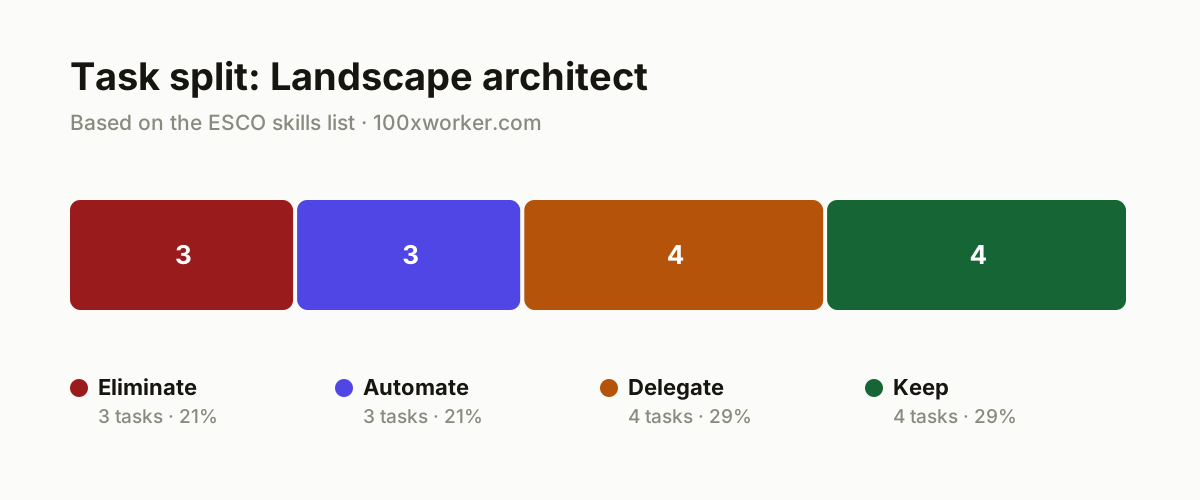
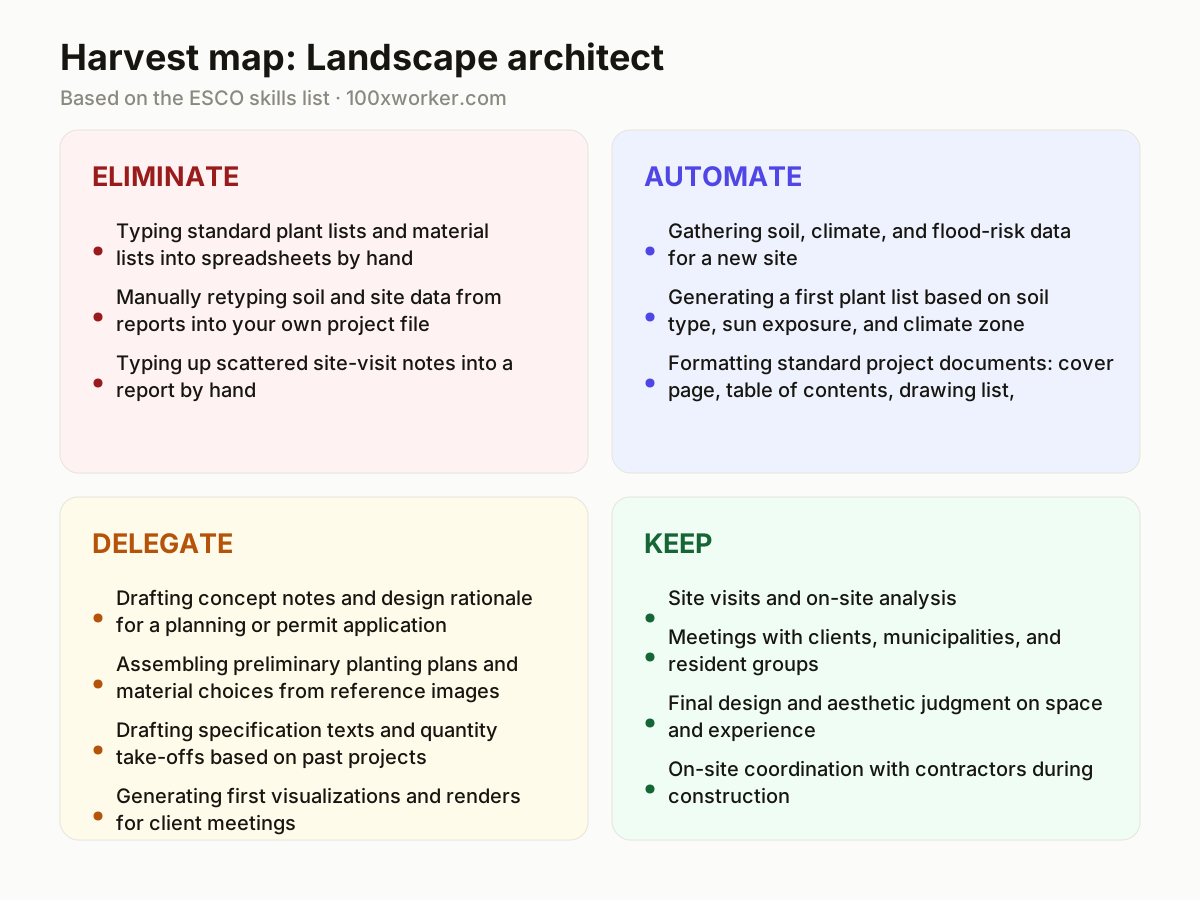
This article sorts landscape architect tasks into four buckets: eliminate (manual work AI makes redundant), automate (rule-based tasks AI can run largely unsupervised), delegate (work AI drafts and you check), and keep (judgment calls, relationships, and physical presence that stay with you). The split follows a simple principle backed by recent occupational AI research: generative AI reshapes the task list inside a job far more often than it removes the job itself.
| Task | Bucket | Why |
|---|---|---|
| Typing standard plant lists and material lists into spreadsheets by hand | eliminate | A database or AI tool generates this faster and with fewer errors from project data. |
| Manually retyping soil and site data from reports into your own project file | eliminate | Data import via AI tools makes manual retyping unnecessary and error-prone. |
| Typing up scattered site-visit notes into a report by hand | eliminate | Speech-to-text or writing tools turn raw notes into structured text immediately. |
| Gathering soil, climate, and flood-risk data for a new site | automate | An AI agent pulls and combines this data from existing maps and registers. |
| Generating a first plant list based on soil type, sun exposure, and climate zone | automate | Based on fixed parameters, this is predictable, repeatable work. |
| Formatting standard project documents: cover page, table of contents, drawing list, version control | automate | Fixed structure, no creative choices needed, ideal for full automation. |
| Drafting concept notes and design rationale for a planning or permit application | delegate | AI writes a strong first draft, you check legal precision and site knowledge. |
| Assembling preliminary planting plans and material choices from reference images | delegate | Fast concept ready, you judge suitability for the specific site. |
| Drafting specification texts and quantity take-offs based on past projects | delegate | Pattern recognition from your own archive works well for AI, you check amounts and standards. |
| Generating first visualizations and renders for client meetings | delegate | Quick mood images move the conversation along, you guard technical feasibility. |
| Site visits and on-site analysis | keep | Feeling the soil, reading the light, and sensing the atmosphere cannot be done remotely by a model. (Your edge: physical presence and site intuition) |
| Meetings with clients, municipalities, and resident groups | keep | Weighing interests and building trust needs one human facing another. (Your edge: building trust and weighing interests) |
| Final design and aesthetic judgment on space and experience | keep | Taste, sense of scale, and coherence with the surroundings remain a human decision. (Your edge: spatial sense and aesthetic judgment) |
| On-site coordination with contractors during construction | keep | Unforeseen situations on site require quick, accountable decisions. (Your edge: making calls on unforeseen situations) |
Will AI replace landscape architects?
No, not in any near-term sense. Landscape architecture combines physical site visits, negotiation with clients and municipalities, and final aesthetic judgment, none of which current generative AI systems can perform on their own. Microsoft's occupational research puts the closest hands-on comparison, Landscaping and Groundskeeping Workers, at only 4.3% AI applicability, among the lowest scores in the entire dataset. Landscape architects likely score higher because more of the job is writing, drafting, and data lookup, but the design decisions, site intuition, and stakeholder relationships that define the profession stay firmly with people. What changes is the mix of tasks inside the job, not the existence of the job itself.
Which landscape architect tasks will AI take over first?
AI moves fastest on tasks with a fixed structure and low creative stakes. Typing plant lists and material lists into spreadsheets, retyping soil and site data from reports, and turning scattered field notes into a report are already redundant once you use a tool that imports and formats data directly. A step further along, AI agents can pull soil, climate, and flood-risk data for a new site, generate a first plant list from soil type and climate zone, and assemble the standard scaffolding of a project document, including cover page, table of contents, drawing list, and version numbers. None of this requires design judgment, so it moves to automation first.
What can you do this month as a landscape architect with AI?
Start small and specific. Pick one recurring task, such as drafting the design rationale section of a permit application or generating a first plant list for a site brief, and run it through a general chatbot like ChatGPT or Claude using your own project data as input. Compare the draft against your usual work and note where it gets facts or plant suitability wrong. Set up a template prompt for that one task so the next project takes minutes instead of hours. Do not try to automate client meetings, final design decisions, or site visits. Those stay on your desk.
How does landscape architect work differ from landscape gardening when it comes to AI?
A landscape gardener (ESCO code 6113.6, part of the Gardeners, horticultural and nursery growers group) does hands-on planting, pruning, pest control, and site maintenance, tasks that Microsoft's research scores at just 4.3% AI applicability because they are physical and location-bound. A landscape architect spends more time on design documents, permit applications, client communication, and drawings, work with a higher share of text and data that generative AI already handles reasonably well. In practice, the gardener's task list barely shifts because of AI, while the architect's shifts toward review and direction instead of manual drafting. Both professions keep the on-site judgment calls, but the office-based share of the architect's job absorbs more of the change.
How applicable generative AI is to an occupation tracks how much of the work is language and data based, rather than physical and location bound.
Microsoft Research, Working with AI (2025)
Become the AI person on your team
Build a personal prompt library
Save the prompts that produce usable first drafts for permit rationales, plant lists, and client emails. Reuse and refine them instead of starting from a blank chat each time.
Audit one project end-to-end
Walk through a recent project and mark which tasks were pure data entry, which were drafting, and which needed your judgment. Route the first two categories to AI tools on the next project and measure the time saved.
Set a verification habit for plant and code data
Generative AI can misstate plant hardiness zones, local codes, or permit requirements. Treat every AI-generated fact about plants, materials, or regulations as a draft that needs a check against a reliable source before it goes into a client document.
Want this for your actual task list?
The free scan on the homepage builds your personal task map in 30 seconds, based on your role and industry.
Run the free task scanTools for this work
| Tool | For which tasks | The sober take |
|---|---|---|
| ChatGPT or Claude | Delegate bucket: concept notes, permit rationale, specification text drafts | Good first drafts, but always verify local regulations and technical claims before submission. |
| Microsoft Copilot (Excel/Word) | Eliminate bucket: plant lists, material lists, formatting site-visit notes into reports | Works directly inside the files you already use, so it removes retyping rather than adding a new tool. |
| Midjourney or Adobe Firefly | Delegate bucket: first visualizations and renders for client meetings | Useful for mood and concept images, not for construction-ready drawings. |
| GIS-linked AI research agents | Automate bucket: gathering soil, climate, and flood-risk data for a site | Speeds up data collection, but cross-check against official survey and hydrology sources. |
Prompts to try today
Draft a design rationale for a permit application
Generate a first plant list from site data
Turn field notes into a client-ready site report
Related jobs
Frequently asked questions
Is landscape architecture a safe career from AI?
It is safer than many office jobs but not untouched. The closest occupational data point, Landscaping and Groundskeeping Workers, scores just 4.3% on Microsoft's AI applicability index, one of the lowest in the dataset, because the work is physical and site-specific. Landscape architects do more writing, drafting, and client communication than groundskeepers, so more of their task list is exposed to generative AI. Even so, site visits, final design judgment, and stakeholder negotiation are not tasks current AI systems can take over.
Which AI tool should a landscape architect start with?
Start with a general chatbot like ChatGPT or Claude for text-heavy tasks such as permit rationale, specification drafts, and meeting summaries. Add an image tool like Midjourney or Adobe Firefly once you need quick concept visualizations for client meetings. Avoid buying specialized landscape-AI software before you have tested whether a general tool already covers the task.
Will AI make site visits unnecessary?
No. Site visits involve reading soil texture, light patterns, drainage, and neighborhood character in ways that require physical presence. No generative AI model can substitute for standing on the site. AI can help you prepare for a visit by pulling existing climate, soil, and flood-risk data in advance, but the on-site judgment stays with you.
How is AI adoption trending among professionals in general?
Adoption is rising fast. In 2025, 32.7% of the EU population aged 16 to 74 had used generative AI in the past three months, according to Eurostat. That trend applies across knowledge work, including design and planning professions, which suggests landscape architects who build AI into their drafting and research workflow now will be ahead of a shift that is already underway.
Sources
- Microsoft Research, Working with AI: Measuring the Applicability of Generative AI to Occupations (2025)
- Anthropic Economic Index
- Eurostat, Individuals using generative AI (isoc_ai_iaiu)
- ESCO, European Commission occupation and skills taxonomy
Hendrik De Winne, author of Becoming AI-Savvy, founder of VibeLab. Helps teams redesign their work with AI.
This article was drafted with AI assistance from public data sources and editorially reviewed.