100×worker · job analysis
Will AI Replace Police Officers?
Police work involves paperwork, interviews, patrol, and split-second decisions backed by legal authority. Generative AI touches some of that, but not much of it. Microsoft Research analyzed 200,000 real conversations people had with Copilot and built an applicability score for hundreds of occupations based on how much of the work is language-based. Patrol officers scored 14.3%, meaning generative AI is demonstrably useful for only a small slice of the job's work activities. Compare that to translators at 49%, the highest score in the study, or nurses at 12%, one of the lowest.
That doesn't mean AI is absent from policing. Anthropic's Economic Index, which classifies millions of Claude conversations against standard occupational task lists, shows two different patterns of AI use: some tasks get automated outright, others get augmented, where a person still drives the work but with AI support. For an officer, most AI use falls into the augmentation camp: drafting a report, transcribing a statement, translating a complaint. Across the EU, 32.7% of people aged 16 to 74 used generative AI in the last three months of 2025, according to Eurostat, so officers increasingly work alongside a public that already expects digital tools.
The real question for a working officer is which specific tasks change, not whether the job disappears. This article breaks the role into four buckets: tasks to eliminate, automate, delegate, and keep.
A police officer enforces the law, prevents and investigates crime, and protects the public through patrol.
The task split: what AI takes over and what stays yours
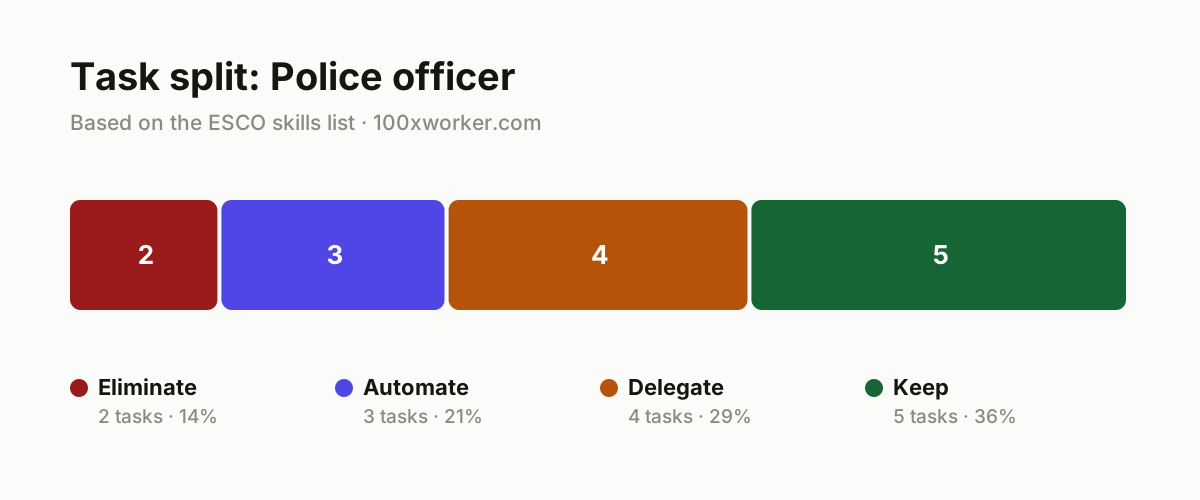
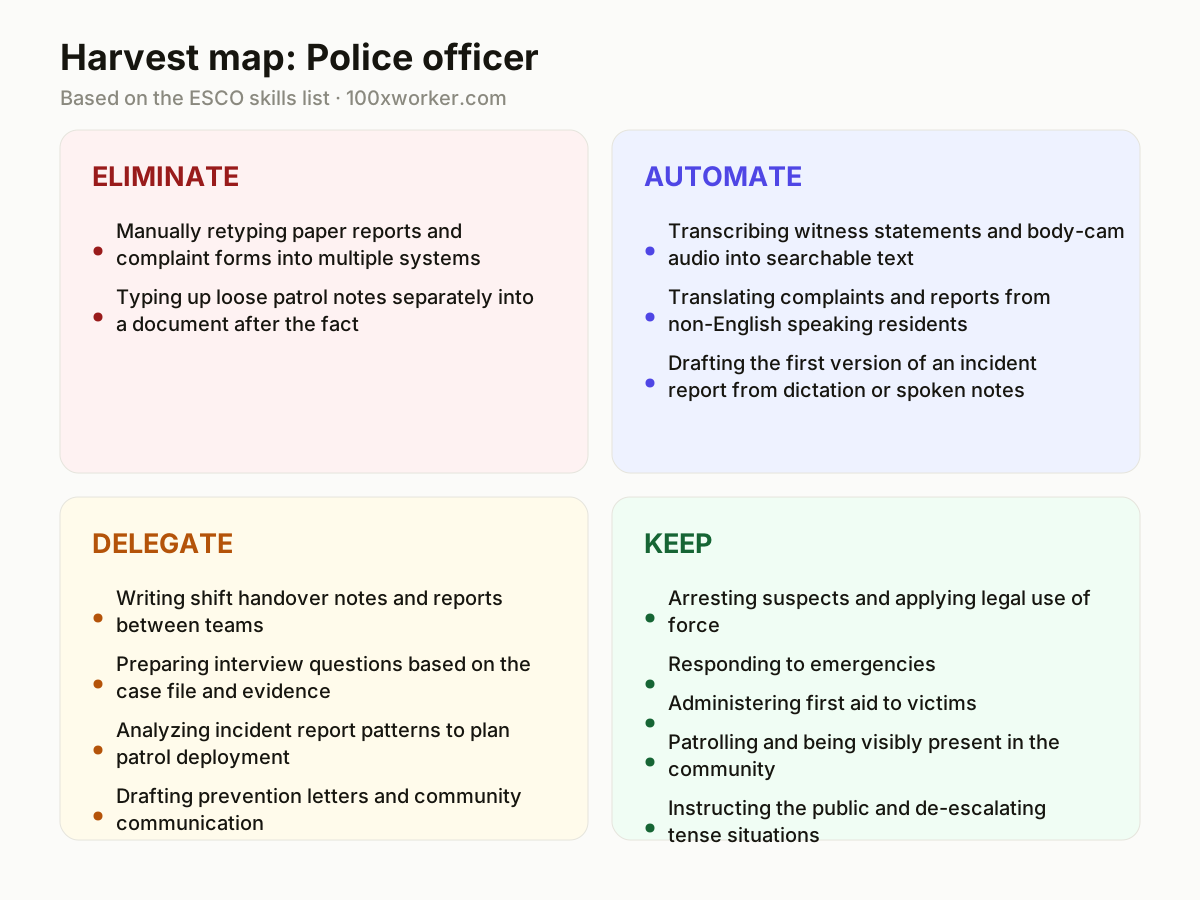
ESCO lists policing as a defined occupation with a fixed set of core skills, from applying legal use of force to instructing the public and handling evidence. Not every one of those skills is equally exposed to generative AI. Sorting the role into four buckets, tasks to eliminate, automate, delegate, and keep, shows where AI actually changes daily work and where the job stays entirely human.
| Task | Bucket | Why |
|---|---|---|
| Manually retyping paper reports and complaint forms into multiple systems | eliminate | Duplicate work with no judgment call involved, error-prone and a waste of a shift. |
| Typing up loose patrol notes separately into a document after the fact | eliminate | Retyping work that adds no legal or tactical value on its own. |
| Transcribing witness statements and body-cam audio into searchable text | automate | Speech-to-text does this faster and more consistently than an officer typing. |
| Translating complaints and reports from non-English speaking residents | automate | A first-pass translation gives immediate understanding, but nuance still needs a human check. |
| Drafting the first version of an incident report from dictation or spoken notes | automate | The skeleton of the text is there, you add legal precision. |
| Writing shift handover notes and reports between teams | delegate | AI turns facts into readable text, you check completeness and accuracy. |
| Preparing interview questions based on the case file and evidence | delegate | An AI-drafted set of questions saves time, running the interview stays yours. |
| Analyzing incident report patterns to plan patrol deployment | delegate | AI spots patterns in data, you turn that into a deployment decision. |
| Drafting prevention letters and community communication | delegate | A first draft is ready fast, tone and context stay human work. |
| Arresting suspects and applying legal use of force | keep | This requires legal authority and split-second judgment only an officer holds. (Your edge: Physical presence and on-the-spot judgment.) |
| Responding to emergencies | keep | Seconds matter, no one can wait for an AI response. (Your edge: Speed and physical action at the scene.) |
| Administering first aid to victims | keep | No system can take over physical intervention on an injury. (Your edge: Hands on a person, no screen in between.) |
| Patrolling and being visibly present in the community | keep | A visible human presence deters in a way a camera doesn't. (Your edge: Human presence deters and reassures.) |
| Instructing the public and de-escalating tense situations | keep | Reading body language and calming a situation takes social judgment in the moment. (Your edge: Empathy and improvisation in real time.) |
What tasks can AI take over from a police officer?
AI is strongest at the parts of policing that involve straight language work. Speech-to-text tools can transcribe witness statements and body-cam audio into searchable text faster and more consistently than an officer typing it up. Translation tools give an immediate first read on a complaint filed in a language the officer doesn't speak, though a human still needs to check nuance before it goes in a file. Generative AI can also draft the first version of an incident report from dictation or spoken notes, leaving the officer to add legal precision and confirm every detail. None of this involves judgment calls, arrests, or force. It's paperwork and transcription, the administrative layer of the job.
Will AI replace police officers?
No. Microsoft Research's applicability score for patrol officers is 14.3%, one of the lowest scores of any occupation the study measured, far below translators at 49%. ESCO's skill list for the role centers on applying legal use of force, responding to emergencies, arresting offenders, and instructing the public during tense situations. None of that is language work a model can do from a transcript. What changes is the paperwork layer around the job: reports, translations, transcription, and pattern analysis in incident data. The arrest, the first aid, the de-escalation on scene, that stays with the person wearing the uniform.
How does a police officer become the AI-savvy person on the team?
Start by owning the tasks nobody else wants to touch. Volunteer to test a transcription tool on interview recordings and report back to the team on accuracy and time saved. Build a small library of report templates that a colleague can fill in from a transcript in minutes instead of typing from scratch. If your department handles complaints in multiple languages, become the person who runs first-pass translations through a tool and flags what still needs a human interpreter. None of this requires a technical background. It requires being the first one in the unit to actually try the tool on a real case and share what worked.
What can you do this month as a police officer?
Pick one repetitive task, transcribing a recorded statement or drafting a routine incident report, and try a transcription or drafting tool on it once this week. Compare the AI-generated version against what you'd normally produce and time both. Ask your department whether a records management system with built-in transcription or translation is already licensed but unused. If you supervise a shift, log which report types eat the most time and use that list to justify adopting one tool for the whole team rather than everyone experimenting alone.
Applicability to generative AI depends on how much of an occupation's work is language-based rather than physical or judgment-based, and patrol officers sit near the bottom of that scale.
Microsoft Research, Working with AI (2025)
Become the AI person on your team
Pilot transcription on one case type
Pick a single recurring report, like routine traffic incidents, and run the audio through a transcription tool for a month. Track how much time it saves compared to manual notes, then bring the numbers to your supervisor.
Build a shared report template library
Create draft templates for the most common incident types so a transcript can be dropped in and cleaned up in minutes. Share the templates with the shift so everyone benefits, not just you.
Become the translation checkpoint
If complaints come in from non-English speakers, offer to run first-pass translations through a tool before an interpreter is called. This speeds up intake without replacing the interpreter for anything that carries legal weight.
Want this for your actual task list?
The free scan on the homepage builds your personal task map in 30 seconds, based on your role and industry.
Run the free task scanTools for this work
| Tool | For which tasks | The sober take |
|---|---|---|
| Microsoft Copilot | Drafting incident reports, summarizing case notes, first-pass translation | This is the tool Microsoft's own applicability research is based on, so it's a reasonable starting point for testing. |
| Speech-to-text transcription software | Transcribing witness interviews and body-cam audio | Accuracy varies with background noise, so treat the output as a draft, not a final transcript. |
| Translation apps (e.g., DeepL, Google Translate) | Translating complaints and statements from non-English speakers | Fine for a first read, not a substitute for a certified interpreter in anything that goes to court. |
| Records management system with AI search | Analyzing incident patterns for patrol deployment | Only useful if your department's data entry is consistent enough for the search to find real patterns. |
Prompts to try today
Clean up dictated report notes
First-pass translation of a complaint
Draft a shift handover summary
Related jobs
Frequently asked questions
Does Microsoft's research look at police officers specifically, or a similar category?
Microsoft Research used the US occupational category 'Police and Sheriff's Patrol Officers' as the closest match, since the underlying data comes from Copilot conversations mapped to US labor categories. That category scored 14.3% on the applicability scale, meaning generative AI is demonstrably useful for a small share of the work activities in that job. It's the closest comparable data available, though exact task lists vary somewhat by country and department.
What's the difference between AI automating a task and AI augmenting it?
Automation means AI does the task with little human involvement, like converting a recording straight into text. Augmentation means a person still drives the work but uses AI to move faster, like drafting a report and then editing it for legal accuracy. Anthropic's Economic Index tracks this split across millions of real conversations mapped to standard task taxonomies, and most police-related AI use falls into the augmentation category rather than full automation.
How many people are already using AI tools that might show up in policing work?
Across the EU, 32.7% of people aged 16 to 74 used generative AI in the three months before Eurostat's 2025 survey. That's relevant for police work indirectly: officers increasingly interact with a public that already uses AI tools daily, and departments face growing pressure to match that with their own tools for translation, transcription, and reporting.
Could AI ever take over investigative decision-making, not just paperwork?
Current applicability data doesn't support that. Investigative judgment, deciding which lead to follow, how to interview a suspect, or when force is justified, depends on legal authority and contextual judgment that generative AI models don't have. The tasks AI handles well in policing are language tasks: transcribing, translating, and drafting. Decisions with legal weight stay with the officer, and that's unlikely to change with current AI capabilities.
Sources
- Microsoft Research, Working with AI: Measuring the Applicability of Generative AI to Occupations (2025)
- Anthropic Economic Index
- Eurostat, Use of generative AI (isoc_ai_iaiu)
- ESCO, European Commission
Hendrik De Winne, author of Becoming AI-Savvy, founder of VibeLab. Helps teams redesign their work with AI.
This article was drafted with AI assistance from public data sources and editorially reviewed.