100×worker · job analysis
Will AI Replace Pharmacy Assistants?
Pharmacy assistants handle a mix of physical, administrative, and patient-facing work: managing stock, printing labels, checking prescriptions, and talking to patients at the counter. Generative AI is now part of that mix, but not evenly. Microsoft Research analyzed 200,000 real conversations with its Copilot tool and scored occupations by how much of their daily task list generative AI can plausibly touch. Pharmacy aides scored 8.9%, near the bottom of the scale, far below occupations like translation (49%) but still not zero.
That low score matters because it tells you where AI is genuinely useful in this job: administrative and pattern-based tasks like inventory tracking, expiry monitoring, and claims processing. It also tells you where AI is not useful: the licensed judgment, empathy, and legal responsibility that come with dispensing medication and talking to patients about their health. Anthropic's Economic Index, which classifies millions of Claude conversations against standardized occupational task lists, finds a similar split across healthcare roles between automation-like use (AI doing a task directly) and augmentation-like use (AI helping a person do it faster).
Across the wider workforce, adoption is already broad: 32.7% of the EU population aged 16 to 74 used generative AI in the three months before Eurostat's 2025 survey. Patients increasingly arrive at the counter having already asked a chatbot about their symptoms or medication. That changes the conversation you have with them, even if it does not change who is legally responsible for what happens next.
A pharmacy assistant supports the pharmacist with inventory, medication dispensing, and patient contact under supervision.
The task split: what AI takes over and what stays yours
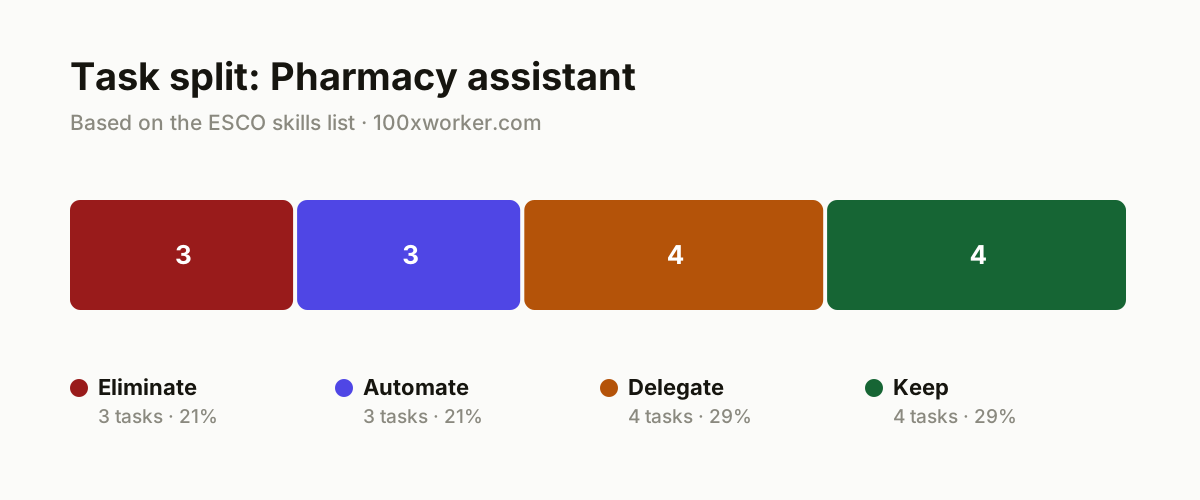
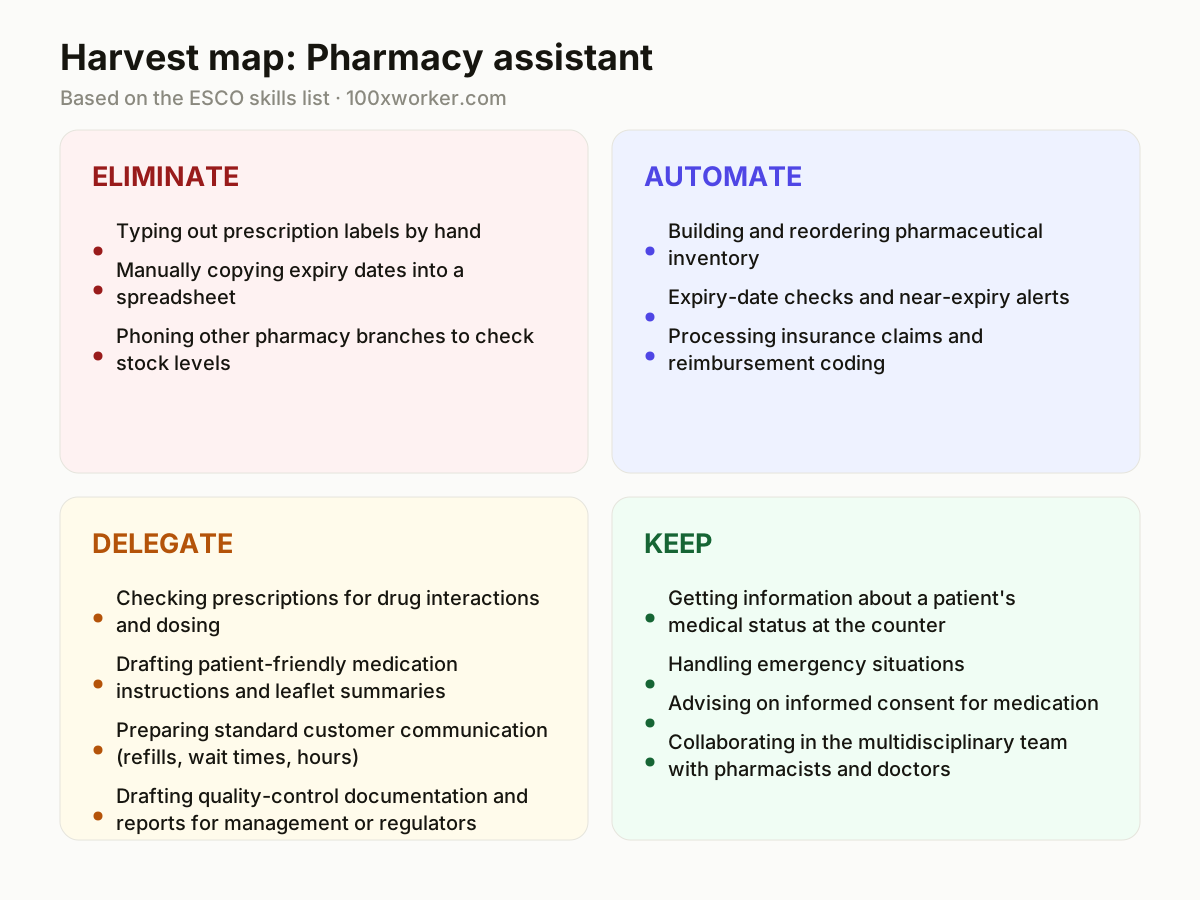
To make sense of where AI actually fits into this job, split your task list into four groups: tasks AI eliminates outright because software now does them without you, tasks AI automates that still need a system set up and checked, tasks you delegate to AI as a first draft you then review, and tasks you keep because they require licensed judgment, legal responsibility, or direct human contact.
| Task | Bucket | Why |
|---|---|---|
| Typing out prescription labels by hand | eliminate | Pharmacy software generates the label directly from the electronic prescription, faster and with fewer errors. |
| Manually copying expiry dates into a spreadsheet | eliminate | A connected inventory system reads shelf-life data automatically and flags discrepancies on its own. |
| Phoning other pharmacy branches to check stock levels | eliminate | Shared inventory systems show stock across branches in real time, no phone call needed. |
| Building and reordering pharmaceutical inventory | automate | An inventory agent recognizes usage patterns and places reorders with the wholesaler automatically. |
| Expiry-date checks and near-expiry alerts | automate | The system scans the full stock daily and flags anything expiring within 30 days. |
| Processing insurance claims and reimbursement coding | automate | Rule-based software matches prescription, tariff, and reimbursement rule without manual entry. |
| Checking prescriptions for drug interactions and dosing | delegate | AI screens quickly against known interaction databases, you assess clinical context and decide. |
| Drafting patient-friendly medication instructions and leaflet summaries | delegate | AI writes a first draft tailored to the patient, you check it for clinical accuracy. |
| Preparing standard customer communication (refills, wait times, hours) | delegate | A chatbot handles the routine question, you step in for anything medically sensitive or unclear. |
| Drafting quality-control documentation and reports for management or regulators | delegate | AI structures the data into a readable report, you validate the numbers and conclusions. |
| Getting information about a patient's medical status at the counter | keep | Building trust and asking the right follow-up question requires a person who senses what is left unsaid. (Your edge: Empathy and clinical intuition at the counter.) |
| Handling emergency situations | keep | An acute situation needs immediate, accountable action, not a wait for an AI response. (Your edge: Direct responsibility for someone's health in the moment.) |
| Advising on informed consent for medication | keep | The patient needs a person in front of them who explains the risks and is accountable for the advice. (Your edge: Legal and human responsibility stays with you.) |
| Collaborating in the multidisciplinary team with pharmacists and doctors | keep | Discussing a complex case requires shared clinical responsibility, not an automated recommendation. (Your edge: Collegial judgment and joint decision-making.) |
What pharmacy assistant tasks can AI take over?
AI is strongest on the administrative and pattern-recognition side of the job: printing labels straight from e-prescriptions, tracking expiry dates across the full inventory, flagging what needs to be reordered, and processing insurance claims and reimbursement codes. It can also draft first versions of patient education material or routine customer replies. It is weak on anything that requires clinical judgment, legal accountability, or reading a patient in person. Microsoft Research's 8.9% applicability score for pharmacy aides reflects that split: a real but limited share of the job.
Will AI replace pharmacy assistants?
No. Pharmacy assistants work under a pharmacist's supervision and carry responsibilities, dispensing medication, checking prescriptions, handling emergencies, that require a licensed, accountable human, not software. Microsoft Research's applicability score of 8.9% for pharmacy aides is one of the lowest of any occupation it studied, well below roles like translation (49%). What changes is the shape of the job: less manual data entry and label typing, more time spent on patient conversations, judgment calls, and checking AI-generated drafts before they go out.
What is already changing in pharmacy assistant work this year because of AI?
Patients are arriving having already asked a chatbot about their symptoms or medication. Eurostat found that 32.7% of the EU population aged 16 to 74 used generative AI in the three months before its 2025 survey, so this is now a routine part of many conversations at the counter. Inside the pharmacy, more inventory and claims systems now run on automated rules rather than manual checklists. The practical shift is that assistants spend less time on repetitive data entry and more time verifying AI-sourced patient information and reviewing AI-drafted documents before they are used.
What can you do this month to become the AI person on your pharmacy team?
Pick one repetitive task, expiry checks or drafting patient leaflets, and test whether an AI tool can produce a usable first draft or flag. Time how long it takes you to check the output versus doing the task from scratch. Bring that comparison to your pharmacist or manager as a concrete proposal, not a general suggestion to "use more AI." Document which tasks you moved to the automate or delegate bucket and keep a short log of any mistakes the AI made, so the team learns where it needs a human check every time.
Generative AI is applicable to just 8.9% of work activities for pharmacy aides, one of the lowest scores among all occupations analyzed.
Microsoft Research, Working with AI (2025)
Become the AI person on your team
Run a task audit
List every recurring task you do in a week and sort each one into eliminate, automate, delegate, or keep. Bring the list to your next team meeting as a starting point for discussion, not a finished plan.
Pilot one drafting tool
Use a general AI assistant to draft patient-friendly medication instructions for one common prescription type. Compare it against what you'd normally write and note where it gets the tone or detail wrong.
Set a verification habit
Whenever a patient mentions something they read from a chatbot, treat it as a starting point for a real conversation, not a fact to confirm or deny outright. Log recurring misconceptions so the team can address them proactively.
Want this for your actual task list?
The free scan on the homepage builds your personal task map in 30 seconds, based on your role and industry.
Run the free task scanTools for this work
| Tool | For which tasks | The sober take |
|---|---|---|
| Pharmacy inventory management systems (e.g., stock and reorder software integrated with your dispensing system) | Automate: inventory buildup, reordering, expiry alerts | Most of these already exist in dispensing software, the gain is in configuring alerts, not buying new tools. |
| E-prescribing and label-printing software | Eliminate: manual label typing | Standard in most modern pharmacy systems; check your current software supports full auto-fill before assuming you need something new. |
| General AI assistants (e.g., Microsoft Copilot, ChatGPT, Claude) | Delegate: drafting patient education text, standard customer replies, report structuring | Use only for drafts you review, never for final patient-facing clinical content without a check. |
| Claims and reimbursement processing software | Automate: insurance claims and tariff coding | Rule-based, not generative AI in most cases, but reduces the same manual workload. |
Prompts to try today
Draft a patient-friendly medication instruction
Prepare a standard customer response
Structure a quality-control report
Related jobs
Frequently asked questions
Do I need to learn to code or use AI tools to keep my job as a pharmacy assistant?
No coding is needed. What helps is knowing how to use general AI assistants to draft routine text, like patient instructions or standard replies, and then checking that draft for accuracy before it goes to a patient. Basic comfort with software, which most pharmacy assistants already have from dispensing systems, is enough to work with these tools.
Which pharmacy tasks are safest from AI automation?
Tasks that involve direct patient contact, legal responsibility, or emergency judgment are the safest: getting a patient's medical history in conversation, advising on informed consent, handling an emergency, or discussing a complex case with the pharmacist and doctor. These require a licensed, accountable person, which is exactly why Microsoft Research scored this occupation among the lowest for AI applicability.
How is the Anthropic Economic Index relevant to pharmacy work?
Anthropic's Economic Index classifies millions of real AI conversations against standardized occupational task lists and splits usage into automation-like (AI does the task) and augmentation-like (AI helps a person do it). For healthcare support roles like pharmacy assistants, this pattern suggests most current AI use is augmentation on administrative tasks, not full automation of patient-facing work.
Will patients start expecting AI-level speed from pharmacy staff?
Some patients already arrive with information from a chatbot and expect quick, confident answers. Eurostat reported that 32.7% of the EU population aged 16 to 74 used generative AI in the last three months as of 2025, so this expectation is becoming common. The practical response is not to match AI's speed but to correct, contextualize, and add the clinical judgment a chatbot cannot provide.
Sources
- Microsoft Research, Working with AI: Measuring the Applicability of Generative AI to Occupations (2025)
- Anthropic Economic Index
- Eurostat, isoc_ai_iaiu (generative AI use, 2025)
- ESCO, European Commission (occupation and skills taxonomy)
Hendrik De Winne, author of Becoming AI-Savvy, founder of VibeLab. Helps teams redesign their work with AI.
This article was drafted with AI assistance from public data sources and editorially reviewed.